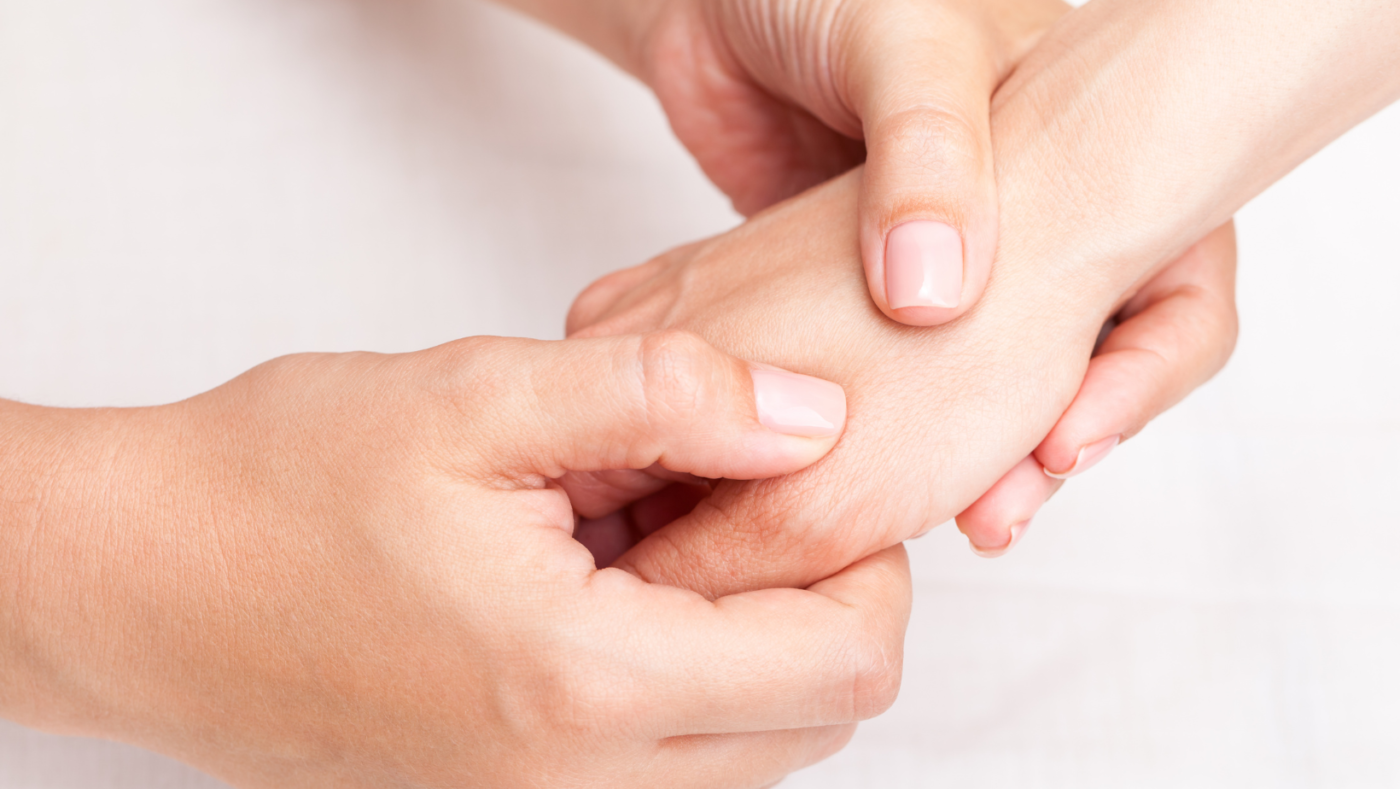

Applying a pressure point for migraine relief works by stimulating specific nerves that send calming signals to the brain and reduce blood vessel tension. This technique comes from traditional Chinese medicine and has been practiced for over 2,000 years. It doesn’t replace medication, but for millions of people, it cuts migraine intensity significantly when applied correctly and early.
- Each pressure point for migraine works through a specific nerve pathway, not just general relaxation
- LI-4, GB-20, and Taiyang are the three most clinically supported points for migraine pain
- Applying pressure for 1-3 minutes per point gives the strongest response
- Trigger points in neck causing migraine are among the most overlooked and most effective targets
- Acupressure works best in the prodrome or early headache phase, not after peak pain
- Pregnant women should avoid the LI-4 point; it stimulates uterine contractions
How to Use Pressure Points for Migraines
How to use pressure points for migraines correctly matters more than just knowing where the points are.
Basic technique:
- Sit or lie down in a quiet, low-light space
- Use your thumb or index finger, not your nail
- Apply firm, steady pressure directly on the point
- Move in small, slow circular motions
- Hold pressure for 1-3 minutes per point
- Breathe slowly and deeply throughout
- Repeat on both sides of the body when the point is bilateral
The pressure should feel like a “good pain,” tight and slightly uncomfortable, but not sharp. If it’s sharp, you’re pressing too hard or in the wrong spot. Work through 3-5 points per session, spending 5-10 minutes total.
Best Pressure Point for Migraine Relief
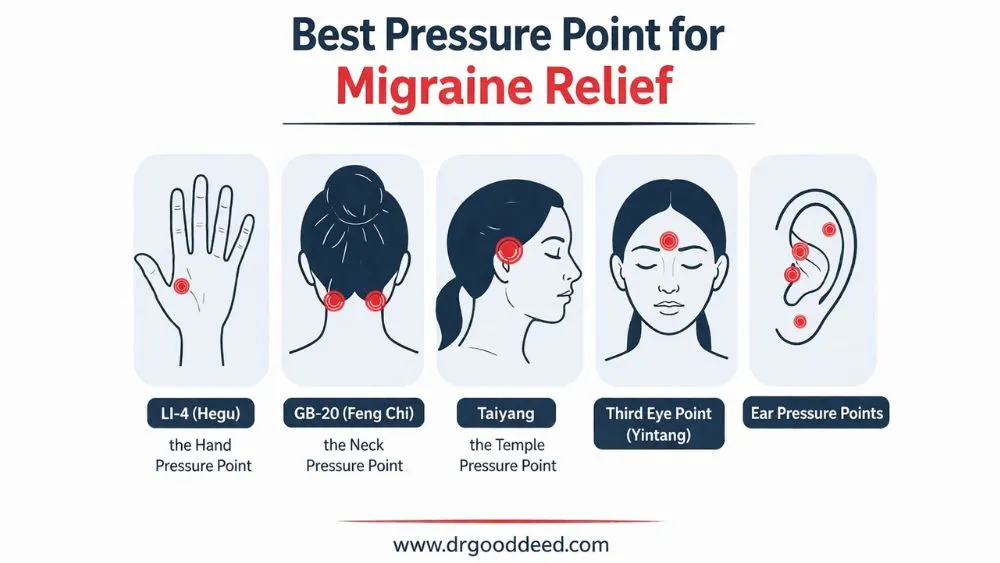
LI-4 (Hegu), the Hand Pressure Point
LI-4 is the most researched pressure point for migraine relief in clinical literature. A 2018 meta-analysis published in Cephalalgia reviewed multiple acupressure trials and found LI-4 stimulation consistently reduced headache intensity scores.
Location: Place your right thumb on the webbing between your left thumb and index finger. The point sits in the fleshy mound at the highest spot when you pinch that webbing together.
How it works: LI-4 connects to the large intestine meridian in traditional Chinese medicine pressure points migraine therapy. In Western physiology terms, stimulating this point activates the median nerve, which sends signals that reduce pain perception in the trigeminal nerve, the same nerve responsible for migraine pain in the face and head.
Important: Avoid this point entirely during pregnancy. It stimulates uterine contractions and carries a documented risk of inducing labor.
GB-20 (Feng Chi), the Neck Pressure Point
GB-20 targets the base of the skull directly. This makes it the most effective point for trigger points in neck causing migraine, which is something most people never address.
Location: Place both thumbs at the back of your neck. Move them upward until you reach the base of the skull. You’ll feel two hollows on either side of the spine where the neck muscles attach to the skull. Those hollows are GB-20.
How it works: The suboccipital muscles in this area attach to the skull and frequently become tight from screen use, poor posture, and stress. That tightness compresses the greater occipital nerve, which feeds directly into migraine pain. Pressing GB-20 releases that muscular compression and reduces nerve irritation.
Apply pressure with both thumbs simultaneously, angling slightly upward toward the skull. Hold for 2-3 minutes. Many people feel immediate tension release in the back of the head.
Taiyang, the Temple Pressure Point
Taiyang sits directly over the temporal artery, one of the blood vessels that dilates during a migraine.
Location: Place your index finger on the outer edge of your eyebrow. Slide it backward toward your ear. Stop about one inch past the eyebrow’s end, in the slight depression in your temple. That’s Taiyang.
Benefits: Pressing here reduces local blood vessel tension and eases eye strain, which often accompanies migraines. It also targets the temporal branch of the trigeminal nerve directly.
Use two or three fingers and apply gentle circular pressure. Unlike LI-4 and GB-20, Taiyang needs lighter pressure. The skin over the temple is thinner and the artery sits close to the surface.
Third Eye Point (Yintang)
Yintang sits at the midpoint between the eyebrows. It’s the pressure point for migraine most associated with stress-induced headaches.
Location: Directly between the two eyebrows, in the bridge of the nose area.
How it works: Yintang stimulates the frontal branch of the trigeminal nerve and activates the parasympathetic nervous system, the “rest and calm” response. This lowers cortisol, reduces heart rate, and creates a measurable relaxation effect within 60-90 seconds of steady pressure.
Apply with one finger, firm and steady, for 1-2 minutes. Some people combine this with slow 4-7-8 breathing for stronger effect.
Ear Pressure Points
Ear acupressure, called auriculotherapy, maps the entire body onto the ear. Two points work specifically for migraines.
- Ear apex: The very top tip of the ear. Pinch it firmly between your thumb and index finger.
- Ear gate (TW-21): Located just in front of the upper part of the ear canal opening.
These points connect to the vagus nerve through the auricular branch. Vagus nerve stimulation reduces neuroinflammation, which is a core mechanism in migraine attacks. A small 2020 study in Frontiers in Neurology found auricular acupressure reduced migraine frequency in chronic sufferers over a 4-week period.
Best Acupressure Techniques for Migraine Pain
Best acupressure techniques for migraine pain combine multiple points into one focused session rather than working one point in isolation.
Recommended sequence for a migraine attack:
- Start with GB-20 (neck base) for 2-3 minutes
- Move to LI-4 on both hands, 1-2 minutes each
- Apply pressure to Taiyang on both temples simultaneously
- Finish with Yintang for 1-2 minutes
The full session runs 8-12 minutes. Starting at the neck first makes sense because releasing tight neck muscles early prevents additional nerve compression from worsening the attack.
Techniques include steady circular massage, firm hold-and-release cycles, and bilateral stimulation, pressing both sides at once, which creates a more balanced nervous system response.
Acupressure Massage for Migraine Attacks
Acupressure massage for migraine attacks is most effective in the prodrome or aura phase, before the full headache begins. Once the migraine peaks, the brain is already in a high-sensitivity state and direct pressure may feel overwhelming for some people.
Step-by-step process during an active attack:
- Reduce all sensory input first: dim lights, quiet the room
- Apply firm pressure to GB-20 neck points with both thumbs
- Massage temples at Taiyang with slow circular motion
- Stimulate LI-4 on the dominant hand first
- Breathe slowly throughout, 4 counts in, 6 counts out
- Stay still for 5 minutes after finishing
Trigger Points in Neck Causing Migraine
Trigger points in neck causing migraine are tight, knotted muscle spots that refer pain upward into the head. This is called cervicogenic migraine, and it’s underdiagnosed.
The most common trigger areas:
- Upper trapezius: The muscle running from neck to shoulder. Tightness here refers pain to the temple and behind the eye.
- Suboccipital muscles: Four small muscles connecting the upper cervical vertebrae to the skull. When these tighten, they directly compress the greater occipital nerve.
- Sternocleidomastoid (SCM): The rope-like muscle running from behind the ear to the collarbone. Trigger points here cause frontal headache and sometimes eye pain.
These muscles tighten from prolonged screen use, sleeping in poor positions, carrying a heavy bag on one shoulder, or sustained stress. Pressing GB-20 addresses the suboccipital area. For the trapezius, press the midpoint of the muscle between the neck and shoulder. Apply steady pressure for 90 seconds.
When Acupressure May Not Be Enough
Acupressure works best for tension-related and mild-to-moderate migraine pain. It won’t override a severe neurological migraine attack.
See a doctor when:
- Migraines occur 4 or more times per month
- A headache came on suddenly and is the worst of your life
- Headache comes with weakness, slurred speech, or vision loss
- Over-the-counter medication has stopped working
- Migraines last longer than 72 hours
These signs point to conditions that acupressure won’t address, including medication overuse headache, cluster headaches, or in rare cases, secondary causes that need imaging.
Other Ways to Manage Migraine Pain
Acupressure works better when combined with other immediate interventions.
Pair it with:
- Hydration: Drink 500ml of water before starting the session. Dehydration tightens muscles and worsens nerve sensitivity.
- Cold compress: Apply to the back of the neck or forehead after the acupressure session. Cold narrows dilated blood vessels.
- Dark, quiet environment: Reduces sensory overload that amplifies migraine pain signals
- Migraine medication: Take prescribed triptans or NSAIDs at the same time, not instead of acupressure. The two approaches work on different mechanisms simultaneously.
Frequently Asked Questions
What pressure point helps migraines the most?
LI-4 (Hegu) on the hand has the strongest clinical evidence. Pressing the webbing between thumb and index finger for 2 minutes activates the median nerve, which inhibits the trigeminal pain pathway responsible for migraine head pain. GB-20 at the neck base outperforms LI-4 specifically for neck-tension migraines.
How long should I press a migraine pressure point?
Press each pressure point for migraine for 1-3 minutes. Under 60 seconds produces minimal nerve response. Over 4 minutes adds no extra benefit. A full session covering 3-4 points runs 8-12 minutes total. Consistency matters more than duration.
Do pressure points actually help migraines?
Yes. A 2017 review in The Journal of Pain found acupressure reduced migraine frequency and pain scores in 11 out of 14 controlled trials reviewed. The mechanism is real, stimulation of peripheral nerves reduces central pain sensitization in the trigeminal system.
Can neck trigger points cause migraines?
Yes. Trigger points in neck causing migraine are a documented phenomenon called cervicogenic headache. Tight suboccipital and trapezius muscles compress the greater occipital nerve, sending pain signals forward into the head. Many people diagnosed with migraine actually have cervicogenic headache as a contributing cause.
Is acupressure safe for migraines?
Yes, with one exception. Avoid LI-4 during pregnancy; it stimulates uterine contractions. All other pressure point for migraine techniques are safe for most adults. People with blood clots, open wounds, or skin infections should avoid pressing those specific areas.
Can I massage pressure points during a migraine attack?
Yes. Acupressure massage for migraine attacks is most effective early in the attack during the prodrome or aura phase. Apply lighter pressure during peak pain since the scalp and neck become hypersensitive. Start with GB-20 on the neck, which most people tolerate well even during severe attacks.
How often can acupressure be used?
Daily acupressure sessions of 5-10 minutes work as prevention. During an active migraine, use it once per attack as needed. There is no maximum frequency, but daily preventive sessions on GB-20 and LI-4 specifically reduce attack frequency in people with chronic migraines over 4-8 weeks.
Is acupressure better than medication?
No, for moderate-to-severe migraines. Triptans reduce attack intensity in 70-80% of cases versus roughly 35-45% for acupressure alone. Best acupressure techniques for migraine pain work well for mild attacks and as a supplement to medication. Using both together produces faster relief than either alone.
Can pressure points prevent migraines?
Yes, when used consistently. Daily stimulation of traditional Chinese medicine pressure points migraine therapy, specifically LI-4 and GB-20, reduces migraine frequency over time. A 2020 clinical trial found participants who used acupressure daily for 8 weeks had 35% fewer migraine days compared to the control group.
When should I see a doctor for migraines?
See a doctor if migraines happen more than 3 times monthly, last beyond 48 hours, or include neurological symptoms like arm weakness, confusion, or sudden vision loss. These signs mean the pressure point for migraine approach and over-the-counter options are insufficient for your case.