
What to do after unprotected sex depends on how much time has passed and what risks are present. The first 72 hours matter most for pregnancy prevention. The first 72 hours also matter for HIV exposure. After that window closes, some options disappear entirely.
Immediate Steps to Take After Unprotected Sex
Steps to take after unprotected sex start with what you do in the first few minutes and hours, not days.
Do these immediately:
- Urinate after sex. This does not prevent pregnancy, but it flushes the urethra and reduces the risk of a urinary tract infection. The CDC recommends this specifically after unprotected sex.
- Wash the external genital area gently with warm water and mild soap. Wash externally only, not internally.
- Do not douche. Douching disrupts the vaginal pH and actually increases the risk of bacterial vaginosis and pelvic inflammatory disease. It does not remove sperm from inside the vagina.
- Note the exact time of intercourse. Emergency contraception effectiveness is time-dependent. Knowing the exact hour matters when deciding which option to take.
Steps to take after unprotected sex do not include anything that prevents pregnancy after the fact, except emergency contraception. Washing, urinating, and hygiene steps are for infection prevention only.
Emergency Contraception to Prevent Pregnancy
After unprotected sex for pregnancy prevention requires choosing the right emergency contraceptive based on timing.
Morning-After Pill: Levonorgestrel (Plan B)
- Works by delaying ovulation before it happens
- Most effective within 24 hours: up to 95% effective
- Still works up to 72 hours: drops to 58% effective
- Less effective in people weighing over 75 kg (165 lbs); higher-dose options like Next Choice One Dose exist for this group
- Does not terminate an existing pregnancy
Ulipristal Acetate (ella)
- Available by prescription in most countries
- Works up to 120 hours (5 days) after unprotected sex
- Maintains consistent effectiveness across the full 5-day window, unlike levonorgestrel which drops sharply after 24 hours
- More effective than Plan B between 72 and 120 hours
Copper IUD (Paragard)
- The most effective emergency contraception available: over 99% effective
- Works up to 5 days after unprotected sex
- Inserted by a healthcare provider
- Also serves as long-term contraception for up to 10 to 12 years afterward
- Works regardless of where you are in your cycle or body weight
After unprotected sex if you are past 72 hours: Plan B is no longer reliable. Ella or a copper IUD are your remaining options.
Chances of Pregnancy After Unprotected Sex
Chances of pregnancy after unprotected sex vary significantly based on where you are in your menstrual cycle.
| Cycle Timing | Pregnancy Risk |
| Days 1 to 7 (menstruation and early follicular) | Very low |
| Days 8 to 9 | Low to moderate |
| Days 10 to 17 (fertile window, ovulation) | Highest, up to 30% per cycle |
| Days 18 to 28 (luteal phase) | Low to very low |
Sperm survive inside the female reproductive tract for up to 5 days in fertile cervical mucus. This means unprotected sex on day 10 of a cycle can still result in pregnancy if ovulation happens on day 14.
Chances of pregnancy after unprotected sex are not zero outside the fertile window, but they drop sharply. Pre-ejaculate also contains viable sperm, so ejaculation inside the vagina is not required for pregnancy risk to exist.
Irregular cycles make this calculation unreliable. If your cycle varies by more than 7 days month to month, the fertile window shifts and cannot be predicted accurately without tracking tools like basal body temperature or ovulation test kits.
Signs of Pregnancy After Unprotected Sex
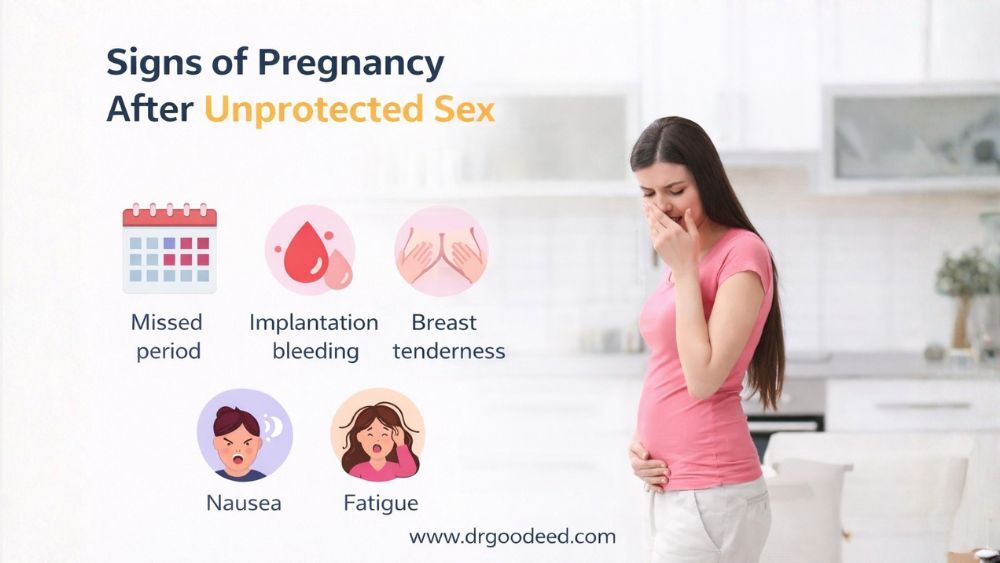
Signs of pregnancy after unprotected sex do not appear immediately. The body does not produce detectable pregnancy hormones until after implantation, which takes 6 to 12 days after fertilization.
Early symptoms that appear 1 to 2 weeks after conception:
- Missed period: The most reliable early sign. A period that is 5 or more days late after unprotected sex warrants a pregnancy test.
- Implantation bleeding: Light pink or brown spotting lasting 1 to 3 days, often mistaken for a light period. It happens around 10 to 14 days after conception.
- Breast tenderness: Specifically, heaviness and sensitivity around the nipple area caused by rising progesterone.
- Nausea: Starts around week 6 of pregnancy, so 3 to 4 weeks after conception. Not a very early symptom despite the popular belief.
- Fatigue: Progesterone rises sharply in early pregnancy and causes significant tiredness that feels different from normal tiredness.
Signs of pregnancy after unprotected sex are not reliable for confirming or ruling out pregnancy. A test is the only accurate method.
When to Take a Pregnancy Test
Testing too early gives false negatives, and a false negative sends people into a false sense of security.
Home pregnancy tests detect human chorionic gonadotropin (hCG), a hormone the body only produces after a fertilized egg implants in the uterine wall. hCG doubles every 48 to 72 hours after implantation.
Test timing:
- 10 days after unprotected sex: Early result tests like First Response Early Result detect hCG at 6.3 mIU/mL and give reliable results at this point for most people
- 14 days after unprotected sex: The most accurate window for any home pregnancy test
- After a missed period: The highest accuracy, since hCG levels are well above detection threshold
Testing at day 3 or day 5 after sex produces inaccurate results. The hCG is not present yet. A negative test that early does not mean pregnancy did not occur.
Risk of STDs After Unprotected Sex
Risk of STDs after unprotected sex is real and depends on the partner’s infection status. Many STIs produce no symptoms in infected people, which means partners do not always know they are carrying an infection.
Risk of STDs after unprotected sex by specific infection:
- Chlamydia: The most common bacterial STI. Up to 70% of infected women and 50% of infected men have no symptoms. Transmission rate per unprotected act with an infected partner is estimated at 30 to 50%.
- Gonorrhea: Transmission rate per act is 50 to 80% from male to female. Throat and rectal infections are common and frequently missed.
- HIV: Transmission risk per unprotected vaginal act with a positive partner is 0.08%. Post-exposure prophylaxis (PEP) taken within 72 hours reduces this risk by over 99%.
- Herpes (HSV-2): Transmits through skin-to-skin contact, not just fluid exchange. Condoms reduce risk by about 30%, not 100%.
- Syphilis: Primary stage causes a painless sore that most people miss. Untreated, it progresses to secondary syphilis with a full-body rash.
Vaginal Infection Risk After Unprotected Sex
Vaginal infection risk after unprotected sex includes conditions that are not STIs but still cause real symptoms and discomfort.
Three infections that commonly follow unprotected sex:
Bacterial vaginosis (BV):
- Semen has a pH of 7.2 to 8.0, which disrupts the vaginal pH of 3.8 to 4.5
- This pH shift allows bacteria like Gardnerella vaginalis to overgrow
- Symptoms: thin gray or white discharge with a fishy odor, itching, burning
- Treated with metronidazole (oral or vaginal gel)
Yeast infection (Candidiasis):
- pH disruption from semen also reduces Lactobacillus bacteria, allowing Candida to overgrow
- Symptoms: thick white discharge without odor, intense itching, redness, soreness
- Treated with fluconazole (oral) or clotrimazole (topical)
Urinary tract infection (UTI):
- Sex introduces bacteria from the genital area into the urethra
- Symptoms: burning during urination, frequent urge to urinate, cloudy or strong-smelling urine
- Urinating immediately after sex reduces but does not eliminate this risk
Vaginal infection risk after unprotected sex increases with multiple partners, with partners who are not tested, and when hygiene steps are skipped afterward.
When to See a Doctor
See a doctor immediately if any of these apply after unprotected sex:
- You need emergency contraception and are past 72 hours: only ella or a copper IUD remain as options
- You had possible HIV exposure: PEP must start within 72 hours, ideally within 24 hours
- You develop pelvic pain, fever above 38°C, or unusual discharge within days of sex, which may signal pelvic inflammatory disease
- Your period is more than one week late and a home pregnancy test reads negative, this needs clinical confirmation
- You have visible sores, rashes, or unusual discharge anywhere on the genitals
How to Prevent Future Risks
Reliable prevention strategies:
- Condoms with correct technique: Male condoms used perfectly reduce pregnancy risk to 2% per year. Typical use puts that at 13%, mostly due to application errors.
- Long-acting contraceptives (IUDs, implants): Over 99% effective at preventing pregnancy with no daily action required
- Regular STI testing: The CDC recommends annual STI testing for anyone sexually active with more than one partner, and every 3 to 6 months for higher-risk individuals
- PrEP for HIV: Truvada and Descovy, taken daily, reduce HIV infection risk by over 99% in high-risk individuals
- Open communication with partners: Knowing a partner’s recent STI test results before unprotected sex eliminates a large portion of the risk
Frequently Asked Questions
What should I do immediately after unprotected sex?
After unprotected sex immediately urinate to reduce UTI risk, wash the external genital area with water, avoid douching, and note the exact time. Then decide on emergency contraception. Levonorgestrel (Plan B) must be taken within 72 hours. A copper IUD works up to 5 days.
How soon should emergency contraception be taken?
Take it as soon as possible. Plan B taken within 24 hours is 95% effective. At 48 to 72 hours, it drops to 58%. After 72 hours, switch to ella (effective up to 120 hours) or get a copper IUD inserted, which is over 99% effective regardless of timing within the 5-day window.
Can washing after sex prevent pregnancy?
No. Washing the external genitals after sex does not remove sperm from inside the vagina. Sperm reaches the cervix within 90 seconds of ejaculation. External washing only reduces infection risk from surface bacteria. It has zero effect on preventing pregnancy.
What are the chances of pregnancy after unprotected sex?
Chances of pregnancy after unprotected sex peak at around 30% per cycle if sex occurs during the fertile window, days 10 to 17 of a typical 28-day cycle. Outside the fertile window, the risk drops below 5% per act. Sperm survives up to 5 days inside the reproductive tract.
When should I take a pregnancy test?
Take a test 10 to 14 days after unprotected sex for an accurate result. Testing before day 10 produces false negatives because hCG levels are below detection threshold. First Response Early Result detects hCG as low as 6.3 mIU/mL, making it the most sensitive over-the-counter option available.
Can unprotected sex cause STIs even without symptoms?
Yes. Chlamydia shows no symptoms in 70% of infected women and 50% of infected men. Gonorrhea, herpes, and HPV also frequently produce no visible signs. Risk of STDs after unprotected sex exists whether or not either partner has visible symptoms.
When should I get tested for STIs?
Testing windows vary by infection. Chlamydia and gonorrhea: test 1 to 2 weeks after exposure. HIV: test at 18 to 45 days for the most sensitive antigen/antibody tests, or at 90 days for conclusive results. Syphilis: test at 3 to 6 weeks after exposure. Herpes blood tests: test at 12 to 16 weeks for full accuracy.
Can emergency contraception stop an existing pregnancy?
No. Emergency contraception works by delaying or stopping ovulation before fertilization. If a fertilized egg has already implanted in the uterus, no emergency contraceptive pill stops the pregnancy. The copper IUD prevents implantation if inserted before it occurs, within 5 days of sex.
What symptoms suggest an infection after sex?
Vaginal infection risk after unprotected sex shows thin gray discharge with a fishy smell (bacterial vaginosis), thick white discharge with itching and redness (yeast infection), or burning during urination with frequent urgency (UTI). Pelvic pain with fever signals possible pelvic inflammatory disease, which needs immediate medical attention.
How can I prevent pregnancy and STIs in the future?
Combine a long-acting contraceptive like an IUD or implant with consistent condom use. This gives over 99% pregnancy protection plus STI risk reduction. Get tested every 3 to 6 months if you have multiple partners. If HIV exposure is a recurring risk, discuss daily PrEP with a doctor.