

Adults need 1.5 to 2 hours of deep sleep per night, which equals roughly 13 to 23% of total sleep time. Most people get 7 to 9 hours of sleep total, and deep sleep naturally fills the first half of that window.
sleep is the stage where your body repairs tissue, releases growth hormone, and consolidates memory. Without enough of it, your brain and body show measurable decline within days.
Stages of Sleep and Deep Sleep Role
Sleep is not one continuous state. Your brain cycles through distinct stages every 90 minutes, and each stage does something different. Stages of sleep and deep sleep determines how restored you feel the next morning.
Light Sleep vs Deep Sleep vs REM
- Light sleep (NREM Stage 1 and 2): Your body slows down. Heart rate drops. This takes up roughly 50 to 60% of your night.
- Deep sleep (NREM Stage 3): Slowest brain waves. Hardest to wake from. This is where physical recovery happens.
- REM sleep: Brain is active. Dreams occur. Memory processing and emotional regulation happen here.
Each stage is necessary. Skipping deep sleep for more REM does not give you the same outcome.
NREM Stage 3 Slow-Wave Sleep
Stage 3 sleep is also called slow-wave sleep because the brain produces delta waves, which are the slowest brain waves measured during sleep. The pituitary gland releases 70 to 80% of your daily human growth hormone during this stage. This is also when your brain’s glymphatic system flushes out metabolic waste, including amyloid plaques linked to Alzheimer’s disease.
Brain Activity During Deep Sleep
Your brain is not inactive during deep sleep. Neurons fire in slow, coordinated bursts. The prefrontal cortex, the part of the brain responsible for decision-making and emotional control, enters a restorative low-activity state. Research from the University of California, Berkeley, shows that even one night of disrupted deep sleep reduces emotional regulation the next day.
Why Deep Sleep Happens Earlier at Night
Deep sleep is front-loaded. The majority of your deep sleep occurs in the first two 90-minute sleep cycles, which means it happens mostly between 10 PM and 2 AM if you sleep at a standard time. If you go to bed at 2 AM instead of 10 PM, you do not simply shift the deep sleep window. You reduce its total duration.
How Much Deep Sleep Do You Need
How much deep sleep do you need differs by age. The number is not just about hours; it is about percentage of total sleep time.
Deep Sleep Needs for Adults
Adults between 18 and 60 years need 90 to 120 minutes of deep sleep per night. This falls within 7 to 9 total hours of sleep. Wearable data from Fitbit’s 2023 sleep study across 6 million users found that the average adult gets only 62 minutes of deep sleep per night, well below the recommended amount.
Deep Sleep Needs for Children
Children aged 6 to 13 need 9 to 11 hours of total sleep. Deep sleep makes up a higher proportion for children, around 25 to 30% of total sleep, because growth hormone release during Stage 3 is essential for physical development. A child getting 9 hours should ideally get around 135 to 160 minutes of deep sleep.
Deep Sleep Needs for Older Adults
Adults over 65 typically get 15 to 20 minutes less deep sleep than younger adults. This is biological, not behavioral. Slow-wave sleep naturally decreases by about 2% per decade after age 30, according to research published in the journal Sleep. By age 70, some adults get as little as 30 to 40 minutes of deep sleep per night.
Average Deep Sleep Percentage
The healthy target is 13 to 23% of total sleep in deep sleep. For a person sleeping 8 hours, that equals 62 to 110 minutes. Consistently falling below 13% signals a recovery deficit even if total sleep hours appear normal.
How Deep Sleep Affects Health
Deep sleep is not a passive recovery period; it is when the most critical biological repair happens.
- Growth hormone secretion peaks during deep sleep, repairing muscle tissue, bone density, and skin cells
- The glymphatic system clears beta-amyloid and tau proteins from the brain, both linked to neurodegenerative disease
- Blood pressure drops during deep sleep, reducing cardiovascular strain
- Insulin sensitivity resets overnight, with deep sleep deprivation raising diabetes risk by up to 30% according to University of Chicago research
- The immune system produces cytokines during deep sleep, molecules that fight infection and inflammation
Signs You Are Not Getting Enough Deep Sleep
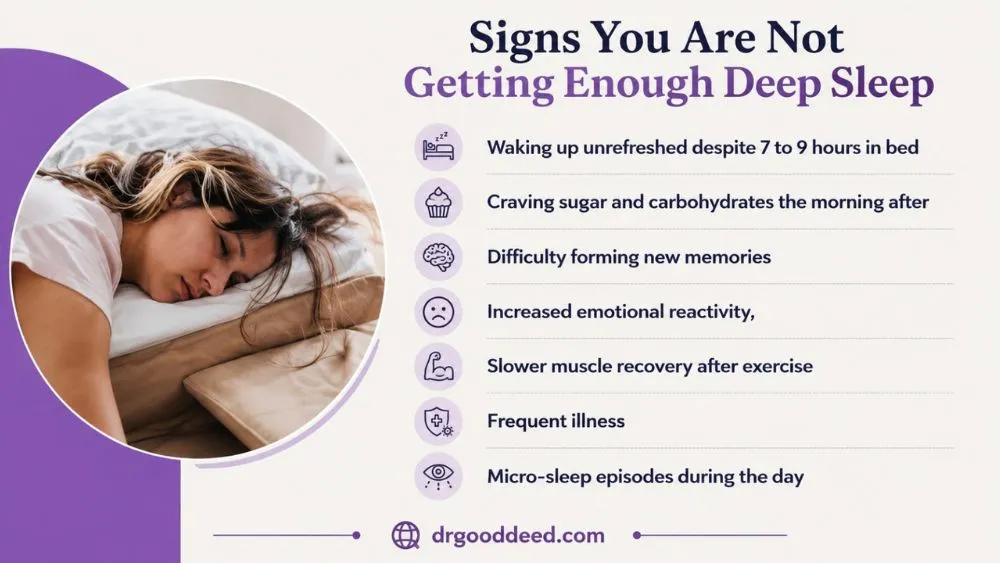
Signs you are not getting enough deep sleep are subtle and get misattributed to stress or poor diet.
- Waking up unrefreshed despite 7 to 9 hours in bed
- Craving sugar and carbohydrates the morning after (a ghrelin spike from disrupted sleep)
- Difficulty forming new memories or retaining information learned the day before
- Increased emotional reactivity, small frustrations feel disproportionately large
- Slower muscle recovery after exercise
- Frequent illness, meaning the immune system is not resetting overnight
- Micro-sleep episodes during the day, where you briefly lose consciousness for 1 to 2 seconds
Waking Up Tired Due to Poor Deep Sleep
Waking up tired due to poor deep sleep is different from not sleeping enough hours. You can sleep 9 hours and still feel exhausted if your deep sleep is fragmented or cut short.
- Sleep apnea is the most common medical cause. Each apnea event, where breathing stops briefly, pulls the brain out of deep sleep without full awakening.
- Alcohol consumption suppresses slow-wave sleep significantly. Even two drinks before bed reduce deep sleep by up to 20%, based on data from the Journal of Clinical Sleep Medicine.
- Sleeping in a warm room (above 67°F or 19.5°C) prevents the core body temperature drop required to sustain deep sleep cycles.
- High cortisol at bedtime, whether from late-evening stress or caffeine, blocks the transition into Stage 3.
Stress and Deep Sleep Disruption
Stress and deep sleep disruption are directly connected through cortisol. Cortisol is your primary stress hormone and a biological enemy of deep sleep.
Cortisol and Nighttime Alertness
Cortisol should be at its lowest between midnight and 4 AM. In chronically stressed people, cortisol remains elevated throughout the night. This keeps the brain in a lighter sleep state and prevents full entry into Stage 3.
A 2021 study in Psychoneuroendocrinology found that individuals with high evening cortisol spent 40% less time in slow-wave sleep.
Anxiety and Racing Thoughts
Anxiety activates the amygdala, which is the brain’s threat-detection center. An active amygdala at bedtime competes directly with the brain’s ability to produce slow delta waves. The result is lighter, more fragmented sleep with very little deep sleep.
Effects of Chronic Stress on Sleep
Long-term stress reshapes your sleep architecture over weeks. The hypothalamic-pituitary-adrenal axis stays overactive, meaning cortisol release does not normalize even on days without acute stress. This reduces total deep sleep time cumulatively.
Relaxation Techniques Before Bed
Lowering cortisol before bed is practical. These methods have published evidence:
- 4-7-8 breathing (inhale 4 seconds, hold 7, exhale 8) lowers heart rate within 5 minutes
- Progressive muscle relaxation reduces cortisol by an average of 12% before bed
- Writing tomorrow’s task list (not journaling emotions) reduces bedtime cognitive arousal, based on a 2018 Baylor University study
Why Deep Sleep Decreases With Age
Brain Changes in Sleep Cycles
The brain’s ability to generate slow delta waves weakens with age. The ventrolateral Preoptic nucleus, the region that initiates sleep, becomes less active as neurons in it degrade naturally after age 50.
Reduced Slow-Wave Sleep Over Time
Adults over 60 generate delta waves at roughly half the amplitude of adults in their 20s. Weaker delta waves mean less restorative deep sleep even when total sleep time stays the same.
Sleep Fragmentation in Older Adults
Older adults wake more frequently at night, often without remembering it. Each awakening resets the sleep cycle back to Stage 1. This interrupts deep sleep before it completes its full repair cycle.
Ways to Increase Deep Sleep Naturally
How much deep sleep do you need is a fixed target. How you reach it is adjustable.
Regular Exercise and Sleep Quality
Aerobic exercise lasting 30 minutes or more increases slow-wave sleep the same night. A Stanford University study found that moderate aerobic exercise increased deep sleep by 18 minutes on average. The effect is strongest when exercise happens before 6 PM.
Cooling the Body Before Sleep
A warm shower 1 to 2 hours before bed drops core temperature fast once you step out. Cooler room temperature (between 60 and 67°F) sustains deep sleep longer by preventing the warming that triggers waking.
Magnesium and Sleep Support
Magnesium glycinate at 200 to 400mg before bed increases GABA activity in the brain, which promotes delta wave generation. A 2012 randomized controlled trial in the Journal of Research in Medical Sciences confirmed this increases deep sleep duration in older adults.
Consistent Sleep Schedule
Going to bed and waking at the same time every day, including weekends, trains the circadian rhythm to initiate deep sleep at a predictable point in the cycle. Even one late night shifts the deep sleep window and reduces its total duration.
Habits That Improve Deep Sleep Quality
Small, consistent changes produce measurable results in deep sleep quality.
- Stop alcohol 3 hours before bed; its sedative effect is not the same as deep sleep
- Dim lights in your home after 8 PM to signal melatonin onset
- Avoid eating large meals within 2 hours of bed, since active digestion raises core temperature
- Keep bedroom temperature at or below 67°F
- Limit caffeine after 1 PM (caffeine’s half-life is 5 to 7 hours)
- Use blackout curtains; even dim light during sleep suppresses melatonin by 50%
When Poor Deep Sleep Needs Medical Attention
Deep Sleep Below Healthy Range
If your sleep tracker consistently shows under 45 minutes of deep sleep per night for more than 2 to 3 weeks, that warrants investigation.
Persistent Daytime Fatigue
Fatigue that does not improve with more hours in bed often points to disrupted sleep architecture, not total sleep deficit. This is a clinical distinction most people miss.
Symptoms of Insomnia or Sleep Apnea
Loud snoring, gasping during sleep, waking with a dry mouth, or stopping breathing briefly are signs of sleep apnea. This condition directly destroys deep sleep continuity and requires a polysomnography test (overnight sleep study) to diagnose.
When to Consult a Sleep Specialist
See a sleep specialist if fatigue persists for more than 3 months despite good sleep hygiene, or if a bed partner observes breathing pauses. The American Academy of Sleep Medicine recommends CBT-I (Cognitive Behavioral Therapy for Insomnia) as the first-line treatment, ahead of sleep medication.
Frequently Asked Questions
How much deep sleep should adults get?
Adults need 90 to 120 minutes of deep sleep per night, which equals 13 to 23% of total sleep time. For someone sleeping 8 hours, that is roughly 62 to 110 minutes. Below 45 minutes consistently is a red flag.
Is 45 minutes of deep sleep enough?
No. 45 minutes falls below the healthy minimum of 90 minutes for adults. It means your brain completed fewer than one full deep sleep cycle, leaving tissue repair and memory consolidation incomplete.
What percentage of sleep should be deep sleep?
13 to 23% of your total sleep should be deep sleep. For 7 hours of sleep, that is 55 to 96 minutes. Most adults only average 62 minutes, which sits at the lower edge of the healthy range.
Why am I not getting deep sleep at night?
The four most common causes are high cortisol at bedtime from stress, alcohol consumption before bed, room temperature above 67°F, and sleep apnea. Each one pulls the brain out of Stage 3 before it completes.
Can stress reduce deep sleep?
Yes. Elevated cortisol from stress directly blocks slow-wave delta brain activity. A 2021 study found that high evening cortisol reduced time in deep sleep by 40%. Chronic stress compresses this effect over weeks.
Why do I wake up tired even after 8 hours?
Waking up tired due to poor deep sleep means your sleep architecture is disrupted, not your total hours. Sleep apnea, alcohol, or a warm room prevents Stage 3 sleep, leaving you unrestored despite adequate time in bed.
Does exercise increase deep sleep?
Yes. 30 minutes of aerobic exercise before 6 PM increases deep sleep by an average of 18 minutes the same night, based on Stanford research. Resistance training has a similar effect within 48 hours.
Is REM sleep or deep sleep more important?
Both are necessary but for different functions. Deep sleep restores the body and clears brain waste. REM sleep consolidates emotional memory and supports learning. Sacrificing either one produces different but equally measurable deficits.
Can supplements improve deep sleep?
Magnesium glycinate (200 to 400mg) and low-dose melatonin (0.5 to 1mg) have clinical evidence for increasing deep sleep duration. High-dose melatonin (5 to 10mg) does not increase deep sleep and often causes grogginess.
How do sleep trackers measure deep sleep?
Most wearables like Fitbit, Garmin, and Oura Ring use accelerometer data and heart rate variability (HRV) to estimate sleep stages. They are reasonably accurate for light versus deep sleep classification, but a clinical polysomnography test remains the gold standard for diagnosis.