
The human body can survive roughly 11 days without sleep before the brain begins to break down in ways that are potentially irreversible. You may start showing severe cognitive and physical symptoms after just 24 hours.
Sleep deprivation kills cells, distorts perception, collapses immune function, and eventually forces the brain into involuntary sleep regardless of your intentions.
Maximum Time a Human Can Stay Awake
The maximum time a human can stay awake under documented conditions is 264 hours, which equals exactly 11 days. You may not safely push past 72 hours without risk of hallucinations, organ stress, and dangerous cognitive failure.
Longest Recorded Sleep Deprivation Cases
In 1964, 17-year-old Randy Gardner stayed awake for 264 hours as part of a Stanford University research project. By day 11, he was hallucinating, unable to complete simple arithmetic, and struggled to form sentences. He recovered with no permanent damage after sleeping 14 hours. This remains the most studied voluntary sleep deprivation case in medical history.
Tonny Wright, a UK man, matched Gardner’s record in 2007. His case showed similar cognitive decline, though he had supervision and regular medical checks throughout.
Scientific Estimates of Sleep Limits
No controlled study has pushed human subjects beyond 11 days because the ethical risks become too high past that point. Animal studies, particularly in rats conducted by University of Chicago researcher Allan Rechtschaffen, showed that complete sleep deprivation caused death within 11 to 32 days. The cause was systemic organ failure, not brain shutdown alone.
Why the Brain Eventually Forces Sleep
The brain accumulates adenosine during waking hours. Adenosine is a chemical byproduct of neural activity that builds sleep pressure. After 20 to 25 hours, adenosine levels force the brain into microsleeps, which are involuntary 1 to 30-second sleep episodes that happen without the person realizing it. The brain does not ask for permission, but takes sleep.
Symptoms After One Night Without Sleep
Symptoms after one night without sleep appear faster after missing just one full night, changing brain chemistry within hours.
After 17 to 19 hours without sleep, cognitive performance drops to the equivalent of a blood alcohol level of 0.05%, based on research from the University of New South Wales. Reaction time slows. Short-term memory weakens. Emotional control drops noticeably.
You may feel these effects and dismiss them as ordinary tiredness. They are not. The neurological changes are measurable on an EEG within the first 24 hours.
Effects After 24 Hours Without Sleep
24 hours without sleep causes measurable damage.
Brain Fog and Poor Concentration
The prefrontal cortex, which handles reasoning and focus, reduces activity significantly. Tasks that normally take 10 minutes take 25 to 30. The brain loses the ability to filter out irrelevant information, which is why everything feels overwhelming.
Impaired Judgment and Decision Making
The ventromedial prefrontal cortex, the region that weighs risk, goes offline first. People who have been awake 24 hours consistently make riskier financial and personal decisions in controlled lab studies. They also rate themselves as “fine,” which is part of the problem.
Reduced Motor Coordination
Hand-eye coordination drops by 30 to 40% after 24 hours without sleep. The cerebellum, which controls fine motor skills, cannot recalibrate properly without slow-wave sleep. This is why driving while sleep-deprived is statistically as dangerous as drunk driving.
Hormonal Stress Responses
Cortisol rises sharply after 24 hours of wakefulness. Ghrelin (the hunger hormone) spikes, while leptin (the fullness hormone) drops. This combination drives intense sugar and carbohydrate cravings. Insulin sensitivity also falls within the first 24 hours of sleep loss.
Effects After 36 to 48 Hours Awake
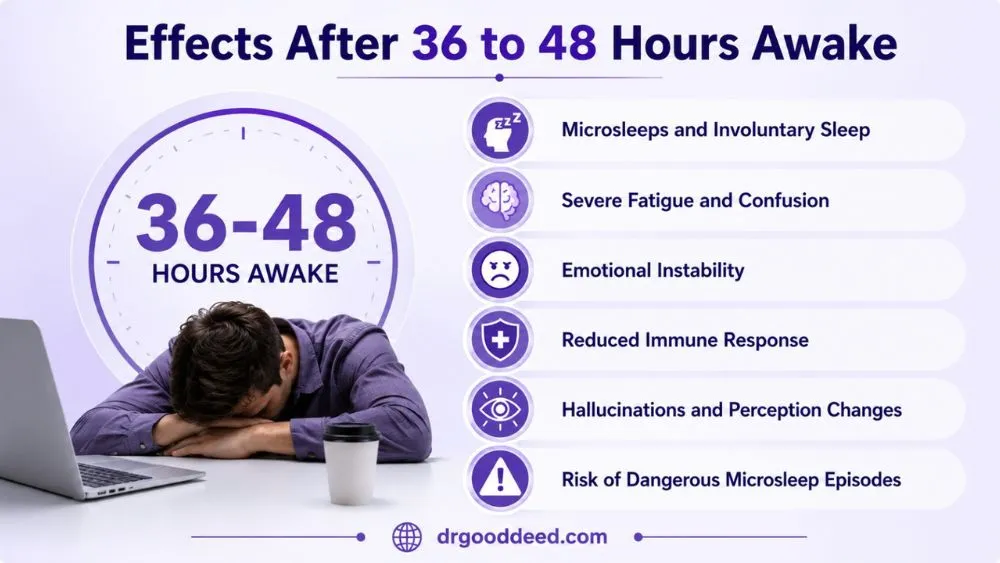
At 36 to 48 hours, the body is in serious physiological distress, even if the person does not feel it clearly.
Microsleeps and Involuntary Sleep
Microsleeps start occurring at this point. They last between 1 and 30 seconds. The person’s eyes stay open. They appear awake, but their brains are not. This is the stage at which driving becomes life-threatening.
Severe Fatigue and Confusion
The hippocampus, which forms new memories, begins to malfunction. People struggle to recall events from earlier the same day. Processing speed drops to 50% of baseline, per research from Harvard Medical School.
Emotional Instability
The amygdala, the brain’s emotional center, becomes 60% more reactive after 35 hours without sleep, based on a 2007 study published in Current Biology. Small frustrations trigger disproportionate responses. Some people describe feeling emotionally raw or unpredictably tearful.
Reduced Immune Response
Natural killer cell activity, which fights off viruses and abnormal cells, drops by 28% after just one night of sleep deprivation. At 48 hours, the body’s production of cytokines (immune signaling molecules) falls sharply, leaving the immune system significantly weakened.
What Happens After 72 Hours Without Sleep
After 72 hours without sleep, body reaches its most dangerous non-fatal threshold.
Hallucinations and Perception Changes
Visual and auditory hallucinations begin around the 72-hour mark. People report seeing objects move, hearing voices, and experiencing paranoid thoughts. The brain, deprived of REM sleep where it normally processes sensory input, starts generating false perceptions to compensate.
Severe Cognitive Impairment
Working memory essentially collapses. The ability to hold and use information in real-time drops to near zero. People at 72 hours without sleep perform worse on cognitive tests than individuals with a 0.10% blood alcohol concentration, which is legally drunk in every U.S. state.
Risk of Dangerous Microsleep Episodes
Microsleeps at this stage last longer and happen more frequently. A microsleep at 70 mph takes a car 100 meters down a road with no driver in control.
Major Disruption of Brain Function
The thalamus, which filters sensory information before it reaches conscious awareness, starts misrouting signals. This is why sounds feel too loud, and lights feel too bright after extended wakefulness. The brain is no longer filtering input correctly.
Memory Problems From Sleep Loss
Memory problems from sleep loss begin at 24 hours and worsen with each additional hour awake.
Sleep is when the hippocampus transfers short-term memories into long-term storage. This process, called memory consolidation, requires slow-wave sleep and REM sleep to complete. Skip those stages and memories formed during the day do not stick.
A 2019 study from UC Berkeley found that even one night of total sleep deprivation reduced hippocampal activity by 40%, resulting in a near-complete failure to form new long-term memories. The memories did not transfer. They simply did not get saved.
Chronic partial sleep loss (6 hours per night for two weeks) produces the same memory impairment as two full nights without sleep, according to research published in Sleep journal by David Dinges at the University of Pennsylvania.
Immune System Effects of Sleep Loss
Immune system effects of sleep loss are severe and set in faster than most people realize.
A study from Carnegie Mellon University exposed 153 volunteers to the rhinovirus (common cold) after tracking their sleep habits for two weeks. People who slept under 6 hours per night were 4.2 times more likely to get sick than those who slept 7 or more hours.
After 24 hours without sleep, the body reduces T-cell production and increases inflammatory cytokines. This combination means the immune system is both slower to respond to threats and more likely to create low-grade inflammation throughout the body. Chronic inflammation is directly linked to cardiovascular disease, type 2 diabetes, and certain cancers.
Can Sleep Deprivation Kill
Sleep deprivation can kill though the path is usually through secondary causes rather than sleep loss directly shutting the body down.
Fatal Familial Insomnia Explanation
Fatal Familial Insomnia (FFI) is a rare prion disease that destroys the thalamus’s ability to regulate sleep. Patients lose the ability to sleep entirely and die within 7 to 36 months of onset. There is no treatment. FFI has affected fewer than 40 families globally but provides the clearest evidence that the human body cannot survive permanent sleep loss.
Extreme Sleep Deprivation Experiments
Allan Rechtschaffen’s rat studies at University of Chicago (1983 to 1995) showed that total sleep deprivation caused death in every subject within 11 to 32 days. Autopsies showed systemic organ failure, metabolic collapse, and immune breakdown. No single organ failed first; everything failed together.
Why Chronic Sleep Loss Harms the Body
People rarely die directly from sleep deprivation in real life. They die from its consequences: falling asleep at the fast, cardiovascular disease accelerated by years of poor sleep, immune failure leading to fatal infections, or accidents caused by impaired judgment.
Rare Cases of Fatal Sleep Disorders
Beyond FFI, Morvan’s syndrome and Agrypnia Excitata are conditions that severely disrupt sleep and carry high mortality if untreated. Both involve thalamic dysfunction. Both confirm that the brain physically cannot sustain life without adequate sleep cycles.
Why the Body Cannot Function Without Sleep
Brain Waste Clearance During Sleep
The glymphatic system, a waste-clearance network in the brain, is almost exclusively active during sleep. It flushes beta-amyloid and tau proteins, both linked to Alzheimer’s disease. Without sleep, these proteins accumulate. Even one night of missed sleep increases beta-amyloid in the brain by a measurable amount, based on NIH research from 2017.
Hormone Regulation Cycles
Growth hormone, cortisol, leptin, ghrelin, and testosterone all reset during sleep. Miss sleep and these hormones drift out of their normal ranges. Testosterone in men drops by 10 to 15% after one week of 5-hour nights, per University of Chicago data.
Memory Consolidation Processes
As noted above, the hippocampus requires sleep to move short-term memories into long-term storage. Without this transfer, learning effectively does not happen.
Energy Restoration Mechanisms
Glycogen stores in the brain replenish during sleep. Without this replenishment, the brain runs on a reduced energy supply, which explains the cognitive fog and fatigue that begin within the first 16 to 20 waking hours.
How to Recover After Severe Sleep Loss
Recovery from short-term sleep deprivation (24 to 48 hours) happens faster than most people expect.
- After one all-nighter, a full recovery night of 9 to 10 hours restores most cognitive function
- After 72 hours without sleep, full cognitive recovery takes 2 to 3 nights of adequate sleep, not just one
- Microsleep debt from chronic partial deprivation takes 9 to 14 days of full sleep to fully clear, according to research from the University of Colorado
- Napping does not fully substitute for nighttime sleep; naps restore alertness but do not complete the deep sleep and REM cycles needed for memory and immune recovery
Frequently Asked Questions
How long can the average person stay awake?
Most adults begin experiencing involuntary microsleeps at 24 hours and severe cognitive failure by 48 to 72 hours. The world record is 264 hours. Without medical supervision, pushing past 72 hours carries serious risk of hallucinations and dangerous microsleep episodes.
Is it possible to die from sleep deprivation?
Yes. Fatal Familial Insomnia, a rare prion disease that destroys the thalamus, kills patients in 7 to 36 months. In controlled animal studies, total sleep deprivation caused death within 11 to 32 days. In humans, death typically comes from accidents or organ failure caused by chronic sleep loss.
What is the longest someone has stayed awake?
Randy Gardner holds the verified record at 264 hours (11 days), achieved in 1964 under Stanford University supervision. He recovered fully after sleeping 14 hours. His case remains the most studied voluntary sleep deprivation experiment in medical history.
Why does sleep deprivation cause hallucinations?
After 72 hours without sleep, the thalamus misroutes sensory signals and the REM-deprived brain generates false perceptions to compensate for missing dream processing. The hallucinations resemble REM sleep intrusions into waking consciousness; the brain is essentially dreaming while awake.
Can sleep deprivation affect memory permanently?
Yes, in cases of chronic severe deprivation. A single all-nighter causes temporary hippocampal failure that recovers with sleep. But years of sleeping under 6 hours per night accelerates neuronal loss in the hippocampus and raises Alzheimer’s risk by allowing amyloid plaques to accumulate unchecked.
How does lack of sleep affect the immune system?
Sleeping under 6 hours per night makes you 4.2 times more likely to catch a cold (Carnegie Mellon University). After 24 hours without sleep, natural killer cell activity drops 28% and T-cell production falls. This is measurable on a standard blood panel within 48 hours of total sleep deprivation.
How long does it take to recover from no sleep?
One all-nighter: one full recovery night restores most function. After 72 hours awake: 2 to 3 nights of 8 to 9 hours. Chronic partial deprivation (6 hours nightly for weeks): 9 to 14 days of full sleep to fully restore cognitive performance and immune markers.
What are microsleeps and why are they dangerous?
Microsleeps are 1 to 30 second unconscious sleep episodes that happen without warning, with eyes open. The person has no awareness they occurred. At highway speed, a 4-second microsleep means the car travels over 100 meters with no driver response. They begin after 20 hours of wakefulness.
When should you see a doctor for sleep problems?
See a doctor if you regularly sleep 7 to 9 hours but still wake up exhausted, if you snore loudly or stop breathing during sleep, or if daytime fatigue affects your work or safety for more than 3 consecutive weeks. These are clinical indicators of sleep apnea or disrupted sleep architecture, both of which require medical evaluation.