
Do your joints make noise every time you stand up, stretch, or bend your knee? Studies estimate that up to 54% of adults experience joint sounds regularly, and for most, there is no underlying disease. But some joint noises do signal something worth checking. This guide covers the exact causes, which sounds are harmless, and which ones need a doctor’s attention.
What Causes Joint Noises?
Joint sounds, clinically called crepitus, come from four main sources: gas bubbles, tendon movement, pressure shifts, and cartilage friction. The key is knowing which type you are dealing with.
Gas Bubbles Causing Joint Popping
Gas bubbles causing joint popping is the most studied mechanism, confirmed in research published in PLOS ONE in 2015 using real-time MRI. Every joint is surrounded by synovial fluid containing dissolved gases, mainly carbon dioxide, oxygen, and nitrogen.
When you pull or stretch a joint rapidly, pressure drops inside the cavity. That drop causes dissolved gases to form a bubble. The bubble collapses almost instantly. That collapse is the “pop” you hear.
Tendons and ligaments sometimes flick over a bony bump during movement. That flicking creates a snapping or clicking sound. This is extremely common in the hip, shoulder, and knee. The sound repeats at the same point in a movement, which is its biggest identifying feature.
Changes in Joint Pressure During Movement
Joint cavities are sealed spaces. After staying still for a while, the pressure inside shifts when you move. That shift alone produces a soft cracking sound, similar to opening a vacuum-sealed jar. It does not cause tissue tears or fluid loss.
Cartilage Wear and Surface Friction
Healthy cartilage is smooth. When it roughens from age or mild wear, surfaces create friction during movement. That friction produces a grinding or grating sound. Softer and more continuous than a gas-bubble pop.
Causes of Cracking and Popping Joints
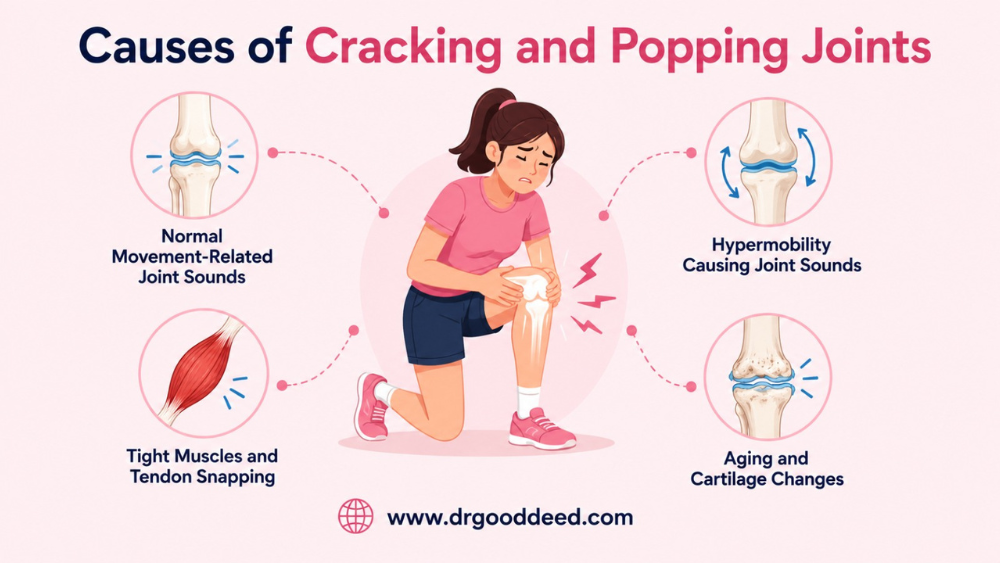
The causes of cracking and popping joints range from harmless movement patterns to early signs of cartilage stress. Knowing the difference matters.
Normal Movement-Related Joint Sounds
After sitting at a desk for two hours, standing up and hearing your knees pop is normal. The joint has been static, pressure has built, and movement releases it.
Tight Muscles and Tendon Snapping
Tight hip flexors cause snapping in young adults most often. When the iliotibial band flicks over the greater trochanter (a bony prominence on the femur), it creates a loud snap. This is called snapping hip syndrome and affects runners and cyclists most frequently.
Hypermobility Causing Joint Sounds
Hypermobility causing joint sounds affects approximately 10 to 15% of the US population, with higher prevalence in women and younger individuals. Hypermobile joints have looser ligaments, which allow more movement across bony surfaces and more frequent clicking. People with hypermobile Ehlers-Danlos Syndrome experience this most severely in the fingers, knees, and shoulders.
Aging and Cartilage Changes
After age 40, cartilage loses water content gradually and becomes less cushiony. Joints silent at 25 start making sounds at 50. This is normal aging, not arthritis. Arthritis requires additional signs: swelling, pain, and morning stiffness lasting more than 30 minutes.
Why Some Joints Crack More Than Others
Knees, knuckles, and neck joints crack most often due to anatomy and synovial fluid volume. Knees carry four times your body weight per step, making them the most mechanically stressed joints in the body. The neck has many small facet joints stacked close together with high movement frequency throughout the day.
- Knees: Large synovial cavity, high load, multiple tendons crossing the joint
- Neck: Stacked facet joints with frequent daily movement
- Shoulders: Biceps tendon snaps over the humeral groove during arm rotation
- Hips: The iliopsoas or IT band snaps over bony structures with each stride
Gas Bubbles Causing Joint Popping Explained
The 2015 University of Alberta MRI study confirmed the pop occurs when the bubble forms, not when it bursts. This reversed a 50-year-old assumption in medicine.
Synovial Fluid and Dissolved Gases
Synovial fluid is roughly 80% water with dissolved gases in equilibrium at rest. Fast stretching breaks the equilibrium instantly.
Why Popping Happens Repeatedly
After a joint pops, gas re-dissolves into the synovial fluid over approximately 20 minutes. That is why the same knuckle cannot be cracked again immediately.
Exercises for Healthy Joints
Exercises for healthy joints reduce sound frequency by improving muscle support around the joint and reducing tendon tightness.
Strength Training Supporting Joint Stability
Quadriceps strengthening is the most evidence-backed strategy for reducing knee joint sounds. Straight-leg raises, mini-squats, and wall sits build the quad without compressing the kneecap. Results typically appear within 6 to 8 weeks of consistent training.
Stretching Improving Flexibility Safely
Hip flexor and calf stretches reduce the tendon tension behind snapping sounds. Hold each stretch for 30 seconds without bouncing. Ballistic stretching increases tendon irritation.
Low-Impact Exercises Protecting Cartilage
Swimming and cycling load joints without impact and increase synovial fluid production. A 2019 study in the Journal of Aging and Physical Activity found 30 minutes of cycling three times per week reduced reported knee joint noise in adults over 50.
Mobility Exercises Reducing Stiffness
Cat-cow stretches for the spine, hip circles, and ankle alphabet exercises break up synovial fluid pooling and reduce morning stiffness. Stiffness under 30 minutes is mechanical. Over 30 minutes warrants evaluation.
How to Reduce Joint Cracking Sounds
To reduce joint cracking sounds, target the specific source.
- Posture correction: Forward head posture compresses cervical facet joints. Chin tucks and monitor-height adjustment cut neck cracking by 40% in 8 weeks, per a 2020 study.
- Muscle strengthening: Rotator cuff work reduces shoulder clicking. Glute work reduces hip snapping. Weak muscles force joints to absorb excess load.
- Hydration: Synovial fluid is 80% water. Mild dehydration thickens it. Drink 2 to 2.5 liters of water daily to maintain fluid viscosity.
- Movement breaks: Micro-breaks every 45 minutes of desk work reduce cervical and wrist cracking caused by repetitive strain.
Lifestyle Habits That Affect Joint Health
Daily habits affect joint health faster than most people expect. In the US, approximately 42% of adults are Vitamin D deficient, directly linked to faster cartilage loss. Every 1 pound of excess body weight adds 4 pounds of force on the knee joint.
- Omega-3 fatty acids: 1 to 3g daily from fish oil reduces synovial inflammation
- Vitamin D: Target serum level above 30 ng/mL for cartilage maintenance
- Sleep: Growth hormone released during deep sleep supports cartilage repair
- Smoking: Reduces blood supply to cartilage, accelerating wear
Conditions Linked to Abnormal Joint Sounds
Your joints make noise, which becomes a clinical concern when sound arrives with pain, swelling, locking, or restricted motion.
Osteoarthritis and Cartilage Wear
Osteoarthritis affects 32.5 million US adults. Cartilage thins and roughens. Grinding sounds during knee or hip movement, combined with morning stiffness under 30 minutes, point toward osteoarthritis. X-ray confirms it through narrowed joint space.
Tendon Inflammation and Injury
Patellar tendinopathy causes clicking below the kneecap with pain on jumping. Achilles tendinopathy produces ankle clicking with heel pain. Rest alone does not resolve these; progressive loading exercises are the standard treatment.
Rheumatoid Arthritis and Inflammation
Rheumatoid arthritis causes symmetrical joint involvement, morning stiffness over 60 minutes, and elevated CRP and ESR on blood tests. The joint sounds come from inflamed synovial tissue, not cartilage loss.
Previous Injuries Affecting Joint Movement
ACL tears, meniscus damage, or past dislocations change joint mechanics permanently. Scar tissue and altered alignment create new clicking patterns years after the original injury. If sounds appeared after specific trauma, that history is diagnostically relevant.
FAQs
What causes cracking and popping sounds in joints?
The causes of cracking and popping joints are gas bubble formation in synovial fluid, tendons snapping over bony bumps, and cartilage friction. Gas produces a sharp single pop. Tendon snapping creates repetitive clicks at the same movement point. Cartilage friction sounds like a continuous low grind.
Are gas bubbles inside joints harmful?
No. Gas bubbles causing joint popping involve gases already dissolved in synovial fluid. They form and re-dissolve within 20 minutes with zero tissue damage. MRI studies confirm zero structural harm.
Why do knees and shoulders crack more often than other joints?
Knees absorb four times body weight per step. Shoulders have the biceps tendon running directly through the joint, snapping with rotation. Both have large synovial cavities with more dissolved gas available for bubble formation.
Can hypermobility increase joint clicking and popping?
Yes. Hypermobility causing joint sounds is direct. Loose ligaments increase joint range across bony surfaces, creating more frequent tendon-over-bone snapping. People with hypermobile Ehlers-Danlos Syndrome experience daily clicking in the fingers, knees, and hips, often without pain in early stages.
Does cracking knuckles actually cause arthritis?
No. Physician Donald Unger cracked only his left hand’s knuckles for 60 years and found no arthritis in either hand. A 1990 study of 300 habitual knuckle-crackers confirmed the same result. Your joints make noise from knuckle cracking has no established link to arthritis.
Which exercises help improve joint stability and mobility?
Exercises for healthy joints with the strongest evidence: quadriceps sets for knees, rotator cuff external rotation for shoulders, and glute bridges for hips. Six to eight weeks of consistent training produces measurable reduction in joint sound frequency.
How does posture affect joint noises and stiffness?
Forward head posture adds up to 60 extra pounds of pressure per inch of forward shift on cervical facet joints. That compression directly causes neck cracking. Correcting monitor height and practicing chin tucks reduced neck cracking by 40% in 8 weeks in a 2020 clinical study.
When are joint sounds a warning sign?
Your joints making noise becomes a red flag with: pain lasting more than 3 days, visible swelling, joint locking or giving way, or morning stiffness beyond 30 minutes. Any one of these alongside new joint sounds needs medical evaluation.
Can dehydration affect joint lubrication?
Yes. Synovial fluid is approximately 80% water. Mild dehydration increases its viscosity. Thicker fluid distributes joint load unevenly, increasing friction and sound. Drinking 2 to 2.5 liters of water daily maintains normal synovial fluid consistency.
What symptoms alongside joint noises need medical evaluation?
Seek evaluation when your joints make noise, accompanied by: fever and joint warmth (septic arthritis), symmetrical hand and foot swelling (rheumatoid arthritis), sudden onset after trauma (meniscus or ligament injury), or progressive stiffness with fatigue (inflammatory arthropathy). Sound alone needs monitoring, not urgent care.