



To stop a heart attack, you must understand the immediate first-aid actions, early warning signs, and the medical treatments that actually save heart tissue. Delays, confusion about symptoms, and myths about home remedies often cost valuable minutes.
To stop a heart attack, call emergency services the moment symptoms appear. After which, aspirin, staying calm, or CPR if needed. None of it replaces what paramedics and cardiologists do with real equipment.
The proven tips to prevent a heart attack are blood pressure control, cholesterol management, and quitting smoking before the event. Once the blockage starts, the only winning move is getting professional help on the way as fast as possible.
Can You Stop a Heart Attack Once It Starts?
No. You cannot stop a heart attack at home once it begins. Immediate emergency medical treatment is required to restore blood flow and prevent heart muscle damage.
“Stopping” a heart attack means reducing how much heart muscle dies before medical help arrives. Every minute of blocked blood flow destroys approximately 1.9 million cardiac cells. Those cells do not regenerate. What the emergency response (both at home and at the hospital) does is shrink the damage window.
The faster the ambulance arrives, the more muscle survives. To stop a heart attack, call for help first, then manage the waiting.
First Aid for Heart Attack
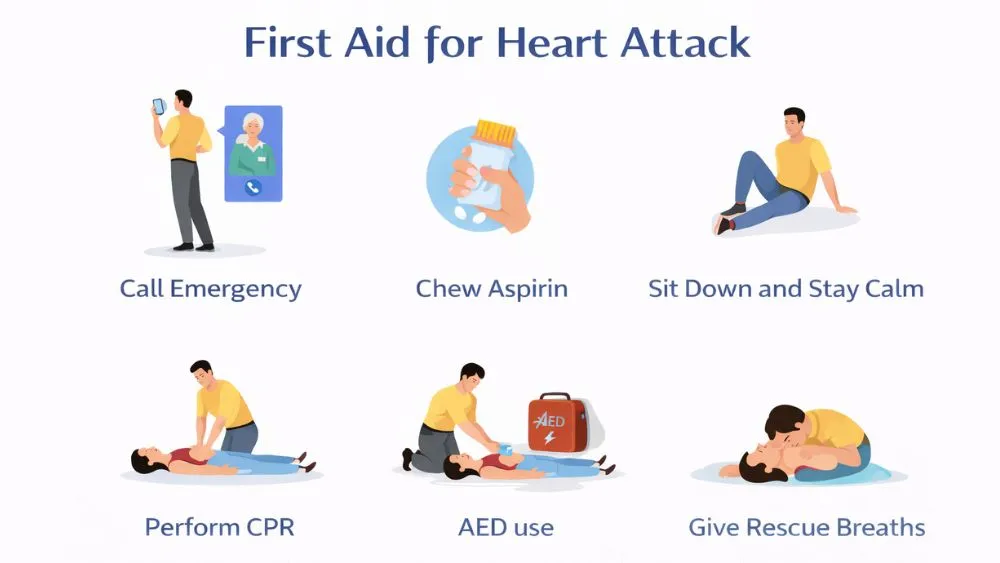
First aid for a heart attack does not require medical training. It requires fast, calm action in a specific order.
Call Emergency Services Immediately
Paramedics can begin treatment inside the ambulance by providing oxygen, aspirin, ECG monitoring, IV access, and cardiac drugs. A patient arriving by ambulance gets a faster cardiac catheterization than one who walks into the ER. The hospital receives advance notice and prepares the cath lab before the patient arrives.
Driving yourself to the hospital is dangerous. If VF (ventricular fibrillation) occurs in the car, the driver loses consciousness and car control. An ambulance carries a defibrillator. Your car does not.
Chew Aspirin (If Not Allergic)
The standard dose is 325 mg; one regular adult aspirin, chewed, not swallowed whole. Chewing gets it into the bloodstream faster. Aspirin works by blocking platelet aggregation, preventing the clot from growing larger during transport. It does not dissolve the blockage; it slows its expansion.
Do not take aspirin if you are allergic, have active bleeding, or have a confirmed aspirin sensitivity. Do not double the dose.
Sit Down and Stay Calm
Physical activity forces the heart to work harder. A heart already starved of blood cannot handle extra demand. Sitting still, ideally in a semi-reclined position, reduces cardiac workload and oxygen demand. This alone slows the rate of muscle damage while waiting for help.
Use Nitroglycerin if Prescribed
Nitroglycerin dilates blood vessels and temporarily relieves chest pressure. It does not fix the blockage. If you have nitroglycerin prescribed by a doctor, one tablet under the tongue is appropriate. Do not use someone else’s nitroglycerin. Do not give it if blood pressure is low because it can cause a dangerous drop.
Perform CPR if the Person Collapses
If the person becomes unresponsive and stops breathing normally, begin CPR immediately.
- Compression-only CPR: Push hard and fast on the center of the chest. Rate: 100–120 compressions per minute. Depth: at least 2 inches. Let the chest fully rise between compressions.
- AED use: If an automated external defibrillator is available, turn it on and follow its voice instructions. AEDs are designed for untrained users. They deliver a shock only when needed.
CPR does not restart the heart. It manually pumps blood to the brain and keeps organs alive until a defibrillator or medical team arrives.
Is There a Fast Way to Stop a Heart Attack?
There is no fast way to stop a heart attack at home.
The cough CPR myth
The claim is that forceful coughing during a heart attack can maintain circulation. This is false for bystander use. The American Heart Association does not recommend cough CPR. A person at home attempting to cough through a heart attack loses time they should spend calling for help.
Herbal remedies, deep breathing, and cold water
None of these herbal remedies or deep breathing restores coronary blood flow. None opens a blocked artery. None reduces troponin release. They cause a delay.
The only fast way to stop a heart attack from causing maximum damage is to get a paramedic on scene within minutes and a cardiologist in the cath lab within 90 minutes.
Every 10-minute delay in calling emergency services during a STEMI increases mortality by approximately 3.3%.
Hospital Treatments That Actually Stop a Heart Attack
Emergency Angioplasty (PCI)
PCI (percutaneous coronary intervention) is the gold standard method to treat heart attacks. A cardiologist inserts a thin wire through the wrist or groin artery, reaches the blocked coronary artery, inflates a small balloon to crush the clot open, and places a metal stent to keep it open permanently.
When done within 90 minutes of hospital arrival, PCI reduces STEMI mortality from around 30% (untreated) to approximately 5–7%. Nothing else works fast enough to treat heart attacks other than PCI.
Thrombolytic Therapy
When a cath lab is not reachable within 120 minutes (in rural hospitals or remote areas), thrombolytics (clot-busting drugs like alteplase or tenecteplase) dissolve the clot chemically. Less effective than PCI but life-saving when distance makes surgery impossible.
Oxygen, Anticoagulants, Beta-Blockers
- Oxygen: Given only if blood oxygen drops below 94%. Routine oxygen in uncomplicated MI is no longer recommended by current guidelines.
- Anticoagulants (heparin) prevent new clots from forming while the blocked artery is treated.
- Beta-blockers slow the heart rate and reduce oxygen demand on damaged muscle. Given after stabilization to reduce arrhythmia risk and long-term remodeling.
Proven Tips to Prevent Heart Attack
Proven tips to prevent heart attacks focus on the five modifiable risk factors responsible for 80% of premature cardiac events.
Control Blood Pressure
Keep systolic blood pressure below 130 mmHg. Hypertension damages artery walls, making plaque buildup faster and clot formation more likely. Every 10 mmHg reduction in systolic blood pressure cuts heart attack risk by about 20%.
Lower LDL Cholesterol
Target LDL below 70 mg/dL in high-risk individuals. High-intensity statins (atorvastatin 40–80 mg) reduce LDL by 40–60% and cut heart attack risk by 25–35%. Diet changes alone reduce LDL by about 10–15% but insufficient for most high-risk patients.
Stop Smoking
Smoking accelerates plaque formation and increases clot risk by raising fibrinogen levels. Quitting reduces heart attack risk by 50% within one year. After 15 years of not smoking, the risk matches that of someone who never smoked.
Manage Diabetes
Blood sugar control directly affects artery health. HbA1c above 7% accelerates coronary artery disease progression. Metformin reduces cardiovascular events in type 2 diabetics. SGLT2 inhibitors (empagliflozin, dapagliflozin) have shown specific heart protection beyond blood sugar control in clinical trials.
Maintain Healthy Weight
A BMI above 30 increases cardiac workload, raises blood pressure, and worsens insulin resistance. Even a 5–10% reduction in body weight meaningfully improves blood pressure, LDL, and blood sugar, three of the five main risk factors simultaneously.
8 Ways to Reduce Your Risk of Heart Failure After a Heart Attack
These 8 ways to reduce your risk of heart failure apply once a heart attack has already occurred. Post-MI management prevents the damaged heart from weakening further.
- Cardiac rehabilitation: Structured supervised exercise and education. Reduces recurrence risk by 25% and mortality at 5 years. The most underused evidence-based intervention in cardiology.
- Take prescribed medications consistently: Stopping beta-blockers, ACE inhibitors, or antiplatelet drugs within 12 months of a heart attack raises recurrence risk significantly.
- Monitor blood pressure daily: Post-MI patients target below 130/80 mmHg. Home monitoring catches spikes early before they cause another event.
- Limit sodium intake: Below 1,500 mg per day if signs of heart failure (ankle swelling, breathlessness) are present. Excess sodium causes fluid retention and increases heart’s workload.
- Exercise safely under supervision: 30 minutes of moderate activity five days per week. Start only after cardiac clearance. Unsupervised high-intensity exercise within 6 weeks of MI carries real risk.
- Avoid alcohol excess: More than 1–2 drinks per day raises blood pressure, triggers arrhythmias, and weakens heart muscle over time.
- Manage stress: Chronic stress raises cortisol and adrenaline, both of which increase blood pressure and clotting tendency. Evidence supports mindfulness, cognitive behavioral therapy, and structured relaxation.
- Attend follow-up appointments: Echocardiograms at 6–12 weeks post-MI assess ejection fraction (how well the heart pumps). If it drops below 40%, additional medications (aldosterone antagonists) are added.
6 Best Exercises for Heart Health
6 best exercises for heart health that cardiologists actually recommend:
- Brisk walking: 30 minutes, 5 days per week. Proven to reduce blood pressure and LDL. Accessible to almost everyone, including recent MI patients.
- Swimming: low joint stress, full cardiovascular load. Ideal for patients with arthritis or obesity, limiting land exercise.
- Cycling: Stationary or outdoor. Effective for LDL reduction and blood pressure control. One of the lowest injury-risk aerobic options.
- Light resistance training: Two sessions per week using moderate weights. Builds muscle mass, improves insulin sensitivity, and reduces abdominal fat. Cleared for most post-MI patients after 6 weeks.
- Yoga: Reduces cortisol, lowers resting blood pressure, and improves heart rate variability. Yoga reduces systolic blood pressure by an average of 4.9 mmHg in cardiovascular patients.
- Interval walking (doctor-approved): Alternating 3 minutes of brisk walking with 3 minutes of slow walking. Interval walking improves aerobic capacity 20% more than continuous moderate walking in cardiac patients.
Warning Signs You Should Never Ignore
- Chest pressure lasting more than 10 minutes, not sharp pain, but heaviness or tightening
- Pain spreading to the jaw, left arm, or upper back
- Cold sweat appearing suddenly without obvious cause
- Shortness of breath at rest with no respiratory illness
- Sudden nausea with upper body discomfort
These signs together demand emergency services. Any one of them alone with no obvious cause deserves at a minimum a same-day medical evaluation.
When to Go to the ER Immediately
- Chest pain that does not resolve in 5 minutes
- Sudden collapse or near-fainting
- Severe breathlessness without exertion
- Confusion, slurred speech, or sudden weakness alongside chest discomfort
Do not wait. Do not call a family member first. Call emergency services directly.
FAQs on How to Stop a Heart Attack
Can you stop a heart attack in 30 seconds?
No. Nothing stops a heart attack in 30 seconds. The blockage requires medical equipment to open, specifically a balloon catheter in a cath lab. The 30-second timeframe circulating online refers to cough CPR, which the American Heart Association explicitly does not recommend for home use. Call 911 instead.
Does coughing stop a heart attack?
No. Cough CPR is not approved for bystander use by any major cardiac organization. It was studied in monitored hospital settings with supervised patients. In an unsupervised home setting, forceful coughing during a heart attack delays the emergency call that actually saves lives.
Can aspirin stop a heart attack?
No, but it limits damage. Aspirin 325 mg chewed prevents the clot from growing larger. It does not dissolve the existing blockage or restore blood flow. It buys time. Without emergency PCI or thrombolytics, aspirin alone does not save the heart muscle.
Can you survive without treatment?
Sometimes. Small, spontaneously resolving blockages, usually in NSTEMI, occasionally normalize. But waiting for spontaneous resolution carries a 30% untreated mortality risk for STEMI. Surviving without treatment does not mean recovering without damage, scarring, and heart failure.
What is the fastest treatment?
Emergency PCI (angioplasty with a stent) is the fastest and most effective treatment. Done within 60–90 minutes of hospital arrival, it restores blood flow and stops ongoing muscle death. No medication matches its speed or effectiveness for STEMI.
Can lifestyle changes stop one in progress?
No. Lifestyle changes prevent future events, but they do not reverse an active blockage. A heart attack in progress requires physical removal or dissolution of the clot. Diet and exercise changes take weeks to months to affect plaque and clot risk.
Is nitroglycerin enough to stop a heart attack?
No. Nitroglycerin dilates blood vessels and reduces chest pain temporarily. It does not open a blocked artery. Patients sometimes feel relief and delay calling for help, that delay is dangerous. Nitroglycerin manages symptoms. It does not treat the cause.
Can heart attacks stop on their own?
Rarely. Coronary spasm (a temporary artery cramp without a fixed clot) can resolve spontaneously. But a true thrombotic MI (clot blockage) rarely clears without treatment. The heart muscle continues dying during any spontaneous resolution window. Assuming self-resolution and waiting is a leading cause of delayed care and preventable death.







Leave a Comment