



The types of heart attacks determine how fast doctors need to act, which procedures are used, and what the next 10 years of a patient’s cardiac health look like.
A STEMI can kill within an hour without emergency surgery. An NSTEMI has symptoms so mild that you may blame a bad night’s sleep. A silent heart attack shows no symptoms until an ECG weeks later reveals the damage.
The types of heart attacks differ based on which artery is blocked, how completely it is blocked, and which part of the heart takes the hit. Every type of heart attack carries specific risks. Those risks carry specific responses. And those responses, done fast and done right, are what keep people alive.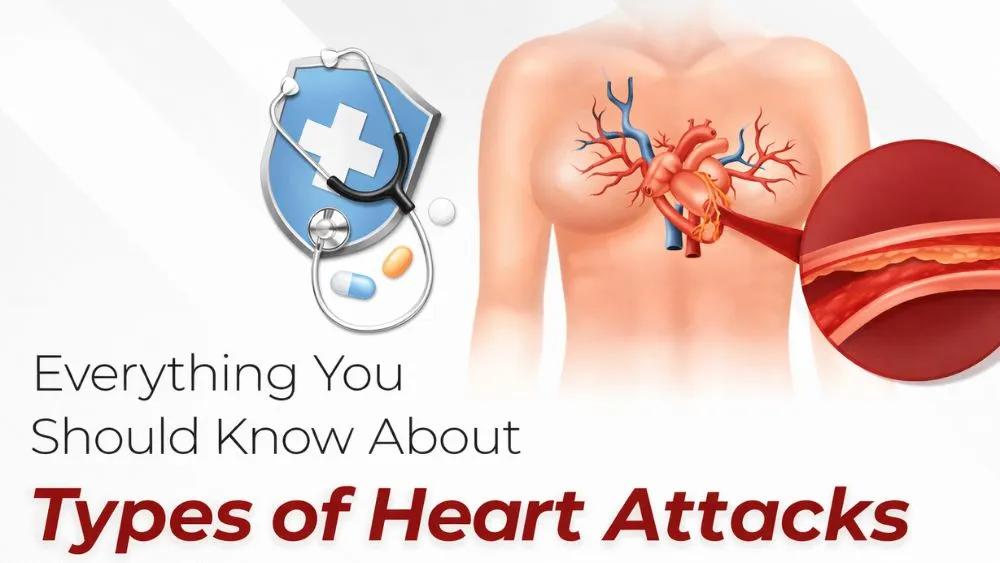
How Doctors Diagnose Different Types of Heart Attacks
Diagnosing different types of heart attacks starts in the first 10 minutes of hospital arrival. Three tools do most of the work.
ECG Findings
The ECG reads the heart’s electrical activity in real time. Different types of heart attacks leave different electrical signatures:
- ST elevation: The ST segment rises above the baseline. This signals a complete blockage. It is the defining feature of a STEMI and demands immediate intervention.
- ST depression: The ST segment dips below baseline. This suggests partial blockage or severe demand on the heart without full occlusion. Seen in NSTEMI and unstable angina.
- T-wave inversion: The T wave flips downward. This indicates ischemia (areas of heart muscle struggling without enough blood). Can appear in both NSTEMI and stable coronary disease.
A normal ECG does not rule out a heart attack. NSTEMI, in particular, can present with a completely clean ECG in the first hour.
Cardiac Biomarkers
When heart muscle cells die, they release proteins into the blood. Doctors measure these to confirm damage.
- Troponin (high-sensitivity): Troponin levels rise within 1–3 hours of heart muscle injury and stay elevated for 10–14 days. A rising troponin level on two blood tests taken 3 hours apart confirms myocardial infarction.
- CK-MB: An older marker, less specific than troponin. Still used when troponin testing is unavailable or to time a second heart attack (CK-MB normalizes faster than troponin, so a new rise signals a new event).
Imaging
- An echocardiogram uses sound waves to show heart wall movement. Damaged areas move poorly or not at all. Detects which wall is affected and how much function is lost.
- Coronary angiography is the most direct tool. A thin tube goes through the wrist or groin into the coronary arteries. Dye injected under X-ray reveals exactly where the blockage is and how complete it is.
STEMI (ST-Elevation Myocardial Infarction)
STEMI is the most immediately life-threatening of all types of heart attacks. It is the one where every minute counts, literally.
What Happens in a STEMI?
A blood clot completely blocks a coronary artery. Zero blood flows past the blockage. The heart muscle fed by that artery starts dying within 20 minutes of the blockage. After 6 hours without treatment, the damage becomes largely irreversible.
| Cardiologists use the phrase “door-to-balloon time” (the time from hospital arrival to when the blocked artery reopens). International guidelines require this under 90 minutes. Every 30-minute delay in STEMI treatment increases 1-year mortality by roughly 7.5%. |
Symptoms of STEMI
Symptoms of STEMI tend to be severe and hard to ignore:
- Crushing chest pressure, not a sharp pain, but a heavy, squeezing weight in the center of the chest
- Pain spreading to the left arm, jaw, or back
- Drenching cold sweats
- Shortness of breath at rest
- Nausea or vomiting
Symptoms of STEMI can occasionally be milder in diabetics and older adults due to nerve damage blunting pain signals. This is why the ECG matters regardless of symptom intensity.
How STEMI Is Treated
- Emergency PCI (percutaneous coronary intervention): A cardiologist threads a thin wire through the blocked artery, inflates a balloon to open it, and places a metal stent to keep it open. This is the preferred treatment when available.
- Thrombolytics (clot-busting drugs) are used when a cath lab is not reachable within 120 minutes. Drugs like alteplase dissolve the clot chemically. Less effective than PCI, but it saves lives when distance makes surgery impossible.
NSTEMI (Non-ST Elevation Myocardial Infarction)
NSTEMI is a partial blockage. The artery narrows severely but does not close completely. Blood still trickles through. Heart muscle damage occurs, but typically less than in STEMI.
What Happens in an NSTEMI?
A clot partially blocks an artery. The heart muscle downstream gets a reduced blood supply. Some cardiac cells die. The troponin level rises, confirming muscle injury, but the ECG does not show ST elevation.
| NSTEMI does not reflect on the ECG, so it is easier to miss or delay treating. |
Symptoms of a NSTEMI
Symptoms of an NSTEMI are often milder and easier to dismiss:
- Chest discomfort rather than crushing pain, a tightness or ache rather than the severe pressure of STEMI
- Unusual fatigue that arrives without a physical reason
- Mild breathlessness with light activity
- Atypical symptoms, such as in women, elderly patients with diabetics, often present with only jaw pain, back discomfort, nausea, or extreme tiredness
Symptoms of an NSTEMI are subtle, which makes it dangerous in the long term. Patients who ignore mild NSTEMI symptoms and delay care have significantly higher rates of recurrent heart attacks within 30 days.
Treatment Approach for NSTEMI
- Blood thinners: Heparin and antiplatelet agents (aspirin plus ticagrelor or clopidogrel) stabilize the clot and prevent it from expanding
- Cardiac catheterization: High-risk NSTEMI patients go to the cath lab within 24 hours. Lower-risk patients within 72 hours.
- Risk-based invasive management: Doctors use GRACE or TIMI scores to calculate risk and decide timing. High scores mean earlier intervention.
Unstable Angina (Pre-Heart Attack Condition)
Unstable angina sits just below a full myocardial infarction on the danger scale. The artery narrows severely (sometimes the same way as in NSTEMI), but troponin stays normal. No heart muscle has died yet.
| It is the body’s warning signal that a full heart attack is close. Unstable angina patients who leave the hospital without treatment face up to a 20% risk of full MI within 30 days. |
It requires urgent hospital evaluation, the same antiplatelet medications used in NSTEMI, and often coronary angiography to find the narrowed artery before it closes completely.
Silent Heart Attack
A silent heart attack is one of the most underreported types of heart attacks. The coronary blockage happens, and the muscle damage occurs. But the person feels little or nothing, maybe some unusual tiredness or mild upper body discomfort that passes.
Silent heart attacks are most common in people with diabetes (nerve damage reduces pain perception) and older adults. Silent heart attacks account for roughly 45% of all MIs and carry a similar long-term mortality risk to symptomatic ones.
They get found during routine ECGs (a pattern called Q waves) or during echocardiograms, showing a section of the heart wall that moves poorly for no known reason. The damage is already done.
How to Treat Different Kinds of Heart Attacks
How to treat different kinds of heart attacks follows a layered approach, such as immediate stabilization, fixing the blockage, then long-term prevention.
Immediate Emergency Care
- Aspirin 300 mg chewed: Starts working within minutes to prevent the clot from growing. Given before hospital arrival if possible.
- Oxygen: Only if blood oxygen drops below 94%. Routine oxygen in uncomplicated MI no longer recommended by current guidelines.
- Nitroglycerin: Given under the tongue to dilate blood vessels and reduce chest pain. Not used if blood pressure is low.
Revascularization
- PCI: Balloon and stent procedure, preferred for STEMI and high-risk NSTEMI
- CABG (coronary artery bypass grafting): Open heart surgery to reroute blood flow around multiple blocked arteries. Used when PCI cannot fix the blockage anatomy effectively.
Medications After Stabilization
How to treat different kinds of heart attacks goes beyond the acute phase involves four core drug classes:
- Beta-blockers (metoprolol, carvedilol) slow the heart rate and reduce strain on the healing muscle
- ACE inhibitors (ramipril, lisinopril) reduce blood pressure and prevent the heart from remodeling poorly after damage
- Statins (atorvastatin 40–80 mg) stabilize plaques in other arteries and reduce recurrence risk by up to 25%
- Antiplatelets: dual antiplatelet therapy (aspirin plus a P2Y12 inhibitor) for 12 months post-stent to prevent re-clotting
Recovery and Long-Term Outlook by Type
- STEMI carries higher immediate risk. The 30-day mortality without treatment can reach 30%. With prompt PCI, in-hospital mortality drops to around 5–7%.
- NSTEMI carries lower immediate risk but significant long-term recurrence risk. Up to 10% of NSTEMI patients have another event within 12 months without proper secondary prevention.
- Cardiac rehabilitation: Structured exercise and education programs after any MI reduce recurrence risk by 25% and improve survival at 5 years. Most patients skip it. Those who complete it consistently do better.
FAQs About Types of Heart Attacks
What is the most dangerous type of heart attack?
STEMI is the most immediately dangerous of all types of heart attacks. A complete coronary blockage destroys full-thickness heart muscle within 6 hours without treatment. Anterior STEMI (blocking the left anterior descending artery) carries the highest mortality because it affects the largest muscle mass.
Can NSTEMI turn into STEMI?
Yes. An unstable partial blockage in NSTEMI can progress to complete occlusion, converting to STEMI without warning. This is why high-risk NSTEMI patients go to the cath lab within 24 hours to fix the lesion before it closes entirely.
Is unstable angina a heart attack?
No. Unstable angina causes no measurable troponin rise or confirmed muscle death. But it shares the same blocked-artery mechanism as NSTEMI, and it precedes full MI. Cardiologists treat it with the same urgency as NSTEMI.
Can you survive a silent heart attack?
Yes. Most people with silent heart attacks survive because they never knew it happened. The danger is the undetected damage; weakened heart muscle increases the risk of a second, symptomatic MI. Survival rates after silent MI are similar to symptomatic MI when managed properly.
Are symptoms different in women?
Yes. Women are significantly more likely to present with nausea, jaw or upper back pain, and extreme fatigue rather than classic chest pressure. Symptoms of an NSTEMI in women are especially atypical, leading to longer delays before diagnosis and higher rates of missed MIs in emergency rooms.
Do all heart attacks need surgery?
No. STEMI always requires either PCI or thrombolytics. NSTEMI uses PCI only in moderate-to-high-risk cases. Low-risk NSTEMI and unstable angina are often managed with medications alone. Silent heart attacks discovered weeks later receive only medical management.
Can heart attacks happen without chest pain?
Yes. Around 30% of MIs present without any chest pain. Diabetics, women over 65, and patients with prior bypass surgery are most likely to have painless presentations. The mechanism is diabetic neuropathy and altered pain perception.
How fast must STEMI be treated?
PCI must open the artery within 90 minutes of hospital arrival. Beyond 12 hours, emergency PCI offers minimal benefit unless the patient remains symptomatic. The first 60 minutes produce the greatest muscle-saving impact.
Is NSTEMI less serious?
Short-term, yes. Long-term, no. NSTEMI 1-year mortality equals STEMI in some studies due to higher rates of recurrence, multiple vessel disease, and older patient populations. Calling NSTEMI “minor” is a clinical mistake that leads to under-treatment.
Can lifestyle prevent all types?
No, but it prevents most. Around 80% of premature heart disease is attributable to modifiable risk factors: smoking, hypertension, high LDL cholesterol, diabetes, and physical inactivity. Genetic predisposition accounts for 20–30% of cases and cannot be fully offset by lifestyle alone.





Leave a Comment