

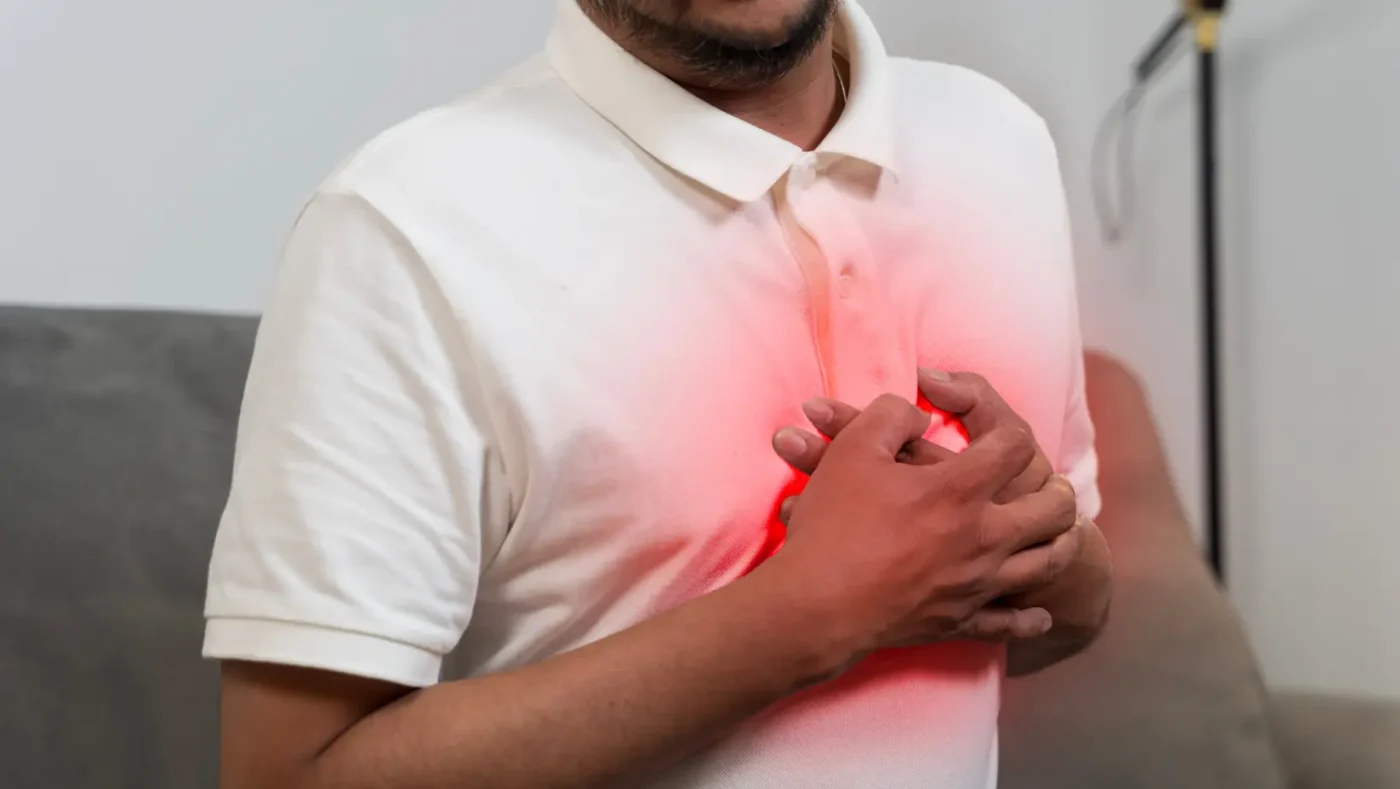

Heart disease is the number one cause of death in the United States. The American Heart Association reports that someone in the US has a heart attack every 40 seconds. Most deaths from heart attacks happen within the first hour, before the person even reaches a hospital. Knowing the signs early is survival.
The experience of a heart attack varies widely between people. Someone with diabetes feels fatigue and nausea. A post-menopausal woman feels jaw pain and breathlessness. An older man feels crushing chest pressure. The signal is different, but the cause is the same, and the window for effective treatment is narrow.
If you want to understand your personal cardiac risk (blood pressure patterns, cholesterol levels, family history assessment), speaking with a cardiologist is the most direct step.
Symptoms of Heart Attack
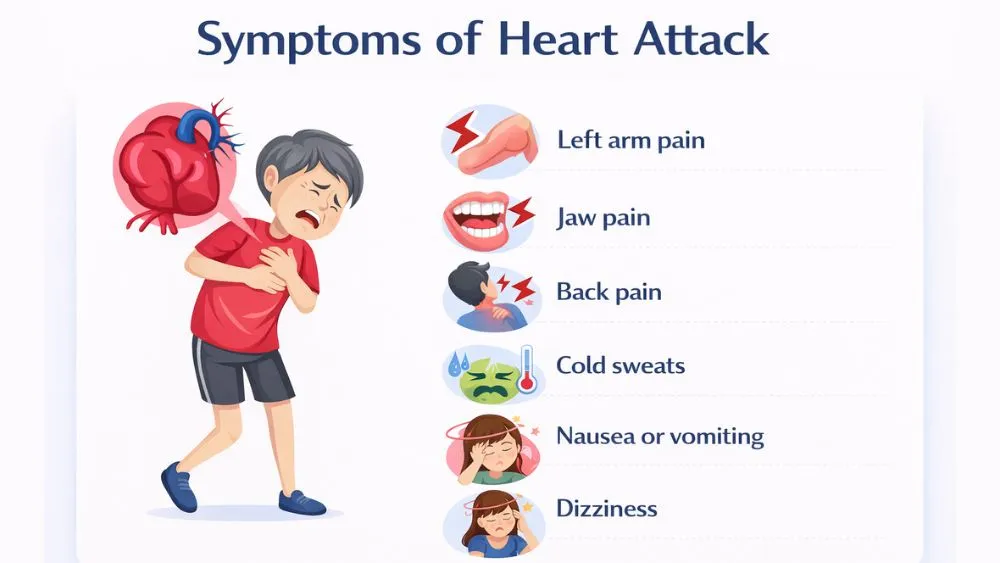
Symptoms of a heart attack are often subtle at first and easy to blame on stress, bad sleep, or a heavy meal.
Chest Symptoms
The most common heart attack symptom is pressure in the center of the chest, not a sharp stab, but a heavy squeezing weight. Like someone placed a brick on your sternum and left it there. For some, a heart attack symptom feels like a crushing sensation, the chest being squeezed from the inside.
A sharp, knife-like chest pain is less likely to be cardiac. That kind of pain is more associated with muscle strain or anxiety. The heart attack pain is usually pressure-based, not sharp.
Upper Body Symptoms
The heart attack pain travels because the heart shares nerve pathways with other body parts. The brain sometimes cannot tell exactly where the pain signal is coming from, so you feel it in the arm, jaw, or back instead.
- Left arm pain: A radiating ache that runs from the shoulder down to the elbow or wrist
- Jaw pain: Often mistaken for a toothache; the pain sits in the lower jaw or spreads up the neck
- Back pain: Dull ache between the shoulder blades, more common in women than men
Systemic Symptoms
The body reacts to a heart attack at the systemic level.
- Cold sweats: Sudden, clammy sweating with no obvious reason, even in a cool room
- Nausea or vomiting: The stomach does not cause this; it is a nervous system response to cardiac stress
- Dizziness: Reduced blood flow to the brain makes you feel lightheaded or unsteady
Women are significantly more likely to experience these systemic symptoms without classic chest pressure. It is one reason women are more often misdiagnosed in emergency rooms.
Shortness of Breath Heart Attack
Shortness of breath and heart attack symptoms are among the most misread signs.
This breathlessness feels like sudden air hunger, like your body suddenly cannot pull in enough oxygen, even at rest. It is not gradual but happens instantly.
It can show up with or without chest pain. In fact, shortness of breath alone (with no chest symptoms) is a documented sign of a heart attack, especially in diabetic patients and older adults.
It sometimes gets worse when lying flat. If you wake up at night unable to breathe comfortably and have to sit up to catch your breath (orthopnea), it signals that the heart is struggling to pump effectively.
| Do not assume breathlessness is always respiratory. If it arrives suddenly and is paired with sweating or fatigue, treat it as cardiac until proven otherwise. |
10 Warning Signs of a Heart Attack
The 10 warning signs of a heart attack below cover the full range, from the obvious to the ones that get missed every day:
- Chest pressure or pain: Heaviness, tightening, or squeezing in the center
- Pain spreading to arm or jaw: Left arm is most common, but right arm and jaw also occur
- Shortness of breath: Sudden and unexplained, at rest or with minimal activity
- Cold sweat: Clammy, sudden, unrelated to heat or exercise
- Nausea: Stomach discomfort without a food-related cause
- Lightheadedness: Sudden dizziness or near-fainting
- Unusual fatigue: Extreme tiredness that hits without exertion, lasting hours or days beforehand
- Sudden weakness: Arms or legs feel heavy and difficult to move
- Anxiety or sense of doom: A sudden, overwhelming feeling that something is seriously wrong
- Symptoms lasting more than 5 minutes: This threshold separates a heart attack from most other causes
Heart Attack Symptoms at Night
Heart attack symptoms at night catch you off guard because you wake up confused, half-asleep, and more likely to dismiss what you feel.
Waking from sleep with chest pressure is a warning sign of an early heart attack. The heart’s demand for blood does not stop at night. In the early morning hours (roughly 6 AM to noon), the risk of a heart attack is statistically higher due to cortisol spikes and blood pressure surges after waking.
Night-specific symptoms include:
- Waking up with chest tightness or pain
- Night sweats: drenching sweats unrelated to room temperature
- Sudden breathlessness that forces you to sit upright
- Silent or atypical symptoms; no pain at all, just a vague unwell feeling
Silent heart attacks are particularly dangerous at night. The person sleeps through a cardiac event and does not know until an ECG weeks later reveals the damage. Diabetics and older adults are most vulnerable to silent presentations.
If you wake up feeling wrong (heavy chest, breathless, sweating), do not go back to sleep and hope it passes. Call emergency services.
Types of Heart Attacks
The types of heart attacks differ based on which artery is blocked and by how much. That distinction matters for treatment.
STEMI (ST-Elevation Myocardial Infarction)
A complete blockage of a coronary artery. Blood flow stops entirely to a section of the heart muscle. This is the most severe type. The affected muscle begins dying within 20–40 minutes of the blockage. Treatment requires emergency angioplasty, ideally within 90 minutes of symptom onset.
NSTEMI (Non-ST-Elevation Myocardial Infarction)
NSTEMI is a partial coronary blockage. Blood flow is severely reduced but not completely cut off. Still life-threatening. Symptoms are often less dramatic, which is why you may wait longer before seeking help. It requires urgent hospital care and medication to prevent a full STEMI.
Silent Heart Attack
A silent heart attack has no dramatic heart attack symptoms. You may feel mild discomfort, unusual fatigue, or nothing at all, but the heart muscle still sustains damage. Silent heart attacks account for roughly 45% of all heart attacks. You may discover it during routine ECGs or stress tests, sometimes months later.
When to Call Emergency Services
- Chest pain lasting more than 5 minutes requires emergency services immediately.
- Shortness of breath with sweating, especially when it comes on at rest needs medical evaluation.
- Sudden collapse or loss of consciousness is a medical emergency, and begin CPR if the person is unresponsive and not breathing normally.
| Do not drive yourself to the hospital. Paramedics can begin treatment in the ambulance and alert the hospital ahead of arrival. That head start saves heart muscle.Do not wait to see if symptoms improve. Every minute of delay during a STEMI results in approximately 1.9 million cardiac cells dying. That damage is permanent. |
FAQs on What a Heart Attack Feels Like
Does a heart attack always feel like severe chest pain?
No. Around 30% of heart attacks present without significant chest pain. Jaw pain, back pain, nausea, and breathlessness are documented standalone presentations, especially in women, diabetics, and adults over 75.
Can a heart attack feel like indigestion?
Yes. The vagus nerve connects the heart and the stomach, so cardiac events trigger identical gut sensations. A burning, full feeling in the upper abdomen during physical activity or stress is a red flag, not just reflux.
How long does heart attack pain last?
More than 5 minutes. Angina (temporary chest pain from reduced blood flow) usually eases within 1–3 minutes of rest. Heart attack pain persists, often intensifying. Pain that does not resolve within 5 minutes needs emergency care, not antacids.
Can heart attack symptoms come and go?
Yes. Unstable angina and NSTEMI both produce intermittent symptoms. The pain or pressure appears, fades, and returns. This pattern signals a partial blockage that can become a full STEMI without warning.
Is shortness of breath a warning sign?
Yes. Sudden breathlessness at rest, especially with sweating or upper body discomfort, is a cardiac warning sign. The American Heart Association lists it as one of the primary symptoms of heart attack, independent of chest pain.
Do women have different symptoms?
Yes. Women are significantly more likely to experience nausea, jaw or back pain, fatigue, and breathlessness as their dominant symptoms, often without classic chest pressure. This atypical pattern leads to more missed diagnoses in women under 65.
Can you have a heart attack without chest pain?
Yes. Silent heart attacks and NSTEMI presentations occur without any chest pain in a substantial number of cases. Fatigue, breathlessness, or nausea alone can be the only signs.
Does back pain mean heart attack?
Not always, but upper back pain between the shoulder blades, especially in women, combined with any other symptom like sweating or nausea, warrants immediate evaluation. Isolated lower back pain is unlikely to be cardiac.
Is anxiety a symptom of heart attack?
Yes. A sudden overwhelming sense of doom or dread, with no obvious psychological trigger, is a documented cardiac symptom. The nervous system responds to cardiac distress with an alarm signal. If it arrives alongside physical symptoms, treat it as an emergency.









Leave a Comment