


An itchy scalp affects roughly 1 in 4 people at some point, and most cases don’t need a dermatologist. The right home remedies for an itchy scalp can stop the itch within days.
The cause determines the fix. Dry scalp, dandruff, product buildup, and fungal overgrowth all cause itching, but they respond to different treatments.
Most cases of scalp itch clear up with consistent, correctly matched treatment. Correctly matched treatment, using a dry scalp remedy on dandruff, or an antifungal on plain dryness, delays results. Identify the cause first, then apply the remedy.
This article covers 10 evidence-based remedies, what’s actually causing your itch, and when to stop treating it at home.
How to Relieve Itchy Scalp Naturally
Mild scalp itching responds well to moisturizing oils, anti-fungal ingredients, pH-balancing rinses, and proper scalp hygiene. You may get rid of itchy scalp within 1–2 weeks of consistent home treatment.
Home remedies work well for:
- Dry scalp from weather or dehydration
- Mild dandruff (Malassezia fungal overgrowth)
- Product buildup or residue irritation
- Sensitivity to harsh shampoo ingredients
See a doctor instead if:
- Itching continues beyond 2 weeks of home treatment
- You notice thick yellow or white crusts
- Patches of hair are falling out
- Your scalp is bleeding or deeply inflamed
Knowing how to relieve itchy scalp naturally starts with identifying which of these categories you’re in.
10 Home Remedies for Itchy Scalp

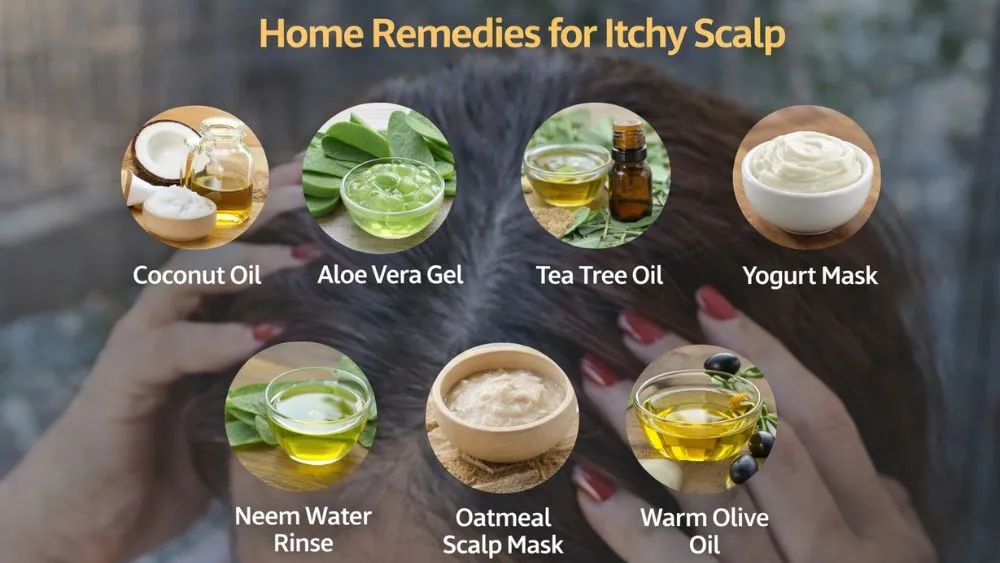
The 10 home remedies for itchy scalp below are organized by the cause they target.
1. Coconut Oil — Dry Scalp Itching Remedy
Coconut oil contains lauric acid, which penetrates the hair shaft and scalp skin barrier faster than most oils. It reduces transepidermal water loss, meaning your scalp holds onto moisture longer.
This is one of the best dry scalp itching remedies available without a prescription.
How to apply:
- Warm 1–2 tablespoons of virgin coconut oil between your palms
- Massage into the scalp (not just the hair) for 5 minutes
- Leave for 30–60 minutes, then wash out with a mild shampoo
Apply 2–3 times per week. Daily use causes buildup if you have fine hair.
2. Apple Cider Vinegar Rinse
The scalp’s natural pH is between 4.5 and 5.5. Many shampoos are alkaline (pH 6–9), which disrupts that balance and creates an environment where bacteria and fungus thrive, causing itch.
ACV has a pH of around 3. Diluted properly, it restores scalp pH and removes alkaline buildup left by shampoos.
Dilution ratio: 1 part ACV to 1 part water. Apply after shampooing, leave 2–3 minutes, rinse thoroughly. Don’t use undiluted because it’s acidic enough to irritate already-sensitive skin.
3. Aloe Vera Gel
Aloe vera contains acemannan, which reduces histamine release in the skin. Histamine is what causes the itch signal. Reducing it at the source calms the itch without numbing the scalp.
Apply fresh aloe vera gel (straight from a leaf, not processed gel with alcohol) directly to the scalp. Leave for 20 minutes. Rinse with cool water. Works well for itching caused by sunburn, irritation, or sensitivity.
4. Tea Tree Oil (Diluted)
Tea tree oil contains terpinen-4-ol, a compound that kills Malassezia globosa, the fungus responsible for dandruff and seborrheic dermatitis. 5% tea tree oil shampoo reduces dandruff by 41% compared to a placebo.
Correct dilution: 4–5 drops of tea tree oil in 1 tablespoon of carrier oil (coconut or jojoba). Never apply undiluted because it causes chemical burns on sensitive scalp skin.
This is one of the most evidence-backed home remedies for itchy scalp tied to dandruff.
5. Yogurt Mask — Itchy Scalp and Dandruff Home Remedies
Plain yogurt contains Lactobacillus bacteria and lactic acid. The lactic acid gently exfoliates dead skin from the scalp without harsh scrubbing. The live cultures compete with Malassezia fungus for scalp territory.
This makes yogurt particularly effective as one of the itchy scalp and dandruff home remedies when both dryness and mild dandruff are present.
Apply full-fat plain yogurt to the scalp. Leave for 20–30 minutes. Rinse with cool water. Warm water curdles the yogurt and makes rinsing harder.
6. Baking Soda Exfoliation — Use Sparingly
Baking soda (pH 9) physically removes flakes and product buildup. But it’s alkaline, which temporarily disrupts scalp pH. This is why you should use baking soda occasionally, once every 2–3 weeks at most.
Mix 1 tablespoon of baking soda with enough water to make a paste. Massage gently into the wet scalp for 60 seconds. Rinse immediately. Follow with an ACV rinse to restore pH balance. Skip this entirely if your scalp is already cracked or bleeding.
7. Neem Water Rinse
Neem contains nimbidin and nimbin, compounds with antimicrobial and antifungal properties that specifically target scalp fungi. In Ayurvedic medicine, neem is used specifically for scalp infections.
Boil 10–15 neem leaves in 2 cups of water for 10 minutes. Cool completely. Use as a final rinse after shampooing. Don’t rinse out and let it dry on the scalp.
8. Oatmeal Scalp Mask
Colloidal oatmeal contains avenanthramides, compounds that directly block the nerve signals responsible for itch. The FDA classifies colloidal oatmeal as a skin protectant for good reason. It’s one of the few ingredients with clinical evidence for itch reduction in sensitive skin.
Blend plain oats into a fine powder. Mix with enough water to form a paste. Apply to scalp, leave 15–20 minutes, rinse with cool water. Especially useful for itching caused by eczema or contact dermatitis on the scalp.
9. Lemon Juice (Diluted)
Lemon juice has a pH of 2–3 and contains citric acid, which has mild antifungal properties. It reduces dandruff flaking and rebalances an overly alkaline scalp.
Important caution: Never apply to a cracked, broken, or bleeding scalp. Citric acid on broken skin stings severely and delays healing.
Dilute 1 part fresh lemon juice with 2 parts water. Apply to scalp, leave 5 minutes, rinse. Use once a week because more frequent use dries the scalp out further.
10. Warm Olive Oil Massage
Olive oil contains squalene and oleic acid, which mimic the scalp’s natural sebum. Warm oil penetrates the outer skin layer faster than cold oil, making the massage more effective for restoring moisture in severely dry scalps.
Warm 2 tablespoons of olive oil to body temperature (test on your wrist). Massage into scalp for 5–10 minutes. The massage motion increases blood flow to scalp follicles, that’s an additional benefit beyond the oil itself.
Dry Scalp Itching Remedy vs. Dandruff — Know the Difference
You must know the difference between a dry scalp and dandruff because getting this wrong means using the wrong remedy for weeks. A dry scalp itching remedy like coconut oil works great for dryness. Apply it to active dandruff, and it feeds the fungus.
The two conditions look similar but require opposite approaches.
| Dry Scalp | Dandruff | |
| Flake appearance | Small, white, dry | Larger, oily, yellowish |
| Scalp feel | Tight, sometimes flaky without oil | Greasy or waxy |
| Cause | Lack of moisture | Malassezia fungal overgrowth |
| Best remedy | Coconut oil, olive oil, oatmeal mask | Tea tree oil, ACV, zinc pyrithione shampoo |
| Worsened by | Cold weather, over-washing | Humidity, stress, oily skin |
Scalp Itching After Hair Wash Remedy
If your scalp itches specifically after washing, the shampoo (not your scalp) is the problem. This is one of the most consistently misdiagnosed causes of scalp itch.
Common causes for scalp itching after hair wash:
- Sodium lauryl sulfate (SLS) strips the scalp’s natural oil barrier completely
- Synthetic fragrance: One of the top contact allergens in hair products
- Hard water minerals: Calcium and magnesium deposits coat the scalp after rinsing
- Product residue: Silicones and heavy conditioners not fully rinsed out
Effective scalp itching after hair wash remedies:
- Switch to a sulfate-free shampoo (look for “sodium lauryl sulfate–free” on the label)
- Rinse with filtered or softened water if possible
- Use lukewarm water; hot water strips oils and triggers histamine release in scalp skin
- Apply a light oil (jojoba or argan) to the scalp 30 minutes before washing to buffer against harsh detergents
Itchy Scalp and Dandruff Home Remedies
For itchy scalp and dandruff home remedies, the goal is to reduce the Malassezia fungus population while keeping the scalp’s moisture intact.
Ranked by evidence strength:
- Tea tree oil (5% concentration): Strongest antifungal evidence
- Zinc pyrithione shampoo (Head & Shoulders) reduces Malassezia by up to 85% in 4 weeks
- Apple cider vinegar rinse rebalances pH, reduces fungal growth environment
- Yogurt mask: Mild probiotic competition with scalp fungus
- Ketoconazole shampoo (1%): Available OTC in some countries; stronger than the above
Home remedies work well for mild dandruff. If flaking is thick, persistent, and accompanied by redness, that’s seborrheic dermatitis, which needs medicated shampoo or a prescription antifungal, not just ACV.
Common Mistakes That Make Scalp Itching Worse
You may make at least one of these mistake that worsens scalp itching:
- Scratching with fingernails breaks the skin barrier, introduces bacteria, and creates inflammation that makes the itch rebound harder
- Over-washing: Daily shampooing strips the scalp’s sebum layer, triggering more dryness and itch
- Applying undiluted essential oils: Tea tree, peppermint, and eucalyptus at full concentration cause chemical irritation; always dilute
- Using heavy styling products: Waxes, gels, and dry shampoos build up on the scalp and block follicles
When to See a Doctor
Stop treating at home for an itchy scalp and seek medical care if:
- Itching continues for more than 2 weeks despite consistent home remedies for itchy scalp
- You develop thick yellow, white, or silvery crusts (may indicate psoriasis)
- Round patches of hair loss accompanied by itching could signal ringworm (tinea capitis), which needs oral antifungals
- Scalp is deeply red, swollen, or producing clear fluid
- Itching spreads to the neck, ears, or forehead
Ringworm of the scalp is contagious and won’t respond to any home treatment. It needs prescription oral medication, usually terbinafine or griseofulvin, for 4–8 weeks.
FAQs
What is the fastest way to stop an itchy scalp?
Tea tree oil diluted in coconut oil provides relief within 20–30 minutes for fungal-caused itch. For dry-scalp itch, warm olive oil massage works faster than any rinse. Both are among the most effective home remedies for itchy scalp with visible results in one application.
Can apple cider vinegar cure itchy scalp?
No, ACV reduces scalp pH and removes alkaline buildup, which reduces fungal activity and itching. It works as a consistent home remedy for itchy scalp but requires ongoing use. One rinse won’t permanently fix dandruff or chronic dryness.
Why does my scalp itch after washing hair?
Sodium lauryl sulfate (SLS) in most shampoos strips the scalp’s oil barrier completely, triggering itch within hours. The scalp itching after hair wash remedy is switching to an SLS-free shampoo and rinsing with cooler water, not adding more products on top.
Is tea tree oil safe for scalp itching?
Yes, when diluted correctly. Use 4–5 drops in 1 tablespoon of carrier oil. Undiluted tea tree oil causes contact dermatitis, redness, burning, and more irritation than before. The 5% dilution is the clinically studied concentration for home remedies for itchy scalp from dandruff.
Can stress cause scalp itching?
Yes. Stress increases cortisol, which triggers scalp sebum overproduction and worsens Malassezia overgrowth. Seborrheic dermatitis flares are correlated directly with periods of psychological stress, not just skin factors.
Does dandruff always cause itching?
No. You can have visible flaking with no itching at all. Itching in dandruff happens when Malassezia produces oleic acid, which penetrates the scalp barrier and triggers an immune response. People with low sensitivity to oleic acid flake without itching.
Can itchy scalp cause hair loss?
Yes, indirectly. Aggressive scratching damages hair follicles and causes traction alopecia. Inflammatory scalp conditions like seborrheic dermatitis, when untreated for months, reduce follicle health and slow regrowth. Treating the itchy scalp with home remedies early prevents this progression.








Leave a Comment