



Knee pain is one of the most common physical complaints across all age groups. Athletes get it from overuse. Older adults get it from arthritis. Desk workers get it from prolonged sitting and weak supporting muscles. The cause matters, but the relief process often starts the same way.
Home remedies for knee pain are strengthening exercises to support the joint, heat or ice, depending on the type of pain, and dietary habits that reduce inflammation. The knee responds well when you address both the muscle weakness and the inflammation together.
If home care is not moving the needle after two weeks, that is not a sign to try harder at home. It is a sign to get a proper diagnosis. Knowing the exact cause of knee pain changes the treatment entirely.
Can Knee Pain Be Treated at Home?
Yes, mild knee pain from strain, overuse, or early arthritis responds well to home care. Rest, ice or heat, gentle strengthening exercises, and body weight management handle most non-injury cases without any medication.
Medical evaluation is needed if:
- The knee buckles or feels unstable
- There is visible deformity after impact
- Swelling develops within hours of an injury
- Pain comes with redness and fever (possible infection)
For everything below that threshold, home remedies for knee pain are the right starting point.
15 Home Remedies for Knee Pain Relief
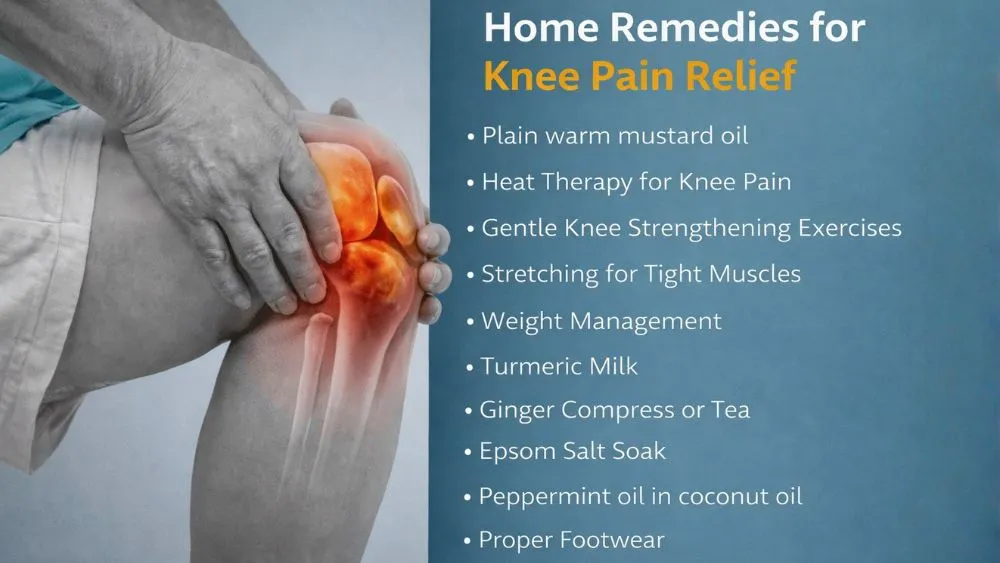
These 15 home remedies for knee pain relief target different aspects of the problem. Some reduce inflammation. Some strengthen the muscles that protect the joint. Some address the root cause. Use more than one at a time for the best results.
1. RICE Method (Rest, Ice, Compression, Elevation)
RICE is the standard first response for sudden knee pain or minor injury.
- Rest: Stop the activity causing pain. Give the joint 24 to 48 hours.
- Ice: Apply a cold pack wrapped in a cloth for 15 to 20 minutes, three to four times a day. Never put ice directly on skin.
- Compression: Wrap with an elastic bandage to reduce swelling. Tight enough to support, not tight enough to cut off circulation.
- Elevation: Prop the leg above heart level when sitting or lying down. This drains excess fluid away from the joint.
RICE works best in the first 48 to 72 hours after an injury. After that, it transitions into heat therapy.
2. Heat Therapy for Knee Pain
Heat therapy for knee pain works differently from ice. Heat increases blood flow, relaxes the muscles around the knee, and reduces stiffness. It is not for fresh injuries or swollen knees. Use it for chronic pain, morning stiffness, and arthritis.
Apply a heating pad or warm damp towel to the knee for 15 to 20 minutes. Do this before exercise to loosen the joint, or before bed to reduce overnight stiffness. Moist heat penetrates deeper than dry heat and works faster.
3. Gentle Knee Strengthening Exercises
Weak quadriceps (the muscles at the front of the thigh) are the single biggest risk factor for knee pain. Strengthening them takes the load off the knee joint directly. Straight leg raises, wall squats, and step-ups are all low-impact options covered in the exercise section below.
4. Stretching for Tight Muscles
Tight hamstrings, calves, and hip flexors all pull on the knee from different angles. Stretching these regularly reduces that tension. A tight hamstring, for example, increases compressive force on the kneecap during walking. Five minutes of daily stretching prevents more pain than most supplements.
5. Weight Management
Every extra kilogram of body weight adds roughly 4 kilograms of pressure on the knee joint with each step. Losing just 5 kilograms of body weight reduces knee pain and improves function significantly in overweight adults with knee osteoarthritis. Weight management is a direct home remedy for knee pain with measurable clinical impact.
6. Turmeric Milk
Curcumin, the active compound in turmeric, inhibits inflammatory pathways called COX-1 and COX-2, the same ones targeted by ibuprofen. The bioavailability of curcumin increases significantly when taken with black pepper (which contains piperine). One teaspoon of turmeric with a pinch of black pepper in warm milk, taken nightly, is the most evidence-aligned version of this remedy. Plain turmeric without black pepper absorbs poorly.
7. Ginger Compress or Tea
Ginger contains compounds called gingerols that reduce the production of prostaglandins, the chemicals that cause pain and swelling. For a compress: steep 4 to 5 slices of fresh ginger in hot water, soak a cloth in the warm liquid, and apply to the knee for 10 to 15 minutes. For internal use, fresh ginger tea twice daily provides anti-inflammatory support from the inside.
8. Epsom Salt Soak
Epsom salt is magnesium sulfate. Warm water baths with 2 cups of Epsom salt reduce muscle tension around the knee and provide short-term pain relief. The magnesium absorbs through the skin in small amounts, supporting muscle relaxation. This works best for muscle-related knee pain, not for structural joint issues.
9. Knee Pain Massage Oil Home Remedy
Knee pain massage oil home remedy options with clinical relevance:
- Eucalyptus oil diluted in coconut oil: Eucalyptus contains 1,8-cineole, a compound with documented analgesic effects. Dilute 5 drops per tablespoon of carrier oil.
- Peppermint oil in coconut oil: Menthol creates a cooling sensation and reduces pain signal transmission through the skin.
- Plain warm mustard oil: Widely used in South Asian traditional medicine. Warming the oil and massaging it into the knee increases local circulation.
For any knee pain massage oil home remedy, massage in circular motions around the kneecap for 5 to 10 minutes. Do not massage directly on a swollen or hot joint.
10. Compression Knee Brace
A compression sleeve or brace reduces swelling by preventing fluid buildup. It also provides proprioceptive feedback, meaning it helps the brain sense where the knee is in space, which improves movement stability. Wear during activity. Remove during rest. A brace worn 24/7 weakens the surrounding muscles over time.
11. Proper Footwear
Flat, worn-out shoes shift the load from the heel unevenly across the knee. Shoes with proper arch support and cushioning absorb shock before it reaches the joint. Shoe insoles reduce knee pain in people with osteoarthritis by redistributing ground impact forces. This is one of the most overlooked home remedies for knee pain in everyday life.
12. Elevation During Rest
When sitting, prop the leg on a pillow or footstool. Keeping the knee below the heart during prolonged rest allows fluid to pool in the joint, which worsens swelling and stiffness. Elevation is not just for the first 48 hours after injury. It helps anytime the knee is inflamed.
13. Avoid High-Impact Activities
Running, jumping, and climbing stairs repeatedly put compressive force through the knee joint. During an active pain period, swap these for swimming, cycling, or walking on flat surfaces. Water reduces body weight by about 90% through buoyancy, making swimming one of the best forms of exercise for knee pain.
14. Stay Hydrated
Cartilage, the cushioning tissue inside the knee, is approximately 70 to 80% water. Chronic dehydration reduces cartilage volume and increases friction within the joint. Eight to ten glasses of water daily is the standard guidance. This is not a cure, but dehydration actively makes knee pain worse. Hydration is a legitimate, often ignored home remedy for knee pain.
15. Magnesium-Rich Diet
Magnesium deficiency is linked to increased inflammation and muscle cramping around joints. Foods high in magnesium include almonds, dark leafy greens, pumpkin seeds, and black beans. Higher dietary magnesium intake is associated with lower levels of inflammatory markers in the body. For knee pain driven by inflammation, diet matters.
What Are the Best Exercises for Knee Pain?
The best exercises for knee pain depend on where the weakness is. Most knee pain comes from weak quadriceps and tight hamstrings. These five target both.
1. Straight Leg Raises
Lie flat on your back. Bend one knee with the foot flat on the floor. Keep the other leg straight and raise it to about 45 degrees. Hold for 3 seconds, lower slowly. Do 3 sets of 15 reps. This strengthens the quadriceps without putting any pressure through the knee joint itself.
2. Wall Squats (Partial Range)
Stand with your back flat against a wall. Slide down until your knees are at roughly 30 to 40 degrees, not a full squat. Hold for 10 seconds. Slide back up. Do this 10 times. Partial wall squats activate the quadriceps safely without the deep knee flexion that causes pain.
3. Hamstring Stretch
Lie on your back. Pull one leg toward your chest with both hands behind the thigh. Hold for 30 seconds. Switch sides. Do this twice per leg, twice daily. Tight hamstrings pull on the back of the knee and are a primary driver of patellofemoral pain (pain behind the kneecap).
4. Calf Stretch
Stand facing a wall. Place both palms on the wall. Step one foot back and press the heel flat to the ground. Hold for 30 seconds. Tight calves increase stress on the knee during walking. This stretch takes 2 minutes and prevents significant pain over time.
5. Clamshell Exercise
Lie on your side with knees bent at 90 degrees. Keeping feet together, lift the top knee as high as it goes without rotating the hip. Lower slowly. Do 15 reps per side. Clamshells strengthen the gluteus medius, the hip muscle that controls how the knee tracks during movement. Weak glutes are a major cause of knee pain in runners.
Important: Stop any exercise immediately if it causes sharp pain. Mild discomfort is okay. Sharp or sudden pain is not.
Knee Stiffness Home Remedy
Knee stiffness home remedy options depend on what causes the stiffness.
Morning stiffness that improves after 20 to 30 minutes of movement usually points to osteoarthritis. Stiffness that worsens with activity or comes with visible swelling suggests inflammation. The approach differs.
For morning stiffness:
- Apply heat therapy for knee pain for 15 minutes before getting out of bed
- Gentle range-of-motion circles with the foot while still lying down
- Warm oil massage before standing
For inflammation-related stiffness:
- Ice after activity, not heat
- Compression brace during movement
- Avoid prolonged sitting, set a reminder to stand and walk for 2 minutes every 45 minutes
Sleeping with a pillow between the knees (for side sleepers) or under the knees (for back sleepers). This prevents the knee from locking into a compressed position overnight, which directly reduces morning stiffness.
When to Use Ice vs Heat
| Situation | Use Ice | Use Heat |
| Sudden injury or fall | Yes | No |
| Active swelling | Yes | No |
| Morning stiffness | No | Yes |
| Chronic arthritis pain | No | Yes |
| After exercise (mild ache) | Yes | No |
| Before exercise (stiff joint) | No | Yes |
Applying heat to a swollen knee: Heat brings more blood to the area, which increases swelling. Ice is always the choice when the knee is visibly swollen or warm to the touch.
When to See a Doctor
Stop using home remedies for knee pain and get medical care if:
- The knee buckles or gives way while walking
- There is a locking sensation where the knee gets stuck mid-movement
- Swelling appears within 2 hours of an injury (rapid swelling means bleeding inside the joint)
- Redness and fever accompany the pain (possible septic arthritis, a joint infection)
- Pain does not improve after 2 weeks of consistent home care
Possible serious causes behind these symptoms include ligament tears, meniscus damage, rheumatoid arthritis, or joint infection. All of these need diagnosis before treatment.
How Long Does Knee Pain Take to Improve?
- Mild strain: 1 to 2 weeks with rest and RICE
- Overuse injury (like runner’s knee): 3 to 6 weeks with activity modification and strengthening
- Early osteoarthritis: Ongoing management. Symptoms improve with weight loss, exercise, and anti-inflammatory strategies but do not resolve permanently without medical intervention
FAQs
Is massage good for knee pain?
Yes. Weekly Swedish massage reduces knee osteoarthritis pain by 17% and improves function after 8 weeks. Massage increases circulation, reduces muscle tension around the joint, and lowers cortisol, which reduces pain sensitivity. Use circular strokes around the kneecap, never direct pressure on it.
Can walking help knee pain?
Yes, but only on flat surfaces and at a comfortable pace. Walking strengthens the quadriceps and promotes cartilage nutrition through a process called fluid diffusion. Cartilage has no direct blood supply. It absorbs nutrients from joint fluid during movement. Complete rest weakens cartilage over time. Aim for 20 to 30 minutes of flat walking daily during active knee pain.
Is heat better than ice for knee pain?
It depends on the type of pain. Ice wins for swelling and acute injury within the first 72 hours. Heat therapy for knee pain works for chronic stiffness, arthritis, and muscle tension. Using heat on a swollen knee increases fluid in the joint and worsens pain. Using ice on a stiff arthritic knee increases stiffness further.\
Does turmeric really help?
Yes, with conditions. A 2021 systematic review in BMJ Open found turmeric extract comparable to ibuprofen for knee osteoarthritis pain over 12 weeks. The active compound curcumin must be taken with black pepper to absorb properly. Raw turmeric in food provides too little curcumin to have clinical effect. Supplements of 500 mg curcumin with piperine, twice daily, are the studied dose.
Can knee pain be cured naturally?
It depends on the cause. Knee pain from muscle weakness, overuse, or minor strain responds fully to home remedies for knee pain with proper exercise and rest. Osteoarthritis does not cure naturally, but improves significantly with weight loss and strengthening. Structural damage, like a torn ligament or meniscus, requires surgical evaluation. Natural remedies manage pain but do not repair torn tissue.





Leave a Comment