

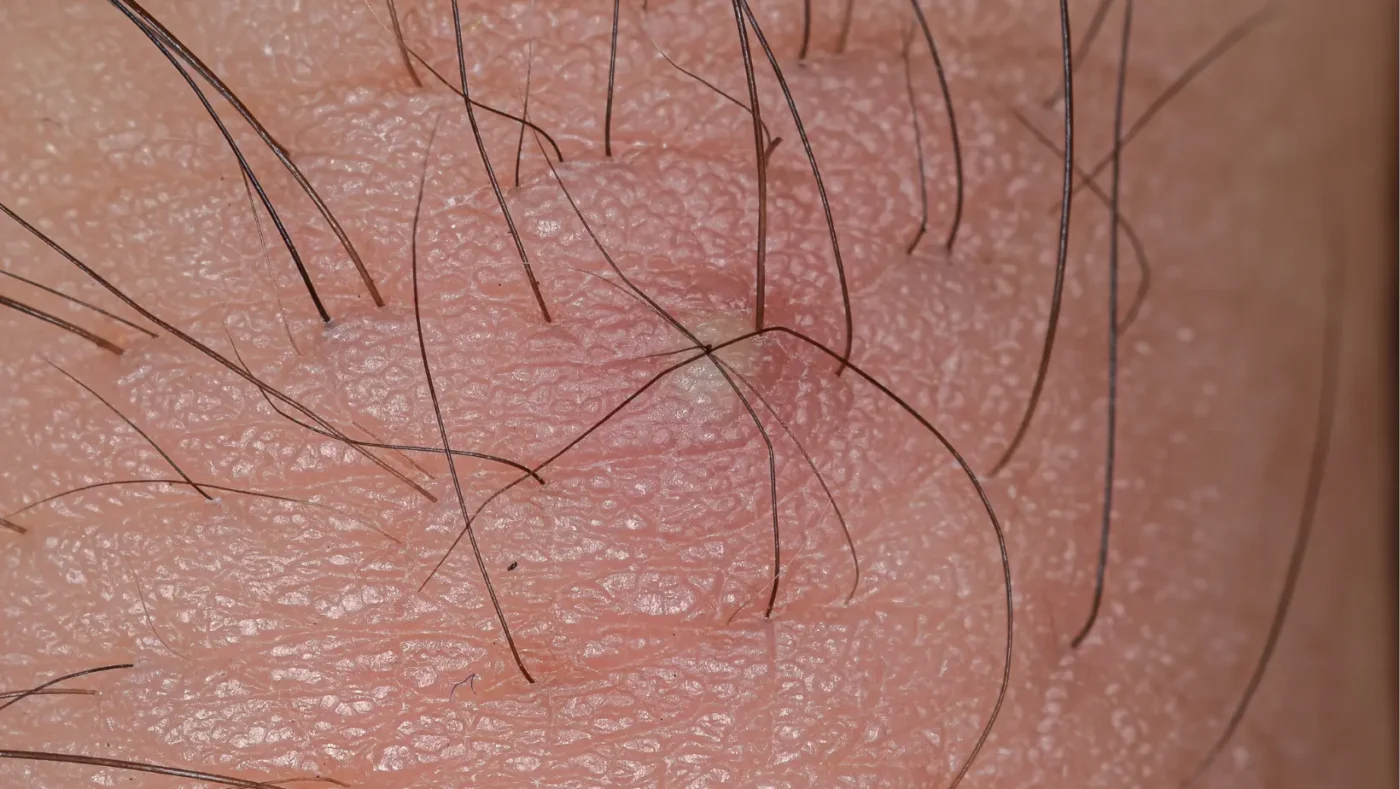

An ingrown hair on penis skin is a hair that curls back into the skin instead of growing outward. It looks like a small red or skin-colored bump, sometimes with a visible hair trapped inside. It’s common, it’s benign in most cases, and it’s treatable at home.
The genital area has thin, sensitive skin and dense hair follicles. That combination makes ingrown hairs more likely here than on other body parts. Shaving is the most frequent trigger, but it’s not the only one.
What Is Ingrown Hair on the Penis
An ingrown hair on penis skin forms when a hair grows sideways or downward instead of upward through the skin. The body treats the trapped hair as a foreign object and sends an immune response to the area, which causes redness, swelling, and sometimes a pus-filled bump.
How Ingrown Hairs Form on Penile Skin
Hair follicles sit at an angle inside the skin. When a hair gets cut too short, it can lose direction and grow back into the follicle wall instead of exiting the pore. The sharp tip of a freshly shaved hair makes this more likely.
Why the Genital Area Is Prone to Ingrowns
The pubic and penile area has:
- Thinner, more elastic skin than the face or legs
- Denser hair follicles packed closely together
- Frequent friction from clothing and movement
- Higher sweat and moisture levels that soften skin and allow hairs to turn inward
Difference Between Ingrown Hair and Normal Bumps
An ingrown hair bump is localized, usually 2 to 5 mm in size, and often shows a dark spot or curved hair underneath the skin surface. A random pimple lacks the visible trapped hair. A cyst is deeper, firmer, and doesn’t have a hair visible at the surface.
Common Locations on the Penile Shaft
Ingrown hairs most often appear at:
- The base of the penis where pubic hair grows densely
- The penile shaft near the pubic hairline
- The scrotum and inner thigh border
- Less often on the shaft itself, since that skin has fewer hair follicles
What Causes Ingrown Hairs on Penis
The causes of ingrown hairs in the genital area are almost always mechanical or hygiene-related. Skin type and hair texture also affect how frequently they form.
Shaving and Hair Removal Methods
Shaving cuts hair at a sharp angle. That sharp tip is what re-enters the skin. Dry shaving is worse than wet shaving. Shaving against the grain increases the risk by 60 to 70% compared to shaving with the grain. Waxing and threading pull hair from the root, which sometimes causes the regrowth to emerge at the wrong angle.
Tight Clothing and Friction
Tight underwear and synthetic fabrics push hairs sideways as they try to grow out. The constant rubbing bends hair tips back toward the skin. Men who wear compression shorts or tight briefs daily have higher rates of recurring ingrown hairs in the pubic area.
Curly or Coarse Hair Growth Patterns
Naturally curly or tightly coiled hair has a higher curve radius. As it grows, it curves back toward the skin without needing any shaving at all. This is why men with curly pubic hair get ingrown hairs even without shaving.
African American men, for example, have significantly higher rates of pseudofolliculitis (chronic ingrown hair disease) for this reason.
Poor Hygiene and Clogged Follicles
Dead skin cells and oil build up around hair follicles. This debris blocks the hair’s exit path and forces it sideways. Regular exfoliation of the pubic area removes this buildup and reduces follicle blockage.
Red Painful Bump on Penile Skin Ingrown Hair
A red painful bump on penile skin ingrown hair is one of the most common reasons men search this topic online, and most of the time it’s not an STD. The bump forms as the immune system reacts to the trapped hair beneath the skin.
Early Signs of an Ingrown Hair
The first sign is a small, firm bump, usually 1 to 3 mm. It appears 1 to 3 days after shaving or waxing. The area feels slightly tender when pressed. No open sore or blister forms at this stage.
Pain, Redness, and Swelling Symptoms
As the body’s response intensifies, the bump grows to 3 to 5 mm and becomes visibly red. The skin around it feels warm. Pain increases with friction from clothing. In some cases, the surrounding skin darkens slightly from inflammation.
When a Bump Becomes Infected
An infected ingrown hair, also called folliculitis, develops when bacteria (usually Staphylococcus aureus) enter the follicle. Signs of infection include:
- Pus visible inside or around the bump
- Bump diameter exceeding 5 mm
- Increasing pain over 48 hours instead of decreasing
- Fever or warmth spreading beyond the bump itself
Pus-Filled vs Non-Infected Bumps
A non-infected ingrown hair bump is firm, slightly red, and contains no liquid. A pus-filled bump is soft at the center, yellowish-white, and painful to touch. Pus means bacterial involvement.
Non-infected bumps resolve on their own within 1 to 2 weeks. Infected ones need treatment to prevent abscess formation.
How to Treat Ingrown Hair on Penis
Knowing how to treat ingrown hair on penis safely prevents infection, scarring, and the bump from getting worse. The process is straightforward but requires patience.
Warm Compress to Reduce Inflammation
Apply a warm, damp cloth to the bump for 10 to 15 minutes, two to three times daily. The heat softens the skin and brings the hair closer to the surface. This alone resolves most mild ingrown hairs within 3 to 5 days.
Gentle Exfoliation Techniques
After a warm compress, use a soft washcloth or a gentle chemical exfoliant (salicylic acid 2% or glycolic acid 5 to 10%) to loosen dead skin over the bump. This clears the path for the hair to exit. Do not scrub hard. Rough scrubbing breaks the skin and introduces bacteria.
Avoiding Picking or Squeezing
Squeezing pushes bacteria deeper into the follicle. Picking breaks the skin and causes scarring. Both increase infection risk. The only acceptable manual intervention is using a sterile needle to gently lift a hair that’s already close to the surface, and only after softening the skin with a warm compress first.
When to Use Topical Treatments
- Hydrocortisone 1%: Reduces redness and swelling. Apply once daily for up to 5 days.
- Benzoyl peroxide 2.5%: Kills surface bacteria. Apply twice daily to prevent infection.
- Salicylic acid 2%: Exfoliates skin over the bump. Apply once daily after cleansing.
- Topical antibiotic (mupirocin): Use only if the bump shows signs of infection. Prescription required in most countries.
Healing Timeline for Ingrown Hairs
- Non-infected ingrown hair: 1 to 2 weeks with warm compress treatment
- Mildly infected bump: 2 to 3 weeks with topical antibiotics
- Abscess or severely infected bump: requires drainage by a doctor; heals in 2 to 4 weeks post-treatment
How to Tell Ingrown Hair vs STD
An ingrown hair on penis and an STD bump can look similar at first glance. The key differences are in texture, location, spread, and associated symptoms.
- Ingrown hair bumps appear within 24 to 72 hours after shaving or friction
- STD sores appear 2 to 30 days after sexual contact, depending on the infection
- Ingrown hair bumps are solitary and stationary; they don’t multiply or spread
- STD lesions frequently appear in clusters or spread over days
Key Differences from Genital Warts
| Feature | Ingrown Hair | Genital Warts |
| Appearance | Single red or skin-colored bump | Flesh-colored, cauliflower-like cluster |
| Texture | Soft or firm, smooth | Rough, irregular surface |
| Pain | Mild tenderness | Usually painless |
| Location | Follows hair growth areas | Any genital skin, including glans |
| Cause | Trapped hair | HPV virus |
| Visible hair | Sometimes visible under skin | Never |
Herpes vs Ingrown Hair Symptoms
| Feature | Ingrown Hair | Herpes |
| Appearance | Single bump, no blister | Cluster of fluid-filled blisters |
| Breaks open | Rarely | Yes; leaves shallow ulcers |
| Tingling before bump | No | Yes, often 1 to 2 days before |
| Fever or body aches | No | Common during first outbreak |
| Recurrence | Only if you shave again | Recurs every few weeks to months |
| Healing | 1 to 2 weeks | 2 to 4 weeks (first outbreak) |
Complications With Ingrown Hair
Most ingrown hairs resolve without issues. But ignoring an infected bump creates complications with ingrown hair that are harder to treat.
Bacterial Infection and Abscess Formation
An untreated infected ingrown hair turns into a follicular abscess, a pocket of pus under the skin. Abscesses require medical drainage. They don’t resolve with warm compresses alone once they form.
Scarring and Skin Discoloration
Repeated picking, squeezing, or infection leaves post-inflammatory hyperpigmentation (dark spots) on penile skin. These spots take 3 to 6 months to fade. Deep folliculitis can cause permanent pitting scars in rare cases.
Chronic Recurring Ingrown Hairs
Recurring ingrown hairs in the same spot signal a structural issue with the follicle. After repeated inflammation, scar tissue forms around the follicle and permanently misdirects future hair growth. Laser hair removal is the only long-term fix for this pattern.
Risk of Spreading Infection
Staphylococcal infections from an ingrown hair can spread to adjacent follicles, causing a wider patch of folliculitis. In immunocompromised individuals, cellulitis (a deeper skin infection) is a real risk if an infected ingrown hair goes untreated for more than 5 to 7 days.
Prevention Tips for Penile Ingrown Hair
Consistent habits prevent most ingrown hair on penis cases. These steps target the root causes directly.
- Shave with the grain: Always move the razor in the direction of hair growth, not against it.
- Use a single-blade razor: Multi-blade razors cut hair below the skin line, increasing ingrown risk.
- Soften skin before shaving: Shower or apply a warm compress for 5 minutes before shaving.
- Apply shaving gel: Dry shaving tears skin and increases ingrown risk significantly.
- Exfoliate 2 to 3 times per week: Use a gentle chemical exfoliant (salicylic acid) to keep follicles clear.
- Wear loose cotton underwear: Reduces friction and lets hairs grow outward without obstruction.
- Moisturize after shaving: Use a fragrance-free lotion to reduce post-shave skin tightening that traps hairs.
- Consider trimming instead of shaving: Trimming keeps hair short without creating sharp tips that re-enter skin.
When to See a Doctor for Ingrown Hair
Most ingrown hair on penis cases don’t need a doctor. These specific signs do.
- The bump exceeds 1 cm in diameter
- Pain is increasing after 5 to 7 days instead of decreasing
- Pus is draining but the bump is not getting smaller
- Fever develops alongside the bump
- Red streaks extend outward from the bump (sign of spreading infection)
- You cannot confirm it’s an ingrown hair and had recent sexual contact
- Multiple bumps appear simultaneously with no clear shaving cause
- Bumps keep recurring every time hair regrows in the same spot
Frequently Asked Questions
Is an ingrown hair on the penis dangerous?
No. An ingrown hair on penis skin is not dangerous in most cases. It becomes a problem only if infected and left untreated for more than 7 days. Staphylococcal abscess from an ignored infected ingrown hair is the most serious outcome, which requires medical drainage.
How long does an ingrown hair take to heal?
A non-infected ingrown hair on penis heals in 1 to 2 weeks with warm compress treatment. An infected one takes 2 to 3 weeks with topical antibiotics. An abscess that requires drainage heals in 3 to 4 weeks post-procedure.
Can I pop an ingrown hair on the penis?
No. Popping pushes bacteria deeper into the follicle and dramatically increases abscess risk. The correct approach is warm compresses twice daily to bring the hair to the surface, then gently lifting it with a sterile needle if it’s visible.
How do I know if it is an STD or ingrown hair?
Check two things: timing and texture. An ingrown hair on penis appears within 72 hours of shaving and feels like a single firm bump under intact skin. Herpes blisters cluster, burst, and leave raw sores. Genital warts are rough, painless, and multiply over weeks.
What causes repeated ingrown hairs in the genital area?
Repeated causes of ingrown hairs in the same spot are usually a combination of naturally curly hair, continued shaving against the grain, and follicle scarring from previous ingrowns. Once scar tissue forms around a follicle, the hair inside it consistently misdirects. Laser hair removal resolves this permanently.
Can ingrown hairs go away on their own?
Yes. Most non-infected ingrown hairs resolve without any treatment in 1 to 2 weeks as the hair eventually exits the skin. Warm compresses speed this up. An infected ingrown hair will not resolve on its own and needs topical or oral antibiotics.
What is the fastest way to treat an ingrown hair?
The fastest approach is a warm compress for 15 minutes, followed by applying salicylic acid 2% directly to the bump. This softens the overlying skin and clears dead cells simultaneously. Most people see visible improvement within 48 to 72 hours using this twice daily.
Can shaving cause ingrown hairs on the penis?
Yes. Shaving is the leading cause of ingrown hairs in the genital area. Multi-blade razors and shaving against the grain cut hair below skin level, creating sharp tips that curve back into the follicle during regrowth. Single-blade razors and shaving with the grain reduce this significantly.
When should I worry about a penile bump?
Worry when the bump grows beyond 1 cm, doesn’t improve after 7 days, shows red streaking outward from its center, causes fever, or appears without any recent shaving. These signs point to infection, abscess, or possibly something other than an ingrown hair on penis.
Can ingrown hair turn into an infection?
Yes. Complications with ingrown hair include bacterial folliculitis, which develops when Staphylococcus aureus enters the inflamed follicle. Signs are increasing pain, pus, warmth, and a bump that grows instead of shrinks over 3 to 5 days. Mupirocin ointment treats mild infections; oral antibiotics handle more severe cases.




Leave a Comment