

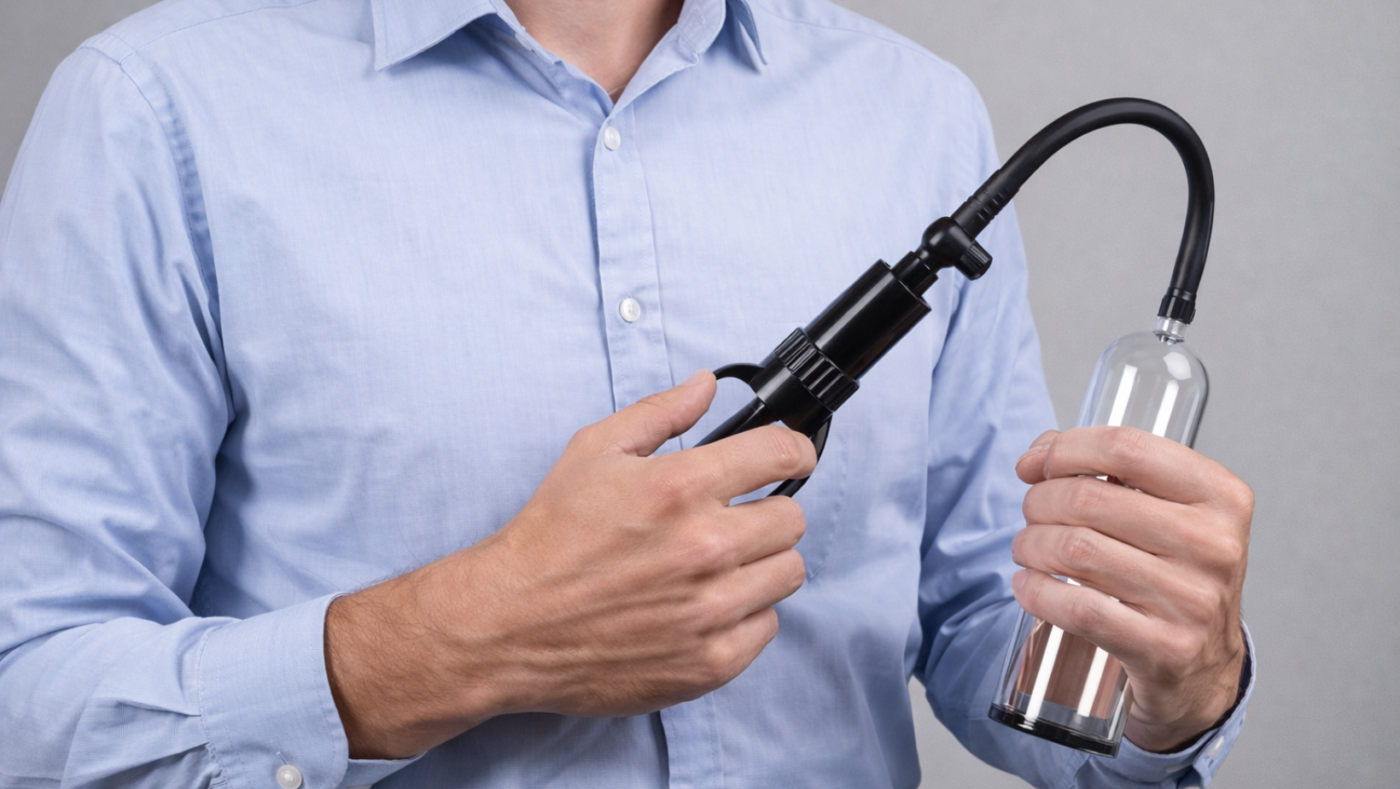

Yes, penis pumps work. Clinical studies show success rates of 60 to 80% for men with erectile dysfunction. Urologists have prescribed them for decades.
Erectile dysfunction has multiple causes, and the treatment that works depends entirely on which cause applies to you. Penis pumps are a legitimate, clinically supported option that many men use successfully long-term, often alongside other treatments.
The most important step is ruling out an underlying health condition first, then choosing a device that fits your needs and situation.
What Is a Penis Pump?
A penis pump is a vacuum erection device. It is a medical tool.
The device has three parts:
- A clear plastic cylinder that fits over the penis
- A hand pump or battery-powered pump that removes air from inside the cylinder
- A constriction ring placed at the base of the penis to hold the erection
Some versions are sold over the counter. Others require a doctor’s prescription. The prescription-grade devices are made to tighter medical standards and generally produce better results.
The FDA classifies vacuum erection devices as Class II medical devices, which means they go through regulatory review before reaching the market.
How a Penis Pump Works
Remove air from a sealed space around the penis, and blood rushes in to fill the tissue. That is the entire process.
Step by step:
- Place the cylinder over the penis
- Create a seal at the base against the skin
- Pump out the air to create a vacuum
- Blood flows into the spongy tissue inside the penis (called corpus cavernosum)
- Slide the constriction ring to the base before removing the cylinder
- The ring keeps blood inside and maintains the erection
Penis pump for improving blood flow works because the vacuum creates negative pressure. The body responds the same way it does during natural arousal, except the signal comes from pressure, not from nerve signals or hormones.
Vacuum Erection Device Effectiveness
Vacuum erection device effectiveness in clinical studies is well-documented.
A review published in the Journal of Sexual Medicine found that 60 to 80% of men with ED achieved erections firm enough for intercourse using vacuum devices. A separate study from Urology reported 68% satisfaction among long-term users.
Results vary based on the cause of ED:
- Vascular ED (blood flow problems): Highest success rate
- Post-prostatectomy ED: Strong evidence supporting pump use, especially in early recovery
- Psychogenic ED (caused by anxiety): Lower success rate compared to blood flow-related cases
- Severe nerve damage ED: Variable results
Men who stop responding to oral ED medications like tadalafil or sildenafil are often prescribed vacuum devices as the next step before considering surgery.
Penis Pumps for Blood Circulation Problems
The penis requires strong blood flow to become erect. When vessels are compromised, that flow is limited. Pumps bypass this problem physically. They do not fix the damaged vessels. But they force blood into penile tissue regardless of the vessel’s condition.
Men with:
- Diabetes-related vascular damage
- Atherosclerosis (artery hardening)
- Post-surgical vascular changes following prostate removal
…all show measurable benefit from regular pump use.
Some urologists also recommend pump use after prostate surgery, specifically to prevent tissue changes that make future erections harder, even before the patient is sexually active again. This is called penile rehabilitation.
Can Penis Pumps Help With Nerve-Related ED?
When ED is caused by nerve damage from prostate surgery, spinal cord injury, or conditions like multiple sclerosis, the nerve signals that trigger erection are disrupted or absent. A pump does not restore nerve function.
But even without a nerve signal, the physical vacuum draws blood into penile tissue. That alone creates an erection. The erection may not feel as natural, and sensitivity may be reduced, but the mechanical effect still works.
Research from Memorial Sloan Kettering Cancer Center found that men who used vacuum devices regularly after radical prostatectomy had better erectile function recovery at 18 months compared to men who did not use them. The pump kept the tissue oxygenated and flexible during recovery.
Benefits of Penis Pumps
The advantages are specific, not vague:
- No systemic side effects, unlike oral ED medications that affect blood pressure throughout the body
- Works within minutes, no 30 to 60 minute wait like with pills
- One-time purchase, a quality device costs $150 to $500 versus ongoing medication costs
- Safe for men who cannot take PDE5 inhibitors due to heart medication conflicts (nitrates)
- Recommended by the American Urological Association as a first-line treatment for ED
Men on blood thinners, men with heart conditions, and men who had negative responses to Viagra all represent groups where pumps are the safer, more practical option.
Side Effects of Penis Pump Devices
Side effects of penis pump devices are real but generally minor with correct use.
Common side effects:
- Mild bruising from excessive suction or overly long use
- Numbness or cold feeling in the penis because the constriction ring limits circulation
- Restricted or blocked ejaculation from the ring squeezing the urethra
- Petechiae, small red dots caused by broken capillaries under the skin from too much vacuum pressure
- Temporary discomfort at the base where the ring sits
The constriction ring should not stay on for more than 30 minutes. Longer than that risks tissue damage from lack of fresh blood flow.
Who Should Avoid Penis Pumps
Some men should not use these devices without a doctor’s clearance:
- Men with blood-clotting disorders like hemophilia
- Men taking anticoagulants like warfarin (higher bleeding risk from capillary damage)
- Men with sickle cell disease or other blood disorders
- Men with Peyronie’s disease (penile curvature from scar tissue), where vacuum pressure can worsen the condition
- Men who have had recent penile surgery
Using a pump with untreated Peyronie’s has caused documented cases of worsening penile curvature.
Alternatives to Penis Pumps
For men whose ED stems from low testosterone, a pump will not address the root cause. Hormone testing should come first.
| Treatment | Best For | Drawback |
| Oral medications (Viagra, Cialis) | Mild to moderate vascular ED | Cannot use with nitrates |
| Penile injections (alprostadil) | Severe ED, nerve damage | Needle required |
| Vacuum erection device | Vascular ED, post-surgery | Interrupts spontaneity |
| Penile implant | Treatment-resistant ED | Surgery required |
| Hormone therapy | Testosterone deficiency | Only works if low T is the cause |
When to See a Doctor
ED is sometimes the first visible sign of cardiovascular disease. The same plaque that blocks blood flow to the penis is the same process that leads to heart attacks and strokes.
See a doctor when:
- ED happens consistently, more than half the time
- Erections suddenly become difficult with no clear reason
- ED appears alongside chest pain, fatigue, or shortness of breath
- ED develops after starting a new medication
Sudden-onset ED in a man under 40 with no prior history warrants a cardiovascular check, not just a trip to buy a pump.
Frequently Asked Questions
Do penis pumps really work for erectile dysfunction?
Yes. Clinical studies show 60 to 80% of men achieve erections firm enough for intercourse. Vacuum erection device effectiveness is highest when ED is caused by poor blood circulation or post-surgical recovery. Results are weaker when the cause is psychological.
How long does an erection from a penis pump last?
The constriction ring holds the erection for up to 30 minutes. That is the maximum safe limit. Blood in the tissue becomes oxygen-depleted after 30 minutes, and keeping the ring on longer raises injury risk.
Can penis pumps permanently increase penis size?
No. The increase in size during use is temporary. Once the ring comes off, the penis returns to its normal state. Any product claiming permanent size increase from a pump is making an unsupported claim.
Are penis pumps safe to use?
Yes, when used correctly with a quality device. Risk increases with excessive suction, ring use beyond 30 minutes, and devices without pressure limiters. Side effects of penis pump devices are mostly mild bruising and temporary numbness.
Do doctors recommend penis pumps?
Yes. The American Urological Association lists vacuum erection devices as a first-line ED treatment. Doctors often prescribe them when oral medications are contraindicated due to heart conditions or drug interactions.
Can penis pumps help after prostate surgery?
Yes. Urologists recommend pump use within weeks of prostate removal to maintain penile tissue health and oxygen supply. Studies show better erectile recovery at 12 to 18 months in men who started penile rehabilitation early with vacuum devices.
How often can you use a penis pump?
Daily use is generally safe. For penile rehabilitation after surgery, many urologists recommend one session per day. For general ED management, use as needed. No evidence shows harm from regular daily use when proper technique is followed.
Do penis pumps improve blood circulation?
Yes, during use. Penis pump for improving blood flow works by forcing blood into penile tissue through negative pressure. It does not repair damaged vessels, but it overcomes poor circulation mechanically. Blood circulation issues and penis pump use is one of the most well-supported clinical applications.
Can penis pumps damage nerves?
No, not with normal use. Nerve damage ED and penis pump effectiveness studies show pumps do not cause nerve damage. Excessive suction pressure from poor-quality devices without limiters has caused tissue bruising, but nerve damage from pump use is not documented in clinical literature.
What is better: Viagra or a penis pump?
Neither is universally better. Viagra works faster and feels more spontaneous, but it cannot be used with nitrate heart medications and loses effectiveness as ED progresses. Pumps have a one-time cost, no drug interactions, and work even in men with severe vascular disease where Viagra fails.













Leave a Comment