

Medical Disclaimer :This article is for informational purposes only and does not replace professional medical advice. Consult a healthcare professional for personalized contraceptive guidance.
You can take Plan B more than once, even during the same menstrual cycle, if needed. Repeated use is generally considered safe, but it may cause temporary side effects, such as irregular bleeding and changes in your period. Plan B is emergency contraception, not a replacement for regular birth control. Explore in this blog and know How Often Can You Take Plan B?
Key Takeaways
- Plan B can be taken more than once, including during the same menstrual cycle.
- It works best when taken as soon as possible after unprotected sex, ideally within 72 hours.
- Repeated use may cause spotting, nausea, headaches, and changes in period timing.
- Plan B does not cause infertility or protect against sexually transmitted infections (STIs).
- Take a pregnancy test three weeks after unprotected sex if you are unsure whether the pill worked.
What Is Plan B and How Does It Work?
Plan B contains a hormone called levonorgestrel. It is a synthetic version of progesterone, and it works at a very specific moment in your cycle.
Here is what it does:
- Delays or stops ovulation (this is its main job)
- Thickens cervical mucus so sperm cannot move well
- Changes the uterine lining slightly
Plan B does not end an existing pregnancy. If a fertilized egg has already implanted in the uterus, Plan B has no effect. The FDA classifies it as a contraceptive, not an abortifacient.
The pill must be taken within 72 hours of unprotected sex. Effectiveness drops with every passing hour:
- Taken within 24 hours: up to 95% effective
- Taken between 24 to 48 hours: around 85% effective
- Taken between 48 to 72 hours: around 58% effective
After 72 hours, effectiveness falls enough that the pill is not a reliable option anymore.
How Many Times Can You Use Plan B in a Month?
The number of times you can use Plan B in a month has no hard limit set by the FDA or any major health organization. But doctors do not recommend using it as a monthly habit.
Each dose contains 1.5 mg of levonorgestrel, which is a large hormonal spike compared to regular birth control pills. Taking that spike repeatedly in one month means your body gets hit with significant progesterone-like hormones multiple times in a short window.
Your cycle gets disrupted. And you are spending money (Plan B costs $40 to $50 per pill in the US without insurance) on something that is far less effective than a daily pill or an IUD.
Taking Plan B Twice in One Cycle
Taking Plan B twice in one cycle is possible. If you had unprotected sex on two separate occasions within the same menstrual cycle, doctors say it is safe to take Plan B both times.
But each pill only covers the incident it was taken for. Taking Plan B on Day 5 of your cycle does not protect you if you have unprotected sex on Day 15. Those are two separate events that need two separate responses.
Taking Plan B twice in one cycle will almost certainly push your period off schedule. Bleeding irregularities are common, and your next one or two cycles can come early, come late, or be lighter or heavier than usual.
Ovulation Timing and Plan B Effectiveness
Ovulation timing and Plan B effectiveness are directly connected. Plan B works by delaying ovulation. If ovulation has already happened before you take the pill, it does not work the same way.
Once an egg is released, it survives for about 12 to 24 hours. Sperm can survive inside the body for up to five days. So if you take Plan B after ovulation has occurred, there is a window where fertilization is still possible and the pill cannot stop it.
Ovulation timing and Plan B effectiveness matter most around the middle of your cycle, roughly days 12 to 16 for a 28-day cycle. Taking the pill during this window is riskier because ovulation may have already started or just finished.
If you know you ovulated before having unprotected sex, Plan B is less reliable. A copper IUD inserted within five days is about 99% effective at preventing pregnancy after unprotected sex, and it does not depend on where you are in your cycle.
Side Effects After Taking Plan B Multiple Times
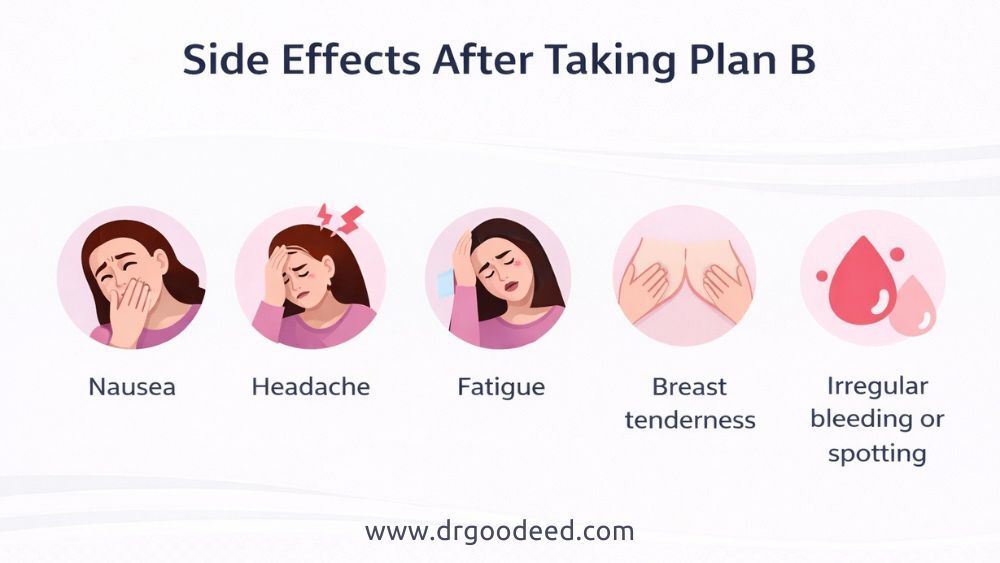
A single dose causes noticeable side effects for many people. Side effects after taking Plan B multiple times are more intense and last longer.
Common side effects from one dose:
- Nausea (most common, especially in the first few hours)
- Headache
- Fatigue
- Breast tenderness
- Irregular bleeding or spotting
Side effects after taking Plan B multiple times within weeks include heavier disruption to your cycle. Your period can arrive two weeks early or two weeks late. You may experience breakthrough bleeding between periods.
Plan B does not cause infertility. Even taken multiple times, it does not affect your long-term ability to get pregnant. Your fertility returns to normal quickly after each dose.
Does Frequent Plan B Reduce Effectiveness?
No, frequent Plan B does not reduce effectiveness over time. Your body does not adapt to levonorgestrel in a way that makes the drug stop working. Each time you take it, it works the same way it did the first time, assuming timing is right.
When your cycle is already disrupted from a previous dose, it becomes harder to predict when you are ovulating. If you cannot track ovulation accurately, you cannot time a second or third pill correctly. That confusion is where effectiveness breaks down.
And again, if ovulation has already happened, the pill is not effective regardless of how many times you have taken it before.
Better Long-Term Birth Control Options
If you take Plan B more than once a year, that is a signal to switch to something more reliable.
Regular contraception options:
- Daily birth control pill: 91% to 99% effective with consistent use. Costs around $20 to $50 per month with insurance.
- Copper IUD (Paragard): Over 99% effective, lasts up to 10 to 12 years, hormone-free, and works as emergency contraception if inserted within five days.
- Hormonal IUD (Mirena, Kyleena): Over 99% effective, lasts three to eight years depending on brand.
- Implant (Nexplanon): A small rod inserted in your arm, over 99% effective, lasts three years.
- Condoms: Around 85% effective with typical use, and the only option that also protects against STIs.
Plan B costs more per incident than most monthly contraceptives. One pack of daily pills costs less than a single Plan B pill in most cases.
When to Take a Pregnancy Test
Take a pregnancy test if your period is more than one week late after taking Plan B.
Do not test too early. A pregnancy test measures hCG, the hormone produced after implantation. That hormone does not show up in detectable amounts until 10 to 14 days after conception.
Testing at three or four days will give inaccurate results. Wait at least 10 days, and if your period still has not come after three weeks, test again and see a doctor.
Frequently Asked Questions
How often can you take Plan B?
There is no medical limit. You can take it more than once in a cycle if needed. But repeated use disrupts your cycle significantly and costs far more than regular contraception. Doctors recommend switching to a reliable method if you need it more than twice a year.
Can you take Plan B twice in one week?
Yes. If unprotected sex happened twice in one week, you can take Plan B for each incident. Each dose only covers the event it was taken for. Expect heavy cycle disruption, including early or delayed periods and spotting.
How many times can you use Plan B in a month?
No hard limit exists. But taking it two or three times in one month floods your body with high doses of levonorgestrel, causes significant bleeding irregularities, and is not a substitute for regular contraception.
Does frequent Plan B reduce effectiveness?
No. Your body does not build resistance to levonorgestrel. But frequent use disrupts cycle tracking, which makes it harder to judge timing accurately, and timing is what determines whether the pill works.
Can Plan B delay your period?
Yes. Plan B commonly shifts your period by one to two weeks in either direction. If it is more than three weeks late, take a pregnancy test.
Is Plan B safe for repeated use?
It is not toxic and does not cause infertility. But repeated doses cause stronger hormonal side effects and make cycle prediction unreliable. It is safe in emergencies, not as a routine.
What happens if you take Plan B multiple times?
Your cycle becomes unpredictable. Spotting between periods, heavier or lighter flow, and shifted period timing are common. These effects resolve within one to two cycles after you stop taking it.
Can Plan B stop ovulation?
Yes, but only if taken before ovulation begins. Once the egg is released, Plan B cannot stop fertilization. The pill works best in the days before ovulation.
Should I use Plan B as regular birth control?
No. It is roughly 85 to 95% effective compared to over 99% for IUDs and implants. It is more expensive per use and causes more side effects than any standard contraceptive method.
When should I see a doctor after taking Plan B?
See a doctor if your period is more than three weeks late, if you have severe abdominal pain (which can signal an ectopic pregnancy), or if you have taken Plan B more than twice in two months and want to switch to a more reliable method.
Source Link
FDA – Plan B One-Step Information
American College of Obstetricians and Gynecologists – Emergency Contraception
CDC – Emergency Contraception Guidelines
Planned Parenthood – How Plan B Works and Side Effects
American College of Obstetricians and Gynecologists – Access to Emergency Contraception