
How much water you should drink daily depends on factors such as your age, body size, activity level, climate, diet, and overall health. A commonly cited U.S. guideline from the National Academies is about 3.7 liters (125 ounces) of total water per day for men and 2.7 liters (91 ounces) for women, including water from beverages and food. Your needs may be higher when exercising, sweating heavily, or spending time in hot weather.
Instead of following one fixed number, use thirst, urine color, and activity level as practical guides, while remembering that certain medical conditions may require individualized fluid recommendations.
Key Takeaways
- The “8 glasses a day” rule has no strong scientific backing behind it.
- The National Academies set an adequate intake near 91 ounces for women and 125 ounces for men, counting food.
- Roughly 20% of your fluid intake normally comes from food, not drinks.
- Heat and exercise can raise your fluid needs well past the standard baseline.
- Thirst is a reliable guide for most healthy adults without kidney or heart disease.
Why the “8 Glasses a Day” Rule Isn’t Actually Scientific
The 8×8 rule (eight 8-ounce glasses daily) never came from a clinical trial or physiology study. It spread from a loose 1945 government suggestion that already counted water from food, a detail later versions dropped entirely.
- Origin gap: No peer-reviewed study has ever tested or validated the specific 64-ounce figure as an optimal target for healthy adults.
- Missing context: The original 1945 Food and Nutrition Board guidance included water from food sources, so the modern retelling strips out that qualifier.
- Thirst physiology: Healthy kidneys and a functioning thirst reflex regulate fluid balance automatically in most people.
- Individual variation: Body size, muscle mass, sweat rate, and diet composition all shift real fluid needs far more than a flat number can capture.
Thirst works well as a built-in gauge for most healthy adults, though older adults and endurance athletes may need to drink proactively.
The Real Starting Point: What the National Academies Actually Recommend
The National Academies of Sciences, Engineering, and Medicine set an adequate total water intake, based on median fluid consumption data from healthy, sedentary adults in temperate climates.
| Group | Total Daily Fluid (All Sources) | Approx. From Drinks |
| Adult women | About 91 oz (2.7 L) | About 73 oz (2.2 L) |
| Adult men | About 125 oz (3.7 L) | About 100 oz (3.0 L) |
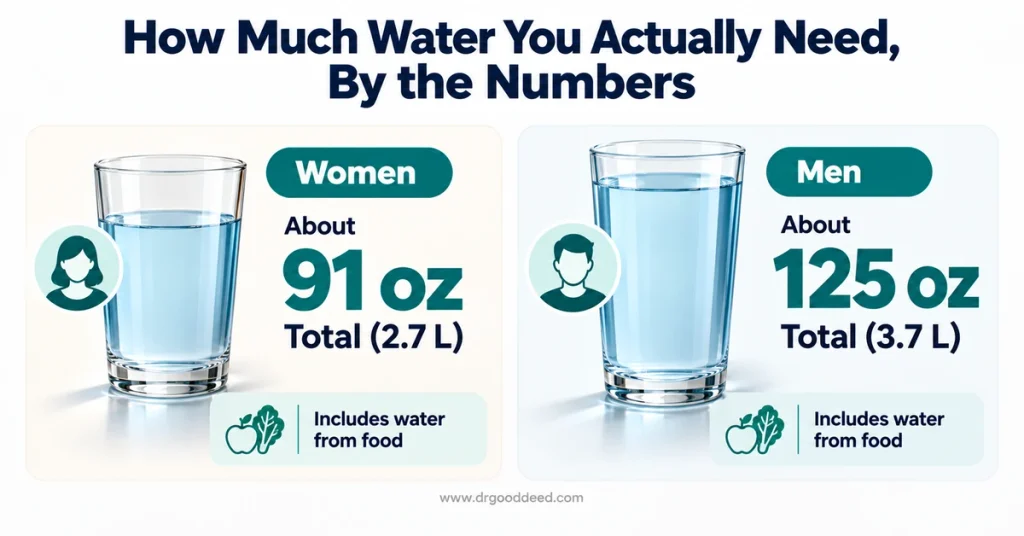
This figure counts water from food, coffee, tea, soup, and every other beverage, not plain water alone. Roughly 80% comes from drinks and 20% from food in a typical American diet.
For a deeper daily hydration routine, see 7 Tips for Staying Hydrated & Improving Daily Health.
How Much Water Should I Drink Based on My Weight?
Body weight is the biggest individual factor in how much water you should drink, since larger bodies carry more total water and lose more through normal metabolism.
- Starting formula: A commonly used clinical estimate is half your body weight in pounds, converted to ounces, as a baseline before activity adjustments.
- Example: A 160-pound adult would start near 80 ounces daily, then adjust upward for exercise, heat, or illness.
- Why it is only a starting point: This formula ignores muscle mass, medication use, and climate, so you always need a second adjustment layer to determine how much water to drink based on your weight.
- Body composition matters: Muscle holds more water than fat tissue, so two people at the same weight can have meaningfully different fluid needs.
How Much Water Do You Need in Hot Weather?
Heat and physical exertion change fluid needs faster than any other factor.
- Sweat losses: Moderate exercise in heat can push sweat losses to 1 to 2 liters per hour, according to sports medicine hydration research.
- Practical range: Many hydration guidelines suggest 1 cup of fluid every 15 to 20 minutes during sustained heat exposure and physical activity.
- Acclimatization effect: People who are not yet heat-acclimated lose more sodium in sweat and need electrolyte-containing fluids.
- Humidity factor: High humidity blunts sweat evaporation, which can raise core body temperature faster even when sweat volume looks similar.
Because how much water you need in hot weather shifts with humidity, exertion, and acclimatization, static daily targets stop being useful during heat waves or endurance activity.
For summer-specific adjustments, see Tips to Sleep Better in Summer.
Why Food Already Covers About 20% of Your Intake
Solid food is not a hydration afterthought. Certain fruits and vegetables are made mostly of water and meaningfully offset how much you need to drink.
- Watermelon: About 92% water by weight, making it one of the highest-water fruits commonly eaten in the US.
- Cucumber: About 95% water, among the highest of any commonly eaten vegetable.
- Strawberries: About 91% water, plus fiber that slows fluid absorption slightly compared to plain water.
- Soups and broths: Often 80 to 95% water depending on preparation, counting fully toward daily fluid totals.
This is why how much water you should consume daily cannot be judged from beverages alone; food contributes a real and measurable share.
Related reading: Can Dehydration Make Your Blood Pressure Go Up.
Does Coffee Count Toward Daily Water Intake?
Coffee’s reputation as dehydrating is outdated. Research directly comparing coffee against water settles the question of whether coffee counts toward daily water intake with more nuance than older advice suggests.
- Habituation matters: A controlled crossover study found no significant hydration differences between coffee and water in habitual coffee drinkers consuming up to four cups daily.
- Diuretic threshold: Caffeine only produces a meaningful diuretic effect at higher single doses, generally above 250 to 300 mg at once, not typical daily cups.
- Alcohol is different: Alcohol suppresses antidiuretic hormone and does cause net fluid loss, so it should not be counted toward daily totals the way coffee can.
Alcohol behaves very differently from coffee here, and heavy drinking should not be relied on for hydration under any circumstance.
Related reading: Does Lemon Water Help You Lose Weight.
How Life Stages and Health Conditions Shift the Number Further
Pregnancy, breastfeeding, fever, and certain chronic conditions change fluid needs beyond the standard adult baseline in specific, documented ways.
- Pregnancy: Increased blood volume and amniotic fluid production raise recommended intake to about 10 cups of total fluid daily.
- Breastfeeding: Milk production adds substantial fluid loss, pushing recommended intake to about 13 cups daily in most guidance.
- Fever and illness: Each degree of fever above normal body temperature increases fluid loss through increased respiration and sweating.
- Kidney or heart disease: Some conditions require fluid restriction rather than increased intake, making self-directed hydration advice inappropriate without physician guidance.
Related reading: Can Dehydration Cause Constipation and Can Constipation Cause Nausea.
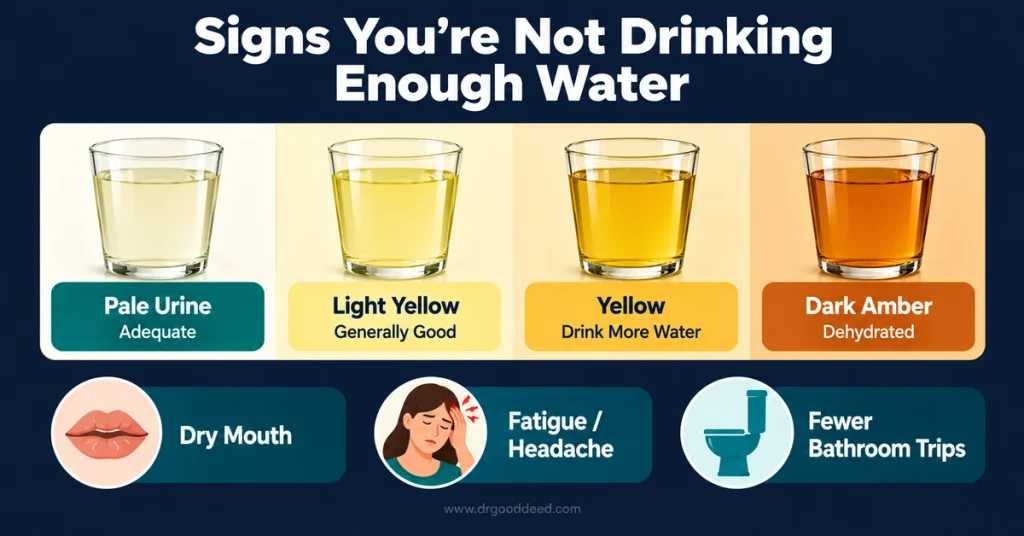
What Are the Signs You’re Not Drinking Enough Water?
Recognizing the real signs you’re not drinking enough water early prevents more serious dehydration, since thirst itself is already a late-stage signal.
- Urine color: Pale straw-colored urine generally signals adequate hydration, while dark yellow or amber urine suggests you need more fluid.
- Dry mouth and lips: Persistent dryness that does not resolve after a normal drink is a reliable early indicator among the signs you’re not drinking enough water.
- Fatigue and headache: Mild dehydration of just 1 to 2% of body weight can measurably impair concentration and mood.
- Reduced urination frequency: Fewer than four to six bathroom trips per day, especially combined with dark urine, points toward inadequate intake.
Watching urine color remains one of the simplest, most practical ways to self-monitor between the signs you’re not drinking enough water and normal hydration.
Related reading: 12 Essential Nutrients Your Body Needs Daily.
Can You Drink Too Much Water?
Yes, though it is uncommon outside specific situations. Drinking too much water leads to a condition called hyponatremia.
- Exercise-associated hyponatremia: Endurance athletes who drink far beyond thirst and sweat losses can dilute blood sodium to dangerous levels, per sports medicine consensus guidelines.
- Symptoms: Nausea, confusion, headache, and, in severe cases, seizures can occur when sodium drops too low too quickly.
- Who is at higher risk: Marathon runners, infants given excessive plain water, and people with certain psychiatric or kidney conditions face elevated risk.
When to See a Doctor Instead of Just Drinking More
Some symptoms mean fluid intake alone will not fix the underlying problem, and self-adjusting your water intake could delay proper care.
- Persistent vomiting or diarrhea lasting more than 24 hours
- Confusion, severe headache, or seizure activity
- Very low or no urination for more than 8 hours
- Rapid heartbeat combined with dizziness or fainting
Get medical attention promptly for these symptoms rather than attempting to self-treat with additional fluids.
Pro Tip: Check urine color first thing in the morning, before any fluid intake, since overnight urine gives the clearest baseline reading of your prior day’s hydration status without being diluted by a recent drink.
FAQs
Is the “8 glasses a day” rule actually accurate?
No. It has no clinical trial support and originated from 1945 guidance that already counted water from food, a detail later dropped entirely.
Does coffee or tea count toward my daily water intake?
Yes. Moderate daily coffee and tea contribute to hydration similarly to water in habitual drinkers, per controlled crossover research.
How much more water do I need if I exercise or live somewhere hot?
Add roughly 12 to 24 ounces per hour of moderate activity in heat, more in humid conditions, adjusted by individual sweat rate.
What are the real signs I’m not drinking enough?
Dark urine, dry mouth, fatigue, and reduced urination frequency are the most reliable early indicators, before thirst itself appears.
Can drinking too much water be dangerous?
Yes, though rare. Exercise-associated hyponatremia from excessive fluid intake can cause confusion, seizures, and in severe cases, death.
Sources
- National Academies of Sciences, Engineering, and Medicine, Dietary Reference Intakes for Water, Potassium, Sodium, Chloride, and Sulfate link
- Mayo Clinic, Water: How Much Should You Drink Every Day? link
- CDC, About Water and Healthier Drinks link
- NIH/NHLBI, Good Hydration Linked to Healthy Aging link
- Dmitrieva et al., EBioMedicine 2023, PubMed link
- Killer, Blannin & Jeukendrup, PLOS ONE 2014 link
- StatPearls, Exercise-Associated Hyponatremia link
- Harvard T.H. Chan School of Public Health, The Nutrition Source: Water link
- Cleveland Clinic, Hyponatremia link
- USDA FoodData Central link
Medical Disclaimer: This article is for general information only and is not medical advice. It does not replace a diagnosis, treatment plan, or guidance from a qualified healthcare professional. Always talk to your doctor about your own symptoms and before starting, stopping, or changing any treatment. If you think you may be having a medical emergency, call 911 or go to your nearest emergency room.