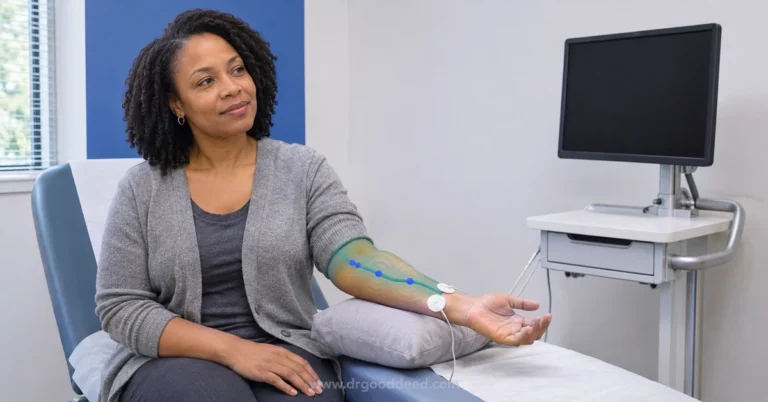
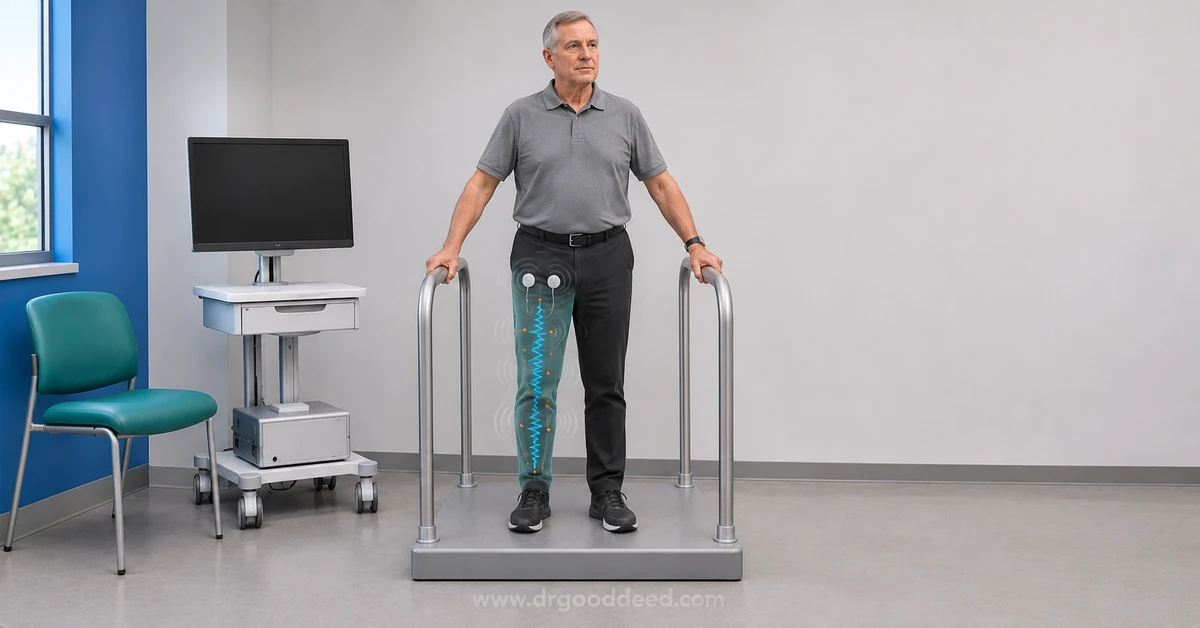

If your legs shake only when you stand still and settle as soon as you walk or sit, orthostatic tremor is one possible cause. This rare movement disorder can make standing in a line, showering, or cooking feel surprisingly difficult. The good news is that a neurologist can check what is causing the shaking and help you find ways to manage it.
Key Takeaways
- Orthostatic tremor is a rare movement disorder that makes your legs shake when you stand still and usually eases when you sit or walk.
- The cause of primary orthostatic tremor is unknown. Other medical or neurological conditions can sometimes cause a similar tremor.
- The shaking may be too fast to see. A surface EMG can record the muscle activity and help confirm the diagnosis.
- Treatment may reduce symptoms, while practical support and mobility aids can make daily activities easier. Call 911 for sudden one-sided weakness or numbness.
Orthostatic Tremor: Why Legs Shake When Standing Still
Orthostatic tremor is a rare disorder in which very fast muscle contractions start when you stand and usually settle when you sit or walk. It can make your legs feel shaky or unsteady even when the shaking is hard to see.
You may notice that:
- Your legs feel as if they are vibrating, trembling, or about to give way.
- Standing in one place feels harder than walking.
- Sitting down or leaning on a support brings relief.
- Your thighs or calves feel shaky, even if someone else cannot see the movement.
- You feel unsteady while waiting in a line, standing at the sink, or taking a shower.
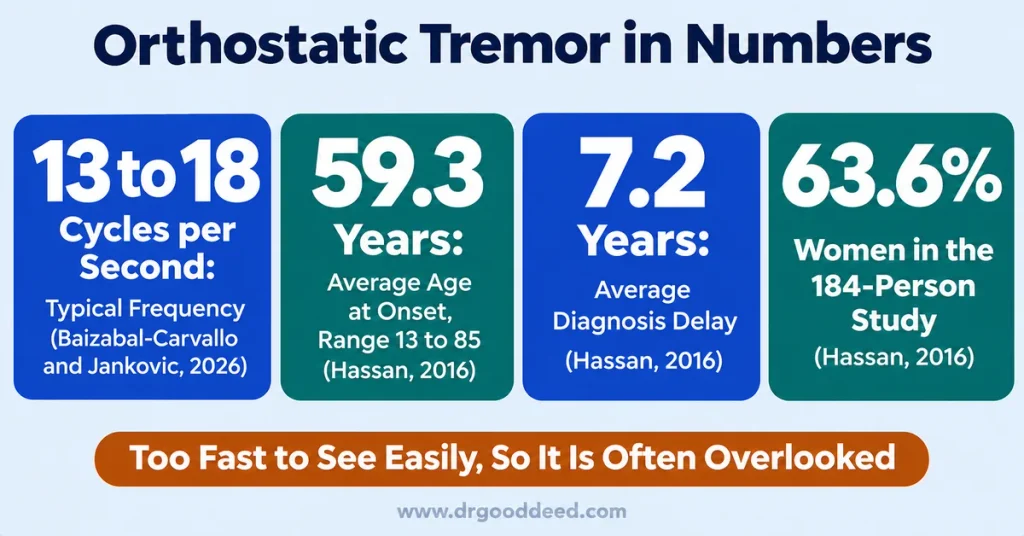
The tremor is usually very fast. A review by Baizabal-Carvallo and Jankovic (2026) describes the typical frequency as 13 to 18 cycles per second, which helps explain why it may not look like ordinary shaking. In some cases, a doctor can feel the movement in your leg muscles or hear a faint rhythmic sound with a stethoscope. A tremor is a rhythmic movement, which is different from muscle twitching all over the body.
Orthostatic tremor often begins in adulthood, but it can occur across a wide age range. In a 2016 study of 184 people (Hassan et al.), the average age when symptoms began was 59.3 years, although the range was 13 to 85 years. The study also found that diagnosis was delayed by an average of 7.2 years, showing how easily this unusual symptom can be overlooked. Women made up 63.6% of that group, and 76.5% of a separate 2016 study of 68 people (Ganos et al.).
Shaky Legs When Standing: How to Tell the Cause
Shaky legs when standing can have several causes, and the timing of the shaking is an important clue. The table below compares common patterns, but it cannot diagnose the cause on its own.
Table: Causes of shaky legs when standing, compared by timing, clue, and next step (NINDS; Medical News Today, 2025; CDC)
| Possible cause | When it tends to happen | Clue to notice | What to do next |
| Orthostatic tremor | Mainly when standing still; often eases with sitting or walking | Legs feel shaky or unsteady, sometimes without visible movement | Ask your doctor whether a movement-disorder evaluation is needed |
| Essential tremor | Often during actions such as reaching, writing, or holding objects | Shaking commonly affects the hands and arms during movement | Discuss the pattern with your doctor |
| Parkinsonian tremor | Often most noticeable when the hands are resting | May involve other movement changes, such as stiffness or slowness | Arrange a medical evaluation |
| Restless legs syndrome | During rest, often in the evening or at night | Strong urge to move the legs, often with uncomfortable sensations | Discuss symptoms and sleep disruption with your healthcare provider |
| Anxiety-related shaking | During periods of anxiety, stress, or panic | Shaking may fade as the anxiety settles | Seek support if it keeps happening or affects daily life |
| Sudden one-sided weakness or numbness | Starts suddenly, rather than following a familiar standing-only pattern | May occur with facial drooping, speech trouble, or sudden balance problems | Call 911 immediately |
Leg shaking does not necessarily mean Parkinson’s. Parkinsonian tremor often appears when the hands are resting, while orthostatic tremor is linked to standing. However, symptoms can overlap, and some people with orthostatic tremor also have another neurological condition.
Restless legs syndrome is different, too. It usually causes an uncomfortable urge to move during rest, especially at night, rather than a fast tremor that appears specifically when you stand still. Temporary shaking from anxiety usually fades once the anxiety settles.
If your legs shake only when standing still, note what happens when you sit, walk, or lean on something. That pattern can help your clinician decide what to check.
What Causes a Leg Tremor When Standing?
A leg tremor when standing often has no known cause. Doctors call this primary orthostatic tremor. Researchers are still working to understand why the rapid muscle activity develops.
There are a few forms:
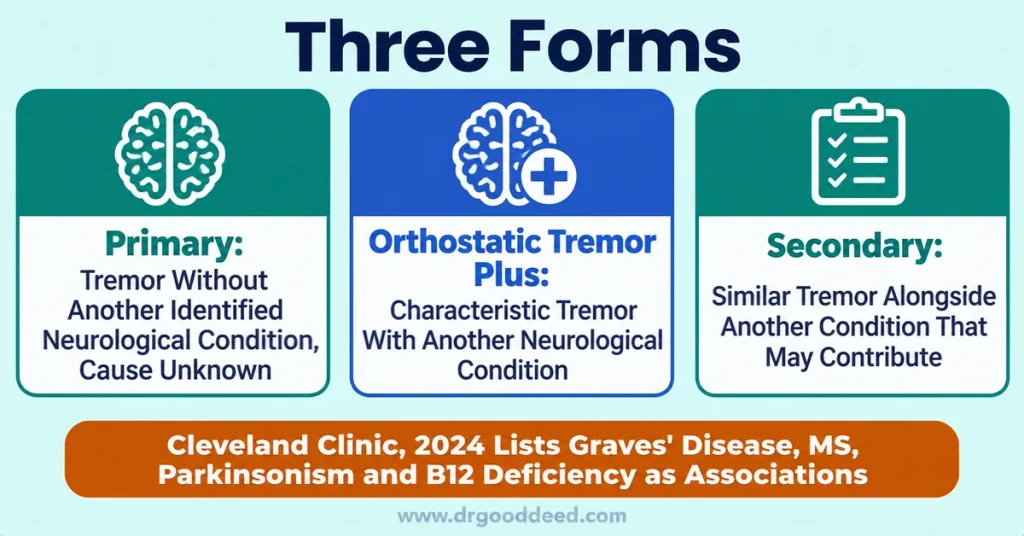
- Primary orthostatic tremor: The tremor occurs without another identified neurological condition.
- Orthostatic tremor plus: The person has the characteristic tremor along with another neurological condition.
- Secondary orthostatic tremor: A similar tremor occurs alongside another condition that may contribute to the symptoms.
Cleveland Clinic (2024) lists conditions that may be associated with secondary orthostatic tremor, including Graves’ disease, multiple sclerosis, parkinsonism, and vitamin B12 deficiency. Your doctor may consider these or other causes based on your symptoms and medical history.
A tremor does not mean you did something wrong, and there is no proven way to prevent primary orthostatic tremor. If you notice shaky legs, focus on getting the right assessment rather than trying to identify the cause yourself.
How Surface EMG Confirms the Diagnosis
Surface EMG records electrical activity from your muscles through small sensors placed on your skin. When you stand, the test can pick up the fast, rhythmic muscle activity associated with orthostatic tremor.
A movement disorders specialist or neurologist can assess your symptoms and decide whether you need this test. Your evaluation may include:
- A discussion of when the shaking starts and stops.
- A physical and neurological examination.
- Checking whether standing, walking, sitting, or leaning changes the symptoms.
- Surface EMG to record muscle activity while you stand.
- Blood tests or imaging, if needed, to look for other possible causes. Thyroid balance problems, for example, can also leave you feeling unsteady.
Because the tremor may be hard to see, it can be mistaken for another condition, including functional tremor (Cleveland Clinic, 2024). Some people describe feeling unsteady rather than noticing visible shaking, which can make the condition harder to recognize.
Doctor’s Tip: If your legs feel shaky but the movement is not obvious, tell the clinician exactly where you feel it. The doctor may be able to feel your thigh or calf muscles while you stand, even when the tremor is difficult to see.
Before your appointment, write down:
- How long you can stand before symptoms begin.
- Whether sitting or walking makes them stop.
- Whether one or both legs feel affected.
- Whether you have fallen or nearly fallen.
- Any other symptoms, such as numbness, weakness, stiffness, or sleep disruption.
- How the shaking affects everyday tasks.
You can also mention whether symptoms occur only while standing still or during other activities. That detail may help guide the evaluation.
What Helps Shaky Legs When Standing
There is no cure for orthostatic tremor, but treatment may reduce symptoms and help you stay more comfortable during daily activities. The best approach depends on how much the tremor affects you and whether another condition is present.
Your neurologist may discuss prescription treatment options. Some people notice improvement, while others get limited relief or find that the benefit fades over time (Hassan et al., 2016). Do not start, stop, or change a medicine on your own. Ask your neurologist about the likely benefits, risks, and alternatives.
For severe symptoms that do not respond well to other approaches, a specialist may discuss procedures such as deep brain stimulation. These options are considered only for selected cases, and improvement is not guaranteed.
Practical changes can also make a difference:
- Use a shower seat if standing in the shower feels unsafe or exhausting.
- Sit while preparing food, folding laundry, or doing other tasks that do not require standing.
- Use a stable counter or support when you need to stand briefly.
- Consider a mobility aid if standing in lines or moving through busy places becomes difficult.
- Ask an occupational therapist to help adapt daily activities and your home environment.
- Talk with your healthcare team about the emotional strain of living with a condition that affects your independence.
If standing in a line is difficult, a wheelchair or other mobility aid may help you conserve energy and reduce the risk of falling. Using support does not mean you are giving up. It means you are choosing a safer way to manage the activities that matter to you.
The condition can affect confidence, social plans, and mood. If you feel anxious, frustrated, or isolated because of the shaking, let your healthcare provider know. Emotional support is part of managing a long-term condition. If you have thoughts of harming yourself, call or text 988.
Does Primary Orthostatic Tremor Get Worse?
Primary orthostatic tremor can worsen over time, although the course varies from person to person. Older sources describe it as relatively stable (Mayo Clinic News Network, 2010), but later studies found that some people experienced increasing symptoms and disability.
In a 2016 study of 68 people (Ganos et al.) followed for a median of six years, 79.4% reported that their symptoms had worsened. The study also found that seven people who initially had isolated orthostatic tremor later developed additional neurological signs.
Falls deserve attention, too. In a 2016 study of 184 patients (Hassan et al.), 24.1% reported falls. An older International Essential Tremor Foundation review (2012) described falls as uncommon, so the evidence is not entirely consistent. Still, it is important not to assume that falling is unlikely or that the condition is harmless.
If you feel less steady over time, tell your doctor. Ask whether you need a mobility assessment, changes to your daily routine, or further evaluation for other symptoms.
When to See a Doctor About Shaking Legs
Make an appointment with your primary care doctor if your legs repeatedly shake when you stand, especially if the symptom affects showering, cooking, shopping, or waiting in line. Your doctor can assess possible causes and refer you to a neurologist or movement disorders specialist if needed.
Go to the ER if you have a fall with a head injury or cannot safely stand or walk. For a fall without a head injury, urgent care can check you the same day.
Call 911 immediately if leg shaking comes with sudden one-sided weakness or numbness, facial drooping, trouble speaking, sudden vision changes, or a sudden loss of balance. These can be warning signs of a stroke, even if the symptoms improve.
Numbness or tingling points elsewhere, so compare it with neuropathy in feet symptoms and tell your doctor. If your leg falls asleep easily instead of shaking, that is a different symptom with its own causes.
If standing still keeps making your legs shake, ask your primary care doctor whether orthostatic tremor could be the cause.
Frequently Asked Questions
Is Primary Orthostatic Tremor Life-Threatening?
Sources describe primary orthostatic tremor as a lasting problem with standing, with falls as the main physical risk. Falls are an important concern. A 2016 study of 184 patients reported falls in 24.1% of participants, so tell your doctor if you feel unsteady or have fallen.
Can Orthostatic Tremor Go Away?
Orthostatic tremor usually persists rather than disappearing on its own, and there is no established cure. However, treatment may reduce symptoms for some people, and practical changes can make standing and daily activities easier. If your symptoms change, discuss them with your neurologist rather than assuming the condition has resolved.
Why Is Only One Leg Shaking When I Stand?
Classic orthostatic tremor usually affects both legs in a coordinated pattern. If only one leg shakes, another cause may be responsible, so it is worth discussing with your doctor. Call 911 if one-sided shaking starts suddenly with weakness, numbness, speech changes, or other stroke warning signs.
Is Orthostatic Tremor Hereditary?
Most cases appear without a clear family history. In a 2016 study of 184 patients (Hassan et al.), a family history was reported in 4.9% of cases. That means inherited factors may play a role for some people, but family history is not present in most reported cases.
Could My Shaky Legs Just Be Anxiety?
Anxiety can cause temporary shaking, and the tremor may fade as the anxiety settles. However, legs that repeatedly shake only when you stand still and improve when you sit or walk deserve a medical evaluation. Do not assume anxiety is the cause until a healthcare professional has assessed your symptoms.
Sources
National Institute of Neurological Disorders and Stroke, Tremor (2026). link
Neurology, Orthostatic Tremor: Clinical, Electrophysiologic, and Treatment Findings in 184 Patients (Hassan et al., 2016). link
Journal of Neurology, Neurosurgery and Psychiatry, The Long-Term Outcome of Orthostatic Tremor (Ganos et al., 2016). link
Tremor and Other Hyperkinetic Movements, Shaking on Standing: A Critical Review (Erro et al., 2014). link
Seminars in Neurology, Orthostatic Tremor (Baizabal-Carvallo and Jankovic, 2026). link
National Institute of Neurological Disorders and Stroke, Restless Legs Syndrome. link
Centers for Disease Control and Prevention, Signs and Symptoms of Stroke. link
Medical Disclaimer: This article is for general information only and is not medical advice. It does not replace a diagnosis, treatment plan, or guidance from a qualified healthcare professional. Always talk to your doctor about your own symptoms and before starting, stopping, or changing any treatment. If you think you may be having a medical emergency, call 911 or go to your nearest emergency room.