

Stomach pain after eating fruit often means your gut is struggling with the sugar, fiber or acid in that fruit, not that fruit is bad for you. Fruit is supposed to be the easy, healthy part of the day, and then an apple or a glass of juice leaves you cramping. Fruit can hurt your stomach for a handful of reasons, and most are manageable once you know which one is yours.
Key Takeaways
- Stomach pain after eating fruit often comes from trouble absorbing fruit sugars, too much fiber at once, or acid reflux.
- Fructose and sugar alcohols are the usual culprits. Fructose malabsorption means the gut doesn’t absorb fructose normally.
- Fruits differ. Apples, pears and watermelon often cause trouble, while grapes, kiwi and oranges are usually easier.
- A short elimination trial of 2 to 6 weeks finds your limit (Cleveland Clinic, 2022).
- Call 911 for trouble breathing or a whole-body reaction. See a doctor if pain keeps returning or comes with weight loss or fever.
What Causes Stomach Pain After Eating Fruit?
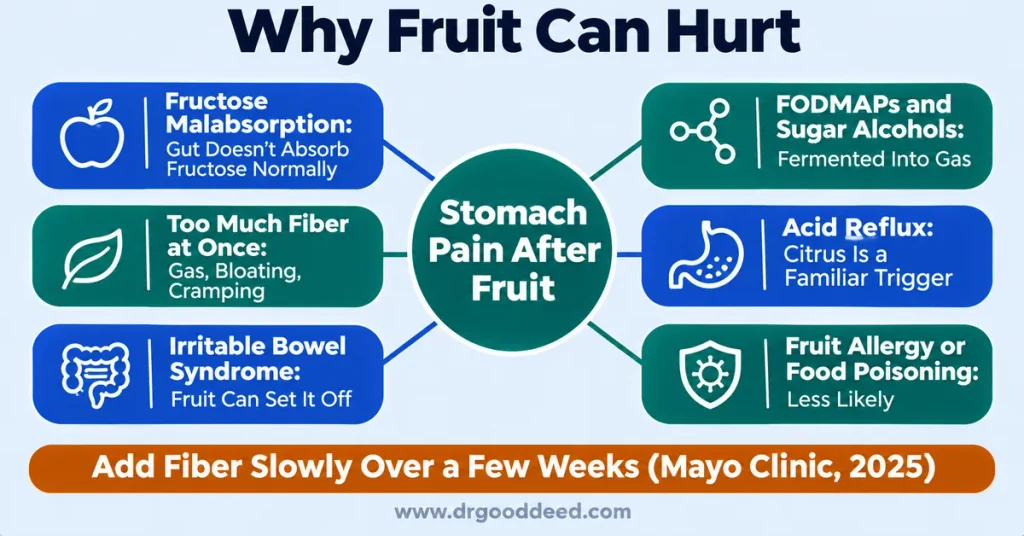
Stomach pain after eating fruit usually traces back to how your gut handles fructose, sugar alcohols, fiber, or acid. An allergy or an infection is less likely. Here are the causes, from most common to rarest.
- Fructose malabsorption: Fructose is the main sugar in fruit. When the cells lining your intestine don’t absorb it properly, you get bloating, gas, stomach pain, and either diarrhea or constipation, according to MedlinePlus Genetics. It says about 40% of people in the Western hemisphere have this. A Cleveland Clinic gastroenterologist says there are no good estimates (2021).
- FODMAPs and sugar alcohols: FODMAPs are a group of carbohydrates that pull water into the gut and then get fermented into gas by bacteria. Sugar alcohols are part of that group, sweet carbohydrates your gut absorbs poorly.
- Too much fiber at once: A big bowl of high-fiber fruit can cause gas, bloating, and cramping; hence, add fiber slowly over a few weeks (Mayo Clinic, 2025). It isn’t just a fruit problem, and it’s one reason why oats can hurt a sensitive gut.
- Acid reflux: Citrus fruits and acid reflux are a familiar pair. NIDDK lists acidic foods such as citrus among those commonly linked to GERD symptoms.
- Irritable bowel syndrome (IBS), a gut disorder with cramping and bowel changes. Fruit can set it off, and a low-FODMAP approach is often tried.
- Fruit allergy, usually an itchy mouth.
- Food poisoning, which brings diarrhea, cramps, nausea, vomiting and fever (CDC, 2025).
If other meals bring on the same pain, read more on why your stomach hurts after eating.
Which Fruits Are Most Likely to Hurt Your Stomach?
Apples, pears, watermelon, and dried fruit are common triggers, though no source ranks one fruit as the hardest to digest. Ripeness changes the picture. Cleveland Clinic’s 2022 guide says a ripe banana is high in fructose, while one that’s not quite ripe is fine. Some lists call every banana lower-fructose, so check which version you’re reading. Even the easier fruit can bother you in large amounts, as the side effects of blueberries show.
Table: Higher- and lower-fructose fruit, compared
| Group | Fruits | Why |
| More likely to cause trouble | Apples, pears, watermelon, cherries, mangoes, peaches, nectarines, plums, dried fruit | High-FODMAP fruits carry more fructose or sugar alcohols (Cleveland Clinic, 2026) |
| Juice | Fruit juice | Mayo Clinic (2024) says to limit it |
| Often easier | Cantaloupe, grapes, kiwi, oranges, pineapple, strawberries | Listed as swaps (Cleveland Clinic, 2026) |
| Depends | Bananas | Ripeness matters (Cleveland Clinic, 2022) |
How to Tell Why Fruit Hurts Your Stomach
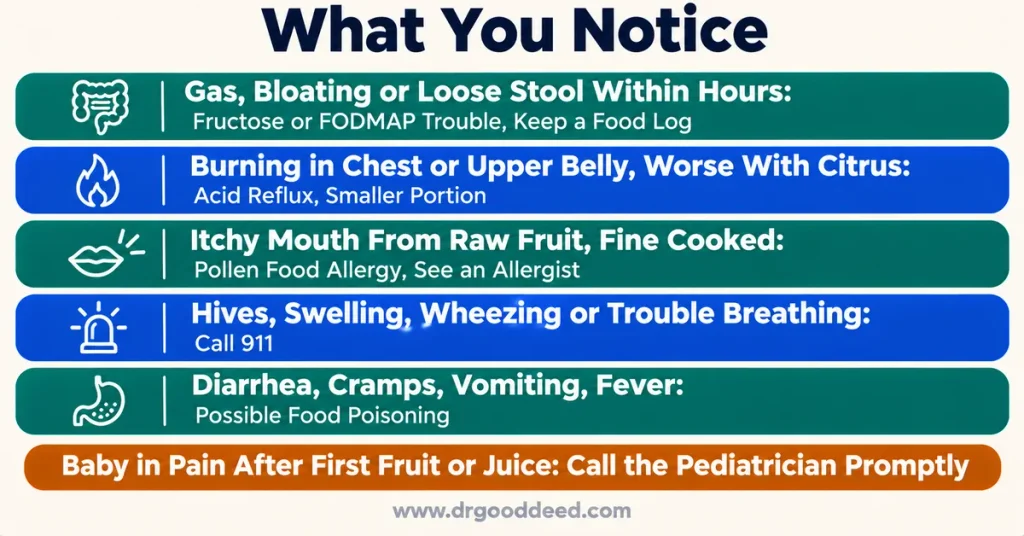
The pattern of symptoms points to the cause: gas and diarrhea suggest absorption trouble, an itchy mouth suggests pollen, and hives suggest an allergy.
Table: What you notice, the likely cause, and the next step
| What you notice | Likely cause | Next step |
| Gas, bloating or loose stool within hours, worse with apples, pears or juice | Fructose or FODMAP trouble | Keep a food log |
| Burning in the chest or upper belly, worse with citrus | Acid reflux | Tell your doctor and try a smaller portion |
| Itchy mouth or throat from raw fruit, fine when cooked | Pollen food allergy, also called oral allergy syndrome | See an allergist |
| Hives, swelling, wheezing or trouble breathing | Serious allergic reaction | Call 911 |
| Diarrhea, cramps, vomiting, fever | Possible food poisoning | See a doctor for bloody diarrhea, diarrhea beyond 3 days, fever over 102°F or dehydration (CDC, 2025) |
| A baby in pain or vomiting after first fruit or juice | Hereditary fructose intolerance | Call the pediatrician promptly |
The pollen-type fruit allergy is the one people miss. ACAAI (2019) says it usually means an itchy mouth after raw fruit, and cooked fruit is often fine. Symptoms beyond the mouth raise the risk of anaphylaxis, a severe whole-body reaction. In one study ACAAI cites, nearly 9% had symptoms beyond the mouth, and 1.7% had anaphylactic shock (ACAAI, 2019). Hives, wheezing, or trouble breathing mean 911.
Fructose Malabsorption vs Hereditary Fructose Intolerance
Fructose malabsorption is a gut absorption problem, while hereditary fructose intolerance is a rare genetic condition that starts in infancy.
Table: Fructose malabsorption and hereditary fructose intolerance compared
| Factors | Fructose malabsorption | Hereditary fructose intolerance |
| What it is | Gut cells don’t absorb fructose normally | A rare inherited condition |
| When it starts | Any age | Infancy, once fruit or juice is introduced |
| What happens | Bloating, gas, stomach pain, diarrhea or constipation | Repeated fructose can damage the liver and kidneys |
| How common | About 40% in the Western hemisphere (MedlinePlus Genetics); no good estimates (Cleveland Clinic, 2021) | Rare |
| What to do | Food log, then a guided elimination trial | Pediatrician promptly |
What Helps Stomach Pain From Eating Fruit?
A food log and a short elimination diet help you find your own limit. You do not have to stop eating fruit, because most people tolerate some fructose.
- Write down what you ate, how much, and when the pain began.
- Pick suspects from the fruit table above, ideally with a doctor or dietitian.
- Cut them out for the trial for at least 2 weeks and no more than 6 (Cleveland Clinic, 2022). It isn’t permanent.
- Add them back one at a time. Full reintroduction runs about 8 weeks (Cleveland Clinic, 2022).
- Keep what works because some people handle lower-fructose fruit, such as grapes, blueberries, and strawberries, in small amounts with meals.
- Add fiber slowly, over a few weeks.
The trial doesn’t work for everyone. Up to 25% of people with IBS may not benefit (Cleveland Clinic, 2022). If fruit sets off IBS symptoms, it helps to know how long an IBS flare lasts.
Doctor’s Tip: Do not give up all fruit for good. The point of an elimination trial is to find your own limit, since most people tolerate some fructose.
How Doctors Test for Fructose Intolerance
A hydrogen breath test measures gas in your breath after a fructose drink, and it isn’t conclusive alone.
For the test, you fast for 12 hours, drink the fructose solution, and breathe into a collection device every 15 to 30 minutes for a few hours. A rise over 20 ppm, which means parts per million, counts as positive. Between 15% and 30% of people make more methane than hydrogen, which may affect results, and Cleveland Clinic (2021) says no single test is 100% sure.
Start with your primary care doctor. A gastroenterologist handles testing, an allergist handles possible allergies, and a dietitian builds the plan.
In a hydrogen breath test, some people produce methane instead of hydrogen, so a normal test doesn’t always clear fructose, and a positive one still needs a food log and an elimination trial to show it matters for your symptoms.
When to See a Doctor for Fruit-Related Stomach Pain
Call 911 for trouble breathing or a whole-body reaction after eating fruit.
- 911: wheezing, trouble breathing, or a whole-body allergic reaction. Also vomiting blood, blood in the stool, sudden sharp belly pain or a rigid belly, which call for 911 or the ER.
- Urgent care or your doctor soon: bloody diarrhea, diarrhea beyond 3 days, fever over 102°F or dehydration.
- Primary care doctor: pain that hasn’t improved in 24 to 48 hours, bloating beyond 2 days, diarrhea beyond 5 days, or weight loss.
- Pregnancy: contact your provider about stomach pain.
Before your visit, this abdominal pain location chart can help you describe where it hurts. Book a visit if stomach pain after eating fruit keeps coming back, gets worse, or comes with weight loss or fever.
Frequently Asked Questions
Why Do Some Fruits Hurt My Stomach but Not Others?
Some fruit can hurt your stomach while other fruits do not, because fruits differ in fructose, sugar alcohols, fiber, and acid. Apples, pears and watermelon are among the likelier triggers, and grapes, kiwi, and oranges are among the easier swaps, but sensitivity varies from person to person.
Why Does an Apple Hurt My Stomach?
Stomach pain after eating an apple is common because apples are high in fructose and a high-FODMAP fruit, so a sensitive gut ferments them into gas. An itchy mouth with raw apple points to a pollen reaction instead, and cooked apple is often fine.
What Can I Do to Relieve Stomach Pain After Eating Oranges?
Oranges are lower in fructose but acidic, and citrus is among foods commonly linked to GERD symptoms. Notice whether you get heartburn, try a smaller portion, and tell your doctor if it keeps happening. If burning or pain continues, ask your doctor whether reflux is the cause.
What Fruit Will Calm an Upset Stomach?
Bananas and applesauce are part of the BRAT diet, a short list of easily digested foods. They suit a brief upset, though a not-quite-ripe banana sits better than a ripe one if you’re fructose-sensitive. If the pain lasts, see a doctor.
Does Eating Fruit on an Empty Stomach Cause Pain?
There is no clear evidence that eating fruit on an empty stomach causes the pain by itself. Some people tolerate lower-fructose fruit in small amounts with meals, so food timing may matter more. Keep a log and share it with your doctor.
Sources:
MedlinePlus Genetics, Hereditary Fructose Intolerance. link
Mayo Clinic, Fructose Intolerance: Which Foods to Avoid? (2024). link
Mayo Clinic, Dietary Fiber: Essential for a Healthy Diet (2025). link
Cleveland Clinic, 30+ High-FODMAP Foods (2026). link
Cleveland Clinic, Low-FODMAP Diet (2022). link
Cleveland Clinic, What Is Fructose Intolerance? (2021). link
Cleveland Clinic, Hydrogen Breath Test. link
Cleveland Clinic, Hereditary Fructose Intolerance. link
Cleveland Clinic, Foods for Upset Stomach. link
National Institute of Diabetes and Digestive and Kidney Diseases, Eating, Diet, and Nutrition for GER and GERD. link
American College of Allergy, Asthma and Immunology, Pollen Food Allergy Syndrome (2019). link
MedlinePlus, Food Allergy. link
MedlinePlus, Abdominal Pain. link
Centers for Disease Control and Prevention, Signs and Symptoms of Food Poisoning (2025). link
Medical Disclaimer: This article is for general information only and is not medical advice. It does not replace a diagnosis, treatment plan, or guidance from a qualified healthcare professional. Always talk to your doctor about your own symptoms and before starting, stopping, or changing any treatment. If you think you may be having a medical emergency, call 911 or go to your nearest emergency room.