
A pineal cyst found on a brain MRI is usually not serious, and most people never need treatment for it, especially when small. However, larger cysts may occasionally press on nearby structures, causing headaches, vision changes, dizziness, or balance problems.
Regular monitoring may be recommended depending on the cyst’s size, appearance, and associated symptoms. A neurologist should review the MRI findings to determine whether follow-up is necessary.
Key Takeaways
- A pineal cyst is usually a harmless, fluid-filled sac found by chance on a brain scan.
- Benign and incidental: These cysts rarely cause symptoms or need long-term monitoring.
- Size and type: The size in millimeters and whether the cyst is called “simple” decide most next steps under ACR recommendations.
- Surgery: Uncommon. It’s discussed only for symptoms, hydrocephalus, or growth.
- Emergency: Sudden severe headache, seizure, fainting, or confusion needs 911.
Is a Pineal Cyst on MRI Serious?
A pineal cyst on MRI is usually not serious because it is a noncancerous, fluid-filled sac that rarely causes symptoms. It’s typically an incidental finding, meaning a scan showed it by chance while looking for something else.
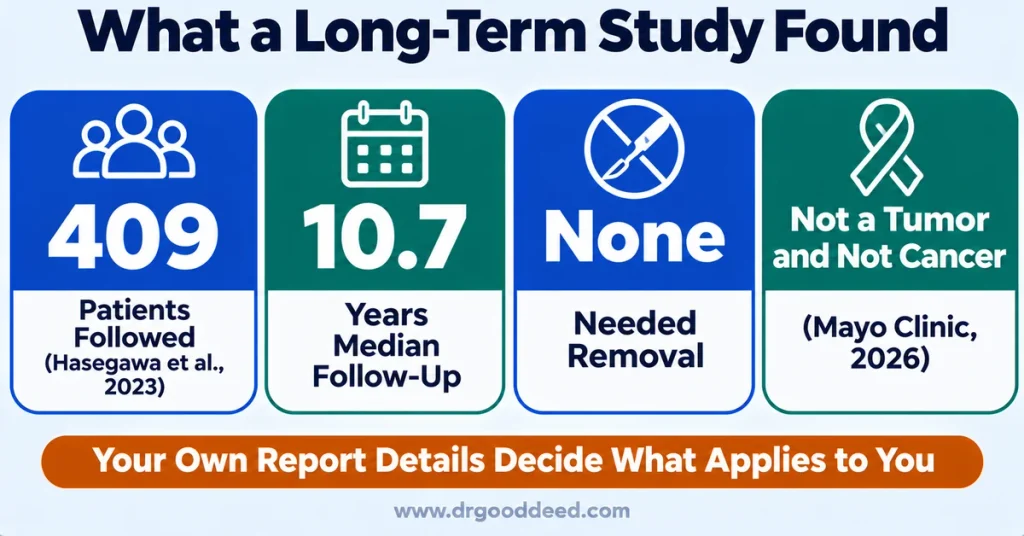
- Why it’s reassuring: A pineal cyst isn’t a tumor and isn’t cancer (Mayo Clinic, 2026), and these cysts often don’t grow. A long-term study agrees. Of 409 patients followed for a median of 10.7 years, none needed removal (Hasegawa et al., J Neurosurg, 2023).
- What could change that: Symptoms that point to the pineal region, a cyst that grows, or a report describing pressure on nearby brain structures.
- Bottom line: Most people do not need to worry, but the details on your report decide that.
A cyst is different from a growth, and these early signs of brain tumor explain which symptoms need a closer look.
What Is a Pineal Gland Cyst and How Common Is It?
A pineal gland cyst is a fluid-filled sac in the pineal gland, a tiny gland deep in the brain that makes melatonin. The cause is not known.
- How common it is depends on the scan. Radiopaedia (2026) reports 1.5 to 10.8% on standard MRI and 20 to 40% on high-resolution MRI. Plymouth NHS (2025) says 1 to 4% of people scanned for other reasons.
- Most are small. Most pineal cysts measure under 1 cm; they peak in the third and fourth decades of life, and they’re more common in females.
What Your MRI Report Means: Pineal Cyst Size and Type
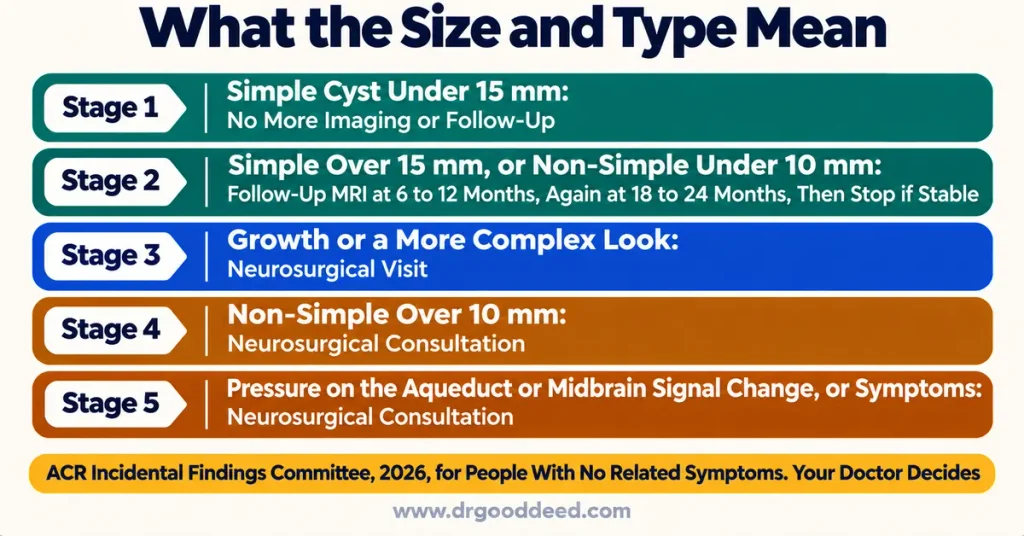
A pineal cyst with no symptoms is sorted by two things: its size and whether it’s simple. A simple cyst looks like a smooth, thin-walled sac of clear fluid. A non-simple cyst has something extra, such as a thicker wall, solid parts, or an irregular look.
You may see 10 mm quoted online as the cutoff. Under the ACR Incidental Findings Committee (2026), the line for a simple cyst is 15 mm, and a non-simple cyst under 10 mm still gets a follow-up scan. Barrow (2025) says scans every 6 to 12 months are typical, while Mayo Clinic (2026) says these cysts rarely need long-term monitoring. The ACR table is the most specific of the three.
Table: Next step for a pineal cyst found by chance on MRI, per the ACR, for people with no related symptoms. Your own doctor decides what is right for you.
| What the MRI report says | Next step in the ACR recommendations |
| Simple cyst, under 15 mm | No more imaging or follow-up |
| Simple cyst over 15 mm, or non-simple cyst under 10 mm | Follow-up MRI at 6 to 12 months. If stable, again at 18 to 24 months. If still stable, stop. Growth or a more complex look leads to a neurosurgical visit |
| Non-simple cyst over 10 mm | Neurosurgical consultation |
| Pressure on the cerebral aqueduct, or signal change in the midbrain tectum, at any size | Neurosurgical consultation |
| Symptoms that point to the pineal region | These recommendations don’t apply. Neurosurgical consultation |
Doctor’s Tip: Find two details on your report: the size in millimeters and whether the cyst is called simple, because those two details decide most next steps.
Can a Pineal Cyst Cause Headaches or Other Symptoms?
A pineal cyst usually causes no symptoms, and a headache may have another cause. Experts debate whether small cysts cause symptoms at all.
- Hydrocephalus: This is an abnormal buildup of cerebrospinal fluid in the brain. In adults, the NINDS (2026) lists headache, blurred or double vision, nausea, balance problems, and sleepiness. A larger cyst can block fluid flow, which is why hydrocephalus matters here.
- Trouble looking up: Rarely, a larger cyst pressing on the midbrain area behind it can make it hard to look upward.
- Bleeding into the cyst: Called pineal apoplexy, it’s rare and can cause a sudden, severe headache.
- Pineal cyst symptoms and sleep: Because the gland makes melatonin, some reports link cysts to sleep problems, but most cysts cause none.
Finding a cyst on a scan done for headaches doesn’t show the cyst caused them. In one UK review of 281 cysts, headache was the main reason for the scan in 50.2%, and no symptoms were attributed to the cyst (Nevins et al., World Neurosurg, 2016).
The other side of the debate comes from MUSC Health (2022), where surgeons report relief after removal in selected patients, based on their own patient survey with no control group. A headache location chart can help you describe your pain clearly at your visit. If headaches are your main concern, the main types of headaches act differently.
Pineal Cyst vs. Pineal Gland Tumor
A pineal cyst is a fluid sac, and a pineal gland tumor is a solid growth. The two can look different on MRI, which is why imaging features matter.
Table: Pineal cyst vs. pineal gland tumor
| Feature | Pineal cyst | Pineal gland tumor |
| What it is | A fluid-filled sac | A solid growth |
| Cancer | Not cancer | Can be cancer |
| Follow-up | Rarely needs long-term monitoring (Mayo Clinic, 2026) | Needs specialist evaluation |
| What imaging looks at | Size, wall, solid parts, effect on nearby structures (ACR, 2026) | Solid parts and other features raise the question |
A cyst is rarely tied to a tumor, and when it is, that is likely apparent on the first scan.
Will a Pineal Cyst Grow, and When Is Surgery Needed?
Most pineal cysts stay stable (Hasegawa et al., 2023). Pineal cyst treatment is only for symptoms, hydrocephalus, or growth.
- Growth numbers: In the 409-patient study (Hasegawa et al., 2023), 5.1% grew, and 13.9% shrank over a median 10.7 years. Radiopaedia (2026) gives 75 to 95% stable and about 5% enlarging, so the figures differ a little.
- Who it affects: Only younger age was linked with growth in that study, so growth is less of a worry in older adults.
- Who decides: A neurosurgeon, based on symptoms, scans, and fluid flow. Surgery is either removal of the cyst or creating a route for fluid to drain, and some cysts can be reached with keyhole brain surgery through a small tube.
- Risks: MUSC (2022) reports that about one-third of its patients had temporary blurry or double vision after surgery, improving within a week or two.
When to See a Doctor About a Pineal Cyst
Three levels of urgency apply here. Sudden or severe symptoms need 911, hydrocephalus-type changes need same-day care, and everything else can wait for a routine visit.
Table: Where to go for pineal cyst symptoms, by urgency
| Level | Signs | Where to go |
| 911 | Sudden severe headache, seizure, loss of consciousness, confusion, trouble walking, sudden vision problems | Call 911 |
| Same day | New or worsening headache with vomiting, double vision, balance trouble or unusual sleepiness | ER or urgent care |
| Routine | Occasional headaches, sleep problems, questions about your report or follow-up scan | Primary care doctor or neurologist |
If a new symptom starts after a pineal cyst is found, do not wait for a routine scan; call your doctor, or call 911 for an emergency sign.
Frequently Asked Questions
What Is the Prognosis for a Pineal Gland Cyst?
The prognosis for a pineal gland cyst is generally excellent, and most people live normal, healthy lives without treatment. Mayo Clinic (2026) adds that these cysts rarely need long-term monitoring. Living with a pineal cyst usually means keeping any follow-up scan your report calls for.
Can You Die From a Pineal Cyst?
Extremely rarely. A 2023 review of 49 articles found four reported sudden deaths (Atallah et al.). The real danger is untreated hydrocephalus, which can cause unconsciousness and death, so emergency signs need fast care. Tell your doctor right away about any new symptoms.
Which Doctor Should I See for a Pineal Cyst?
Start with the clinician who ordered the scan, or your primary care doctor, who can review the report. A neurologist can also help if headaches are the main concern, and the ACR (2026) sends people with symptoms, growth, or large non-simple cysts to a neurosurgeon.
Can a Pineal Cyst Affect Sleep?
It may. Some reports link pineal cysts to sleep problems because the gland makes melatonin, but most cysts cause no symptoms at all. Many common problems explain waking up at 3 a.m. and other broken sleep. If poor sleep continues, mention it to your doctor.
Do Pineal Cysts in Children Need Follow-Up Scans?
Many do not need routine scans. In a study of 79 children (Jussila et al., 2017), 70 cysts did not grow significantly, and the authors suggested follow-up only for unusual imaging features or related symptoms. The child’s doctor makes the call.
Sources
Mayo Clinic, Pineal Gland Tumor: Symptoms and Causes (2026). link
Journal of the American College of Radiology, Management of Incidentally Discovered Pineal Cyst on CT and MRI (ACR Incidental Findings Committee, 2026). link
Journal of Neurosurgery, Pineal Cyst: Results of Long-Term MRI Surveillance (Hasegawa et al., 2023). link
National Institute of Neurological Disorders and Stroke, Hydrocephalus (2026). link
Neuroradiology, Follow-Up of Pineal Cysts in Children: Is It Necessary? (Jussila et al., 2017). link
Atallah et al., Sudden Death in Patients With Pineal Cyst: Evidence From Autopsy Studies (2023). link
World Neurosurgery, Pineal Cyst Imaging Review (Nevins et al., 2016). link
MUSC Health, Uncovering the Mystery of the Pineal Cyst (2022). link
Radiopaedia, Pineal Cyst (2026). link
Medical Disclaimer: This article is for general information only and is not medical advice. It does not replace a diagnosis, treatment plan, or guidance from a qualified healthcare professional. Always talk to your doctor about your own symptoms and before starting, stopping, or changing any treatment. If you think you may be having a medical emergency, call 911 or go to your nearest emergency room.