If your room spins when rolling over in bed, the most likely cause is BPPV, a common inner-ear problem that is rarely dangerous and usually easy to treat. If the spinning comes with weakness, numbness, or slurred speech, call 911 instead.
Key Takeaways
- Your room spins when rolling over in bed mostly because of BPPV, a usually harmless inner-ear problem treated with an office maneuver.
- Tiny calcium crystals come loose in the inner ear and confuse the brain’s sense of movement. BPPV is the most common kind of vertigo.
- A Cochrane review (2014) found that the Epley maneuver raised resolution from roughly 21% to 56%, though BPPV came back in about 36% of people.
- Dizziness with weakness, numbness, slurred speech, vision problems, or trouble walking is a stroke warning sign; call 911 right away.
Why Your Room Spins When Rolling Over in Bed
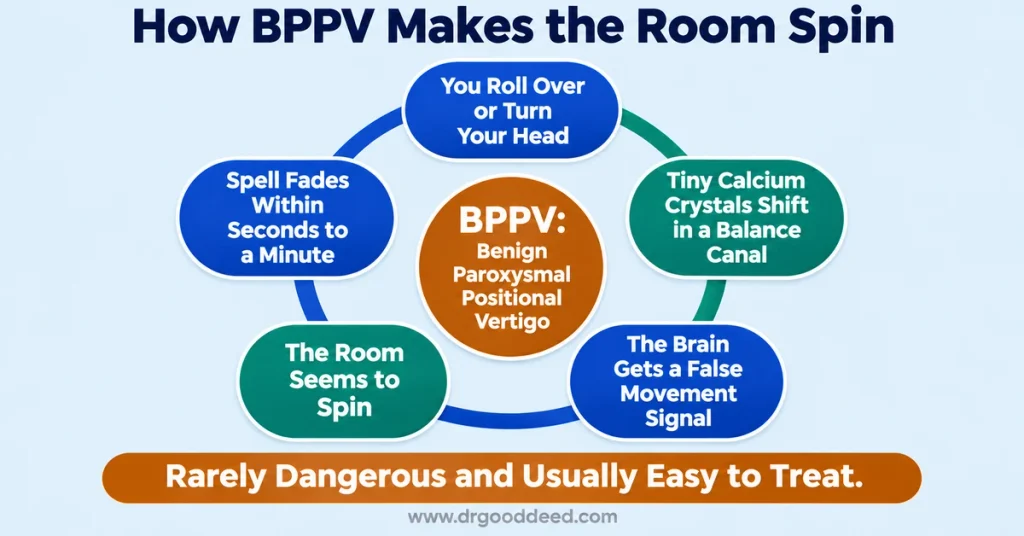
Your room spins when rolling over in bed most often because tiny calcium crystals in the inner ear, often called ear crystals, have drifted into a balance canal, so each head turn sends your brain a false spinning signal. Doctors call this benign paroxysmal positional vertigo, or BPPV.
Both MedlinePlus (2025) and Mayo Clinic (2025) explain the suddenness: one moment you’re fine, and the next you’ve rolled over and the ceiling is moving.
BPPV tops the list of vertigo causes, according to MedlinePlus. The AAO-HNS (2017) puts the share of vertigo patients who turn out to have it somewhere between 17% and 42%.
Mayo Clinic (2025) adds that it becomes more likely after age 50, is seen more often in women, and can follow a head injury, though in plenty of people nobody ever finds a reason.
What BPPV Feels Like
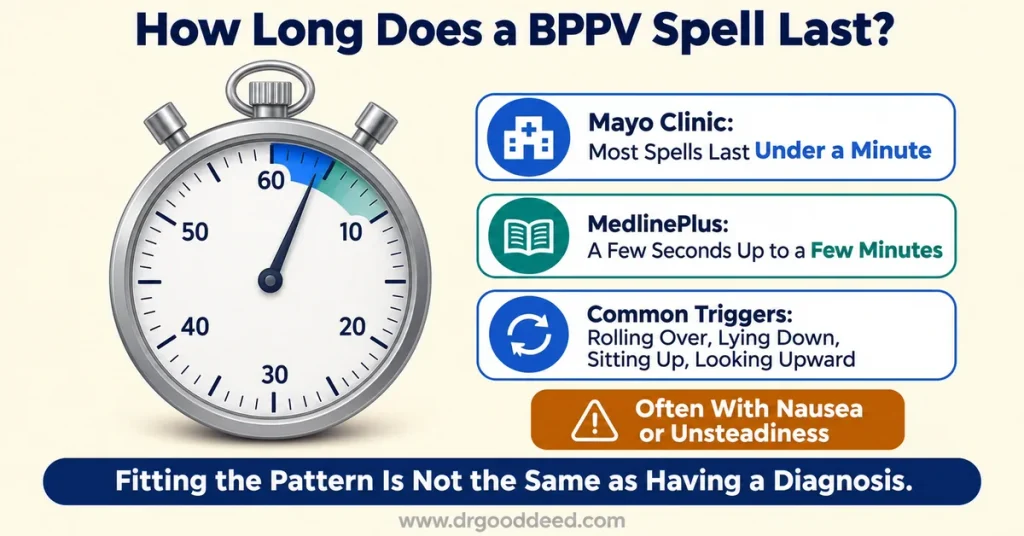
BPPV brings sudden spinning when you move your head, often with nausea and unsteadiness, and each spell usually fades within seconds to a minute.
- Mayo Clinic (2025) says most BPPV spells last under a minute; MedlinePlus (2025) gives a slightly wider window of a few seconds up to a few minutes.
- Besides rolling over, lying down, sitting up and looking upward are common triggers. Vertigo when rolling over in bed fits this pattern, although fitting the pattern is not the same as having a diagnosis.
Falls are more likely with BPPV, especially in older adults (Mayo Clinic, 2025; AAO-HNS, 2017). If the feeling is closer to being lightheaded than spinning, particularly with a racing heart, our article on anxiety and dizziness may be more relevant.
Other Causes of Spinning When Lying Down
BPPV usually announces itself with short spins that start with a head turn. When the spinning goes on for hours, arrives with hearing changes or a headache, or simply never lets up, another cause is more likely.
Several conditions can cause dizziness when lying down in bed, so the overall pattern says more than any single symptom.
| Cause | How long it lasts | Set off by position? | Other clues |
| BPPV | Seconds to a few minutes | Yes, by head movement | Often nausea or unsteadiness |
| Vestibular neuritis | Varies | Not the main trigger | Persistent vertigo, nausea, and balance problems |
| Meniere’s disease | Varies | Not the main trigger | Hearing changes |
| Vestibular migraine | Varies | Not the main trigger | Headache |
| Blood pressure drop on standing | Varies | Yes, when standing up | Lightheaded when you stand |
| Stroke | Sudden onset (NICHD, 2022) | Not by position alone | Weakness, numbness, speech or vision trouble |
| Vertigo versus lightheadedness | Not applicable | Not applicable | Spinning versus feeling faint |
Ongoing off-balance feelings that don’t follow head turns may be stress-related vertigo instead.
How Doctors Diagnose BPPV
A short bedside test, the Dix-Hallpike maneuver, usually confirms BPPV; scans are not needed unless other signs appear.
- The clinician asks what brings the spinning on and how long each episode lasts, then performs the Dix-Hallpike test, moving your head into particular positions to see whether the spinning is reproduced (MedlinePlus, 2025).
- The AAO-HNS (2017) names a supine roll test as the follow-up if the first one doesn’t explain the cause.
- Routine imaging and vestibular testing are not recommended unless other signs point to a different problem.
- Your blood pressure may also be checked, a link we explain in our guide to high blood pressure and dizziness.
Expert Insight: Under the AAO-HNS (2017) guideline, the bedside maneuver is the central test, and routine scans are discouraged.
How BPPV Is Treated
The standard approach is a repositioning maneuver, of which the Epley maneuver is the best known. It moves the stray crystals out of the canal and back to where they belong, and in some people it has to be repeated.
- For numbers, the main source is a Cochrane review by Hilton and Pinder (2014).
- It pooled 11 trials covering 745 adults and found that the Epley maneuver raised the proportion of people whose symptoms resolved from about 21% to about 56%, compared with a sham maneuver.
- About 36% of treated people had BPPV return later.
- Nausea during the procedure affected between 16.7% and 32% of participants, and some people with neck problems couldn’t tolerate it.
- Because the trials were small, followed patients for short periods and the review dates from 2014, treat the percentages as approximate.
Medicines have a limited role: the 2017 guideline recommends against routine vestibular suppressant medicines.
MedlinePlus (2025) says exercises at home may help but work more slowly, and a clinician may recommend vestibular rehabilitation, a type of balance therapy. The repositioning itself should be done by a clinician.
When Dizziness in Bed Is an Emergency
Call 911 if the spinning comes with weakness, numbness, slurred speech, vision trouble or difficulty walking (NICHD, 2022).
- Those are stroke warning signs, along with sudden weakness or numbness of the face, arm, or leg, loss of balance and a severe headache. Signs can differ, so it helps to know the stroke symptoms in women.
- The NICHD advises treating every stroke symptom as an emergency, including ones that fade. Our article on what a stroke feels like can help you recognize the signs.
Some symptoms call for prompt same-day care instead: fever, hearing loss, double vision, fainting or a fall. If your room spins when rolling over in bed and nothing else feels wrong, book a visit with your primary care doctor; if anything else feels wrong, call 911.
Frequently Asked Questions
Can Dizziness When Rolling Over in Bed Be a Stroke?
Rarely. If your room spins when rolling over in bed and it settles quickly with no other symptoms, BPPV is far more likely; spinning with weakness, numbness or slurred speech needs 911. The NICHD (2022) says to treat any stroke sign as an emergency, even if it passes.
How Long Does BPPV Last?
One spell usually lasts less than a minute per Mayo Clinic (2025), though MedlinePlus (2025) allows for a few minutes. Over a longer span, the condition can come and go, sometimes disappearing for a while before it returns. Ask a clinician if the spells keep coming back.
Can BPPV Go Away on Its Own?
It can. The 2017 AAO-HNS guideline lets clinicians offer watchful waiting with a recheck within a month, although treatment tends to bring relief sooner. Since BPPV increases the chance of a fall in the meantime, it’s wiser to have it assessed than to assume it will clear.
Will BPPV Come Back After Treatment?
It can. In the Cochrane review, about 36% of treated people had a recurrence (Hilton and Pinder, 2014), and MedlinePlus (2025) says the maneuver may need repeating. The trials were small with short follow-up, so your own odds may differ. Tell your clinician if the spinning returns.
Do You Need to Sleep Propped Up After Treatment?
Usually not. The 2017 AAO-HNS guideline recommends against routine position restrictions after a repositioning maneuver. Sleeping propped up is a common tip online, but the guideline doesn’t require it. Follow your own clinician’s instructions.
References
- MedlinePlus, Benign Positional Vertigo (reviewed July 17, 2025). link
- Mayo Clinic, Benign Paroxysmal Positional Vertigo (BPPV) (December 31, 2025). link
- Cochrane, The Epley Manoeuvre for Benign Paroxysmal Positional Vertigo (Hilton and Pinder, 2014). link
- AAO-HNS, BPPV: Experts Update Best Practices (March 1, 2017). link
- NICHD, What Are the Symptoms of Stroke? (reviewed February 1, 2022). link
Medical Disclaimer: This article is for general information only and is not medical advice. It does not replace a diagnosis, treatment plan, or guidance from a qualified healthcare professional. Always talk to your doctor about your own symptoms and before starting, stopping, or changing any treatment. If you think you may be having a medical emergency, call 911 or go to your nearest emergency room.