

Sudden hearing loss in one ear, often with muffled sound and ringing, can be a simple blockage or an inner ear problem that needs a doctor right away. Earwax and fluid are common and fixable, but sudden sensorineural hearing loss is an emergency that needs medical care.
Key Takeaways
- Sudden hearing loss in one ear should be treated as an emergency until a doctor rules out inner ear damage, so get checked the same day.
- Only about 10% of people diagnosed have an identifiable cause, so most cases have no clear explanation (NIDCD, 2018).
- Treatment delayed more than 2 to 4 weeks is less likely to reverse the loss (NIDCD, 2018).
- Call 911 if hearing loss comes with face drooping, weakness, confusion, trouble speaking or severe headache.
Is Sudden Hearing Loss in One Ear an Emergency?
Yes, sudden hearing loss in one ear should be treated as an emergency, because inner ear (sensorineural) hearing loss responds best to treatment started early. Muffled hearing in one ear may be earwax or fluid, but only an exam can say which.
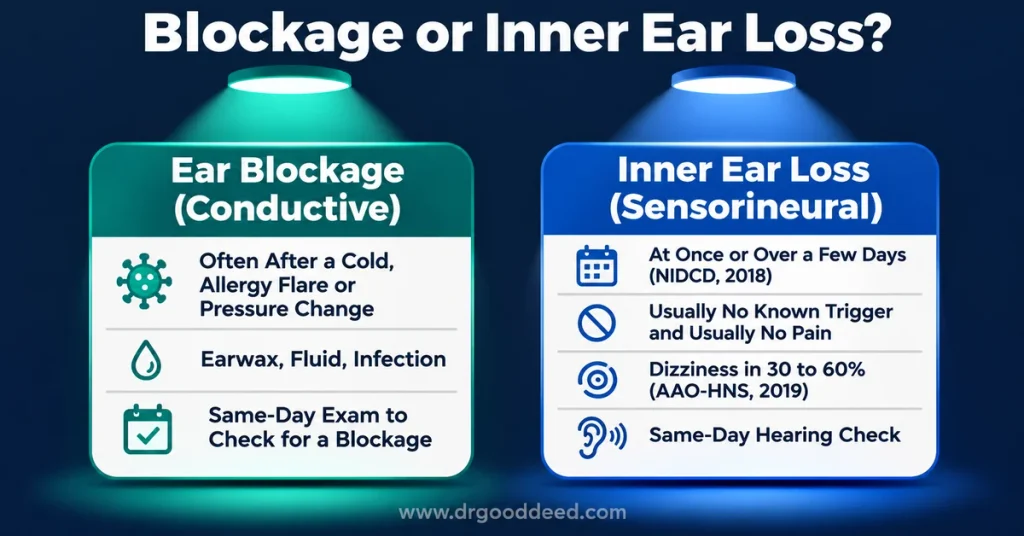
| Feature | Ear blockage (conductive) | Inner ear loss (sensorineural) |
| How it starts | Often after a cold, allergy flare or pressure change | At once or over a few days (NIDCD, 2018) |
| Trigger | Earwax, fluid, infection | Usually none found; about 10% have a known cause (NIDCD, 2018) |
| Pain | Possible, especially with infection | Usually none |
| Ringing | Can occur | Common (NIDCD, 2018) |
| Dizziness | Less typical | 30 to 60% of people (AAO-HNS, 2019) |
| What to do | Same-day exam so a doctor can check for a blockage first | Same-day hearing check, because early treatment works best |
Why One Ear Feels Blocked and Rings
When the inner ear sends a weaker signal, the brain often fills the gap with ringing, so muffling and tinnitus tend to arrive together (Cleveland Clinic, 2025). That is why sudden hearing loss in one ear and ringing so often show up as a pair.
- Ear fullness: a plugged feeling alongside dizziness and ringing. Wax and fluid cause it too, so it cannot separate the causes.
- One ear blocked and ringing: ringing in one ear (tinnitus, a sound with no outside source) plus a blocked feel can come from a blockage or the inner ear. An exam and hearing test tell them apart.
- A pop: some people hear or feel a pop just before the loss (NIDCD, 2018).
- When people notice: many first notice it on waking or when they hold a phone to that ear (NIDCD, 2018), so the true start time is often unclear.
Ringing that beats in time with your pulse is a different symptom called pulsatile tinnitus, which has its own causes.
Common Causes of Sudden Muffled Hearing in One Ear
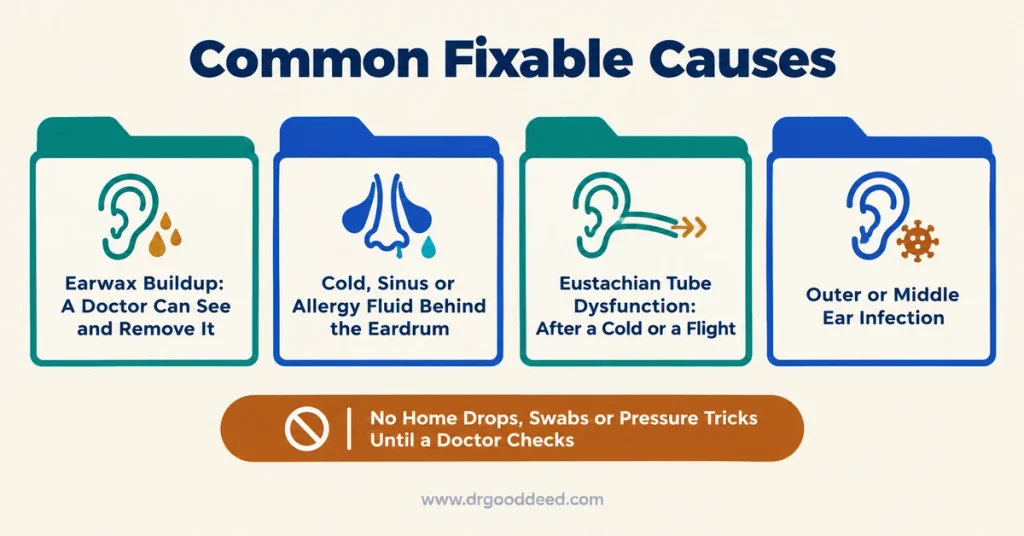
The most common fixable causes are earwax, fluid from a cold or allergy, and pressure changes, which block sound before it reaches the inner ear. NIDCD (2018) calls this conductive loss, and doctors check for it first.
- Earwax buildup: wax can plug the ear canal and dull sound. A doctor can see it and remove it.
- Cold, sinus or allergy fluid: fluid behind the eardrum blocks sound from passing through (NIDCD, 2018).
- Eustachian tube dysfunction: the eustachian tube is the small channel that balances pressure behind the eardrum. It can fail to open after a cold or a flight. Cleveland Clinic (2025) separates this from SSNHL.
- Ear infections: outer and middle ear infections can muffle hearing too, and a guide to types of ear infections explains how each one feels.
The causes of hearing loss in only one ear also include the inner ear and nerve problems covered next. Skip home drops, swabs and pressure tricks until a doctor has checked the ear, because they can delay a time-sensitive diagnosis.
What Causes Sudden Sensorineural Hearing Loss?
Most cases have no clear cause. NIDCD (2018) says only about 10% of people diagnosed have an identifiable cause, so the most common cause of sudden hearing loss is unknown. It most often appears in midlife: late 40s and early 50s (NIDCD, 2018), 40s and 50s (Cleveland Clinic, 2025), and 50s and 60s (Harvard Health, 2019).
Viral Infection or Inflammation
Infection and inflammation are among the known triggers. NIDCD (2018) lists infections and autoimmune disease, in which the immune system attacks inner ear tissue, but links only about 10% of cases to any identifiable cause. It also lists head trauma, ear-toxic drugs (ototoxicity) and multiple sclerosis, one of several autoimmune neurological disorders, so tell your doctor every medicine you take.
Reduced Blood Flow to the Inner Ear
NIDCD (2018) lists circulation problems as a cause, and Harvard Health (2019) says sudden loss may signal a small stroke. A blocked blood supply can harm the inner ear much as an eye stroke harms the retina. There is no home check for the symptoms of an ear stroke, so call 911 if the hearing loss comes with one-sided weakness, face drooping or trouble speaking (American Stroke Association).
Meniere’s Disease
Meniere’s disease is an inner ear disorder that NIDCD (2018) lists among known causes. It often shows up as repeated episodes of vertigo (a spinning feeling), ear fullness and ringing, with hearing changes. A first episode can look like SSNHL, so an exam and hearing test decide which it is.
Acoustic Neuroma
An acoustic neuroma, also called a vestibular schwannoma, is a noncancerous tumor on the hearing nerve. NIDCD (2018) says sudden loss in one ear means doctors should rule out hearing nerve tumors, which is why an MRI is often part of the workup. It is a rare cause, and most people with sudden hearing loss in one ear do not have one.
How Doctors Test and Treat Sudden Hearing Loss
A doctor first checks for a blockage, then orders a hearing test within days to confirm inner ear loss and start treatment early.
- Ear exam: the doctor looks for wax, fluid or infection to rule out conductive loss.
- Hearing test: pure tone audiometry, a test using tones of different pitch and loudness, is done within a few days (NIDCD, 2018).
- The 30 dB rule: SSNHL means a loss of at least 30 decibels (units of sound loudness) in three connected frequencies within 72 hours (NIDCD, 2018).
- Other tests: NIDCD (2018) lists blood tests, MRI and balance tests.
- Treatment: an ENT doctor (ear, nose and throat specialist) prescribes it, either by mouth or as an injection through the eardrum (NIDCD, 2018). Timing matters, and sources differ: NIDCD (2018) says delay beyond 2 to 4 weeks is less likely to reverse loss, Harvard Health (2019) quotes a 10 to 14 day window, and Cureus (2022) says treatment within 7 days does better.
- If loss stays: hearing aids or cochlear implants (devices that stimulate the hearing nerve) can help.
Expert Insight: Clinicians define SSNHL by numbers, not by how bad it sounds: at least 30 decibels lost across three connected frequencies within 72 hours (NIDCD, 2018). A person who feels only muffled can meet that threshold, so a hearing test, not self-assessment, decides whether it counts as an emergency.
Can Hearing Come Back After Sudden Hearing Loss?
Often yes. About half of people recover some or all hearing on their own within 1 to 2 weeks (NIDCD, 2018), and early treatment improves the odds, but hearing does not come back for everyone and outcomes vary.
- Recovery ranges: NIDCD (2018) says about half recover some or all hearing, usually within 1 to 2 weeks. Cleveland Clinic (2025) says half to two-thirds.
- Severity: Harvard Health (2019) says about 20% of moderate or severe cases recover fully. Cleveland Clinic (2025) says mild loss treated within a week does better.
- Poorer signs: Cureus (2022) lists vertigo as a sign of a poorer outcome.
When to See a Doctor for Sudden Hearing Loss
Get seen the same day for any sudden hearing loss in one ear, and call 911 if it comes with stroke signs.
- 911: hearing loss with sudden one-sided numbness or weakness, face drooping, confusion, trouble speaking or a severe headache (American Stroke Association).
- ER or urgent care: go here if no same-day appointment is available. AAO-HNS (2019) says care often starts at the ER, urgent care, or primary care.
- Primary care doctor: a same-day visit for an ear exam and a referral.
- ENT and audiologist: the ENT treats inner ear loss, and the audiologist (hearing specialist) runs the hearing test.
If you notice sudden hearing loss in one ear, do not wait to see if it clears on its own; get a hearing check the same day.
Frequently Asked Questions
Can a Brain Tumor Cause Ringing in One Ear?
Yes, rarely. A noncancerous tumor on the hearing nerve, called an acoustic neuroma, can cause one-sided hearing loss and ringing, which is why an MRI is often ordered (NIDCD, 2018). One-sided hearing loss is only one of the early signs of a brain tumor, and most cases have other causes.
Is Sudden Deafness in One Ear Common?
No, it is uncommon. Estimates range from 5 to 27 per 100,000 people a year (AAO-HNS, 2019) to 1 to 6 per 5,000 (NIDCD, 2018), which says it is likely undercounted. AAO-HNS (2019) puts it at about 66,000 new US cases a year.
Is Sudden Muffled Hearing in One Ear Serious Without Pain?
Yes, sudden muffled hearing in one ear can be serious even without pain, because inner ear hearing loss usually does not hurt. No pain does not make it safe to wait. Delay lowers treatment effectiveness (NIDCD, 2018), so sudden hearing loss in one ear with no pain still needs a same-day check.
Can Sudden Muffled Hearing Come and Go?
Yes. Brief muffling after a cold or flight is often a blocked eustachian tube, the small channel that balances ear pressure (Cleveland Clinic, 2025). Repeated episodes with vertigo and ear fullness can point to Meniere’s disease. A hearing test can help sort out which.
Can Sudden Hearing Loss Happen in Both Ears?
Yes, but it usually affects one ear. Autoimmune disease is one cause that can involve both ears, and sudden loss in both ears needs urgent care too. Do not wait to see if one ear recovers; get a same-day hearing check.
Sources
- National Institute on Deafness and Other Communication Disorders (NIDCD), Sudden Deafness (2018). link
- American Academy of Otolaryngology-Head and Neck Surgery, Sudden Hearing Loss: Update to Guideline to Improve Implementation and Awareness (2019). link
- Cleveland Clinic Health Essentials, Why Does Sudden Hearing Loss Happen? (2025). link
- Harvard Health Publishing, Now Hear This: Don’t Ignore Sudden Hearing Loss (2019). link
- Cureus, Sudden Sensorineural Hearing Loss and Why It’s an Emergency (2022). link
- American Stroke Association, Signs and Symptoms of Stroke. link
Medical Disclaimer: This article is for general information only and is not medical advice. It does not replace a diagnosis, treatment plan, or guidance from a qualified healthcare professional. Always talk to your doctor about your own symptoms and before starting, stopping, or changing any treatment. If you think you may be having a medical emergency, call 911 or go to your nearest emergency room.