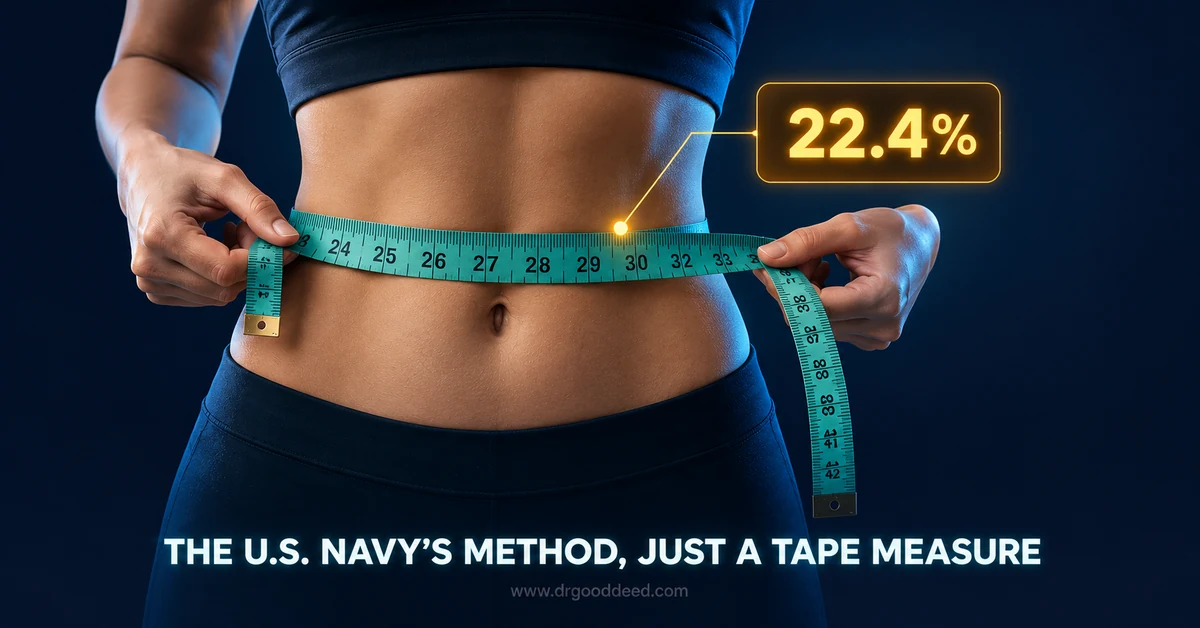

A body fat percentage calculator estimates how much of your body weight comes from fat versus lean tissue, using tape measurements instead of expensive lab equipment. This body fat calculator for men and women applies the U.S. Navy circumference method, a formula the Navy has used since 1981 to track body composition in active-duty personnel.
The result sorts you into a category, essential fat, athletic, fitness, average, or obese, based on standards from the American Council on Exercise (ACE). Below, you will find the exact ranges by sex and age, an honest look at how accurate a tape measurement can be, and when a number like this is worth a conversation with your doctor.
Key Takeaways
- This body fat percentage calculator uses the U.S. Navy tape method: height, neck, and waist for men; height, neck, waist, and hip for women.
- Healthy ranges differ by sex. Women naturally carry more essential fat (10% to 13%) than men (2% to 5%) to support reproductive and hormonal function.
- Body fat percentage vs BMI: body fat percentage tells you what your weight is made of; BMI only compares weight to height.
- This is an estimate, not a diagnostic measurement. Expect the result to sit within about 3 to 4 percentage points of a lab-grade reading.
- More precise options exist, including a DEXA scan and hydrostatic weighing, for anyone who needs a clinical-grade number.
How This Calculator Works
The US Navy body fat method was developed by researchers James Hodgdon and Marcie Beckett at the Naval Health Research Center in 1984, and the Navy still uses it under its Physical Readiness Program. Instead of calipers or a scale, it uses a cloth or flexible tape measure at three or four sites.
- Men need three inputs: height, neck circumference (measured just below the larynx), and waist circumference (measured at the navel).
- Women need four inputs: height, neck circumference, waist circumference (measured at the narrowest point), and hip circumference (measured at the widest point).
- The formulas differ by sex because they use logarithmic equations built from separate validation studies on male and female Navy personnel, not a single unisex formula adjusted after the fact.
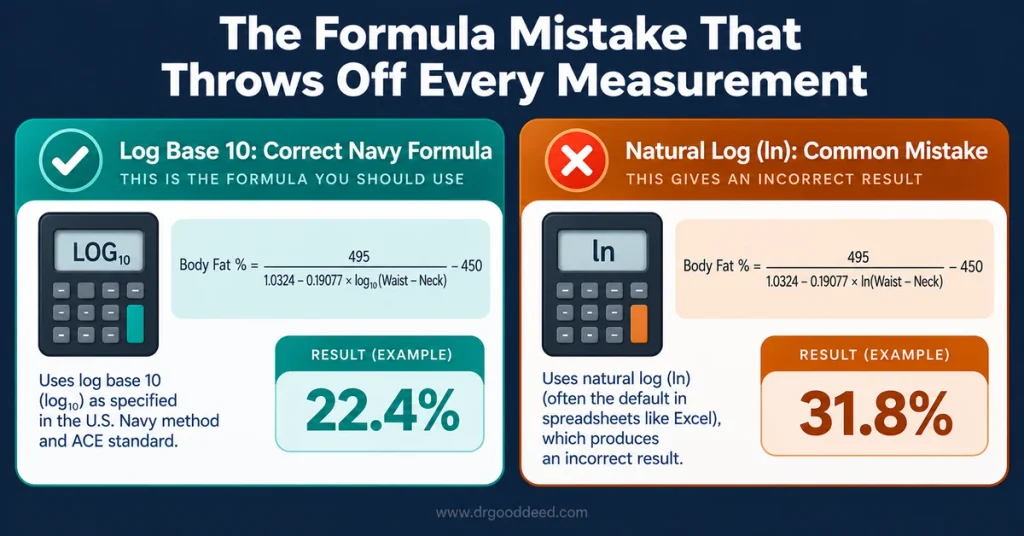
- A detail most calculators never mention: the math uses log base 10, not natural log. Punch the wrong log function into a spreadsheet and the output can be off by several percentage points, even though every measurement was taken correctly.
Measure at the same time of day, ideally in the morning before eating, and keep the tape snug but not compressed against the skin.
Healthy Body Fat Percentage Ranges by Sex and Age
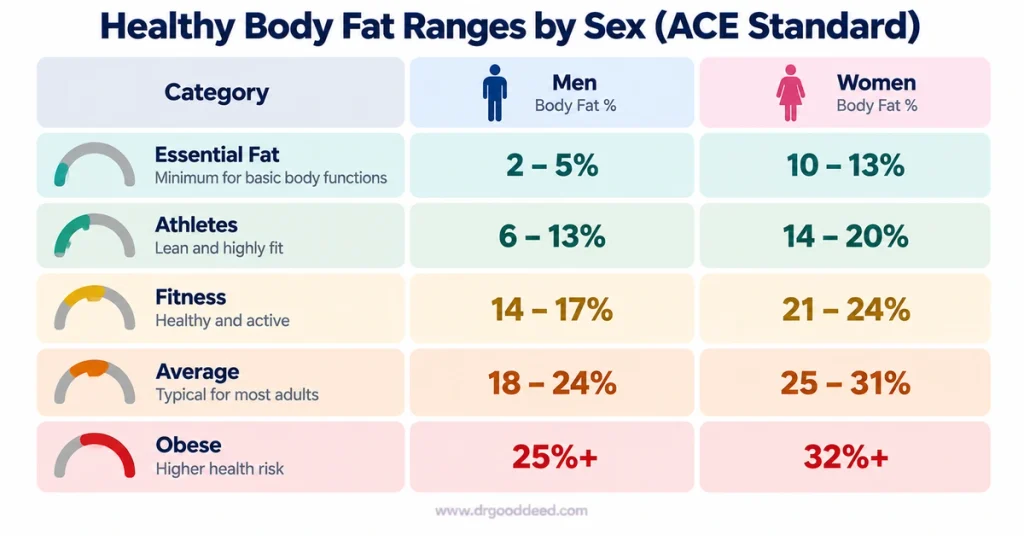
The chart below uses the five-category system published by the American Council on Exercise, the reference most personal trainers and sports medicine clinicians use for adults.
| Category | Men | Women |
| Essential fat | 2% to 5% | 10% to 13% |
| Athletes | 6% to 13% | 14% to 20% |
| Fitness | 14% to 17% | 21% to 24% |
| Average | 18% to 24% | 25% to 31% |
| Obese | 25% and above | 32% and above |
A separate, peer-reviewed approach from researchers at Columbia University ties healthy body fat percentage by age directly to the BMI thresholds set by the NIH and WHO.
- Using that model, a healthy range for adults ages 20 to 39 runs roughly 8% to 19% for men and 21% to 32% for women, and that ceiling rises by about 3 to 5 percentage points per sex by ages 60 to 79.
- Sarcopenia, the gradual loss of muscle mass with age, means the same body weight contains a smaller share of muscle and a larger share of fat over time, even without any weight gain on the scale.
Why Body Fat Percentage Is a Better Metric Than BMI Alone
Body mass index only divides weight by height squared. It cannot tell the difference between 20 pounds of muscle and 20 pounds of fat, which is why our body mass index page already flags this limitation directly.
- A muscular athlete can register as “overweight” on BMI while sitting in the athletic body composition category on a tape measurement.
- A person with a “normal” BMI can still carry a high fat percentage relative to lean mass, a pattern researchers call normal-weight obesity.
- Two people with identical BMI numbers, same height, same weight, can differ by 10 or more percentage points in actual body fat depending on muscle mass, sex, and age.
Expert Insight: A BMI in the “healthy” range does not rule out excess visceral fat, especially in people who have lost muscle mass through inactivity or aging. Clinicians increasingly use body fat percentage or waist circumference alongside BMI specifically because BMI alone misses this normal-weight obesity pattern in an estimated one in four adults with a nominally healthy BMI.
How Accurate Is This Calculator?
The US Navy body fat method correlates at r=0.90 with underwater hydrostatic weighing in the original validation study, with a standard error of about 2.7 to 4 percentage points depending on sex.
- This is an estimate, not a diagnostic measurement. Every result from this body fat percentage calculator should be read as a range.
- Body fat calculator accuracy drops further at the extremes: people who are very lean, very muscular, or carry fat in an unusual distribution tend to see larger errors than the general population the formula was built on.
- A single loose or tight tape pull at the waist can shift the result by a full percentage point or more, which is why consistency in technique matters as much as the formula itself.
- Talk to your doctor for a clinical assessment if you need a number for a medical decision rather than a fitness benchmark.
Pro Tip: Measure your waist twice, a few minutes apart, and average the two readings. Waist circumference can shift measurably after a large meal, a bloating episode, or a heavy hydration load, and averaging cancels out most of that noise without needing new equipment.
Other Ways to Measure Body Fat
- DEXA scan: Considered the clinical reference standard. It uses low-dose X-rays to separate fat, lean tissue, and bone, and it can map where fat sits on the body, not just how much exists.[4] Cost and clinic access are the main barriers for everyday use.
- Hydrostatic weighing: Estimates body density by comparing weight on land to weight underwater. It is accurate but requires full submersion and specialized equipment most people never have access to.
- Bioelectrical impedance: Sends a low, painless electrical current through the body and estimates fat from how much resistance it meets. It is convenient, sold in home scales, but a 2019 comparison against DEXA in youth found bioelectrical impedance readings could differ from DEXA by more than 10 percentage points in some individuals, driven heavily by hydration status.[5]
- Skinfold calipers: Pinches skin at multiple sites to estimate subcutaneous fat thickness. Accuracy depends heavily on technician skill and consistent site selection, more than on the calipers themselves.
Every field method, tape, calipers, or a home scale, trades some precision for convenience. Choose based on what you need the number for: general tracking favors convenience, while a medical decision favors DEXA.
When to Talk to a Doctor About Body Composition
A single body fat percentage calculator reading rarely needs a doctor’s visit on its own. Talk to your doctor if your result consistently falls in the obese range alongside other risk signals, such as a large waist circumference, high blood pressure, or a family history of type 2 diabetes or heart disease. A physician can also order a DEXA scan or refer you to a dietitian when body composition is the real concern behind a broader health plan.
FAQs
Is the U.S. Navy method accurate?
Yes, within limits. It correlates 0.90 with hydrostatic weighing and carries a standard error of about 3 to 4 percentage points, so treat the output as a range, not an exact number, especially at very low or very high body fat.
What is essential body fat?
Essential fat is the minimum fat your body needs for hormone production, organ cushioning, and cell membrane function. It is 2% to 5% in men and 10% to 13% in women, higher in women due to reproductive biology.
Does body fat percentage change with age?
Yes. Healthy ranges rise by roughly 3 to 5 percentage points from your 20s to your 60s because muscle mass naturally declines with age, so the same body weight shifts toward a higher fat share over time.
Can two people with the same BMI have different body fat percentages?
Yes. BMI cannot separate muscle from fat, so two people at the identical height and weight can differ by 10 or more percentage points in actual body fat depending on muscle mass, sex, and fat distribution.
How often should you measure body fat percentage?
Every four to six weeks is enough to see a real trend. Weekly measurements mostly capture water weight and measurement noise rather than genuine changes in body composition.
Sources
- Hodgdon JA, Beckett MB. Prediction of Percent Body Fat for U.S. Navy Men From Body Circumferences and Height. Naval Health Research Center Report No. 84-11 (1984) link
- American Council on Exercise. Percent Body Fat Norms for Men and Women link
- Gallagher D, Heymsfield SB, Heo M, et al. Healthy Percentage Body Fat Ranges: An Approach for Developing Guidelines Based on Body Mass Index. Am J Clin Nutr. 2000;72(3):694-701 link
- Marra M, et al. Assessment of Body Composition in Health and Disease Using Bioelectrical Impedance Analysis and DXA: A Critical Overview. Contrast Media Mol Imaging. 2019 link
- Body Fat Assessment in Youth With Overweight or Obesity by an Automated Bioelectrical Impedance Device, Compared With DEXA. BMC Pediatrics link
- CDC. BMI Frequently Asked Questions link
- Tran ZV, Weltman A. Predicting Percent Body Fat From Circumference Measurements. Research Quarterly for Exercise and Sport. 1989 link
- Peterson DD. History of the U.S. Navy Body Composition Program. Military Medicine. 2015 link
This tool gives an estimate only. It is not a diagnostic measurement and does not replace a clinical body composition assessment from your doctor.