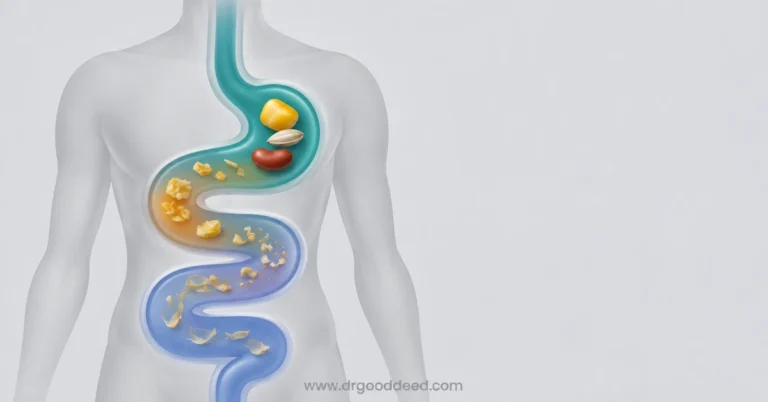

Feeling bloated after bread with a negative celiac test is common, and it usually points to fructans, gluten sensitivity or IBS rather than celiac disease. A negative result taken while you were eating gluten makes celiac disease much less likely, but it does not rule out every cause. This guide covers how a test can miss celiac disease, the other causes and how to find your trigger with a clinician.
Key Takeaways
- Feeling bloated after bread with a negative celiac test is real; fructans, gluten sensitivity, IBS or a missed celiac result are the usual reasons.
- A celiac test can miss the disease if you were not eating gluten before it, so do not go gluten-free before testing (NIDDK, 2020).
- In one 2018 trial of 59 people, fructans raised bloating scores more than gluten did (Skodje et al., Gastroenterology, 2018).
- Talk to a doctor or dietitian before cutting out gluten, and call 911 if wheat causes trouble breathing or swelling of the lips or tongue.
Bloated After Bread With a Negative Celiac Test?
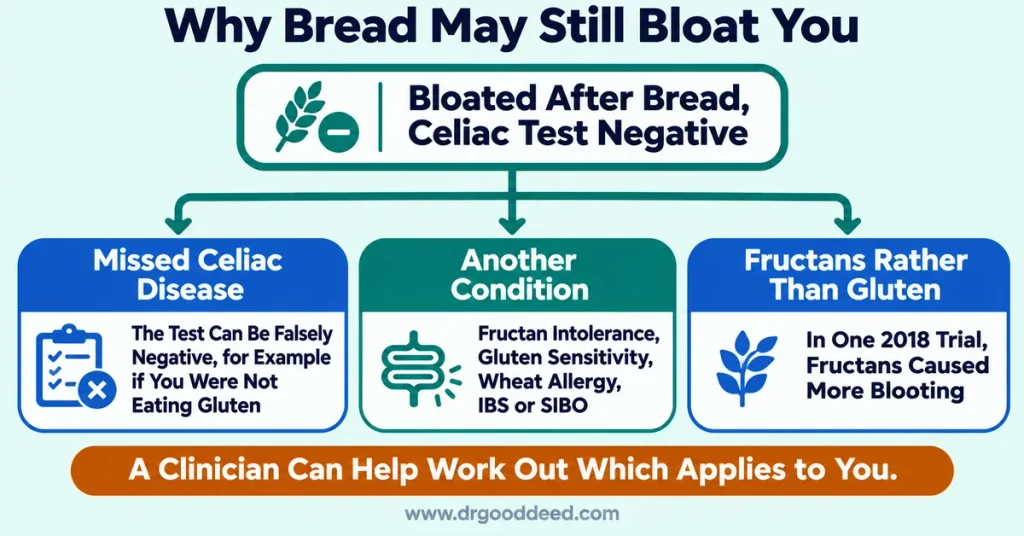
Being bloated after bread with a negative celiac test usually means something in the bread other than celiac disease is the trigger, most often fermentable carbs called fructans. The main reasons are:
- Missed celiac disease: the test can be falsely negative, for example if you were not eating gluten before it.
- Another condition: fructan intolerance, gluten sensitivity, wheat allergy, IBS or SIBO can all cause bloating after bread.
- Fructans rather than gluten: in one 2018 trial, fructans caused more bloating than gluten did.
The opposite pattern happens too, and some people find oats hurt your stomach while wheat sits fine.
Could Your Celiac Test Have Been Wrong?
Yes, it can happen, most often when you were not eating gluten before the test or have low IgA levels. NIDDK (2020) advises against starting a gluten-free diet before testing, because it can affect the results.
Beyond Celiac (2025) suggests eating gluten daily for at least six weeks before a celiac blood test. If you had already cut out gluten, a clinician decides how to test you, so do not restart gluten on your own to find out.
IgA deficiency can cause a false negative celiac test, because the usual antibody test looks for IgA. Beyond Celiac (2025) says about 2% of people with celiac disease have it, so ask whether your total IgA was checked.
If the DQ2 and DQ8 gene variants are absent, celiac disease is very unlikely, but a positive gene test does not confirm it (NIDDK, 2020). An upper endoscopy with small-intestine biopsies is the gold standard for diagnosis (Beyond Celiac, 2025), so a negative celiac blood test but positive biopsy can happen.

Other Conditions That Feel Like Celiac Disease
Fructan intolerance, gluten sensitivity, wheat allergy, IBS and SIBO can all cause bloating after bread, and their symptoms overlap with celiac disease, an autoimmune condition. The difference between celiac disease and gluten intolerance is that gluten intolerance does not cause the intestinal damage of celiac disease (Beyond Celiac, 2025).
| Condition | Trigger | Key clue | How it is checked |
| Fructans (FODMAPs) | Fermentable carbs in wheat that some people absorb poorly | Gas, bloating and bowel changes | Elimination and reintroduction with a dietitian (Beyond Celiac, 2025) |
| Wheat allergy | Immune overreaction to wheat | Fast reaction: itching, hives, trouble breathing or swelling of the lips or tongue | Blood and skin tests (Cleveland Clinic, 2026) |
| Non-celiac gluten sensitivity (NCGS) | Gluten or other parts of wheat | Bloating, gas, tiredness; celiac tests are negative and the intestine is not damaged | No test; diagnosed by ruling out other causes (Beyond Celiac, 2025) |
| IBS or SIBO | IBS: several food triggers; SIBO: too many bacteria in the small intestine | Cramping, bloating, diarrhea or constipation | A doctor rules out other causes (Beyond Celiac, 2025) |
A wheat allergy also has to be ruled out before sensitivity is considered (Celiac Disease Foundation).
Non-celiac gluten sensitivity describes symptoms like those of celiac disease that improve when gluten is removed, after celiac disease and wheat allergy have been ruled out (Celiac Disease Foundation). Cleveland Clinic (2026) calls it non-celiac gluten or wheat sensitivity.
Wheat sensitivity symptoms include bloating, gas, diarrhea or constipation, stomach pain, brain fog, fatigue, headache, and joint pain. Symptoms can last for several hours or days after eating gluten (Cleveland Clinic, 2026).
There is no test for gluten sensitivity, so it is diagnosed by ruling out celiac disease, IBS, IBD and a wheat allergy (Beyond Celiac, 2025).
Is It the Gluten or the Fructans?
For many people it is the fructans. In one 2018 trial of 59 people with self-reported gluten sensitivity, fructans raised overall and bloating scores more than gluten did, and gluten and placebo did not differ (Skodje et al., Gastroenterology, 2018).
Fructans are fermentable carbs (FODMAPs) in wheat that some people absorb poorly. The Celiac Disease Foundation also names amylase-trypsin inhibitors, proteins in wheat, as a possible trigger. As this is one trial, a clinician should help you work out which applies to you.
Bread-related bloating can overlap with IBS (Beyond Celiac, 2025). If your symptoms come and go, our guide on how long an IBS flare-up can last may help you describe the pattern. Bloating also has other causes, covered in why your stomach hurts after eating.
How to Find Your Bread Trigger
Keep eating as usual until testing is complete, track your symptoms, then test triggers one at a time with a doctor or dietitian. Cleveland Clinic (2026) describes a supervised plan: about eight weeks of eating gluten while celiac disease and wheat allergy are ruled out, at least six weeks without gluten, then reintroducing it to see whether symptoms return.
Follow these steps:
- Keep eating as usual: do not cut out gluten until celiac testing is complete (NIDDK, 2020).
- Keep a food and symptom diary: note what you ate, when bloating began and how long it lasted, and bring your celiac test report to your appointment.
- Try an elimination diet only with support: a doctor or dietitian can guide removing and reintroducing foods, including FODMAPs (Beyond Celiac, 2025).
- Ask about more testing: if celiac disease is still suspected, ask whether an EMA blood test or a biopsy makes sense (Beyond Celiac, 2025).
If you also feel sick after eating dairy, note it in your diary, since more than one food can be involved.
When to See a Doctor
See a primary care doctor or gastroenterologist if bloating keeps returning, or comes with weight loss, diarrhea, fatigue, blood in your stool or severe pain. Blood relatives of people with celiac disease should also discuss their risk with a doctor (NIDDK, 2020).
Call 911 if eating wheat causes trouble breathing or swelling of the lips or tongue, as these can be signs of a wheat allergy reaction (UChicago Medicine, 2020). If you keep feeling bloated after bread with a negative celiac test, a gastroenterologist can check whether the test missed something or another cause fits better.
Frequently Asked Questions
Why Am I Still Bloated Even Though I’m Gluten-Free?
Because gluten is often not the trigger. FODMAPs such as fructans, IBS or SIBO can keep causing bloating after you cut out gluten (Beyond Celiac, 2025), and in one 2018 trial, fructans caused more bloating than gluten. A doctor or dietitian can help you find what is still setting off your symptoms.
Can You Test Negative for Celiac Disease and Still Have Gluten Intolerance?
Yes, you can test negative for celiac and still have gluten intolerance, because gluten sensitivity has no blood test. It is diagnosed by ruling out celiac disease, IBS, IBD and a wheat allergy (Beyond Celiac, 2025). A clinician can then guide a supervised elimination and reintroduction to see whether gluten is the trigger.
What Does Untreated Celiac Feel Like?
It varies from person to person. Some people have diarrhea, belly pain or bloating, others have headaches, rashes or tiredness, and some have no symptoms at all (UChicago Medicine, 2020). Because symptoms differ so much, talk to your doctor if you think your celiac test could have missed something.
Does Gluten Sensitivity Damage the Intestine?
No. Gluten sensitivity does not cause the intestinal damage seen in celiac disease (Beyond Celiac, 2025). It can still cause real symptoms such as bloating, gas and tiredness, so it is worth seeing a clinician who can rule out other causes before you change your diet.
Should I Stop Eating Gluten After a Negative Celiac Test?
Talk to your doctor first. NIDDK (2020) says doctors do not recommend a gluten-free diet before testing is complete, and going gluten-free too early can make any repeat celiac testing unreliable. A doctor or dietitian can tell you whether more testing is needed and how to make changes safely.
Sources
NIDDK (NIH), Diagnosis of Celiac Disease. link
Beyond Celiac, So Your Celiac Disease Blood Test Was Negative? link
Beyond Celiac, Gluten Sensitivity FAQs. link
Gastroenterology (PubMed), Fructan, Rather Than Gluten, Induces Symptoms in Patients With Self-Reported Non-Celiac Gluten Sensitivity. link
UChicago Medicine, Two conditions that seem like celiac disease, but aren’t. link
Cleveland Clinic, Gluten Intolerance. link
Celiac Disease Foundation, Non-Celiac Gluten/Wheat Sensitivity. link
Medical Disclaimer: This article is for general information only and is not medical advice. It does not replace a diagnosis, treatment plan, or guidance from a qualified healthcare professional. Always talk to your doctor about your own symptoms and before starting, stopping, or changing any treatment. If you think you may be having a medical emergency, call 911 or go to your nearest emergency room.