
The type 1 honeymoon phase is a temporary stretch after diagnosis when your pancreas still makes some insulin, and its length varies from person to person. This can make blood sugar easier to manage and reduce your insulin needs. However, it does not mean type 1 diabetes has gone away.
Key Takeaways
- The type 1 honeymoon phase is temporary, usually lasts months, and varies widely, so you still need insulin and your care team.
- The American Diabetes Association (ADA) reports that it can last from one week to one year.
- Never stop or reduce insulin on your own, even if your blood sugar readings improve.
- Contact your diabetes care team about changing readings, and seek emergency help for signs of diabetic ketoacidosis or severe low blood sugar.
What Is the Type 1 Honeymoon Phase?
The type 1 honeymoon phase is a period after diagnosis when surviving beta cells still make some insulin, so insulin needs drop and blood sugar is steadier.
Type 1 diabetes is an autoimmune disease. This means the immune system attacks the insulin-producing cells in the pancreas. These cells are called beta cells. As the immune system damages them, the body produces less insulin.
During this period, some beta cells continue to work and produce insulin. This can make blood sugar easier to manage for a while.
Doctors may call this partial remission. It means the body still produces some insulin, and blood sugar levels may become easier to manage. However, the autoimmune process has not stopped.
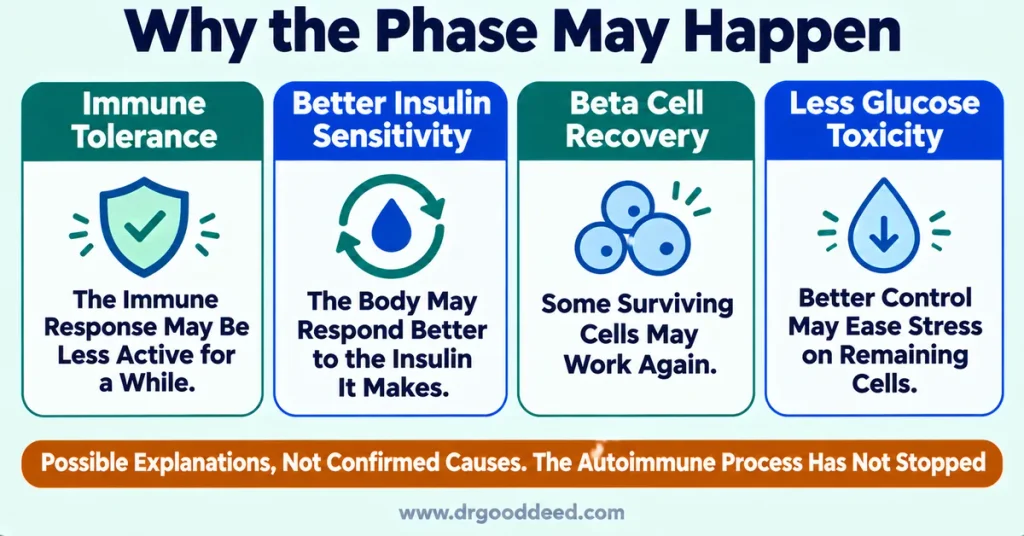
Researchers have suggested several possible reasons for this phase:
- Immune tolerance: The immune response may temporarily become less active.
- Improved insulin sensitivity: The body may respond better to the insulin it produces.
- Beta cell recovery: Some surviving beta cells may regain function.
- Reduced glucose toxicity: Better blood sugar control may reduce stress on the remaining beta cells.
These are possible explanations, not confirmed causes.
How Long Does the Honeymoon Phase Last?
The type 1 honeymoon phase usually lasts several months, but the duration varies from person to person. Different health organizations and studies report different ranges.
Table: How long the honeymoon phase lasts, by source
| Source | Reported duration |
| American Diabetes Association (ADA), date not listed | One week to one year |
| Breakthrough T1D (2026) | Several months, sometimes up to 1 to 2 years |
| Breakthrough T1D UK (2024) | A few months to one year, although some cases last a few years |
| Mittal et al. (2024) | One month to 13 years, with a mean of 7 months |
Mittal et al. (2024) reported a mean duration of seven months based on a childhood cohort discussed in their review. This figure may not reflect the experience of adults.
The longest reported case, 13 years (Mittal et al., 2024), is far longer than the usual experience. However, these unusually long cases are rare.
This range is not a reliable way to predict how long the phase will last for one person. Your age, health, blood sugar levels, and other factors may affect your experience.
Who Gets a Honeymoon Phase, and Who Does Not
Not everyone with type 1 diabetes experiences a honeymoon phase. Research reports different rates, but some factors may make partial remission more likely.
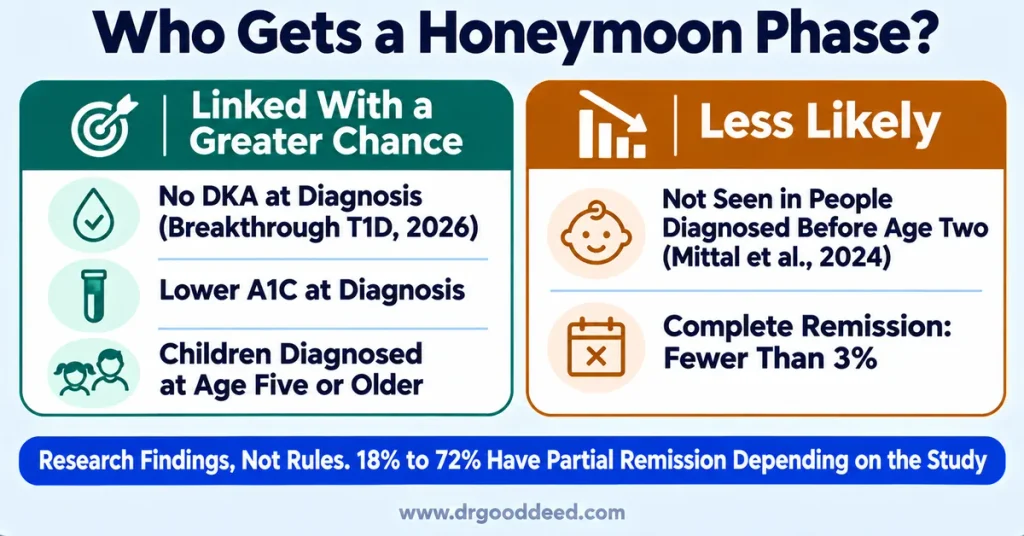
Mittal et al. (2024) reported that around 18% to 72% of people experience partial remission, depending on the study. Fewer than 3% experience complete remission. A 2025 review in Frontiers in Endocrinology puts it at about 50%.
Factors linked with a greater chance of experiencing this phase include:
- Not having DKA at diagnosis: The phase appears to be more common in people who do not have diabetic ketoacidosis (DKA) when diagnosed (Breakthrough T1D, 2026).
- Lower A1C: Breakthrough T1D (2026) links lower A1C levels at diagnosis with a greater chance of partial remission.
- Age: Breakthrough T1D (2026) reports that the phase is more common in children diagnosed at age five or older.
- Age at diagnosis: Mittal et al. (2024) reported that the phase was not seen in people diagnosed before age two.
These are research findings, not rules. You may experience partial remission even if none of these factors apply to you.
Why You Still Need Insulin in the Honeymoon Phase
You still need insulin during the honeymoon phase because your pancreas may not produce enough to keep blood sugar within a safe range. Even when some beta cells are working, the autoimmune process may continue.
Your body may still need insulin from outside sources to manage blood sugar. Stopping insulin or reducing it without medical advice can lead to diabetic ketoacidosis (DKA).
DKA is a serious condition that develops when the body does not have enough insulin to use glucose for energy. The body starts breaking down fat instead, which causes acids called ketones to build up in the blood.
Your insulin needs may change during this period. However, too much insulin can also cause hypoglycemia (low blood sugar).
Remember:
- Continue taking insulin as prescribed.
- Monitor your blood sugar as advised by your care team.
- Speak to your care team if you notice that your insulin needs are changing.
- Ask your diabetes care team how your readings compare with normal blood sugar levels.
Doctor’s Tip: Just because your blood sugar readings are within a normal range does not mean your type 1 diabetes is gone. Work with your diabetes care team to manage insulin and reduce the risk of low blood sugar. Never change your insulin plan without their guidance.
A blood sugar monitor worn on the skin can also help show patterns that your care team can review.
Signs the Type 1 Honeymoon Phase Is Ending
The type 1 diabetes honeymoon phase ending may involve rising insulin needs and blood sugar that becomes harder to manage. These changes can happen gradually.
As the remaining beta cells lose function, your body may produce less insulin. You may notice:
- Increased insulin needs: Your care team may find that your treatment plan needs review.
- Higher blood sugar: Your readings may become higher more often.
- Fluctuating blood sugar: Your readings may become less predictable.
- Increased A1C: Your A1C may rise as your average blood sugar increases.
- Returning symptoms: You may feel thirstier, urinate more often, feel tired, or lose weight without trying.
Table: What you notice, what it may mean, and what to do next
| Change noticed | Possible reason | Action |
| Higher blood sugar readings | Your body may be producing less insulin. | Share your readings with your diabetes care team. |
| Increased insulin needs | Your treatment needs may be changing. | Ask your care team to review your plan. |
| Fluctuating blood sugar | Your diabetes may be becoming harder to manage. | Discuss the pattern with your care team. |
| Increased thirst or frequent urination | Your blood sugar may be high. | Check your readings and contact your care team. |
| Vomiting, fruity-smelling breath, or difficulty breathing | Possible DKA. | Call 911 or go to the ER. |
Not every change means the honeymoon phase is ending. Illness, stress, food, and physical activity can also affect blood sugar. Read why blood sugar can run high when sick.
Can You Extend the Honeymoon Phase?
There is currently no FDA-approved treatment proven to extend the honeymoon period. Researchers are studying ways to protect the remaining beta cells, but no approach can guarantee a longer remission period.
Breakthrough T1D (2026) reports that no FDA-approved therapy is available specifically to extend this phase. Research is ongoing, but treatments being studied should not be considered proven ways to prolong remission.
If you are wondering how to extend the honeymoon period, focus on managing your diabetes safely:
- Follow your insulin plan.
- Monitor your blood sugar as advised.
- Attend regular diabetes appointments.
- Tell your care team about frequent high or low readings.
- Never change your treatment without speaking to your care team.
- Ask your doctor whether any clinical trials may be suitable for you.
These steps help you manage diabetes safely. However, they cannot stop the autoimmune process or guarantee that the honeymoon phase will last longer.
When to Call Your Care Team or 911
Contact your diabetes care team if your blood sugar patterns change, your insulin needs increase, or you are unsure whether your treatment plan needs review. Some symptoms require emergency medical attention.
Contact your diabetes care team if:
- You experience frequent high or low blood sugar readings.
- You notice increasing insulin needs.
- You feel unusually thirsty, urinate more often, or feel very tired.
- You need help understanding why your blood sugar readings are changing.
Go to the emergency room or call 911 if you have signs of DKA. According to the CDC, emergency warning signs include:
- Blood sugar that stays at 300 mg/dL or above.
- Fruity-smelling breath.
- Vomiting and being unable to keep food or drinks down.
- Trouble breathing.
- Multiple symptoms of DKA.
Severe hypoglycemia also requires urgent help. If someone has severe low blood sugar and cannot safely treat themselves, another person should provide the emergency treatment they have been taught to use. If emergency treatment is not available, the NIDDK (2021) advises calling 911.
If the type 1 honeymoon phase is ending and your numbers are changing, call your diabetes care team early rather than changing insulin on your own.
Frequently Asked Questions
What Are the Symptoms of the Honeymoon Phase?
Honeymoon phase symptoms are mostly positive changes, such as steadier blood sugar readings and lower insulin needs. However, blood sugar can still rise or fall during this period. Continue monitoring your readings and follow the treatment plan provided by your diabetes care team.
Is There a Honeymoon Phase in Type 2 Diabetes?
No, type 2 diabetes does not typically have this phase, though symptoms can ease. Some people with type 2 diabetes may see improved blood sugar after diagnosis or treatment, but this is a different process from partial remission in type 1. The differences between type 1 and type 2 diabetes explain why this phase is linked to type 1.
Can Adults Have a Honeymoon Phase?
Yes, adults can experience a honeymoon phase after a type 1 diabetes diagnosis. Research findings about age vary. Some studies suggest it may be more common in people diagnosed after age 15, while others do not show a clear link between age and remission. (Mittal et al., 2024).
Is the Type 1 Diabetes Honeymoon Phase a Cure?
No, the type 1 diabetes honeymoon phase is not a cure, because the immune attack continues and insulin needs later rise. The ADA explains that having fewer symptoms does not mean diabetes is gone. Complete remission is rare, occurring in fewer than 3% of cases in the review by Mittal et al. (2024).
Does a Honeymoon Phase Affect Long-Term Health?
It may be linked with some long-term health benefits. Mittal et al. (2024) discussed studies that found an association between past partial remission, lower A1C, and fewer small blood vessel complications. However, this is an association and does not prove that the honeymoon phase directly prevents complications.
Sources
American Diabetes Association, Understanding Type 1 Diabetes. link
World Journal of Clinical Cases, Honeymoon Phase in Type 1 Diabetes Mellitus (Mittal et al., 2024). link
Centers for Disease Control and Prevention, Diabetic Ketoacidosis (2024). link
American Diabetes Association, DKA: Signs, Symptoms, and Treatment. link
National Institute of Diabetes and Digestive and Kidney Diseases, Low Blood Glucose (Hypoglycemia) (2021). link
Breakthrough T1D, Type 1 Diabetes Honeymoon Phase 101: FAQ (2026). link
Breakthrough T1D UK, The Honeymoon Phase of Type 1 Diabetes (2024). link
Frontiers in Endocrinology, The Partial Clinical Remission Phase of Type 1 Diabetes (2025). link
Medically reviewed by: Dr. Anshu Alok, Endocrinology. Read more
Medical Disclaimer: This article is for general information only and is not medical advice. It does not replace a diagnosis, treatment plan, or guidance from a qualified healthcare professional. Always talk to your doctor about your own symptoms and before starting, stopping, or changing any treatment. If you think you may be having a medical emergency, call 911 or go to your nearest emergency room.