

A normal A1C level is below 5.7%, which matches an estimated average blood sugar (eAG) of under about 117 mg/dL (ADA, 2026; ADAG formula). The chart below shows how different A1C results translate into estimated average glucose in mg/dL and mmol/L. You can also use the conversion formula in reverse to estimate your A1C from your average glucose.
Key Takeaways
- A normal A1C level is below 5.7%; 5.7% to 6.4% is prediabetes and 6.5% or higher is diabetes (ADA, 2026).
- The eAG formula is 28.7 × A1C − 46.7 (ADAG, 2008).
- An A1C of 5.1% equals an estimated average glucose of about 100 mg/dL.
- An A1C of 5.6% equals an estimated average glucose of about 114 mg/dL.
- Diagnostic A1C ranges are the same for nonpregnant men and women, but some medical conditions can affect test accuracy.
What Is a Normal A1C Level?
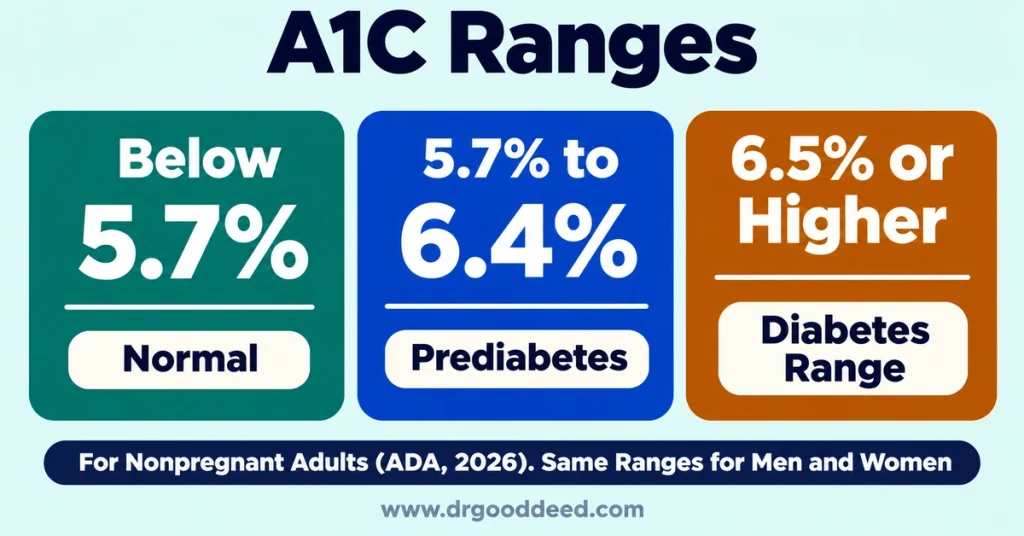
A normal A1C level for nonpregnant adults is below 5.7%, according to the American Diabetes Association (ADA) Standards of Care, 2026. An A1C result of 5.7% to 6.4% is in the prediabetes range, while 6.5% or higher is in the diabetes range.
A1C, also known as hemoglobin A1C or HbA1c, is a blood test that measures the percentage of hemoglobin in your red blood cells that has glucose attached to it. This is also called glycated hemoglobin.
Red blood cells typically live for about three months. Therefore, an A1C test gives an estimate of your average blood sugar over the past two to three months. It does not show your blood sugar at one specific moment (MedlinePlus, 2025).
The ADA uses the following diagnostic ranges for adults who are not pregnant:
| A1C result | mmol/mol | Estimated average glucose (eAG) | Category |
| Below 5.7% | Below 39 | Below about 117 mg/dL | Normal |
| 5.7% to 6.4% | 39 to 47 | About 117 to 137 mg/dL | Prediabetes |
| 6.5% or higher | 48 or higher | About 140 mg/dL or higher | Diabetes range |
Source: ADA Standards of Care in Diabetes, 2026. eAG values are estimates based on the ADAG conversion formula.
An A1C result of 6.5% or higher is in the diabetes range. Doctors generally use an NGSP-certified laboratory test to diagnose diabetes. If you do not have clear symptoms, your doctor may recommend repeating the test to confirm the result.
These are diagnostic ranges, not a measure of your entire health. The risk of blood sugar-related problems can increase gradually, even below the prediabetes range. An A1C below 5.7% does not mean you have no risk of developing diabetes in the future (ADA, 2026).
For fasting and after-meal targets, see normal blood sugar levels by age.
A1C to Average Blood Sugar Chart
The A1C to average blood sugar chart below converts A1C results into estimated average glucose (eAG). It includes results from 5.0% to 12.0%, covering both the normal range and higher A1C levels.
The ADAG study by Nathan and colleagues (2008) established the formula used to estimate average glucose from A1C:
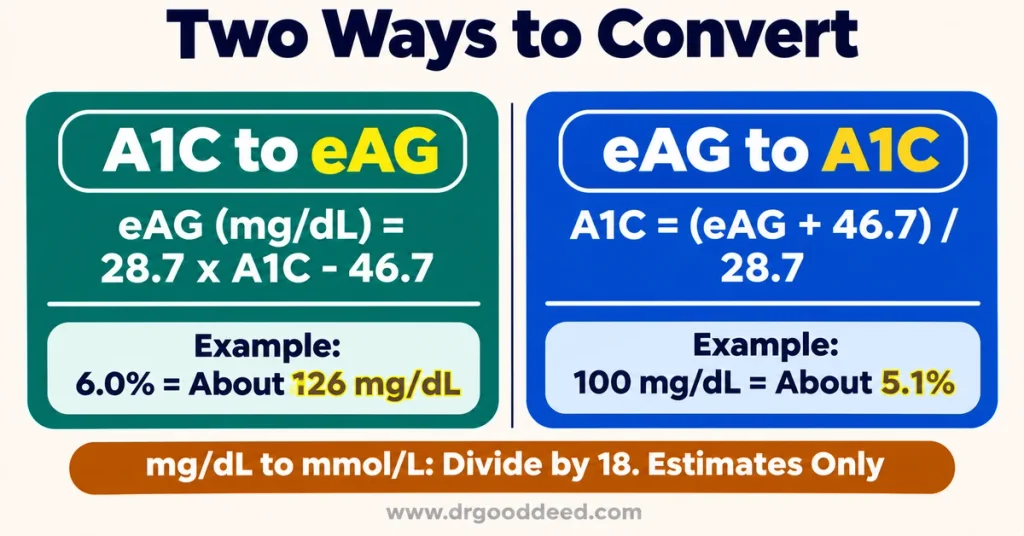
eAG (mg/dL) = 28.7 × A1C − 46.7
The ADA professional eAG calculator uses this conversion. To convert mg/dL into mmol/L, divide the mg/dL value by 18. The values below are rounded to the nearest whole number for mg/dL and one decimal place for mmol/L.
| A1C (%) | eAG (mg/dL) | eAG (mmol/L) | Range |
| 5.0% | 97 | 5.4 | Normal |
| 5.5% | 111 | 6.2 | Normal |
| 6.0% | 126 | 7.0 | Prediabetes |
| 6.5% | 140 | 7.8 | Diabetes range |
| 7.0% | 154 | 8.6 | Diabetes range (common goal: under 7%) |
| 7.5% | 169 | 9.4 | Diabetes range |
| 8.0% | 183 | 10.2 | Diabetes range |
| 8.5% | 197 | 11.0 | Diabetes range |
| 9.0% | 212 | 11.8 | Diabetes range |
| 9.5% | 226 | 12.6 | Diabetes range |
| 10.0% | 240 | 13.4 | Diabetes range |
| 10.5% | 255 | 14.1 | Diabetes range |
| 11.0% | 269 | 14.9 | Diabetes range |
| 11.5% | 283 | 15.7 | Diabetes range |
| 12.0% | 298 | 16.5 | Diabetes range |
Source: ADAG conversion formula (Nathan et al., 2008) and the ADA professional eAG calculator. These are estimated values.
For example, an A1C of 6.0% corresponds to an eAG of about 126 mg/dL. An A1C of 6.5% corresponds to an eAG of about 140 mg/dL and falls within the diabetes range.
Remember that eAG is an estimate of your average blood sugar. It will not necessarily match your fasting or after-meal glucose readings. Your blood sugar can rise and fall throughout the day.
How to Convert A1C to Average Blood Sugar
You can use the ADAG formula to convert your A1C result into estimated average blood sugar. You can also reverse the calculation to estimate your A1C from an average glucose reading.
The formulas are:
To convert A1C to eAG:
eAG (mg/dL) = 28.7 × A1C − 46.7
To estimate A1C from eAG:
A1C = (eAG + 46.7) ÷ 28.7
Nathan and colleagues developed this formula through the ADAG study in 2008. It can be used for most people with type 1 and type 2 diabetes, although individual results may vary.
Example 1: Converting average blood sugar of 100 mg/dL into A1C
If your estimated average blood sugar is 100 mg/dL, you can calculate your A1C as follows:
A1C = (100 + 46.7) ÷ 28.7
A1C = 146.7 ÷ 28.7
A1C = approximately 5.1%
This means an average blood sugar of 100 mg/dL corresponds to an estimated A1C of 5.1%.
Example 2: Converting average blood sugar of 140 mg/dL into A1C
If your estimated average blood sugar is 140 mg/dL, the calculation is:
A1C = (140 + 46.7) ÷ 28.7
A1C = 186.7 ÷ 28.7
A1C = approximately 6.5%
An average blood sugar of 140 mg/dL therefore corresponds to an estimated A1C of 6.5%, which is in the diabetes range.
These calculations can help you understand your results, but they do not replace an A1C laboratory test. eAG is an estimate and may not match your individual glucose readings exactly (Nathan et al., 2008).
Is 5.1 A1C Good?
Yes. An A1C of 5.1% is within the normal range for a nonpregnant adult. It corresponds to an estimated average blood sugar of about 100 mg/dL.
The ADA defines prediabetes as an A1C result of 5.7% to 6.4%. Therefore, a result of 5.1% does not meet the diagnostic criteria for prediabetes or diabetes (ADA, 2026).
There are a few things to keep in mind:
- It is within the normal range. An A1C of 5.1% is below the prediabetes threshold of 5.7%.
- It is an average. Your estimated average glucose may be about 100 mg/dL, but your blood sugar can still fluctuate throughout the day.
- It does not guarantee zero risk. Blood sugar-related risk can increase gradually, even when your A1C is below 5.7%.
- Other factors matter. Your family history, medical conditions, lifestyle, and previous test results can also affect your overall risk.
Your A1C is only one part of your health assessment. Your doctor can help you understand the result alongside your medical history and other test results.
Read more about high blood sugar without diabetes.
You can also learn how to improve insulin sensitivity through everyday habits.
What an A1C of 5.6 Means
An A1C of 5.6% is still within the normal range for a nonpregnant adult, but it is close to the prediabetes threshold. It corresponds to an estimated average blood sugar of about 114 mg/dL.
According to the ADA’s 2026 guidelines, prediabetes begins at 5.7%. Therefore, an A1C of 5.6% does not meet the diagnostic criteria for prediabetes.
Here are a few things to understand about this result:
- It is not prediabetes. A result of 5.6% is below the diagnostic threshold of 5.7%.
- It is close to the threshold. You may want to discuss the result with your doctor, especially if it has increased over time.
- Risk can increase gradually. Blood sugar-related risk does not suddenly begin at 5.7%.
- You may need an earlier repeat test. The ADA recommends repeating screening at least every three years when results are normal. Your doctor may suggest testing sooner based on your health and risk factors.
An A1C of 5.6% does not mean you will definitely develop diabetes. However, it can be a useful opportunity to review your overall health and understand your risk.
What Is a Normal A1C Level for a Woman?
A normal A1C level for a nonpregnant woman is below 5.7%, which is the same diagnostic range used for nonpregnant men (ADA, 2026). However, pregnancy can affect A1C results and diabetes management goals.
During pregnancy, A1C may be slightly lower because red blood cells turn over more quickly. For someone with diabetes who is pregnant, the ADA’s 2026 guidelines recommend aiming for an A1C below 6% if this can be achieved safely. A less strict goal, such as below 7%, may be appropriate when needed to reduce the risk of hypoglycemia.
A1C is not used to diagnose gestational diabetes. Glucose testing is used for this purpose (MedlinePlus, 2025).
Glucose-6-phosphate dehydrogenase (G6PD) deficiency can also affect A1C results. The ADA Standards of Care, 2026, note that the G202A variant of G6PD can lower A1C.
If you are pregnant, planning a pregnancy, or have a medical condition that may affect your red blood cells, discuss your A1C result with your healthcare professional.
Normal A1C by Age: Does It Change?
No. The diagnostic A1C ranges do not change as adults get older. The normal range remains below 5.7% for nonpregnant adults, according to the ADA’s 2026 guidelines.
There is no separate higher diagnostic threshold for older adults. Being older does not automatically make an A1C result above 5.7% normal.
However, an older adult who already has diabetes may have a different A1C target. A doctor may consider overall health, other medical conditions, the risk of hypoglycemia, and the person’s ability to manage their care when setting an individual target.
It is important to understand the difference between a diagnostic range and a treatment target:
- Diagnostic range: This helps determine whether an A1C result is normal, in the prediabetes range, or in the diabetes range.
- Treatment target: This is the A1C goal a person may aim for after being diagnosed with diabetes.
Your doctor can help set a target based on your health. Do not use age-specific healthy population ranges instead of the ADA’s diagnostic ranges.
Goals can differ between type 1 and type 2 diabetes.
A1C Goals if You Have Diabetes
Many nonpregnant adults with diabetes should aim for an A1C below 7%, provided they are not at significant risk of severe hypoglycemia. This is the general target recommended by the ADA’s 2026 Standards of Care, Recommendation 6.3a.
This is not a target for everyone. Your doctor may recommend a different goal based on your overall health, how long you have had diabetes, other medical conditions, and your risk of low blood sugar.
Your doctor may consider:
- Your age and overall health.
- How long you have had diabetes.
- Whether you experience episodes of low blood sugar.
- Other medical conditions or diabetes-related complications.
- How well you can manage your diabetes care.
Your target may also depend on whether you have type 1 or type 2 diabetes. The goal is to support your health while reducing the risk of complications and avoiding harmful episodes of low blood sugar.
Do not compare your target with someone else’s. Ask your doctor what A1C goal is appropriate for you.
Some people also compare their A1C results with readings from CGMs for non-diabetics. However, continuous glucose monitors and A1C tests measure glucose in different ways, so their results may not match exactly.
When Your A1C Result May Be Misleading
An A1C result may not always give an accurate picture of your average blood sugar. Conditions or treatments that affect red blood cells, hemoglobin, or red blood cell turnover can cause your A1C to appear higher or lower than expected.
According to the ADA’s 2026 Standards of Care, factors that may affect A1C accuracy include:
- Anemia: Some forms of anemia can affect A1C results.
- Hemodialysis: A1C may be less reliable in people receiving dialysis.
- Erythropoietin treatment: Treatment that changes red blood cell production can affect A1C.
- HIV treatment: Some HIV medications may affect A1C results.
- Hemoglobin variants: Conditions such as sickle cell trait may interfere with certain A1C tests.
- G6PD deficiency: The ADA notes that the G202A variant of G6PD can lower A1C.
- Pregnancy: Faster red blood cell turnover during pregnancy can affect A1C results.
A1C depends partly on how long glucose has been attached to hemoglobin. Changes in the lifespan or turnover of red blood cells can therefore affect the result.
The type of laboratory test used can also matter. If you have a hemoglobin variant or a medical condition that affects red blood cells, your doctor may need to consider this when interpreting your result.
Doctor’s Tip: Bring your blood glucose meter readings or average readings from your continuous glucose monitor (CGM) to your appointment. If they do not seem to match your eAG, ask your doctor whether something could be affecting your A1C result.
A CGM measures glucose patterns throughout the day, while an A1C test estimates average blood sugar over the past two to three months. Because they measure glucose differently, their results may not match.
If your A1C does not seem to match your glucose readings, do not assume that one result is incorrect. Ask your healthcare professional to review your test results, medical history, and any factors that could affect accuracy.
How Often to Test and When to See a Doctor
The ADA’s 2026 Standards of Care recommend that adults without other risk factors begin diabetes screening at age 35. If the result is normal, testing should be repeated at least every three years. Your doctor may recommend more frequent testing based on your risk factors or previous results.
You should make an appointment with your doctor if:
- Your A1C result is 5.7% or higher.
- Your A1C has increased compared with previous tests.
- You have symptoms or concerns about your blood sugar.
- Your home glucose readings do not seem to match your A1C.
- You have a medical condition that may affect A1C accuracy.
- You are pregnant or planning a pregnancy and need advice about blood sugar management.
Your primary care doctor can review your A1C result, discuss your risk factors, and decide whether further testing is needed. They may also refer you to an endocrinologist if you need specialist care.
If you need prompt medical attention but are not experiencing an emergency, urgent care may be an option. However, urgent care is not a replacement for emergency treatment when you have severe symptoms related to very high or low blood sugar.
If you experience severe symptoms of very high or low blood sugar, seek emergency medical help. Call 911 or go to the emergency room. Do not rely on an A1C calculation or eAG chart to assess a possible emergency.
If your result is above a normal A1C level, ask your doctor when to retest and what the number means for you.
Frequently Asked Questions
What Is a Dangerous Level of A1C?
There is no single A1C result that is considered dangerous for everyone. An A1C of 6.5% or higher is in the diabetes range. Many nonpregnant adults with diabetes aim for a result below 7%, but individual targets vary. Speak with your doctor if your result is above your personal target.
Is 4.7 a Good A1C?
Yes. An A1C of 4.7% is within the normal range for nonpregnant adults. However, certain medical conditions that affect red blood cells or hemoglobin can make A1C results less reliable. If your result is unexpectedly low or does not match your glucose readings, ask your doctor to review it.
Is A1C Used to Diagnose Gestational Diabetes?
No. A1C is not used to diagnose gestational diabetes. Pregnancy can affect A1C results because red blood cells turn over more quickly. Glucose tests are used to diagnose gestational diabetes (MedlinePlus, 2025). If you are pregnant, follow your healthcare professional’s advice about the appropriate screening tests.
What Is a Normal A1C Level for a Man?
A normal A1C level for a nonpregnant man is below 5.7%. The ADA uses the same diagnostic ranges for nonpregnant men and women. An A1C of 5.7% to 6.4% is in the prediabetes range, while 6.5% or higher is in the diabetes range (ADA, 2026).
What Does eAG Mean on My Lab Report?
eAG stands for estimated average glucose. It converts your A1C result into an estimated average blood sugar level, usually shown in mg/dL. This can make your A1C easier to compare with glucose meter readings. However, eAG is an estimate and may not match your daily readings exactly (Nathan et al., 2008).
Sources
American Diabetes Association, Standards of Care in Diabetes, 2026: Diagnosis and Classification. link
American Diabetes Association, Standards of Care in Diabetes, 2026: Glycemic Goals. link
American Diabetes Association, Standards of Care in Diabetes, 2026: Diabetes in Pregnancy. link
Diabetes Care, Translating the A1C Assay Into Estimated Average Glucose Values. link
American Diabetes Association, Professional eAG/A1C Conversion Calculator. link
MedlinePlus, Hemoglobin A1C (HbA1c) Test. link
Medical Disclaimer: This article is for general information only and is not medical advice. It does not replace a diagnosis, treatment plan, or guidance from a qualified healthcare professional. Always talk to your doctor about your own symptoms and before starting, stopping, or changing any treatment. If you think you may be having a medical emergency, call 911 or go to your nearest emergency room.