

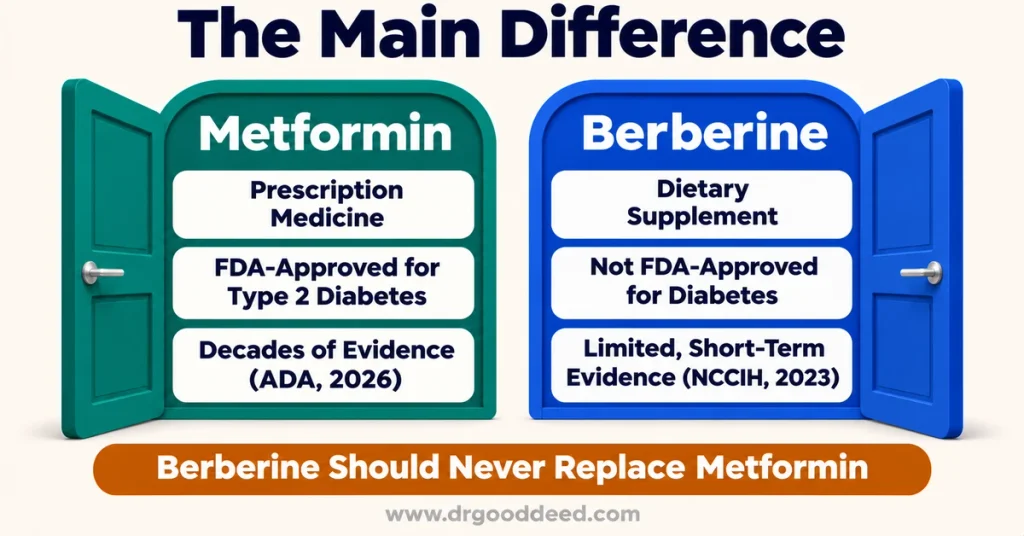
Berberine and metformin can both lower blood sugar, but metformin is an FDA-approved medicine with decades of evidence, while berberine is a dietary supplement with weak, short-term evidence (ADA, 2026; NCCIH, 2023).
Berberine is not as well supported as metformin. There is limited evidence to suggest that the two have similar effects, and they should not be considered interchangeable. It has been medically reviewed by Dr Anshu Alok, an endocrinologist.
Key Takeaways
- Berberine and metformin both lower blood sugar, but only metformin is FDA-approved, proven long term and recommended by diabetes guidelines.
- Berberine has limited evidence. Much of the research comes from small or short-term studies (NCCIH, 2023).
- Dietary supplements are not FDA-approved for safety or effectiveness before they are sold.
- Berberine should not be used during pregnancy or breastfeeding, or given to infants (NCCIH, 2023).
- Never stop prescribed diabetes treatment or replace it with berberine without medical advice.
Berberine vs Metformin: The Short Answer
In the berberine vs metformin comparison, metformin is the proven choice for type 2 diabetes, and berberine should never replace it (ADA, 2026; NCCIH, 2023).
Metformin is a prescription medication with decades of research supporting its use. It helps manage blood sugar levels and has evidence of benefits in reducing diabetes-related complications. It is also widely available and generally affordable.
Berberine is a plant compound sold as a dietary supplement. Some studies suggest (NCCIH) it may help lower blood sugar levels, but there is not enough reliable evidence to show that it is as effective or safe as metformin.
Metformin: An established treatment for type 2 diabetes, supported by substantial clinical evidence.
Berberine: A supplement with some promising research findings but limited evidence and important safety concerns.
The main difference is the strength of the evidence. Metformin has a well-established role in diabetes care, while berberine has not been proven to offer the same benefits.
What Metformin Is and Why Doctors Use It
Metformin is a prescription medication used to treat type 2 diabetes. It helps lower blood glucose levels and has a strong evidence base supporting its use (MedlinePlus, 2026).
The American Diabetes Association’s (ADA) 2026 Standards of Care describe metformin as an effective, safe, and affordable treatment. Research also supports its role in reducing diabetes-related complications and cardiovascular risks.
Your doctor may consider metformin because it:
- Helps lower blood glucose levels.
- Usually does not cause low blood sugar when used alone.
- Is generally weight neutral.
- Has a strong evidence base.
- Is widely available and affordable.
Metformin has historically been used as a first-line treatment for type 2 diabetes. However, the ADA’s 2026 guidelines emphasize person-centered treatment decisions and shared decision-making. This means your doctor should consider your health, personal preferences, treatment goals, and other medical conditions.
Metformin is used to treat type 2 diabetes. Learn more about the differences between type 1 and type 2 diabetes.
What Berberine Is
Berberine is a plant compound sold as a dietary supplement. Some research suggests it may affect blood sugar levels, but it is not an FDA-approved treatment for diabetes (NCCIH, 2023).
It is important to understand how dietary supplements differ from prescription medications:
- Not FDA-approved before sale: Supplements are not reviewed and approved in the same way as prescription medications.
- Different regulation: They are not regulated like prescription drugs.
- Limited research: Some studies have limitations related to their size, duration, or quality.
The ADA does not recommend using herbal supplements to improve blood sugar levels because there is not enough strong evidence to support their use (ADA, 2026).
The FDA explains that dietary supplements are not approved for safety and effectiveness before they are marketed. Being available to purchase does not mean a supplement is proven to treat a medical condition (FDA, 2022).
Berberine should not be viewed as an established diabetes treatment. If you have diabetes or prediabetes, speak with a healthcare professional before considering supplements.
Dark patches on the neck can sometimes be associated with insulin resistance. However, other conditions can also cause skin changes. Speak with a healthcare professional to understand the cause.
Berberine and Metformin Side by Side
Both berberine and metformin have been studied for their potential effects on blood sugar levels. However, they differ in their approval status, evidence, regulation, and safety profile. The table below compares the two side by side.
| Comparison | Metformin | Berberine |
| Type | Prescription medication | Plant compound sold as a dietary supplement |
| FDA-approved? | Yes, for treating type 2 diabetes | No, not approved as a diabetes treatment |
| Evidence | Decades of research supporting its use (ADA, 2026) | Mainly small and short-term studies, some with quality concerns (NCCIH, 2023) |
| Low blood sugar | Usually does not cause hypoglycemia when used alone (ADA, 2026) | May affect blood sugar and interact with medications (NCCIH, 2023) |
| Regulation | Regulated as a prescription medication | Not regulated like prescription medications |
| Safety concerns | Rare lactic acidosis, vitamin B12 deficiency, and kidney function considerations | Medication interactions, pregnancy and breastfeeding risks, possible risks to infants, and uncertain long-term safety |
| Medical guidance | Established treatment with person-centered decision-making (ADA, 2026) | Herbal supplements are not recommended for blood sugar benefits (ADA, 2026) |
Both compounds have been studied for their potential effects on AMPK, a pathway involved in energy regulation within cells. However, this does not mean they have the same clinical effects or safety profile.
The key point is that metformin has well-established benefits and a recognized role in diabetes guidelines. Berberine does not have the same level of evidence.
What the Research on Berberine Shows
Research suggests that berberine may help lower blood sugar levels (NCCIH; Yin et al., 2008). However, the available evidence is limited, and studies vary in their size, quality, and duration. There is not enough evidence to show that berberine is as effective as metformin (NCCIH, 2023).
Some important findings include:
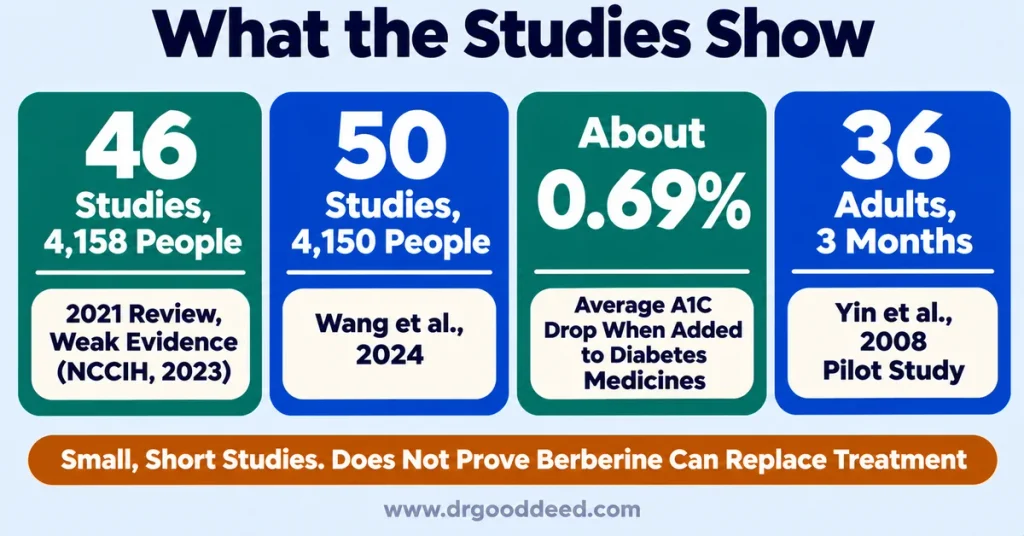
A review of 46 studies: A 2021 review included 4,158 participants. Most studies were conducted in China, and some had quality limitations. The evidence was considered weak and did not establish berberine as a replacement for diabetes treatment (NCCIH, 2023).
A 2024 meta-analysis: Wang et al. analyzed 50 studies involving 4,150 participants. Most studies lasted between one and three months. Adding berberine to diabetes medications was associated with an average reduction in A1C of around 0.69%.
This finding needs careful interpretation. The reduction was associated with berberine being added to diabetes medications. It does not prove that berberine alone can replace prescribed treatment.
A 2008 pilot study: Yin et al. studied 36 adults over three months who had recently been diagnosed with type 2 diabetes. Participants were divided into groups receiving berberine or metformin. The study is often mentioned in comparisons, but its small size limits the conclusions that can be drawn.
Overall, these findings suggest that berberine may affect blood sugar levels. However, they do not establish that it offers the same long-term benefits as metformin.
How Long Does Berberine Take to Lower A1C?
There is no reliable evidence to establish how long berberine takes to lower A1C. Wang et al.’s 2024 meta-analysis included studies lasting between one and three months, but this does not mean berberine will lower your A1C within that timeframe.
A1C reflects average blood sugar levels over approximately the previous two to three months. Other health conditions and medications can also influence your results.
Speak with your doctor about when and how to monitor your blood sugar. You can also compare your results with normal blood sugar levels.
Side Effects and Safety Concerns
Both metformin and berberine have safety considerations. Metformin has well-known risks that healthcare professionals can monitor. Berberine has less established long-term safety evidence (MedlinePlus, 2026; NCCIH, 2023).
Metformin safety concerns
- Lactic acidosis: This is a rare but serious condition. Tell your doctor if you have kidney disease or other health conditions that may increase your risk (MedlinePlus, 2026).
- Vitamin B12 deficiency: Long-term metformin use can contribute to vitamin B12 deficiency. The ADA recognizes this risk in its 2026 guidelines. Your doctor may consider monitoring your levels.
- Kidney function: Your kidney function can affect whether metformin is suitable for you. Your doctor may review your estimated glomerular filtration rate (eGFR).
Berberine safety concerns
- Medication interactions: Berberine can interact with certain medications. Tell your doctor and pharmacist about all prescription medicines, over-the-counter medications, and supplements you take (NCCIH, 2023).
- Pregnancy and breastfeeding: The NCCIH advises against using berberine during pregnancy or while breastfeeding.
- Infants: Berberine should not be given to infants. It may contribute to a dangerous buildup of bilirubin, which can cause brain damage.
- Kidney disease: People with kidney disease may need close medical monitoring.
- Long-term use: Most studies have been short-term. There is not enough evidence to establish the long-term safety of berberine.
Is There a Downside to Taking Berberine?
Yes. Berberine has uncertain long-term safety, can interact with medications, and is not recommended during pregnancy or breastfeeding. It should not be given to infants. Dietary supplements are also not reviewed and approved in the same way as prescription medications (NCCIH, 2023; FDA, 2022).
Why Can’t You Take Berberine Long Term?
The main concern is the lack of reliable evidence about its long-term safety. Many studies have lasted only a few months, so researchers cannot confidently establish the risks of using berberine over several years.
Speak with your healthcare professional before considering berberine, especially if you take medication or have an existing health condition.
Can You Take Berberine and Metformin Together?
You should only consider taking berberine with metformin after discussing it with your doctor. Berberine can interact with medications, and combining substances that may affect blood sugar requires medical review (NCCIH, 2023).
If you are taking metformin, tell your doctor and pharmacist about any supplements you are considering. They need to know about all your prescription medications, over-the-counter medicines, and supplements.
Your healthcare professional may consider:
- Blood sugar levels: Both substances may affect blood sugar, so your doctor should know about their use.
- Medication interactions: Berberine can interact with certain medications.
- Kidney function: Your doctor may review your kidney health and other medical conditions.
- Blood sugar monitoring: Ask whether your current monitoring plan needs to be reviewed.
There is not enough evidence to make a general recommendation about combining the two. Do not change or stop prescribed treatment based on supplement claims.
Can Berberine Replace Metformin?
No. Berberine should not be used as a replacement for prescribed metformin or other diabetes treatment. The NCCIH advises against replacing medical treatment with supplements because their benefits may not be established and they may pose safety risks.
Metformin has well-established benefits and a recognized role in diabetes care. Berberine has not been proven to offer the same long-term protection against diabetes complications.
If metformin causes side effects or is not suitable for you, speak with your doctor. They can review your health, kidney function, blood sugar results, and treatment goals.
Is There a Natural Alternative to Metformin?
There is no dietary supplement proven to be an equivalent alternative to metformin. The ADA does not recommend herbal supplements for blood sugar benefits because of insufficient evidence (ADA, 2026).
Managing blood sugar involves an overall care plan developed with your healthcare professional. This may include reviewing your diet, physical activity, sleep, other health conditions, and prescribed treatment.
There are evidence-based ways to improve insulin sensitivity. However, lifestyle changes should not be used as a reason to stop prescribed medication without medical advice.
The Endocrinologist’s Verdict
Metformin is an established, evidence-based treatment for type 2 diabetes. Berberine is a dietary supplement with some promising short-term findings, but the evidence remains limited. Its long-term safety is uncertain, and it can interact with medications (ADA, 2026; NCCIH, 2023).
The 2024 meta-analysis and earlier pilot studies suggest that berberine may affect blood sugar levels. However, there is not enough evidence to show that it offers the same benefits as metformin or the same protection against diabetes complications.
The ADA’s 2026 guidelines emphasize person-centered treatment decisions. Your doctor should consider your medical history, personal preferences, treatment goals, and safety when discussing your diabetes care.
Doctor’s Tip: Create a list of all the supplements you take, including berberine. Sharing this list with your doctor and pharmacist can help them check for potential interactions (NCCIH, 2023; MedlinePlus, 2026).
Learn more about metabolic health and the factors that can affect it.
Questions to Ask Your Doctor About Berberine
If you have diabetes, prediabetes, or insulin resistance, speak with your primary care doctor or endocrinologist before considering berberine.
You may want to ask:
- Could berberine interact with any of my current medications?
- Is it suitable for me based on my kidney function and other medical conditions?
- Is it safe to consider during pregnancy, breastfeeding, or when planning a pregnancy?
- What is the right A1C target for me based on my health and diabetes history?
- How should I monitor my blood sugar and A1C?
- Are there any concerns with my current treatment that we should review?
Your primary care doctor can review your treatment and may refer you to an endocrinologist if needed. If someone with diabetes loses consciousness, call 911 immediately. Do not give them anything to eat or drink, or any supplements.
Before you combine berberine and metformin or swap one for the other, take these questions to your doctor.
Frequently Asked Questions
Berberine vs Metformin for PCOS: Which Is Better?
Neither is FDA-approved for PCOS. Metformin is an FDA-approved treatment for type 2 diabetes. Its use for PCOS is off-label (not FDA-approved for that use), so ask your doctor. Berberine is a dietary supplement and is not an approved treatment for PCOS. There is not enough strong evidence to show that it is an equivalent option.
Berberine vs Metformin for Weight Loss?
Neither should be considered an FDA-approved weight-loss treatment. Metformin is generally weight neutral when used for type 2 diabetes (ADA, 2026). There is not enough strong evidence to show that berberine causes reliable weight loss. Speak with your doctor about safe and suitable weight-management options.
Is Berberine Safe During Pregnancy?
No. The NCCIH advises against taking berberine during pregnancy or breastfeeding. It should not be given to infants because it may contribute to a dangerous buildup of bilirubin. Speak with your healthcare professional before using any dietary supplements during pregnancy.
Does Metformin Cause Low Blood Sugar?
Not on its own. Metformin usually does not cause low blood sugar when used alone (ADA, 2026). However, the risk can increase when it is taken with other medications that lower blood sugar. Speak with your doctor about how to recognize and manage low blood sugar.
Is Berberine as Good as Metformin?
No. Berberine does not have the same level of evidence as metformin. Much of the research is based on small or short-term studies, and some studies have quality limitations. Metformin has decades of research supporting its role in diabetes care and its benefits in reducing complications and cardiovascular risks (NCCIH, 2023; ADA, 2026).
Sources
National Center for Complementary and Integrative Health (NCCIH), Diabetes and Dietary Supplements: What You Need To Know. link
U.S. Food and Drug Administration (FDA), FDA 101: Dietary Supplements. link
American Diabetes Association, Standards of Care in Diabetes 2026: Pharmacologic Approaches to Glycemic Treatment. link
American Diabetes Association, Standards of Care in Diabetes 2026: Facilitating Positive Health Behaviors and Well-being to Improve Health Outcomes. link
MedlinePlus, Metformin. link
Frontiers in Pharmacology, Berberine alone or in combination on type 2 diabetes: A systematic review and meta-analysis. link
Metabolism, Efficacy of Berberine in Patients with Type 2 Diabetes. link
Medical Disclaimer: This article is for general information only and is not medical advice. It does not replace a diagnosis, treatment plan, or guidance from a qualified healthcare professional. Always talk to your doctor about your own symptoms and before starting, stopping, or changing any treatment. If you think you may be having a medical emergency, call 911 or go to your nearest emergency room.