

If you failed the 1-hour glucose test in pregnancy, it does not mean you have gestational diabetes; it means you need a longer test to find out. This guide explains what your number means, how the 3-hour test works, how to prepare and what happens next.
Key Takeaways
- If you failed the 1-hour glucose test in pregnancy, you most often need a 3-hour test next, and many people pass it.
- A result of 140 mg/dL or more usually leads to a fasting 3-hour test (NIDDK, 2017).
- Two or more high values on the 3-hour test mean gestational diabetes (NIDDK, 2017).
- Between 5% and 9% of pregnancies in the US have gestational diabetes (CDC, 2024).
Does Failing the 1-Hour Glucose Test Mean Gestational Diabetes?
No. Having failed the 1-hour glucose test in pregnancy is a screening result, not a diagnosis, and only the longer glucose tolerance test can confirm gestational diabetes.
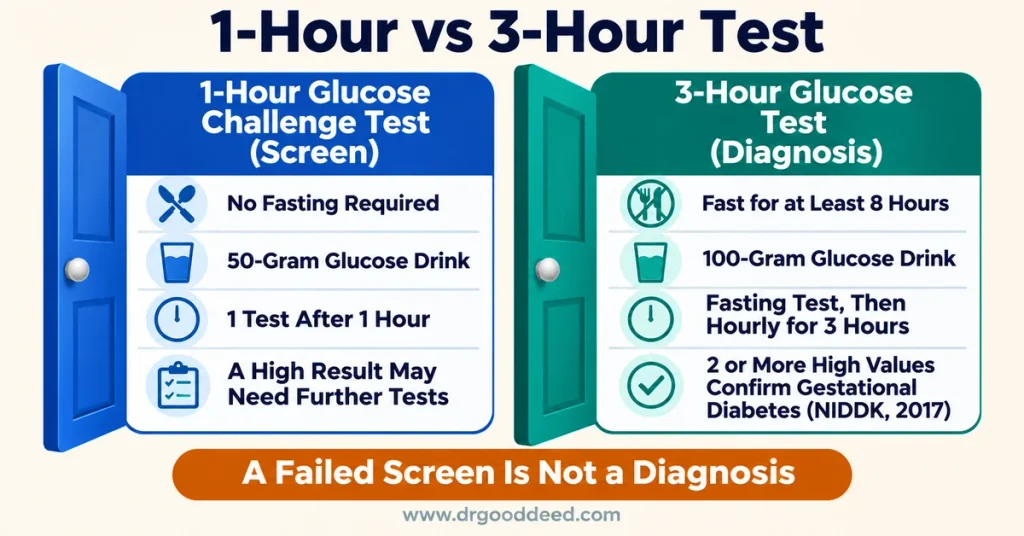
The first test is the glucose challenge test, a screen with no fasting: you drink a sugary drink and have blood drawn 1 hour later (NIDDK, 2017; Mayo Clinic, 2023). The oral glucose tolerance test (OGTT) is the diagnostic test, which tracks your blood sugar for several hours after a larger glucose drink (NIDDK, 2017).
| 1-Hour Glucose Challenge Test | 3-Hour Glucose Test |
| Screening test | Can help diagnose gestational diabetes |
| No fasting required | Must fast for at least 8 hours |
| 50-gram glucose drink | 100-gram glucose drink |
| 1 blood test | 1 fasting blood test and 1 blood test each hour for 3 hours |
| High depends on what your practice uses | High depends on the diagnostic criteria |
| May require further tests | Usually, 2 or more high values confirm gestational diabetes |
The initial test is often performed between weeks 24 and 28 of your pregnancy (CDC, 2024; NIDDK, 2017). You may be advised to have it earlier if you have certain risk factors.
Getting a high result doesn’t mean your baby is affected. Your care team just wants to have a closer look.
What Your 1-Hour Glucose Number Means
A 1-hour result under 140 mg/dL is usually considered normal, though some labs use 130 mg/dL (Mayo Clinic, 2023). Your practice’s own cutoff decides whether you need more testing.
Your 1-hour result:
| Your result | What it usually means |
| Less than 130 mg/dL | Usually normal |
| 130 to below 140 mg/dL | May be considered high, depending on whether your practice uses 130 mg/dL or 135 mg/dL |
| 140 to below 190 mg/dL | Usually requires a 3-hour glucose test |
| 190 mg/dL or higher | May indicate gestational diabetes (Mayo Clinic, 2023) |
ACOG advises practices to pick a cutoff of 135 mg/dL or 140 mg/dL and use it consistently (American Academy of Family Physicians, 2014).
If you failed by a lot, sources differ: Mayo Clinic (2023) says 190 mg/dL or higher indicates gestational diabetes, while NIDDK (2017) says a result of 200 mg/dL or higher may mean type 2 diabetes.
Your practice’s own cutoff applies, and your provider will also look at your medical history to decide what your result means.
Outside pregnancy, targets are different, and a blood sugar chart by age shows the usual adult ranges. Our guide also explains what causes high blood sugar without diabetes.
What Happens at the 3-Hour Glucose Test
For the 3-hour glucose test, you fast for at least 8 hours, drink a stronger glucose drink and have blood drawn fasting and then each hour for 3 hours (NIDDK, 2017). This shows how your body handles glucose over time.
What usually happens:
- You’ll be asked to fast for at least 8 hours. Your care team may give you specific instructions about what to eat and drink and any regular medicines.
- A blood test will be done to check your fasting glucose levels.
- You’ll be given a 100-gram glucose solution to drink (Cleveland Clinic, 2022).
- Blood tests will be taken 1, 2 and 3 hours after drinking.
- Your provider will compare your results with the diagnostic criteria.
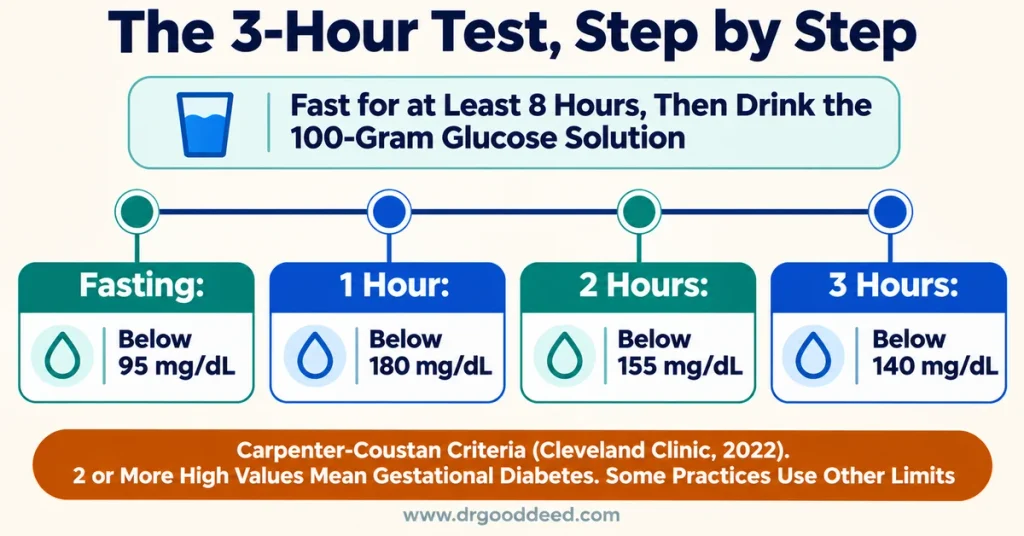
One common set of criteria, the Carpenter-Coustan criteria, uses these limits (Cleveland Clinic, 2022):
| Time | Blood Sugar Level |
| Fasting | Below 95 mg/dL |
| 1 hour | Below 180 mg/dL |
| 2 hours | Below 155 mg/dL |
| 3 hours | Below 140 mg/dL |
Any value at or above these limits counts as high, and two or more high values mean gestational diabetes (NIDDK, 2017). Some practices use the National Diabetes Data Group criteria instead, which have different limits (American Academy of Family Physicians, 2014), so ask your care team which set applies.
How Many Fail the 1-Hour Test but Pass the 3-Hour?
Many people who fail the initial screening test won’t be diagnosed with gestational diabetes. The initial test is designed to screen for people who may need further testing.
This is because:
- A broad screen: The 1-hour test is set to flag anyone who might need more testing, so it catches more people than have gestational diabetes.
- A diagnostic follow-up: The 3-hour test is the one that diagnoses gestational diabetes.
- A fuller picture: The follow-up measures your fasting glucose and how your body handles glucose over 3 hours.
- Different criteria: The two tests use different cutoffs, so a high screen does not settle the question.
The CDC (2024) says gestational diabetes affects 5% to 9% of US pregnancies. That is not a pass rate, and we could not find a reliable source for how many people pass the 3-hour test after failing the 1-hour screen.
Having PCOS can increase your risk of gestational diabetes. If you have PCOS, your provider may take this into consideration when creating your pregnancy care plan. Find out more about how PCOS is diagnosed.
How to Prepare for the 3-Hour Glucose Test
Eat normally in the days before the 3-hour glucose test and don’t cut carbs to try to pass, because that can skew the result. Follow your provider’s instructions.
Cleveland Clinic (2022) advises eating at least 150 grams of carbohydrates a day for 3 days before the test. Check this with your care team, as your practice’s instructions come first.
Things to note:
- Eat normally: Don’t skip meals or suddenly reduce your carbohydrate intake to try to pass.
- Follow fasting instructions: Fast for as long as your provider says, usually at least 8 hours (NIDDK, 2017). Ask if you can have water.
- Check about medicines: Ask your prenatal care team about any regular medicines. Don’t stop taking prescribed medicines on your own.
- Plan your morning: The test takes a few hours. Arrange transport if needed and bring something to read or do.
- Tell the staff how you feel: If you feel dizzy, nauseated or unwell, let them know.
If you’re unsure what could affect your gestational diabetes test, speak to your clinic. Ask about recent illness, fasting instructions, any medicines and whether you need to prepare in a particular way. Don’t try to affect the result.
If the 3-Hour Test Confirms Gestational Diabetes
If the 3-hour test confirms gestational diabetes, treatment usually starts with changes to what you eat, regular activity and checking your blood sugar at home, and most people go on to have healthy babies (Mayo Clinic, 2023).
Your care plan may include:
- A care team: Your OB-GYN or midwife may work with an endocrinologist, maternal-fetal medicine specialist or dietitian to manage your care.
- Home blood sugar checks: You may be asked to check your blood sugar at home at set times.
- Diet and exercise: Your care team can help you plan balanced meals and safe physical activity.
- Medicine: Some people need medicine to keep their blood sugar in their target range. Your provider decides this based on your readings.
- Closer checks on your baby: Your care team may monitor you and your baby more closely.
Managing gestational diabetes matters because high blood sugar can raise the risk of preeclampsia, a larger-than-average baby and a C-section (Mayo Clinic, 2023). With the right care, most people with gestational diabetes have a healthy baby.
You’ll also need follow-up testing after birth. ACOG recommends a glucose test 4 to 12 weeks after giving birth (Mayo Clinic, 2023), and the CDC (2024) says about half of people with gestational diabetes later develop type 2 diabetes. Regular follow-ups help spot changes early.
When to Call Your Doctor or Midwife
If you haven’t been offered follow-up testing or aren’t sure what your result means, speak to your prenatal care team. They can explain what your result means, what cutoff your practice uses and whether you need the 3-hour test.
Contact your care team if:
- You haven’t been offered follow-up: Ask when and where you’ll have your 3-hour test.
- Your result was very high: Ask whether you need a diagnostic test or further assessment.
- You’re unsure how to prepare: Confirm your fasting instructions, how many carbohydrates to eat and whether to take your regular medicines.
- You’re feeling unwell: Follow your pregnancy care plan and contact your provider if you’re concerned.
Go to the ER or call 911 if you have heavy bleeding, severe belly pain, fainting or trouble breathing, and follow any instructions your prenatal team has given you. Our guide to abdominal pain in pregnancy explains other causes of belly pain.
If you failed the 1-hour glucose test in pregnancy and have not been booked for follow-up testing, call your prenatal care team to schedule it.
Frequently Asked Questions
Is It My Fault That I Failed the Glucose Test?
No. Pregnancy hormones make your body use insulin less well, and all pregnant people have some insulin resistance late in pregnancy (CDC, 2024). Gestational diabetes happens when your body can’t make enough extra insulin to keep up. It doesn’t mean you did anything wrong, and it isn’t caused by one meal.
Are There Signs You Failed the Glucose Test?
Usually, there are no clear signs. Gestational diabetes often doesn’t cause any symptoms or causes only mild symptoms, such as increased thirst and urination (CDC, 2024). Feeling always thirsty doesn’t necessarily mean you have gestational diabetes. This is why regular screening is important.
Can I Refuse the Glucose Test?
You can talk to your prenatal care provider about your concerns. However, the USPSTF recommends screening for gestational diabetes at 24 weeks or later (2021). If you’re not comfortable doing the test, ask your provider whether another approach is appropriate. Make sure you understand the possible risks of not having the screening.
Does a Failed Glucose Test in Pregnancy Mean Diabetes After Birth?
No. A failed glucose test in pregnancy is only a screening result, and even confirmed gestational diabetes usually goes away after delivery, though it raises your later risk. ACOG advises a glucose test 4 to 12 weeks after birth (Mayo Clinic, 2023), and about half of people with gestational diabetes later develop type 2 diabetes (CDC, 2024).
Could a Very High Result Mean I Had Diabetes Before Pregnancy?
Possibly. A 1-hour result of 200 mg/dL or more may point to type 2 diabetes (NIDDK, 2017), and high blood sugar early in pregnancy can mean type 1 or type 2 diabetes (CDC, 2024). Your provider will advise further testing. Our guide to type 1 vs. type 2 diabetes explains the difference.
Sources
- National Institute of Diabetes and Digestive and Kidney Diseases, Tests and Diagnosis for Gestational Diabetes (2017). link
- Mayo Clinic, Glucose Challenge Test (2023). link
- American Academy of Family Physicians, ACOG Releases Guideline on Gestational Diabetes (2014). link
- Centers for Disease Control and Prevention, Gestational Diabetes (2024). link
- U.S. Preventive Services Task Force, Gestational Diabetes: Screening (2021). link
- Cleveland Clinic, Oral Glucose Tolerance Test During Pregnancy (2022). link
Medical Disclaimer: This article is for general information only and is not medical advice. It does not replace a diagnosis, treatment plan, or guidance from a qualified healthcare professional. Always talk to your doctor about your own symptoms and before starting, stopping, or changing any treatment. If you think you may be having a medical emergency, call 911 or go to your nearest emergency room.