


Medically reviewed by Dr Anshu Alok, Endocrinology
Being thin, diagnosed with type 2 and not responding to metformin can point to LADA, or type 1.5 diabetes, but only blood tests can tell for sure. LADA is an autoimmune condition that develops gradually in adults. These clues do not confirm LADA, but they may be reasons to discuss further testing with your doctor.
Key Takeaways
- LADA, or type 1.5 diabetes, is a slow autoimmune diabetes often mistaken for type 2, and antibody tests can confirm it.
- Research suggests that some people diagnosed with type 2 diabetes have LADA (Cleveland Clinic Journal of Medicine, 2025), although prevalence estimates vary across studies.
- GAD antibodies can help identify an autoimmune cause, while C-peptide testing helps assess how much insulin the pancreas still produces (American Diabetes Association).
- Many people with LADA eventually need insulin as their insulin-producing cells become damaged, although the progression varies (Cleveland Clinic Journal of Medicine, 2025).
What Is LADA Type 1.5 Diabetes?
LADA, or type 1.5 diabetes, is an autoimmune condition that develops in adulthood and slowly destroys insulin-producing cells, so it can look like type 2 diabetes for months or years.
LADA stands for latent autoimmune diabetes in adults. The immune system mistakenly attacks beta cells in the pancreas, which normally produce insulin. As these cells become damaged, the body gradually loses its ability to regulate blood glucose effectively.
Type 2 diabetes commonly involves insulin resistance, while LADA involves an autoimmune attack on insulin-producing cells. In LADA, insulin production often declines more gradually than in classic type 1 diabetes.
Estimates of how frequently LADA occurs among people diagnosed with type 2 diabetes differ. A 2025 review in the Cleveland Clinic Journal of Medicine (CCJM) estimated that LADA may account for a small but meaningful proportion of type 2 diagnoses, ranging from 4% to 14%. Cleveland Clinic reported a range of 4% to 12% in its 2024 overview. These differences reflect variations in the populations studied and the criteria used to identify LADA.
| Feature | Type 2 diabetes | LADA | Type 1 diabetes |
| Typical age at diagnosis | Can occur at any age, often in adulthood | Usually develops in adulthood | Often begins in childhood or adolescence but can develop at any age |
| Main process | Insulin resistance and declining insulin production | Autoimmune damage to insulin-producing cells | Autoimmune damage to insulin-producing cells |
| Body type | Any body size | Any body size; a lean build may raise suspicion | Any body size |
| Diabetes-related antibodies | Not a defining feature | Usually present | Usually present |
| Progression | Varies from person to person | Often gradual, with insulin production declining over time | Often faster, although the course varies |
| Insulin treatment | May be needed over time | Commonly needed as insulin production declines | Required for treatment |
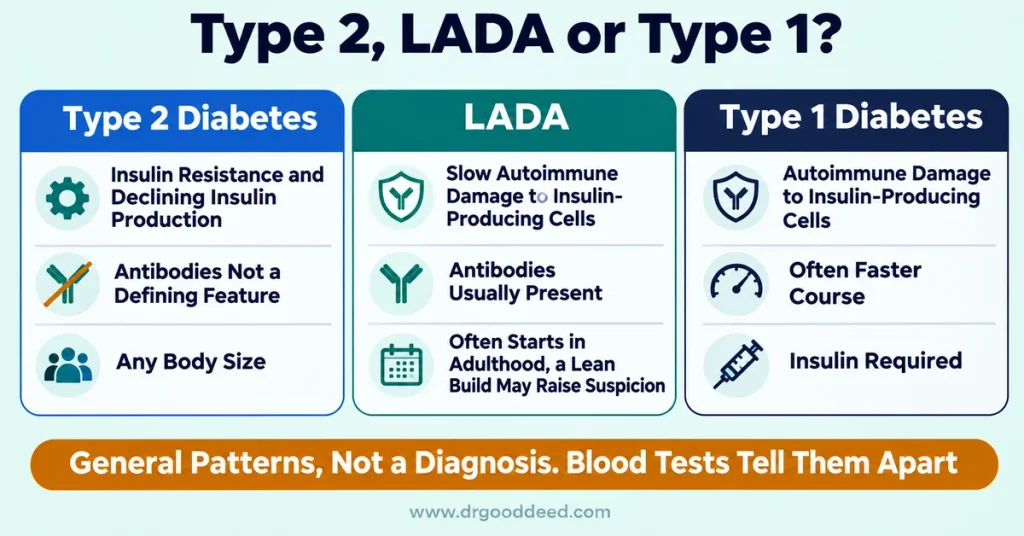
These are general patterns, not rules that can diagnose diabetes on their own. Blood tests and clinical assessment help distinguish between the different types. Read more about the differences between type 1 and type 2 diabetes.
Can You Be Thin and Have Type 2 Diabetes?
Yes. You can develop type 2 diabetes even if you are thin. Body weight alone cannot determine your diabetes type, but a lean build combined with other warning signs may prompt your doctor to investigate LADA.
Type 2 diabetes does not affect only people who are overweight. Genetics, insulin resistance, age, and other factors can contribute to the condition at different body sizes.
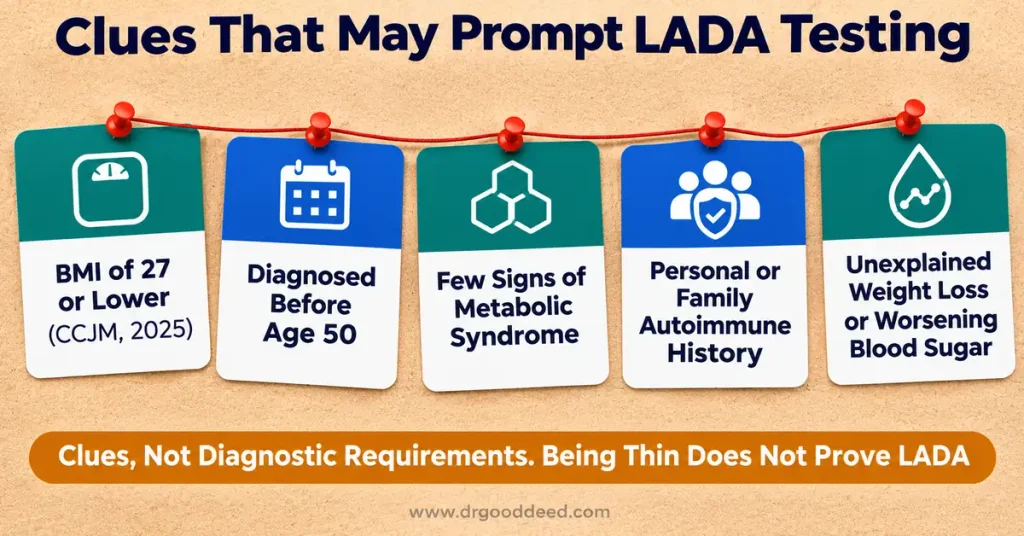
A review published in the Cleveland Clinic Journal of Medicine in 2025 identified several features that may support testing for LADA, including a BMI of 27 or lower, diagnosis before age 50, an absence of metabolic syndrome, and a personal or family history of autoimmune disease. These features are clues rather than diagnostic requirements.
Other signs worth discussing with your doctor include:
- Unexplained weight loss: Losing weight without trying, especially alongside increased thirst or frequent urination, deserves medical attention.
- Few signs of metabolic syndrome: You may not have the typical combination of abdominal fat, high blood pressure, and abnormal blood fats.
- Worsening blood sugar: Your glucose levels remain high despite following your prescribed treatment plan.
- Autoimmune history: You or close family members have an autoimmune condition, such as autoimmune thyroid disease.
Being thin does not prove that you have LADA, and people with LADA can have different body types. Our guide to diabetes in thin people explains why diabetes can occur at different body sizes.
Does LADA Respond to Metformin?
LADA may respond to metformin during its early stages, but the benefit can decline as the pancreas loses more insulin-producing cells (Cleveland Clinic, 2024). A poor response does not automatically mean you have LADA.
Early in the condition, your body may still produce enough insulin for metformin to help manage blood glucose. As insulin production declines, the same treatment may no longer provide adequate control.
A few important points can help put this into perspective:
- Early response: Blood sugar may improve initially, even when someone has LADA.
- Changing treatment needs: As the condition progresses, the original treatment plan may no longer be sufficient.
- Type 2 diabetes can also progress: People with type 2 diabetes may need changes to their treatment over time (NIDDK, 2022), so declining effectiveness does not confirm LADA.
- Further assessment: Your doctor may review your A1C, glucose readings, symptoms, medical history, and whether antibody or C-peptide testing is appropriate.
If your blood sugar remains above your target, arrange a medical review rather than assuming your diagnosis is incorrect. Do not stop metformin or change your treatment without speaking with your healthcare team.
Signs Your Type 2 Diagnosis Might Be LADA
LADA may be worth investigating when several clues occur together, such as adult-onset diabetes, a lean build, an autoimmune history, unexplained weight loss, or blood sugar that becomes harder to manage over time.
The age used to identify people who may benefit from testing varies across clinical sources. The Cleveland Clinic Journal of Medicine review from 2025 generally discusses adults aged 30 and older, while Mayo Clinic (2023) says over 30 and Cleveland Clinic (2024) gives 30 to 50. The American Diabetes Association uses 35 or older. There is no single age cutoff that confirms or rules out LADA.
Look at the overall pattern rather than focusing on one symptom:
- Age at diagnosis: LADA usually begins in adulthood, but age alone cannot determine the diabetes type.
- Autoimmune history: A personal or family history of autoimmune disease may increase suspicion.
- Symptoms of high blood sugar: Increased thirst, frequent urination, tiredness, blurred vision, and unexplained weight loss can occur.
- Treatment becoming less effective: Glucose levels may remain above target even when you follow your prescribed plan.
- Lean body type: A lean build may support further testing when other clues are present.
Sex is not a reliable standalone clue. An older UVA Health article (2016) highlighted women aged 40 to 70 as a possible group to consider, but the more recent Cleveland Clinic Journal of Medicine review (2025) found no consistent difference in LADA occurrence between men and women.
If these signs sound familiar, ask your doctor whether testing for LADA makes sense. Symptoms and body weight alone cannot confirm it.
Tests That Confirm LADA
A GAD antibody test and a C-peptide test are important parts of a LADA assessment (American Diabetes Association; CCJM, 2025). The antibody test looks for signs of an autoimmune response, while C-peptide helps show how much insulin your pancreas is still producing.
Your doctor may recommend several tests depending on your symptoms and medical history.
GAD65 antibody test: GAD antibodies are markers of an immune response against an enzyme found in insulin-producing cells. GAD65 is the most commonly detected antibody in LADA and is found in about 90% of affected people (CCJM, 2025).
Additional antibody tests: If the GAD65 result is negative but LADA remains a concern, your doctor may consider other antibodies, including IA-2, ZnT8, or islet cell antibodies (ICA). A negative GAD65 result does not rule out every case. Repeating a negative GAD65 test or routinely tracking antibody levels over time is generally not standard practice (CCJM, 2025).
C-peptide test: C-peptide is released when the pancreas produces insulin. Measuring it helps your doctor assess how much insulin your body still makes. Results need to be interpreted alongside your glucose level and clinical findings.
Review of diagnostic criteria: Doctors consider adult-onset diabetes, diabetes-related antibodies, and the pattern of insulin dependence. Some diagnostic criteria include not needing insulin for at least 6 months after diagnosis (CCJM, 2025). However, this is not an absolute rule, and the full clinical picture matters.
Tests for other conditions: Not every unusual diabetes presentation is LADA. Monogenic diabetes, including maturity-onset diabetes of the young (MODY), can resemble type 1 or type 2 diabetes and may run through several generations of a family (NIDDK, 2024). Pancreatic disease can also cause type 3c diabetes.
Your doctor may also review your A1C, glucose readings, symptoms, family history, and changes in treatment needs. These findings should be considered together rather than interpreted in isolation.
How Type 1.5 Diabetes Is Treated
Treatment depends on how much insulin your body still produces and how well your blood sugar is controlled. Some people initially manage LADA without insulin, but insulin commonly becomes necessary as the condition progresses.
Your care plan may include:
- Blood sugar monitoring: Regular glucose checks and A1C testing help show whether treatment is working.
- Treatment reviews: Your healthcare team can reassess your plan as your insulin production changes.
- Insulin when needed: Insulin helps replace what your body can no longer produce adequately.
- Regular follow-up: Symptoms, glucose readings, A1C, and C-peptide results help guide treatment decisions.
The time it takes for someone with LADA to need insulin varies. The Cleveland Clinic Journal of Medicine review published in 2025 reported that more than 80% of affected people may need insulin within six years of diagnosis. An older UVA Health article (2016) described a slower decline in insulin production over 10 to 15 years for some people. These findings show why the timeline cannot be predicted accurately for every individual.
LADA has no established cure (Cleveland Clinic, 2024), but appropriate treatment can help manage blood sugar and reduce the risk of complications. Your healthcare team can explain which approach fits your test results and current needs. Do not stop metformin or make treatment changes on your own.
When to See a Doctor About LADA
Talk to your doctor if you have been diagnosed with type 2 diabetes but are lean, losing weight without trying, have a personal or family history of autoimmune disease, or are struggling to reach your glucose targets despite following your treatment plan.
A primary care clinician can review your symptoms and decide whether you need an endocrinologist. Bring your recent glucose readings, A1C results, medication list, and details of any unexplained weight changes. You can also review our information on diabetes causes and symptoms.
It is important to recognize the warning signs of diabetic ketoacidosis (DKA). This serious complication occurs when the body does not have enough insulin to use glucose effectively and begins breaking down fat for energy.
Seek emergency care if you develop symptoms listed by the CDC (2024), such as:
- Fast, deep breathing
- Fruity-smelling breath
- Nausea or repeated vomiting
- Stomach pain
- Severe tiredness or confusion
- Extreme thirst and frequent urination
DKA can be life-threatening and may sometimes be the first sign of diabetes (CDC, 2024). If these symptoms occur, go to the emergency department or call 911 in the United States.
If you think you might have LADA, or type 1.5 diabetes, ask your doctor for an antibody test before your treatment plan changes.
Frequently Asked Questions
Is Type 1.5 Diabetes Rare?
Type 1.5 diabetes is less rare than its name suggests, and many cases are first labeled type 2. Research estimates vary, but studies suggest that it accounts for a meaningful proportion of adults initially diagnosed with type 2 diabetes (CCJM, 2025). The estimated prevalence depends on the population studied and the diagnostic criteria used.
Is LADA the Same as Type 1 Diabetes?
Mostly. The American Diabetes Association calls LADA an autoimmune form of type 1 diabetes that develops gradually in adults. Like classic type 1 diabetes, it involves damage to insulin-producing cells. The main difference is that insulin production often declines more slowly, so insulin treatment may not be necessary immediately after diagnosis.
Can You Reverse LADA Diabetes?
No. LADA currently has no cure and cannot be reversed (Cleveland Clinic, 2024). Appropriate treatment and regular monitoring can help manage blood sugar and reduce the risk of complications. Treatment needs may change as insulin production declines, so follow-up with your healthcare team is important.
What Causes Type 1.5 Diabetes?
LADA develops when the immune system mistakenly attacks insulin-producing cells in the pancreas. The exact cause is not fully understood, but genetic factors and a personal or family history of autoimmune conditions may contribute to risk. Having these risk factors does not mean you will necessarily develop LADA.
What Is the Life Expectancy With LADA?
There is no single life expectancy figure for everyone with LADA. Outlook depends on factors such as timely diagnosis, blood sugar management, treatment, and other health conditions. Appropriate care can help reduce the risk of serious complications. Your healthcare team can discuss your individual risks and long-term care needs.
Sources
American Diabetes Association, Understanding Latent Autoimmune Diabetes in Adults (LADA). link
Cleveland Clinic Journal of Medicine, Latent Autoimmune Diabetes in Adults: Not Type 1, Not Type 2, a Little of Both (2025). link
NIDDK, Insulin, Medicines, and Other Diabetes Treatments (2022). link
NIDDK, Monogenic Diabetes (MODY and Neonatal Diabetes Mellitus) (2024). link
UVA Health, Assume It’s Type 2? If Glucose Numbers Won’t Budge, It Could Be LADA (2016). link
Cleveland Clinic, Latent Autoimmune Diabetes in Adults (LADA) (2024). link
Mayo Clinic, Latent Autoimmune Diabetes in Adults (LADA): What Is It? (2023). link
CDC, Diabetic Ketoacidosis (2024). link
Medical Disclaimer: This article is for general information only and is not medical advice. It does not replace a diagnosis, treatment plan, or guidance from a qualified healthcare professional. Always talk to your doctor about your own symptoms and before starting, stopping, or changing any treatment. If you think you may be having a medical emergency, call 911 or go to your nearest emergency room.