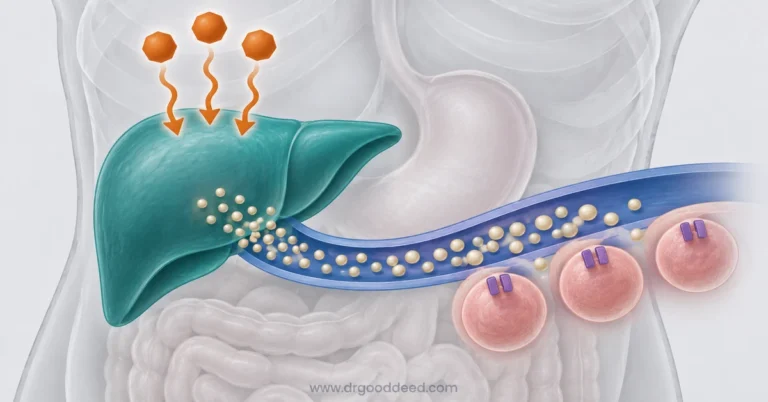

Diabetes increases your risk of developing frozen shoulder, a condition that causes shoulder pain and stiffness. Research suggests that high blood sugar may affect the tissues around your shoulder joint, making movement difficult. A 2026 meta-analysis found 3.69 times higher odds in people with diabetes, though this shows an association, not proof of cause. Understanding the link between frozen shoulder and diabetes can help you recognize the symptoms, understand recovery, and discuss suitable treatment with your doctor.
Key Takeaways
- People with diabetes are more likely to get frozen shoulder: a 2026 meta-analysis found 3.69 times higher odds, though this shows association, not cause.
- Frozen shoulder occurs when the connective tissue in your shoulder joint thickens and tightens.
- High blood sugar, inflammation, and changes in connective tissue may contribute to the condition.
- Frozen shoulder has three stages: freezing, frozen, and thawing.
- Symptoms typically improve within 1 to 3 years (Mayo Clinic, 2026), but recovery time varies from person to person.
- A steroid injection can temporarily raise blood sugar, so tell your clinician you have diabetes and ask about monitoring your glucose.
- Shoulder pain with chest pressure, shortness of breath, sweating or pain spreading to the jaw or arm needs emergency care: call 911 (US) or 999 (UK).
What Is Frozen Shoulder?
Frozen shoulder, also called adhesive capsulitis, causes pain and stiffness that limit how far you can move your arm. It develops when the tissue surrounding your shoulder joint becomes thick and tight.
You may find it difficult to dress, reach overhead, wash your hair, or sleep comfortably on the affected side. Pain often starts gradually, and stiffness may increase over time.
Diabetes increases your risk, but other conditions, such as arthritis and rotator cuff problems, can also cause shoulder pain. A doctor can examine your shoulder to identify the cause. Shoulder pain can also be referred from elsewhere, as with gas pain in the shoulder.
The Frozen Shoulder and Diabetes Link
Research shows that people with diabetes have a higher chance of developing frozen shoulder than people without diabetes.
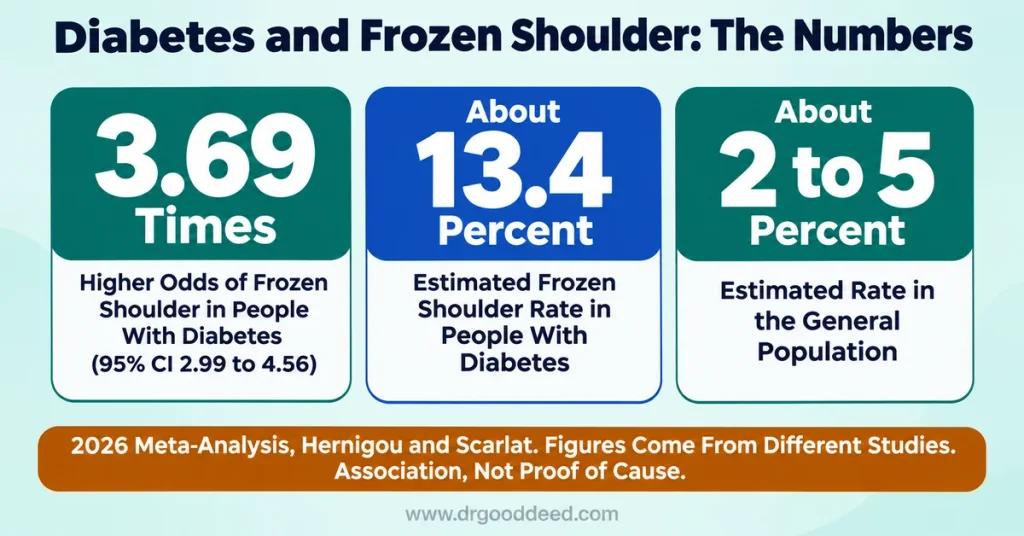
A 2026 systematic review and meta-analysis by Hernigou and Scarlat, published in International Orthopaedics, found 3.69 times higher odds of frozen shoulder in people with diabetes. The analysis included 351,486 participants across the broader evidence base and reported a 95% confidence interval of 2.99 to 4.56.
The researchers also estimated that frozen shoulder affected about 13.4% of people with diabetes, compared with an estimated 2% to 5% of the general population.
These figures come from different studies, so the actual rates may vary. The findings show a strong link between diabetes and frozen shoulder, but they do not prove that diabetes directly causes the condition.
Why Does Diabetes Raise the Risk?
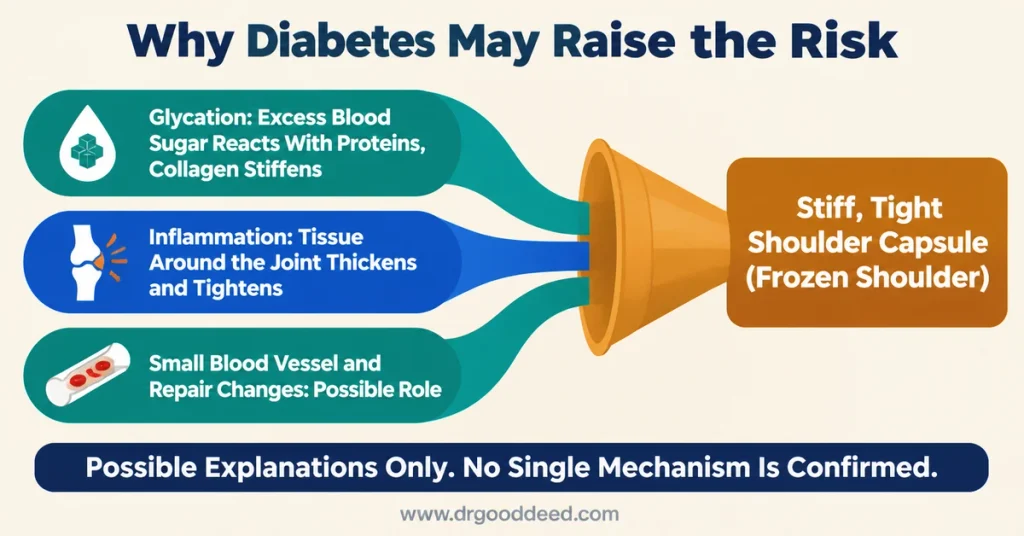
Researchers believe several changes in the body may explain why people with diabetes develop frozen shoulder more often. However, they have not confirmed one exact cause.
Glycation and Collagen Stiffness
Collagen is a protein that helps keep your connective tissues strong and flexible. Over time, excess blood sugar can react with proteins in a process called glycation.
This process may change collagen and make connective tissues less flexible. Researchers believe these changes could contribute to the stiffness seen in frozen shoulder, but more research is needed to confirm the exact role of glycation.
Inflammation and Capsule Changes
Inflammation may cause the tissue around your shoulder joint to become thicker and tighter. Changes in the way the body repairs tissue may also contribute to stiffness.
Researchers have also suggested that changes in small blood vessels may affect the health of the shoulder joint. These are possible explanations, and no single mechanism fully explains the link.
Other Associated Risk Factors
The 2026 meta-analysis also linked frozen shoulder with longer diabetes duration, poorer glucose control, obesity, high cholesterol, high blood pressure, thyroid disease, age 40 to 65 and female sex (Hernigou and Scarlat, 2026).
Having these risk factors does not mean you will develop frozen shoulder. Your medical history and symptoms help your doctor assess your individual risk.
If you want to learn more about diabetes and its effects on your body, read our guide to what diabetes is. Diabetes can affect the nerves too, so you may also want to know whether diabetic neuropathy can be reversed.
What Are the Symptoms of Frozen Shoulder?
Frozen shoulder symptoms usually develop slowly. You may notice pain first, followed by stiffness that makes everyday movements harder.
Common symptoms include:
- Shoulder pain: Your shoulder may ache during movement or at night.
- Stiffness: You may struggle to turn your arm or lift it overhead.
- Limited movement: Reaching behind your back or reaching for objects may become difficult.
- Sleep problems: Pain may make it uncomfortable to lie on the affected shoulder.
If your shoulder pain continues or your movement becomes more restricted, arrange a medical assessment. Your doctor can check your shoulder movement and look for other possible causes, such as arthritis or rotator cuff problems.
When Should You Seek Urgent Care?
Not all shoulder pain comes from frozen shoulder. Certain symptoms need urgent medical attention.
- Possible heart attack: If shoulder pain occurs with chest pain or pressure, shortness of breath, sweating, nausea, or pain spreading to your jaw or arm, call 911 in the US or 999 in the UK.
- Possible joint infection: A hot, red, swollen shoulder or shoulder pain with fever needs same-day medical assessment. In the US, see your doctor the same day or go to urgent care; in the UK, contact NHS 111 or a same-day GP. If you become seriously unwell, call 911 or 999.
- Sudden or severe pain: Get prompt medical attention if your shoulder pain starts suddenly, becomes severe, or worsens despite treatment.
Read more about the warning signs of a heart attack and the symptoms of a silent heart attack.
The Three Frozen Shoulder Stages
Frozen shoulder usually develops through three stages. The symptoms change as the condition progresses, and each stage can last for a different amount of time.
Mayo Clinic (2026) gives these approximate durations:
| Stage | What happens | Duration |
| Freezing | Pain increases, and shoulder movement becomes more difficult. | 2 to 9 months |
| Frozen | Stiffness becomes more noticeable, although pain may decrease. | 4 to 12 months |
| Thawing | Shoulder movement gradually improves. | 5 to 24 months |
These timeframes are estimates, not fixed limits. Some people recover sooner, while others need more time.
Your pain may improve before your shoulder movement returns to normal. Therefore, less pain does not always mean the joint has fully recovered.
How Long Does Frozen Shoulder Last in Diabetes?
Frozen shoulder can last several months or even years. Symptoms generally improve within 1 to 3 years (Mayo Clinic, 2026), although recovery varies.
People with diabetes have a higher risk of developing frozen shoulder, but research has not established exactly how long recovery takes specifically in people with diabetes.
Your symptoms, the severity of stiffness, other health conditions, and your response to treatment may affect your recovery.
Does Blood Sugar Control Affect Recovery?
Poorer glucose control is one of the factors linked to frozen shoulder (Hernigou and Scarlat, 2026), but this link comes from observational studies.
However, current evidence does not prove that lowering blood sugar prevents frozen shoulder or makes it heal faster. Follow your diabetes care plan to support your overall health, and speak with your doctor if your shoulder symptoms persist or worsen.
Frozen Shoulder Treatment for People With Diabetes
Treatment aims to reduce pain, improve movement, and help you return to your daily activities. Your doctor will recommend options based on your symptoms, shoulder movement, and overall health.
Physical Therapy and Movement
A physical therapist may recommend a suitable movement program to help reduce stiffness and maintain shoulder function. Ask a healthcare professional before starting an exercise program, especially if your pain is severe or you have not received a diagnosis.
Steroid Injections and Blood Sugar
A steroid injection may help relieve shoulder pain, but it can also temporarily raise your blood sugar.
A small study of 17 people with diabetes, from Washington University in St. Louis and the Rothman Institute, found an average fasting glucose increase of 38 mg/dL in participants with HbA1c below 7%, compared with 98 mg/dL in participants with poorer glucose control. Glucose levels in the better-controlled group returned close to baseline around day eight. These results cannot predict how every person will respond.
Health Village, a Finnish public health service (2025), also warns that blood sugar may remain elevated for one to two weeks after a steroid injection. The duration and size of the increase vary.
Before receiving an injection:
- Tell your doctor that you have diabetes.
- Ask how often you should check your blood sugar afterward.
- Ask what to do if your readings rise above the range in your diabetes care plan.
- Follow your healthcare team’s advice if your readings remain unusually high.
Never stop or change your diabetes medicines or insulin without medical guidance.
Other Treatment Options
If your shoulder remains stiff, a specialist may consider hydrodistension, a procedure that uses fluid to stretch the shoulder joint capsule.
Surgery is rarely needed. A specialist may discuss it if severe stiffness continues despite appropriate nonsurgical treatment.
Your doctor can explain the benefits and risks of each option and help you choose a suitable approach.
Next Steps for a Diabetic Frozen Shoulder
If you have diabetes and your shoulder feels increasingly stiff or painful, arrange a medical assessment rather than waiting for the problem to interfere with your daily activities. Frozen shoulder is more common in people with diabetes and may need careful treatment planning.
Ask your doctor if your symptoms could be caused by frozen shoulder, what treatments might help, and how to manage your blood sugar if you get a steroid injection for your shoulder. Getting an early diagnosis can help you know what treatment options are available for your condition and rule out other causes of your shoulder pain.
Frequently Asked Questions
Does Diabetes Cause Frozen Shoulder?
Not directly, as far as research shows. Diabetes is strongly linked to frozen shoulder, with 3.69 times higher odds in a 2026 meta-analysis, but these studies show an association, not proof that diabetes causes it.
Why Are People With Diabetes More Likely to Get Frozen Shoulder?
Changes in collagen, inflammation, and small blood vessels may contribute, but researchers have yet to identify the precise cause.
How Common Is Frozen Shoulder in People With Diabetes?
About 13.4% of people with diabetes have frozen shoulder, according to a 2026 meta-analysis by Hernigou and Scarlat, compared with about 2% to 5% of the general population.
How Long Does Frozen Shoulder Last in People With Diabetes?
Recovery varies. Symptoms generally improve within 1 to 3 years (Mayo Clinic, 2026), but a separate recovery timeline for people with diabetes has not been established.
Does High Blood Sugar Make Frozen Shoulder Worse?
Poor glucose control is associated with frozen shoulder risk, but evidence does not prove that lowering blood sugar shortens recovery.
Sources
1. International Orthopaedics, The Diabetic Shoulder: Association Between Diabetes Mellitus and Adhesive Capsulitis (Hernigou and Scarlat, 2026). link
2. Journal of Clinical Medicine, A Narrative Review of Adhesive Capsulitis with Diabetes (Chen and Chen, 2024). link
3. Muscles, Ligaments and Tendons Journal, Adhesive Capsulitis of the Shoulder and Diabetes: A Meta-Analysis of Prevalence (Zreik and others, 2016). link
4. BMJ Open, Diabetes as a Risk Factor for the Onset of Frozen Shoulder: A Systematic Review and Meta-Analysis (Dyer and others, 2023). link
5. Medicine (Baltimore), Does the Intervention for Adhesive Capsulitis in Patients With Diabetes Differ From That for Patients Without Diabetes? (Tang and Tan, 2024). link
6. Mayo Clinic, Frozen Shoulder: Symptoms and Causes. link
7. Health Village (Terveyskylä), Diabetes and Shoulder Joints. link
Medical Disclaimer: This article is for general information only and is not medical advice. It does not replace a diagnosis, treatment plan, or guidance from a qualified healthcare professional. Always talk to your doctor about your own symptoms and before starting, stopping, or changing any treatment. If you think you may be having a medical emergency, call 911 or go to your nearest emergency room.