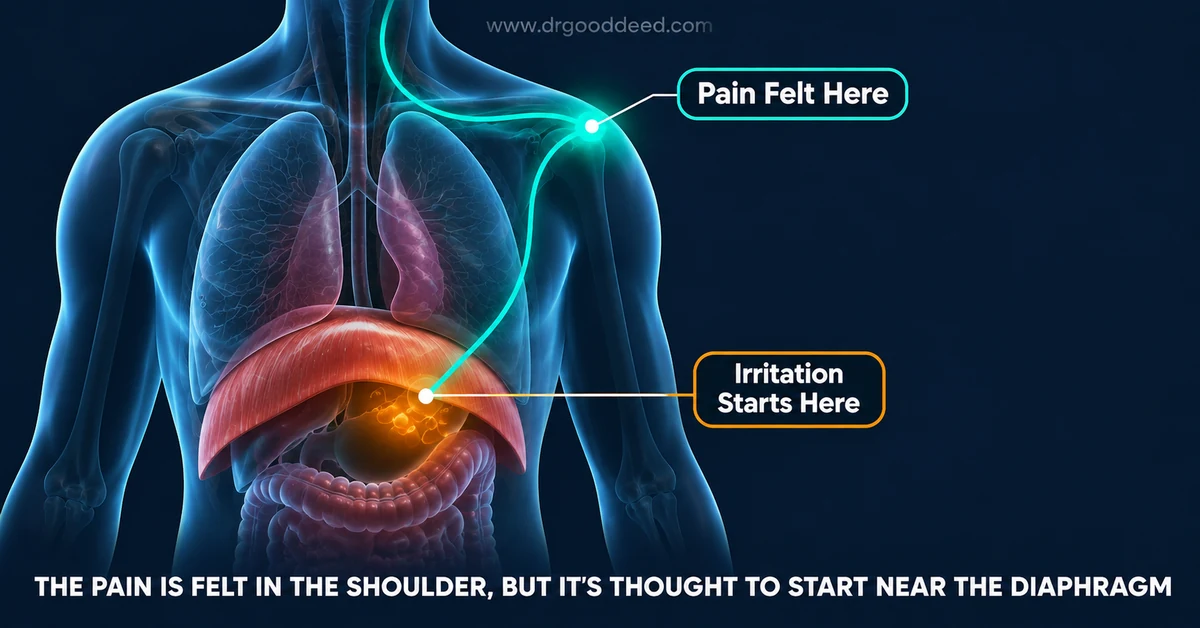

Gas pain in the shoulder is thought to be referred pain: irritation near the diaphragm is felt in the shoulder because the two share nerve pathways. After laparoscopic surgery, it is believed to come from carbon dioxide gas that irritates the diaphragm. Trapped gas in the intestines may sometimes cause similar discomfort, but that link is much harder to prove.
The pain is often described as sharp, aching, or uncomfortable, and it may ease as the gas passes or is absorbed. Knowing the possible causes helps you tell whether the pain is linked to gas or needs medical attention.
Key Takeaways
- Gas pain in the shoulder is thought to be referred pain from gas irritating the diaphragm; chest pain, sweating, or breathlessness needs urgent care.
- About 35% to 80% of people have shoulder symptoms after laparoscopy, and these usually settle within a few days.
- Trapped gas may cause referred discomfort without surgery, but the evidence is weak.
- Get urgent medical help for any one of these signs:
- Left shoulder pain after an abdominal injury
- Shoulder pain with severe upper right abdominal pain
- Shoulder pain with chest pressure
| Situation | Possible cause | Clue |
| Shoulder symptoms 1 to 3 days after surgery | Residual CO2 irritating the diaphragm | Common; affects about 35% to 80% of people after laparoscopy |
| Shoulder symptoms with bloating | Trapped gas, plausible but weakly evidenced | Usually unchanged by shoulder movement |
| Left shoulder pain after abdominal injury | Spleen injury | Faintness may occur; seek emergency care |
| Right shoulder pain with severe upper right abdominal pain | Gallstones or liver irritation | Nausea or vomiting may occur; needs medical assessment |
| Shoulder pain with chest pressure or breathlessness | Heart attack | Call 911 or 999 |
Why Does Gas Pain Go to Your Shoulder?
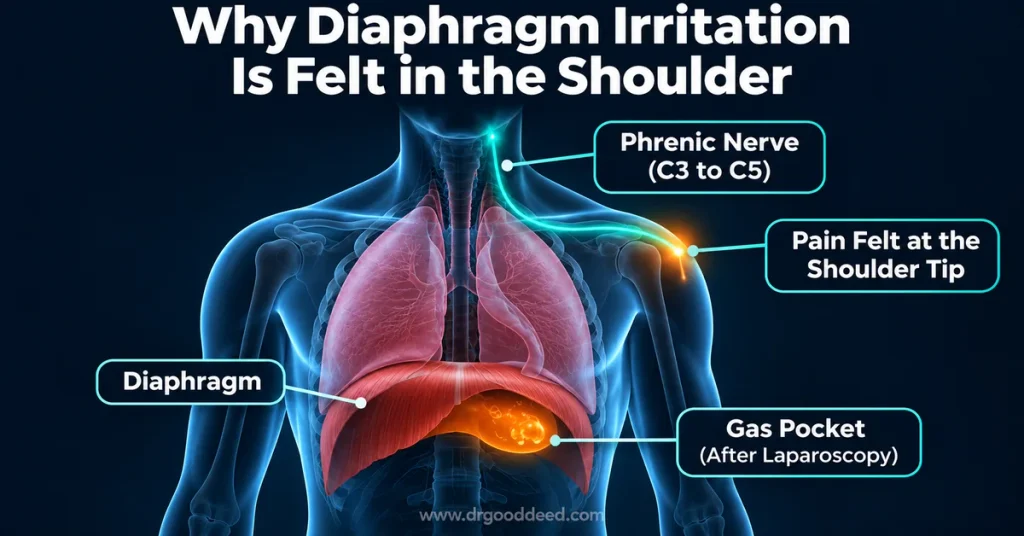
Gas pain in the shoulder is thought to be referred pain: the brain reads irritation near the diaphragm as if it came from the shoulder. The phrenic nerve, which supplies the diaphragm, arises from the C3 to C5 nerve roots. These overlap with the C4 area that covers the shoulder tip. The pain is not actually inside the shoulder, and “gas pain in shoulder” simply describes where it is felt.
FACT: Shoulder pain can follow surgery and still be harmless. If it comes with chest pressure, sweating, breathlessness, fainting, or a rigid abdomen, do not assume it is gas.
Gas Pain in Shoulder After Laparoscopy: Why It Happens
Gas pain in shoulder after laparoscopy is common: studies report shoulder pain in about 35% to 80% of patients, and some gynecologic series report 20% to 80%. It is thought to come from carbon dioxide left under the diaphragm after the abdomen is inflated for surgery, especially near the right side of the diaphragm.
A typical timeline looks like this:
- Day 0 to 1: shoulder-tip pain often begins within the first day.
- Day 2: pain tends to peak.
- Day 3 to 4: pain usually eases as the gas is absorbed.
Some people notice it for longer. Tell your surgical team if the pain is getting worse instead of better.
Some research suggests the surgical team can reduce this pain. In one randomized trial of laparoscopic gallbladder surgery, a pulmonary recruitment maneuver cut the rate of shoulder pain over 48 hours from 63.4% to 44.7%. A separate meta-analysis found about a 1.1-point reduction in pain at 12 hours. The surgical team performs this maneuver at the end of the operation, so it is not something you can do yourself.
SURGERY FACT: Lower-pressure insufflation (8 to 10 mmHg) is associated with less postoperative pain than higher pressure (12 to 15 mmHg). Reports differ on whether any position or technique after surgery helps, so follow your surgical team’s advice.
Can Gas Cause Shoulder Pain Without Surgery?
It may be possible, but the evidence is much weaker than for pain after surgery. Excess gas can stretch the intestines under the diaphragm and may cause referred discomfort, as described in our guide on chest pain due to gas.
No primary study has shown that ordinary intestinal gas causes shoulder pain. Most shoulder pain starts in the shoulder joint, the muscles, or the tendons that attach to it, so gas should not be the first assumption.
Left shoulder pain from gas is possible, for example from gas in the left side of the colon, but it does not necessarily mean bloating is the cause. After an abdominal injury, left shoulder pain may point to a problem with the spleen, so read about upper left abdominal pain under ribs. Unlike many joint or muscle problems, referred pain does not usually change with shoulder movement.
When Is Shoulder Pain Not Gas?
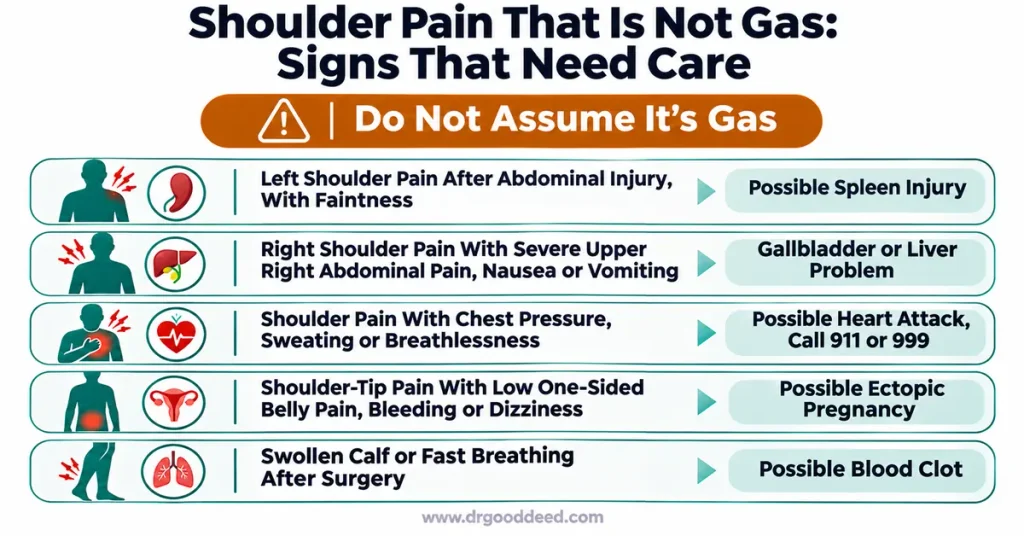
Shoulder-tip pain can be referred from organs other than the gut, so the side of the pain and the other symptoms matter. The side can suggest a possible cause but can never confirm gas. Kehr’s sign is shoulder-tip pain from diaphragm irritation, classically linked to a ruptured spleen after abdominal trauma.
Watch for these patterns:
- Spleen injury: left shoulder pain after abdominal trauma with faintness. See upper left abdominal pain under ribs.
- Gallbladder or liver problems: right shoulder pain with severe pain in the upper right abdomen, nausea, or vomiting.
- Heart attack: shoulder pain with pressure or discomfort in the center of the chest, which may spread to the jaw, neck, arm or upper back, often with sweating or shortness of breath. Women may have less typical symptoms such as nausea, vomiting, upset stomach, or unusual tiredness. See left side chest pain.
- Ectopic pregnancy: shoulder-tip pain with low one-sided belly pain, vaginal bleeding, or dizziness in anyone who is or could be pregnant needs emergency care.
- Serious abdominal problem: a very rigid, hard abdomen.
- Blood clot after surgery: a swollen calf, or fast breathing that does not settle.
If chest pain or pressure comes with sweating, difficulty breathing, or fainting, call 911 in the US or 999 in the UK, or go to an emergency department or A&E. If you have any worrying symptom after surgery, contact the surgical team. For shoulder pain without these signs that lasts more than a few days, or if you are unsure of the cause, see your primary care doctor (US) or GP (UK).
IMPORTANT: If shoulder pain occurs with chest tightness, difficulty breathing, sweating, or fainting, this may be a medical emergency. Any one of these signs is enough. Do not assume left or right shoulder pain is caused by gas.
RED FLAG: When shoulder pain comes with chest pressure, sweating, severe shortness of breath, fainting, or a stiff belly, do not wait to see whether the suspected gas passes. These symptoms must be assessed.
How to Relieve Gas Pain in Shoulder?
There is no proven home treatment to relieve gas pain in the shoulder, because trials have not tested common home remedies for this pain. The options below are low risk, but they are not proven treatments.
- Walking or gentle movement: Purpose: may help the bowel keep moving and is encouraged early after surgery. No specific trial shows it treats referred pain.
- Pain relief recommended by the surgical team: Purpose: may reduce pain while the leftover gas is absorbed. Ask which medicines are safe for you.
- Changing position: Purpose: may change where leftover gas sits under the diaphragm. Reports vary, and no single position is recommended for everyone.
- Not the shoulder: The pain comes from the diaphragm, so shoulder massage or stretching does not treat it. Never press on healing incisions.
If the pain does not ease, or it comes with ongoing upper abdominal pain, see a doctor.
TIP: Follow your surgeon’s instructions after laparoscopy. No specific massage, stretching, icing, or position has been shown to treat this particular pain.
Frequently Asked Questions
When should I call my surgeon about shoulder pain after laparoscopy?
Contact your surgical team if gas pain in your shoulder gets worse instead of better, or comes with shortness of breath, chest pain, fever, a stiff or rigid belly, or a swollen calf. Pain that improves day by day is usually expected, but any new or worsening symptom after surgery should be checked.
Does shoulder pain from gas change when I move my arm or shoulder?
Referred pain usually does not change with shoulder movement, because the signal comes from the diaphragm rather than the joint. If the pain gets worse when you lift, rotate, or press on the shoulder, a joint, muscle, or tendon problem is more likely. Either way, see a doctor if it persists.
Why do I get shoulder pain after eating?
Gallbladder pain can spread toward the right shoulder, often with severe pain in the upper right abdomen, nausea, or vomiting after a meal. Gas and other digestive upsets can also be uncomfortable, so the full picture matters. See a doctor if the pain is severe, repeats after meals, or comes with fever.
Can a heating pad or shoulder massage help gas pain in the shoulder?
There is no evidence that a heating pad or shoulder massage treats this referred pain. They may feel relaxing, but they do not address the cause, which sits near the diaphragm. After surgery, never press on or heat areas around healing incisions, and follow your surgeon’s instructions.
How long does gas pain in shoulder last after surgery?
It often starts within the first day, tends to peak around day 2, and eases by about day 3 to 4 as the carbon dioxide is absorbed. Some people notice it for longer. Contact your surgical team if the pain worsens, does not improve, or comes with breathlessness, chest pain, fever, or a swollen calf.
What helps gas pain in shoulder after surgery or a C-section?
Follow your surgical team’s advice on pain relief, and walk gently as soon as you are allowed. Changing position may help some people, but reports differ, and no position is proven. Shoulder massage and stretching have not been shown to help. Shoulder pain after a C-section is less well studied, so ask your care team if it does not settle.
Can gas cause pain in the neck and shoulder or in the shoulder blade?
Gas can occasionally cause referred discomfort near the shoulder, but good evidence for neck or shoulder blade pain is lacking. Shoulder blade pain can also come from the gallbladder, muscles, or spine, and neck pain from the neck itself. Seek care if it comes with chest pressure, breathlessness, or severe belly pain.
This article is for general information only and is not medical advice. It does not replace an examination or advice from a qualified healthcare professional. If you are worried about your symptoms, see a doctor. If you think you are having a medical emergency, call 911 in the US or 999 in the UK.
Sources
Kihlstedt Pasquier E, Andersson E. Pulmonary Recruitment Maneuver Reduces Shoulder Pain and Nausea After Laparoscopic Cholecystectomy: A Randomized Controlled Trial. World J Surg, 2021. link
- PMC10158010: add title, authors, journal, year] link
- PMC5470318: add title, authors, journal, year] link
- American Heart Association. Warning Signs of a Heart Attack. link
- American Heart Association. Heart Attack Symptoms in Women. link
- NHS. Heart attack. link
- NHS. Ectopic pregnancy. link
Medical Disclaimer: This article is for general information only and is not medical advice. It does not replace a diagnosis, treatment plan, or guidance from a qualified healthcare professional. Always talk to your doctor about your own symptoms and before starting, stopping, or changing any treatment. If you think you may be having a medical emergency, call 911 or go to your nearest emergency room.