


Finding ketones in urine when you are not diabetic usually means your body is burning fat for energy, and small amounts are often normal. Common causes include fasting, skipping meals, low-carb diets, prolonged exercise, or vomiting. Small amounts may be temporary, but persistent or high ketone levels need medical evaluation.
Key Takeaways
- Ketones in urine when you are not diabetic usually mean your body is burning fat; moderate or large amounts need emergency care.
- Main cause: Fasting, low-carb eating, hard exercise, or an illness that stops you eating.
- Strip results: Trace or small amounts are usually normal, but moderate or large amounts aren’t.
- What helps: The fix depends on the cause, and a doctor decides it. No cleanse or remedy replaces that.
- Get care: Fruity breath, trouble breathing, confusion, or vomiting you can’t stop means 911 or the ER.
What Ketones in Urine Mean When Not Diabetic
Ketones are acids the body makes when it burns fat instead of glucose (MedlinePlus; Cleveland Clinic, 2024). A non-diabetic can have high ketones when glucose isn’t available, or isn’t being used, and fat becomes the fuel.
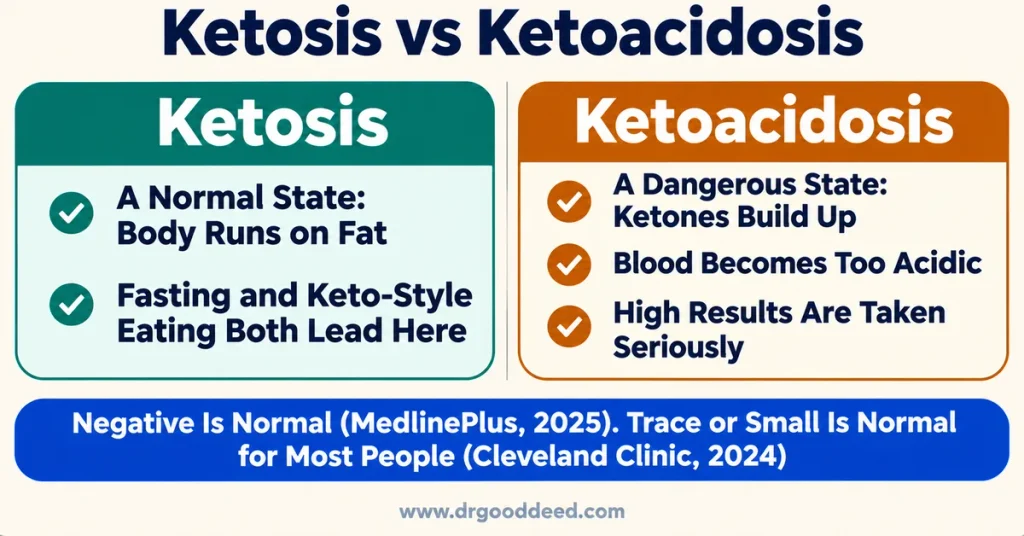
- Ketosis: A normal state in which the body runs on fat. Fasting and keto-style eating both put you there, which some people call nutritional ketosis.
- Ketoacidosis: A dangerous state in which ketones build up and make the blood too acidic. It’s the reason high results get taken seriously.
- What a clean test looks like: A negative result is normal (MedlinePlus Encyclopedia, 2025). Trace or small amounts are normal for most people (Cleveland Clinic, 2024).
- A person without diabetes can have high ketones, and it usually traces back to a cause you can name.
Ketones in Urine When You Are Not Diabetic: Causes
Ketones in urine when you are not diabetic most often come from fasting, a low-carb diet, hard exercise or an illness that stops you eating. The list below runs from the most common to the least.
- Sleep or fasting: A night without food is enough for some people. Long fasts, including water fasting, can make the body burn fat for fuel.
- A low-carb or keto diet: Cleveland Clinic (2024) lists it among the usual reasons for small amounts.
- Hard exercise: MedlinePlus lists it as a risk.
- Long vomiting or diarrhea: When you can’t keep food down, glucose runs low and fat takes over.
- Fever or severe illness: MedlinePlus Encyclopedia (2025) names high fevers, sepsis and burns.
- Pregnancy or nursing: Nursing without enough to eat or drink is a listed cause (MedlinePlus Encyclopedia, 2025).
- Eating disorders, starvation and alcohol use disorder: MedlinePlus lists all three as risks.
- Overactive thyroid and some digestive diseases: Less common causes (MedlinePlus Encyclopedia, 2025).
- Medicines: Certain diabetes medicines can matter too, though that applies mostly to people with a diagnosis. Never change any medicine on your own.
How Many Ketones in Urine Is Too Much?
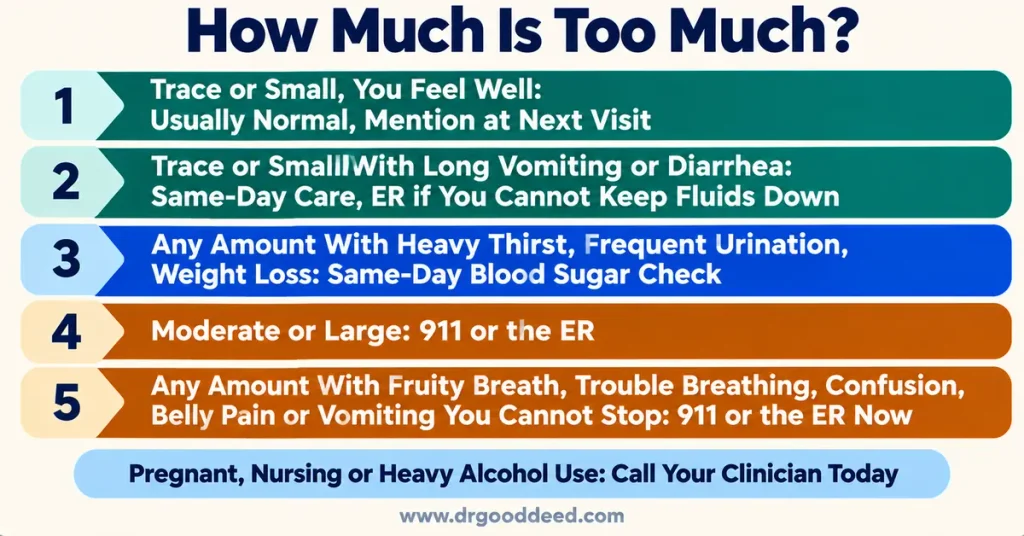
Trace or small ketones are often normal, but moderate or large amounts are not. Moderate or large ketones without diabetes mean 911 or the ER (Cleveland Clinic, 2024).
Sources differ on trace amounts. Cleveland Clinic (2024) says trace or small amounts are normal for most people, while MedlinePlus Encyclopedia counts only a negative test as normal. There’s no number to read off a strip. The amount, your symptoms and the cause together decide, and the table does that sorting.
Table: Strip result and symptoms compared with the next step
| Strip result | How you feel | What it may mean | Next step |
| Trace or small | Well, after fasting, low-carb eating, sleep or hard exercise | Usually normal (Cleveland Clinic, 2024) | Mention it at your next primary care visit, sooner if there’s no clear reason |
| Trace or small | Long vomiting or diarrhea, not eating | Body low on glucose (MedlinePlus) | Same-day primary care or urgent care; ER if you can’t keep fluids down |
| Any amount | Very thirsty, peeing a lot, losing weight | Possible undiagnosed diabetes (CDC, 2024) | Same-day blood sugar check |
| Any amount | Pregnant, nursing or heavy alcohol use | Higher risk (MedlinePlus; Nutrition Journal, 2015) | Call your clinician today |
| Moderate or large | With or without symptoms | Abnormal without diabetes (Cleveland Clinic, 2024) | 911 or the ER |
| Any amount | Fruity breath, trouble breathing, confusion, belly pain, vomiting you can’t stop | Possible ketoacidosis (MedlinePlus; CDC, 2024) | 911 or the ER now |
Ketones along with always feeling thirsty should prompt a blood sugar check.
Doctor’s Tip: A urine strip shows what ketones were in the last few hours, and a blood test is more accurate, so how you feel counts along with the color of the strip (Cleveland Clinic, 2024).
When Ketones Mean Ketoacidosis Without Diabetes
Ketoacidosis without known diabetes can come from undiagnosed diabetes, alcohol use disorder, or starvation. A normal blood sugar doesn’t rule it out.
- Undiagnosed diabetes: The CDC (2024) says diabetic ketoacidosis can be the first noticeable sign of diabetes. When diabetes is new, doctors use more tests to tell apart type 1 and type 2 diabetes.
- Alcohol use disorder: StatPearls (2023) says alcoholic ketoacidosis occurs with chronic alcohol use and may follow binges. Heavy drinking affects blood sugar in several ways, as this guide to alcohol and diabetes explains.
- Starvation: Starvation ketoacidosis follows prolonged fasting (StatPearls, 2023).
- Pregnancy and nursing: Gestational diabetes is the most common cause in pregnancy (Cleveland Clinic, 2024). A 2015 case report in Nutrition Journal described one woman who fasted while nursing.
- Treatment: It happens in the hospital and targets the cause.
Expert Insight: A normal blood sugar doesn’t make ketoacidosis impossible. A 2017 case series of five children (BMC Pediatrics) and the 2015 single case report above both involved ketoacidosis with normal or low blood sugar. These are very small reports, so they show it can happen, not how often. StatPearls (2023) adds that a negative reading doesn’t exclude it, since tests estimate only some ketones.
Tests Doctors Order After Ketones in Urine
Doctors usually check blood sugar and blood ketones next. A urine strip alone rarely settles it.
- Blood sugar: A quick check, since it can point to undiagnosed diabetes.
- Blood ketones: More accurate than urine, because urine reflects the last few hours.
- Acid level: A blood test that shows whether ketones have made the blood too acidic.
- A1C: A longer-term sugar measure that may be recommended.
- The visit: Expect questions about eating, vomiting, alcohol, pregnancy and symptoms. If your reading is raised, learn what causes high blood sugar without diabetes.
Strips have limits. In one study of 50 women on a severely restricted diet (Obesity Science & Practice, 2020), strips picked up mild ketosis only 35%, 52% and 76% of the time at three blood-ketone cut-offs. Across 263 samples, that means a lone strip can miss a mild elevation.
When to See a Doctor for Ketones in Urine
Call 911 or go to the ER for fruity breath, trouble breathing, confusion, or vomiting you cannot stop. Those signs point to possible ketoacidosis, so don’t wait for an appointment or retest first.
- 911 or the ER: Fruity breath, trouble breathing, confusion, belly pain, or vomiting you can’t stop. Any moderate or large strip result also belongs here.
- Urgent care or same-day primary care: Ketones with prolonged vomiting or diarrhea, or with heavy thirst, frequent urination and weight loss.
- Primary care: Trace or small ketones after fasting, low-carb eating, sleep or hard exercise. Mention it at your next visit.
- Ketones in urine symptoms: Early signs can be mild, and ketoacidosis can follow, which is why the sooner a doctor checks, the better.
- If you have diabetes: Follow your own care plan.
Get checked the same day if you cannot explain ketones in urine when you are not diabetic.
Frequently Asked Questions
Can Ketones in Urine Without Diabetes Be From Dehydration?
Ketones in urine without diabetes can appear when dehydration comes with long-lasting vomiting, diarrhea or poor eating. Those stretches use up glucose, so the body turns to fat. Dehydration on its own isn’t a named cause in MedlinePlus or Cleveland Clinic, so ask your doctor to check.
How Do I Get Rid of Ketones in Urine If I Am Not Diabetic?
Treatment for ketones in urine depends on the cause. If you feel well, regular meals and fluids are a common first step, and your doctor can say whether more is needed. No cleanse, supplement, or home remedy is a safe shortcut, and you shouldn’t change any medicine on your own.
Are Ketones in Urine Normal During Pregnancy?
Not always. Pregnancy is a known risk, and gestational diabetes is the most common cause in pregnancy (Cleveland Clinic, 2024). Long vomiting in early pregnancy can also cause them. Tell your prenatal team about any positive result instead of waiting for the next visit.
What Does It Mean If a Non-Diabetic Child Has Ketones in Urine?
Children can have ketones when they’re sick and not eating, but dehydration, poor appetite and deep, fast breathing need urgent care. A small case series of five children (BMC Pediatrics, 2017) found non-diabetic ketoacidosis, sometimes with normal or low blood sugar. Call the child’s doctor the same day.
Should I Retest at Home or Call a Doctor First?
It depends on how you feel. With symptoms, get care instead of retesting. If you feel well, a home retest is reasonable, and home kits are accurate when used as directed. Ask your doctor which kind of home test to use.
Sources
MedlinePlus Medical Encyclopedia, Ketones Urine Test (2025). link
CDC, Diabetic Ketoacidosis (2024). link
StatPearls, NCBI Bookshelf, Ketoacidosis (2023). link
Nutrition Journal, Ketoacidosis in a Non-Diabetic Woman Who Was Fasting During Lactation (2015). link
Obesity Science & Practice, Urine Dipsticks Are Not Accurate for Detecting Mild Ketosis During a Severely Energy Restricted Diet (2020). link
BMC Pediatrics, Pediatric Non-Diabetic Ketoacidosis: A Case-Series Report (2017). link
Medical Disclaimer: This article is for general information only and is not medical advice. It does not replace a diagnosis, treatment plan, or guidance from a qualified healthcare professional. Always talk to your doctor about your own symptoms and before starting, stopping, or changing any treatment. If you think you may be having a medical emergency, call 911 or go to your nearest emergency room.