
Visual snow syndrome is a brain condition that makes you see tiny flickering dots, like TV static, across your whole field of vision all the time. Your eyes are healthy. It isn’t dangerous (AAO, 2026), but an eye exam comes first, because a few serious eye problems look similar.
Key Takeaways
- Visual snow syndrome is a neurological condition that causes constant TV-like static across your whole vision, with your eyes open or closed.
- Doctors also look for afterimages, extra floaters, light sensitivity or poor night vision, plus a normal eye exam.
- It starts in the brain, not the eyes, and it isn’t dangerous, but it can mimic eye problems that are.
- There’s no cure and no FDA-approved medicine, though tinted lenses may ease light sensitivity.
- Sudden new static, especially in one eye or with flashes, floaters or a curtain over your vision, needs same-day care.
What Is Visual Snow Syndrome?
Visual snow syndrome is a long-lasting condition in which the brain processes vision differently, so you see moving, tiny dots across your entire field of vision that do not go away.
- What it looks like: picture vision that looks like TV static, or the grain in a photo taken in the dark, laid over everything you look at.
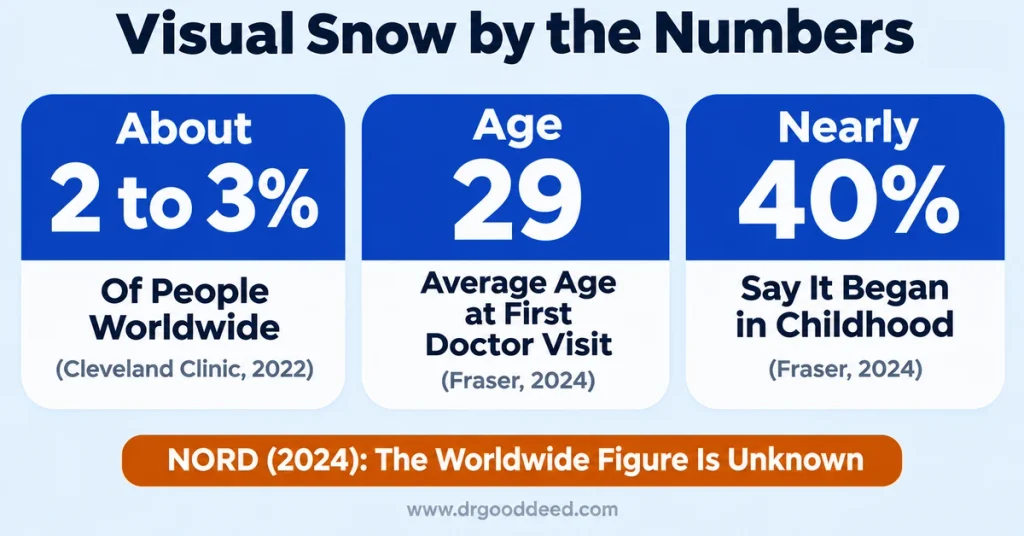
- How common it is: Cleveland Clinic (2022) says about 2 to 3% of people worldwide. Fraser’s 2024 review in Eye estimates about 2% in the UK, and NORD (2024) says the worldwide figure is unknown.
- When it starts: Fraser (2024) reports an average age of 29 at the first doctor visit, and nearly 40% of patients say it began in childhood.
Visual Snow Syndrome Symptoms Beyond the Static
Visual snow syndrome symptoms go beyond the static. Afterimages, light sensitivity, poor night vision, and extra floaters often come with it.
- Afterimages: palinopsia means an image lingers or leaves a trail after you look away.
- Light sensitivity: with photophobia, ordinary light feels too bright.
- Poor night vision: nyctalopia makes dim rooms and dark roads harder to handle.
- Extra floaters and flashes: doctors call these enhanced entoptic phenomena, meaning you notice things inside your own eye more than most people do.
- Migraine and anxiety: Cleveland Clinic (2022) says both often travel with visual snow. Some people also describe ringing in the ears or foggy thinking.
A whooshing sound in time with your heartbeat is different. Read about pulsatile tinnitus if that’s what you hear.
How Do You Know If You Have Visual Snow?
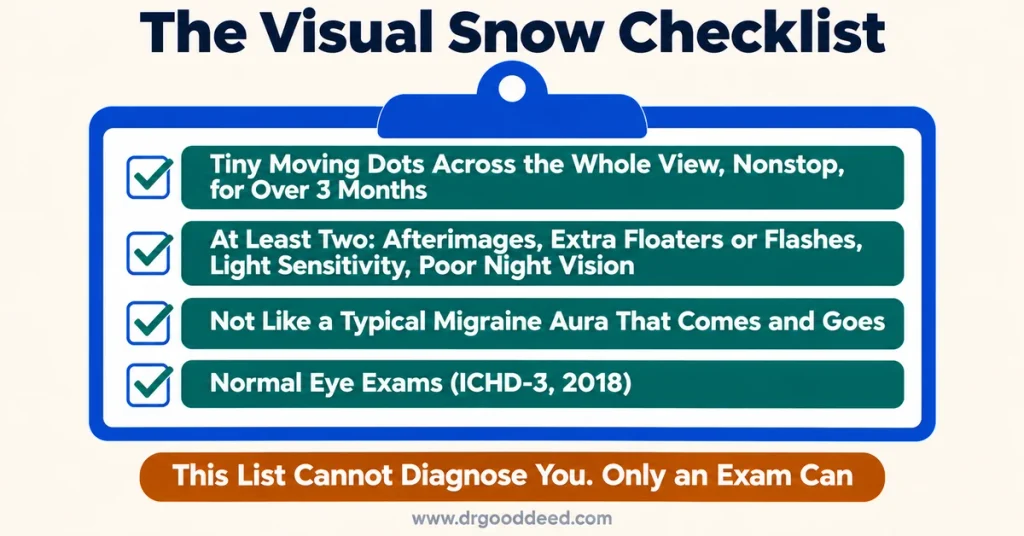
Doctors diagnose visual snow against a checklist: dots for more than 3 months, at least two of four extra symptoms, and normal eye exams (ICHD-3, 2018).
How do I tell if I have VSS? Go through the list below, then book the exam.
- Tiny moving dots fill your whole field of vision, nonstop, for more than 3 months.
- You have at least two of these: afterimages (palinopsia), extra floaters or flashes, light sensitivity, poor night vision.
- It doesn’t behave like a typical migraine aura, which comes and goes.
- Your eye exams are normal. ICHD-3 (2018) lists visual acuity (how sharp you see), a dilated retina exam, visual field testing and electroretinography, which measures the retina’s electrical response to light.
This list can’t diagnose you. Only an exam can.
Visual snow syndrome is defined partly by what the tests don’t find. A normal eye exam is part of the diagnosis, not a reason to dismiss the symptom. The risk runs the other way: assuming static is visual snow without an exam can hide a retinal problem that needs treatment.
What Causes Visual Snow Syndrome?
The exact cause of visual snow syndrome is unknown. The leading idea is an overexcited visual brain, called cortical hyperexcitability.
- The brain idea: the parts of the brain that process sight may fire too easily, so background noise that’s normally filtered out shows up as static. This is a theory, and it’s still being tested.
- The migraine link: ICHD-3 (2018) notes an epidemiological link with migraine with aura, and AAO (2026) says migraine often occurs with visual snow. That’s an association, not a proven cause. Since migraine is common here, learn the early warning signs of a migraine attack.
- What triggers visual snow syndrome? Nobody has pinned it down. Some people report it began after a head injury or certain drugs, but this has not been confirmed, so these are not proven causes.
Visual Snow vs Migraine Aura and Eye Problems
Visual snow is constant and fills the whole view. Migraine aura comes and goes, and a torn or detached retina tends to start suddenly. What can be mistaken for visual snow? Mostly migraine aura and retinal detachment, compared in the table below.
| Feature | Visual snow syndrome | Migraine aura | Retinal detachment (an eye emergency) |
| How it starts | Often since childhood (Fraser, 2024) | Builds, then passes | Suddenly (NEI) |
| How long | Constant for more than 3 months (ICHD-3, 2018) | Comes and goes | Doesn’t go away without treatment |
| Other signs | Afterimages, light sensitivity, poor night vision | Often a headache or other migraine symptoms | New floaters, flashes, a curtain or shadow over your view (NEI) |
| What to do | Eye exam, then a specialist | Talk to your doctor | Eye doctor or ER right away |
Some aura can look like a stroke. See the signs of hemiplegic migraine vs. stroke.
Who Diagnoses Visual Snow and Which Tests
A neuro-ophthalmologist, an eye doctor who specializes in vision problems tied to the brain and nerves, is ideal. A neurologist and a regular ophthalmologist can both help.
- Start with a full eye exam by an ophthalmologist, which checks sharpness, the retina and your field of vision.
- Expect extra tests if the doctor wants more detail, such as electroretinography.
- Brain scans, like an MRI, are sometimes used to rule out other causes.
- There’s no single test for visual snow. The doctor lines your story up against the criteria and rules out other explanations.
Visual Snow Syndrome Treatment and Coping
There’s no cure and no FDA-approved medicine for visual snow (AAO, 2026), and NORD (2024) says medicines have given inconsistent results. Research is ongoing.
- Tinted lenses: AAO (2026) says chromatic filters (colored lenses) may reduce light sensitivity. NORD (2024) calls tint therapy promising but says larger studies are needed.
- Treating what travels with it: migraine and anxiety can be managed on their own with your doctor. Anxiety often comes with visual snow, and anxiety can cause dizziness as well.
- Sleep and stress: Cleveland Clinic (2022) says the static may get stronger with stress or poor sleep, so steady sleep is worth protecting.
- Medicines: Ask your doctor, and never start or stop one on your own.
When to See a Doctor About Static Vision
New static that starts suddenly, in one eye, or with flashes, many new floaters or a curtain over your vision needs an eye doctor or the ER right away (NEI). Treat sudden static vision in one eye as urgent.
- 911: sudden trouble seeing is a stroke sign. Vision loss that clears in minutes still matters, so read about mini-stroke symptoms that went away.
- Eye doctor or ER: flashes, many new floaters, a curtain, or static that changed overnight (NEI).
- Urgent care or your primary care doctor: static that’s new, or worse over days, when you can’t reach an eye doctor the same day.
- 988: if living with this leaves you feeling hopeless, call or text 988.
Doctor’s Tip: Visual snow itself isn’t dangerous, but sudden new static isn’t something to wait on. If it changes, starts in one eye, or arrives with flashes, floaters or a curtain, get seen the same day.
If the static in your vision is new, sudden or getting worse, get checked rather than assuming it is visual snow syndrome.
Frequently Asked Questions
Is It Normal to See a Bit of Static?
A few floaters are normal. Visual snow is different: tiny moving dots across your whole vision that last more than 3 months (ICHD-3, 2018). If your static is new, mild or comes and goes, an eye exam can sort out what it is and rule out an eye problem.
Is Visual Snow Dangerous?
No. Visual snow is not dangerous and does not cause vision loss on its own, but it can look like eye problems that are, so an eye exam comes first. Retinal detachment shares some symptoms, which is why new floaters, flashes or a curtain need same-day care (NEI).
Why Do I See Static When I Close My Eyes?
Because the static comes from the brain’s visual processing, not the eye. Seeing the dots with your eyes open or closed is a typical feature of visual snow syndrome. Static that’s brand new, or comes with flashes or vision loss, still deserves an exam.
Does Visual Snow Go Away?
Sometimes it fades on its own, but for many people it lasts. Cleveland Clinic (2022) says it may get stronger with stress or poor sleep. Fraser (2024) reports nearly 40% of patients have had symptoms since childhood, so for many it’s a long-term pattern, not a passing phase.
Do Tinted Glasses Help Visual Snow?
Colored filters help some people with light sensitivity, but they don’t cure it. AAO (2026) says chromatic filters may reduce light sensitivity, and NORD (2024) calls tint therapy promising while saying larger studies are needed. Ask a neuro-ophthalmologist about visual snow syndrome glasses before you buy any.
Sources
International Headache Society, ICHD-3, A1.4.6 Visual snow. link
Fraser CL, How do I recognise and manage visual snow syndrome? (Eye, 2024). link
NORD, Visual Snow Syndrome. link
American Academy of Ophthalmology, What Is Visual Snow Syndrome? link
Cleveland Clinic, Visual Snow Syndrome (Static Vision): Symptoms & Causes. link
National Eye Institute, Retinal Detachment. link
CDC, Signs and Symptoms of Stroke. link
Medical Disclaimer: This article is for general information only and is not medical advice. It does not replace a diagnosis, treatment plan, or guidance from a qualified healthcare professional. Always talk to your doctor about your own symptoms and before starting, stopping, or changing any treatment. If you think you may be having a medical emergency, call 911 or go to your nearest emergency room.