

Handwriting getting smaller over months, or shrinking as you write a line, can be an early sign of Parkinson’s disease called micrographia, though it has other causes too. Small, cramped writing may happen with changes in movement, stiff fingers, poor vision, or other health conditions. It does not automatically mean you have Parkinson’s.
This article explains what micrographia looks like, how Parkinson’s can cause issues with handwriting, and other causes. We also explain when to see a doctor and how to make writing easier.
Key Takeaways
- Handwriting getting smaller can be micrographia, an early Parkinson’s sign, but aging, stiff hands and other conditions can also shrink writing.
- Micrographia can cause writing to become consistently smaller or gradually smaller.
- Parkinson’s isn’t the only cause. Arthritis, poor vision, writer’s cramp, and other brain conditions can cause issues with handwriting.
- Parkinson’s tends to cause small handwriting, while essential tremor tends to cause shaky handwriting.
- See a doctor about any unexplained handwriting change, and call 911 if a sudden change comes with weakness, numbness, or trouble speaking.
What Micrographia Looks Like
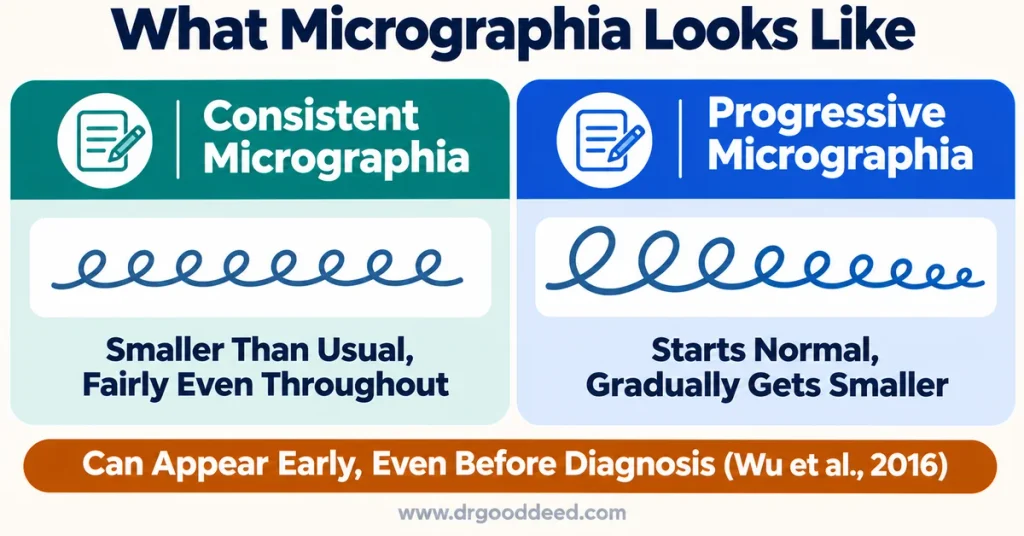
Micrographia is small, cramped handwriting in which letters and words crowd together and may shrink as you write, making the text hard to read. The Parkinson’s Foundation describes it as a common early symptom of Parkinson’s disease.
There are two common types:
- Consistent micrographia: Your handwriting is smaller than usual but remains fairly consistent throughout sentences or pages.
- Progressive micrographia: Your handwriting starts off normal but gradually gets smaller.
A study by Wu and colleagues in the journal Brain (2016) describes both types of micrographia and the brain activity linked to them. It notes that micrographia can be one of the early signs of Parkinson’s and can appear before diagnosis.
You may also notice your signature becoming smaller, cramped, or difficult to replicate. Keeping examples of your writing and signature can help your doctor see how it has changed.
Why Parkinson’s Makes Handwriting Smaller
Parkinson’s can affect the neural pathways in your brain. This can cause issues with initiating, scaling, and maintaining movements. As a result, your handwriting can become small, slow, and cramped.
The basal ganglia are brain areas that help control movement, and they rely on dopamine. When Parkinson’s affects dopamine signaling in this area, movements can shrink and slow, so your handwriting can become smaller or slower.
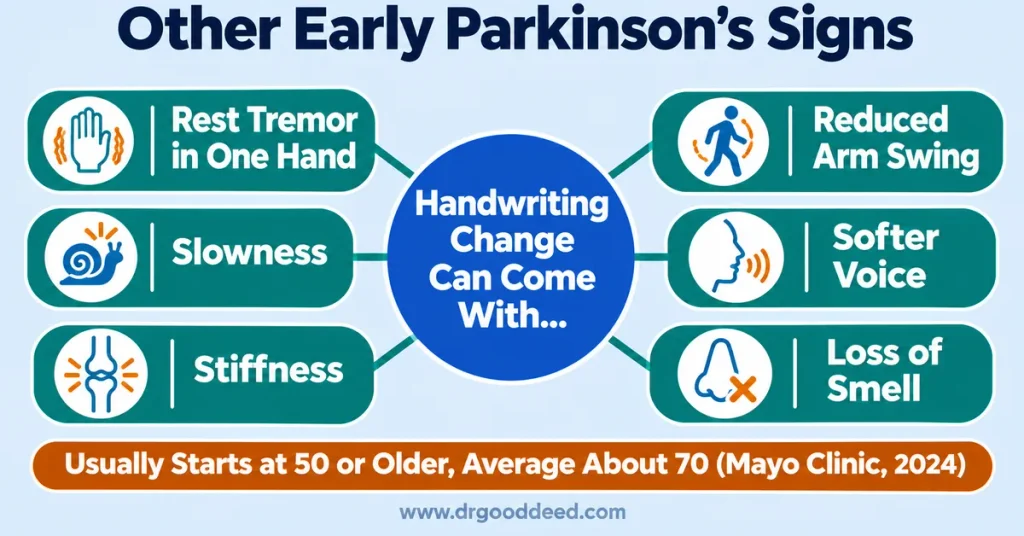
Mayo Clinic (2024) lists other early symptoms of Parkinson’s that can come with handwriting changes, such as:
- Tremor: Usually starts in one hand and occurs at rest.
- Bradykinesia: You may find everyday tasks take longer to do or have difficulty initiating movement.
- Rigidity: Stiffness can cause issues with gripping your pen or moving your fingers.
- Reduced arm swing: One arm may not swing as much when you walk.
- Hypophonia: Your voice may become softer.
- Loss of smell: You may notice a reduced ability to smell familiar foods or scents.
Parkinson’s usually starts at age 50 or older, at an average age of about 70 (Mayo Clinic, 2024). However, age alone can’t tell you whether your handwriting change is due to Parkinson’s.
Some common forms of dementia, such as Lewy body dementia, can cause Parkinson’s-like movement issues, such as stiffness and small handwriting. Read about the main types of dementia to learn more.
Other Causes of Handwriting Getting Smaller
Handwriting getting smaller is not always Parkinson’s; aging eyes, stiff or arthritic fingers, hand cramps from writing and other brain conditions can all change how you write.
Possible causes include:
- Aging and poor eyesight: Issues with your vision can make it hard to see what you’re writing clearly or know how big your letters should be. This can cause your handwriting to become smaller or inconsistent.
- Arthritic hands: Pain, swelling, and stiffness can cause issues with gripping your pen or moving your fingers. These are common symptoms of arthritis in hands and can cause issues with your handwriting unrelated to your brain.
- Writer’s cramp: Also known as hand dystonia, this causes involuntary muscle spasms while writing. This can cause your fingers or wrist to twist, stiffen, or become uncomfortable.
- Essential tremor: This movement disorder causes shaking, which can make your letters uneven or wavy.
- Ataxia: Conditions that affect your coordination can cause issues with controlling how big or spaced out your letters are.
- Other brain conditions: Some neurological conditions, including autoimmune neurological disorders such as multiple sclerosis, can affect movement, coordination, and muscle control, leading to changes in your handwriting.
Your doctor can help work out if your issue is due to your hands, eyes, movements, or other health conditions.
Small Handwriting or Shaky Handwriting?
Parkinson’s tends to cause small handwriting, while essential tremor tends to cause shaky handwriting. However, both can cause issues with handwriting and cannot be used to diagnose a condition.
| Feature | Parkinson’s-related micrographia | Essential tremor |
| Main issue | Small, cramped letters | Shaky or wavy letters |
| Pattern | May get smaller | Shaking throughout |
| Typical tremor | Often at rest | Often while moving or holding a position |
| Other symptoms | Slowness, stiffness, and reduced arm swing | Shaking during tasks such as eating or writing |
Essential tremor is an action tremor that usually affects both hands, while Parkinson’s tremor is most noticeable at rest (NINDS, 2026). Symptoms can vary from person to person.
Essential tremor and Parkinson’s are the two most common causes of handwriting change, and essential tremor is about eight times more common, affecting an estimated 10 million Americans (University Hospitals, 2018). Many other conditions can also cause small or shaky handwriting, so your doctor will look at all your symptoms.
How Doctors Check Handwriting Changes
A neurologist will look at your handwriting and ask when the issue started. They will then look at your movements, muscle tone, and reflexes to identify any patterns and other symptoms.
During your medical visit, you may:
- Be asked questions: Your doctor will ask you when your issue started, if it has gotten worse, and if you’ve noticed any other symptoms, such as tremor, stiffness, slowness, pain, or vision issues.
- Have a handwriting test: You may be asked to write a sentence, trace a shape, or sign your name. Your doctor may want to compare your examples or ask you to write multiple times.
- Have a movement test: Your doctor will test your walking, hand movements, balance, and repetitive movements.
- Have a neurological test: Your doctor will test your muscle tone, coordination, reflexes, and other symptoms that may indicate a neurological condition.
- Have further tests: Depending on your symptoms, your doctor may recommend further tests or refer you to a movement disorders specialist.
Having a handwriting test is just one part of diagnosis. Having small handwriting on its own won’t diagnose Parkinson’s disease.
Ways to Make Writing Easier
Using lined paper, sitting upright at a table, and practicing writing a page each day can make writing easier, according to the Parkinson’s Foundation. Typing, dictation, and occupational therapy can also help.
Try:
- Using lined paper: Using lines or increased spacing can help.
- Sitting up straight: Sit at a table with your feet supported and the paper at a comfortable height.
- Practicing: Try to practice writing a page each day. Focus on writing bigger, consistent letters.
- Taking breaks: Take breaks if your hand gets tired or cramped.
- Using typing or dictation: Use a computer, phone, or dictation to type longer texts.
- Occupational therapy: An occupational therapist can help you practice your writing and find ways to make everyday tasks easier.
If your signature has changed, keep examples of your signature at different times. Ask your bank if they require any documents, such as an affidavit, to change it.
When to See a Doctor About Smaller Handwriting
See a doctor about any handwriting change you cannot explain, as University Hospitals (2018) advises. Go sooner if the change keeps getting more noticeable or comes with tremor, stiffness, slowness, balance problems, or speech changes.
Your primary care doctor can look at your symptoms and refer you to a neurologist or movement disorders specialist. Getting an early assessment can help identify the cause and provide treatment or support.
If you’re experiencing any sudden changes to your handwriting, seek emergency care. If you’re experiencing weakness, numbness, difficulty speaking, vision issues, or balance issues, this could be a sign of a stroke.
A sudden change is different from a slow one, so learn what a stroke feels like and remember BE FAST: Balance, Eyes, Face, Arms, Speech, and Time (CDC, 2026).
If handwriting getting smaller comes on suddenly with weakness, numbness or trouble speaking, call 911.
Frequently Asked Questions
Can Micrographia Get Better?
Often, yes. Micrographia from Parkinson’s can improve when movement symptoms are treated and with regular handwriting practice, though it may not return to how it was. Your neurologist or occupational therapist can suggest ways to help based on your symptoms and daily life.
Is Small Handwriting Always a Sign of Parkinson’s?
No. Aging, poor vision, arthritis, writer’s cramp, and other neurological conditions can also make handwriting smaller, and small handwriting on its own can’t diagnose Parkinson’s. If your handwriting changes without an obvious cause, see your doctor so they can check for other signs.
What Are the Signs of Dementia in Handwriting?
Some types of dementia, such as Lewy body dementia, can cause Parkinson-like stiffness that makes handwriting smaller, along with problems with memory, thinking, and everyday tasks. A handwriting change alone can’t diagnose dementia. If you notice movement and thinking changes together, talk to your doctor and read about the stages of Lewy body dementia.
How Early Can Micrographia Show Up?
Micrographia can be one of the first signs of Parkinson’s, sometimes noticed before a diagnosis is made (Wu et al., 2016). People may first see their writing become smaller or more cramped. Small handwriting has other causes too, so an early change is a reason to see your doctor, not proof of Parkinson’s.
Why Does My Signature Look Different Now?
Your signature may look different because micrographia, stiff hands, pain, tremor, or vision problems can make it smaller or more cramped. Keep dated samples of your signature to show your doctor, and ask your bank whether it needs a notarized affidavit. If the change is sudden or comes with stroke signs, call 911.
Sources
- Parkinson’s Foundation, Small Handwriting (n.d.). link
- Brain (Wu et al.), Neural Correlates Underlying Micrographia in Parkinson’s Disease (2016). link
- Mayo Clinic, Parkinson’s Disease: Symptoms and Causes (2024). link
- National Institute of Neurological Disorders and Stroke (NINDS), Tremor (2026). link
- University Hospitals, What Your Handwriting May Say About Your Health (2018). link
- Centers for Disease Control and Prevention (CDC), Signs and Symptoms of Stroke (2026). link
Medical Disclaimer: This article is for general information only and is not medical advice. It does not replace a diagnosis, treatment plan, or guidance from a qualified healthcare professional. Always talk to your doctor about your own symptoms and before starting, stopping, or changing any treatment. If you think you may be having a medical emergency, call 911 or go to your nearest emergency room.