

The 7 stages of Lewy body dementia describe how this disease moves from no visible symptoms to full-time care needs, and knowing each stage can help families prepare. Lewy body dementia (LBD) affects approximately 1.4 million Americans, according to 2023 data from Marwan N. Sabbagh and colleagues. It is the third most common cause of dementia after Alzheimer’s and vascular dementia.
Unlike Alzheimer’s, LBD progresses faster. Median survival after diagnosis is just 3.72 years, compared to 6.95 years for Alzheimer’s, based on Medicare data. This guide covers every stage of the 7 stages of Lewy body dementia, plus risk factors, treatment options, and caregiver strategies.
At-a-Glance Lewy Body Dementia Progression Chart

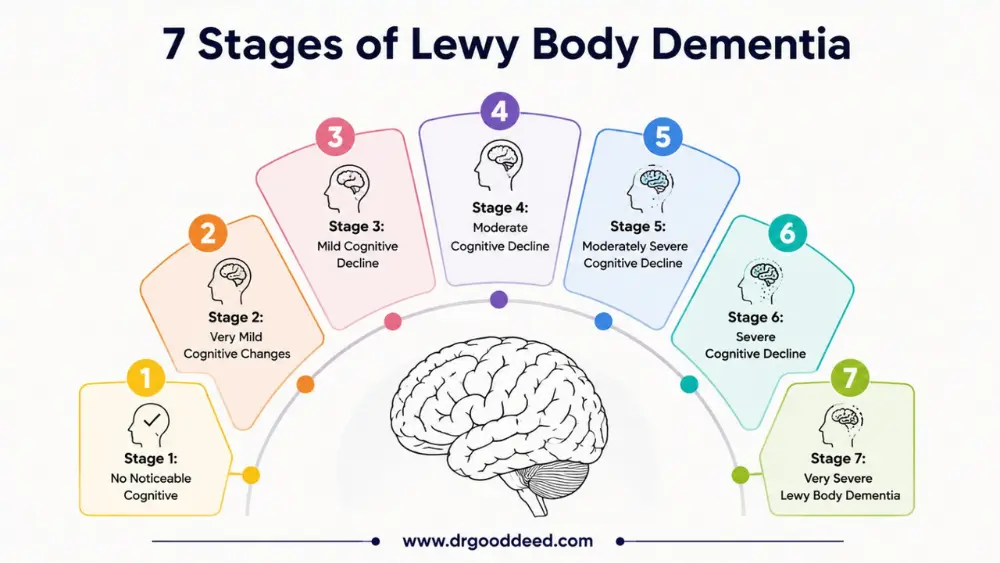
The Lewy body dementia stages follow a clinically recognized 7-stage framework adapted from the Global Deterioration Scale. This gives families a roadmap from early warning signs to advanced care.
Each stage of the 7 stages of Lewy body dementia brings new Lewy body dementia symptoms and care demands. The progression of Lewy body dementia through these stages is faster than most other dementias.
| Stage | Name | Key Symptoms | Care Level |
| 1 | No Impairment | None visible | None needed |
| 2 | Very Mild Changes | Occasional forgetfulness | Minimal |
| 3 | Mild Decline | Memory gaps, concentration issues | Some support |
| 4 | Moderate Decline | Daily task difficulty, hallucinations begin | Increased support |
| 5 | Moderately Severe | Caregiver dependence, Parkinson-like movement | Significant help needed |
| 6 | Severe Decline | Major memory loss, falls risk, communication problems | Near full-time care |
| 7 | Very Severe | Total cognitive loss, loss of mobility, swallowing issues | Full-time care |
Stage 1: No Noticeable Cognitive Impairment
Stage 1 of the 7 stages of Lewy body dementia shows no outward symptoms. The disease process may already be underway in the brain, but nothing appears on cognitive tests or in daily behavior. This stage is often called the silent phase.
Normal Memory and Thinking Abilities
Memory, reasoning, and attention all test within normal range. There are no complaints from the person or family members. Standard clinical assessments show no deficit.
No Functional Limitations
A person in Stage 1 manages all daily tasks without help. Driving, cooking, managing finances, and maintaining relationships all remain intact. No intervention is needed at this point.
Maintaining Brain Health
Even without symptoms, building brain health reserves matters. Regular aerobic exercise, quality sleep, social engagement, and blood pressure control all reduce the risk of faster progression later. The 2020 Lancet Commission report identified 12 modifiable risk factors covering 40% of overall dementia risk.
Stage 2: Very Mild Cognitive Changes
Stage 2 of the 7 stages of Lewy body dementia involves changes so subtle that most people attribute them to normal aging. A doctor testing this person would likely find no clinical evidence of impairment.
Occasional Forgetfulness
A person might misplace keys, forget a name briefly, or lose track of a thought mid-sentence. These lapses are infrequent and the person can recover the memory independently.
Mild Attention Difficulties
Maintaining focus during long conversations or tasks may start to feel slightly harder. This is not obvious to others and does not interfere with daily responsibilities.
Subtle Changes Often Mistaken for Aging
This stage is where LBD most commonly goes unnoticed. The symptoms look exactly like normal cognitive aging. What separates LBD is that these changes will not stabilize; they will progress.
Stage 3: Mild Cognitive Decline
Stage 3 marks the point where the progression of Lewy body dementia starts to become visible. Close friends and family begin to notice something is off, even if a clinical diagnosis has not yet been made.
Early Memory Problems
Short-term memory misses become more frequent. A person forgets recent conversations, repeats questions, or misses scheduled appointments. They may compensate with notes and reminders, which still work at this stage.
Difficulty Concentrating
Reading a book or following a complex TV show becomes harder. Multitasking starts to slip. Work performance may decline, and the person may withdraw from demanding tasks.
Mild Executive Function Changes
Executive function refers to planning, organizing, and making decisions. In Stage 3, small cracks appear: paying bills on time becomes harder, and planning ahead feels more effortful than before.
Early Lewy Body Dementia Symptoms
Stage 3 is where LBD-specific symptoms can first appear. Mild Lewy body dementia symptoms at this stage may include REM sleep behavior disorder (acting out dreams physically during sleep), which is a recognized early biomarker of LBD, sometimes appearing a decade before cognitive symptoms.
Stage 4: Moderate Cognitive Decline
Stage 4 is the stage where most people with LBD receive a formal diagnosis. The Lewy body dementia symptoms become impossible to miss. Daily functioning is clearly affected.
Noticeable Memory Impairment
A person forgets personal history details, struggles with recent events, and has trouble recognizing people they have not seen recently. They can still recognize close family members at this stage.
Difficulty Managing Daily Tasks
Managing finances, cooking complex meals, and handling medication independently become unreliable. Grocery shopping without a list becomes confusing. This is the stage where family members often step in to help with practical tasks.
Increased Cognitive Fluctuations
One of the defining features of LBD is cognitive fluctuation. A person may seem completely clear-headed for hours, then suddenly become confused, drowsy, or unable to follow a simple conversation, often within the same day. This fluctuation does not happen in Alzheimer’s at the same intensity, which is a key diagnostic marker for LBD.
Emerging Visual Hallucinations
Visual hallucinations are a hallmark of LBD and often appear by Stage 4. They typically begin as mild perceptions, seeing a shadow in the periphery, a person standing across the room, or small animals.
Early on, the person often retains awareness that what they are seeing is not real. According to Pacific Neuroscience Institute, hallucinations may begin as illusions before progressing to fully formed images.
Stage 5: Moderately Severe Cognitive Decline
Stage 5 of the 7 stages of Lewy body dementia brings significant loss of independence. Caregivers move from supportive to essential during this phase. The progression of Lewy body dementia at this stage often involves multiple overlapping symptom domains at once.
Increased Dependence on Caregivers
A person can no longer manage medication, prepare meals safely, or handle personal finances alone. They may become disoriented in familiar environments. Full-time supervision during daily activities becomes necessary.
Worsening Hallucinations
Hallucinations grow more frequent and more vivid. The person may lose awareness that what they see is not real. They may try to interact with hallucinated figures, which can cause fear, confusion, and behavioral outbursts.
Parkinson-Like Movement Symptoms
Parkinsonism is a core feature of LBD. In Stage 5, it typically includes a slow, shuffling walk, stiffness in the limbs, soft voice, reduced arm swing while walking, and problems with balance. Falls become a real risk. Levodopa may provide modest relief, but LBD patients are often more sensitive to its side effects than Parkinson’s patients.
Sleep Disturbances Become More Prominent
REM sleep behavior disorder, where a person physically acts out their dreams, becomes more frequent and intense. Melatonin or clonazepam are commonly used to manage this, per guidelines from the Lewy Body Dementia Association (LBDA). Poor sleep accelerates daytime cognitive fluctuations.
Stage 6: Severe Cognitive Decline
Stage 6 of the 7 stages of Lewy body dementia brings profound loss of function across nearly all domains. This is the stage where near full-time care becomes essential.
Significant Memory and Thinking Difficulties
A person may not recognize family members reliably. They lose track of where they are, what year it is, and basic personal history. Long-term memory from decades past may still be partially present, but recent memory is severely impaired.
Limited Ability to Perform Daily Activities
Bathing, dressing, toileting, and eating often require direct assistance. The person may resist care due to confusion or fear. Patience and consistent routine from caregivers become critical.
Behavioral and Mood Changes
Agitation, paranoia, aggression, and severe depression can emerge. These behavioral symptoms can be more distressing for families than physical decline. Antipsychotic medications must be used with extreme caution in LBD; standard antipsychotics like haloperidol can cause a severe, sometimes fatal neuroleptic sensitivity reaction. Quetiapine or pimavanserin are safer options when medically indicated.
Increased Risk of Falls
Balance and coordination deteriorate significantly. Falls become frequent and can cause serious injury. Gait aids, home modifications (grab bars, non-slip mats, bed rails), and physical therapy reduce but do not eliminate fall risk.
Communication Challenges
Speech becomes softer, slower, and harder to follow. Word-finding difficulties increase. The person may lose the thread of a conversation quickly. Caregivers should speak slowly, use short sentences, and avoid correcting or arguing.
Stage 7: Very Severe Lewy Body Dementia
Stage 7 is the final stage of the 7 stages of Lewy body dementia. The disease has reached its most advanced point. Every core function of the brain and body is severely affected.
Profound Cognitive Impairment
The person can no longer recognize close family members, hold a conversation, or respond to their environment in a meaningful way. They exist in a state of near-total cognitive loss.
Loss of Independent Mobility
Most people in Stage 7 cannot walk without support and often cannot stand. They spend most time in a wheelchair or bed. Contractures (permanent muscle tightening) can develop without regular repositioning and physical therapy.
Difficulty Swallowing
Dysphagia (difficulty swallowing) is a serious Stage 7 complication. It raises the risk of aspiration pneumonia, where food or liquid enters the lungs, which is a leading cause of death in late-stage LBD. A speech therapist can recommend modified food textures or, in consultation with the family, a feeding tube.
Minimal Verbal Communication
Verbal responses may reduce to single words, moans, or none at all. Non-verbal communication through touch, eye contact, and familiar music or voice can still reach a person at this stage.
Full-Time Care Requirements
Stage 7 patients require round-the-clock care for all physical needs. Most families transition to hospice care, which focuses on comfort rather than cure. Hospice teams provide pain management, respiratory support, and emotional support for both the patient and caregivers.
Risk Factors for Lewy Body Dementia
Understanding risk factors for Lewy body dementia matters for families with a history of the condition and for those hoping to reduce risk. These risk factors for Lewy body dementia are not all within a person’s control, but some modifiable factors do apply.
- Age: Most LBD cases are diagnosed at an average age of 76.3 years. Risk rises sharply after 60.
- Sex: Men are more commonly affected than women, though both sexes are significantly at risk.
- Parkinson’s disease: Having Parkinson’s disease significantly raises the risk of developing dementia with Lewy bodies.
- REM sleep behavior disorder (RBD): RBD is one of the strongest known predictors of LBD. It can appear 10–15 years before cognitive symptoms. A 2022 study in Sleep Medicine Reviews reported that up to 80% of people with idiopathic RBD go on to develop an alpha-synuclein disease like LBD or Parkinson’s disease.
- Family history: Having a first-degree relative with LBD raises risk, though no single gene is responsible in most cases.
- APOE e4 gene: Carrying this gene variant raises LBD risk, similar to its effect in Alzheimer’s.
- Head injuries: A history of traumatic brain injury increases risk of multiple dementia types including LBD.
Knowing these risk factors for Lewy body dementia early allows for closer monitoring and earlier diagnosis.
Treatments and Supportive Care for Advanced Lewy Body Dementia
Supportive care for advanced Lewy body dementia is multi-layered. There is no cure, but several treatments improve quality of life across the Lewy body dementia stages. The progression of Lewy body dementia does not stop, but the right care plan slows the loss of function and reduces suffering.
Cognitive symptoms:
- Rivastigmine (Exelon) is the only FDA-approved drug specifically for LBD (for Parkinson’s disease dementia). A large multicenter trial showed it improved psychiatric symptoms by 30% from baseline, per the LBDA.
- Donepezil (Aricept) is used off-label and shows comparable efficacy for cognitive and behavioral symptoms.
Movement symptoms:
- Levodopa provides modest benefit but must be started at low doses. LBD patients are sensitive to side effects including worsening hallucinations.
Hallucinations and psychosis:
- Quetiapine (Seroquel) and pimavanserin (Nuplazid) are the preferred options. Standard antipsychotics (haloperidol, olanzapine) are contraindicated due to risk of neuroleptic sensitivity reactions.
Sleep disorders:
- Melatonin is first-line for REM sleep behavior disorder.
- Low-dose clonazepam is used when melatonin is insufficient, with close monitoring.
Non-drug supportive care for advanced Lewy body dementia:
- Physical therapy to maintain mobility and reduce fall risk
- Occupational therapy to adapt the home environment
- Speech therapy for swallowing and communication support
- Music therapy and structured routines to reduce agitation
- Caregiver education programs, available through the Lewy Body Dementia Association at lbda.org
FAQs
How quickly does Lewy body dementia progress?
LBD progresses faster than Alzheimer’s. A 2022 study showed LBD patients lost 1.63 MMSE points per year versus 0.61 for Alzheimer’s. Median survival after diagnosis is 3.72 years, though ranges vary from 2 to 12 years depending on health and care quality.
What are the common Lewy body dementia symptoms?
The four core Lewy body dementia symptoms are: fluctuating cognition (good and bad hours in the same day), recurrent visual hallucinations, Parkinsonism (stiffness, slow shuffling walk), and REM sleep behavior disorder (physically acting out dreams). These differ clearly from Alzheimer’s.
What causes visual hallucinations in Lewy body dementia?
Alpha-synuclein protein deposits (Lewy bodies) accumulate in visual processing areas of the brain and in the cholinergic system. This disrupts how the brain interprets visual information. Hallucinations in LBD typically show people, animals, or children, often with preserved insight in early stages.
What treatments are available for Lewy body dementia?
Rivastigmine is FDA-approved for LBD-related Parkinson’s disease dementia. Donepezil is used off-label. Quetiapine or pimavanserin are used for psychosis. Melatonin or clonazepam treat REM sleep disorder. Supportive care for advanced Lewy body dementia includes physical, speech, and occupational therapy.
How do movement problems change during disease progression?
Movement problems begin subtly in Stage 3, worsen to a shuffling walk and rigidity by Stage 5, and progress to near-complete loss of independent mobility by Stage 7. Falls risk peaks in Stages 5 and 6 before mobility is entirely lost.
How can caregivers manage Lewy body dementia symptoms?
Caregivers should establish consistent daily routines, use simple language, avoid arguing about hallucinations (acknowledge the emotion, not the hallucination), prevent falls with home modifications, and ensure the care team knows to avoid standard antipsychotics. LBDA caregiver resources at lbda.org are free and practical.
Does Lewy body dementia affect sleep?
Yes. REM sleep behavior disorder is a defining feature of LBD and can appear 10–15 years before cognitive decline. The person physically acts out their dreams, sometimes causing injury to themselves or a bed partner. Melatonin is the first-line treatment, starting at 3–6 mg before sleep.
When does full-time care become necessary?
Full-time care typically becomes necessary between Stages 5 and 6 of the 7 stages of Lewy body dementia. Stage 5 brings caregiver dependence for daily tasks; Stage 6 requires near-constant supervision. By Stage 7, 24-hour care and, in most cases, hospice support are standard.
Sources
- Lewy Body Dementia Association (LBDA). Treatment Guidance and Medication Considerations. lbda.org
- Haider A, Spurling BC, Sanchez-Manso JC. Lewy Body Dementia. StatPearls / NCBI Bookshelf. Updated February 2023.
- Cleveland Clinic. Lewy Body Dementia (LBD): What It Is, Symptoms and Stages. Updated August 2025.
- Pacific Neuroscience Institute. Lewy Body Dementia: Symptoms and Treatment.
- Sabbagh MN et al. Dementia with Lewy Bodies: Epidemiology and Prevalence. 2023.
- The World Data. Lewy Body Dementia Statistics in US 2025.
- US Pharmacist. Dementia With Lewy Bodies: Pharmacological Considerations.
- Livingston G, et al. Dementia prevention, intervention, and care: 2020 Lancet Commission. The Lancet, 2020.
- Rocky Mountain Movement Disorders Center. Lewy Body Dementia: Core Features and Management.
- National Institute of Neurological Disorders and Stroke (NINDS). Lewy Body Dementia. Last reviewed January 2025.