Mild cognitive impairment vs normal aging comes down to how often memory problems occur and whether they affect daily life. Occasional forgetfulness can be a normal part of getting older, but repeated difficulties with memory or thinking may indicate mild cognitive impairment (MCI). Understanding the differences can help you recognize when to seek medical advice and what to expect from an assessment.
Key Takeaways
- Mild cognitive impairment vs. normal aging: Normal aging involves occasional memory lapses, while MCI causes greater-than-expected memory or thinking problems, but daily activities remain manageable.
- MCI can affect memory, attention, reasoning, language, or motivation (Alzheimer’s Society).
- MCI does not always progress to dementia, although it can be an early sign of an underlying disease.
- A medical assessment can identify cognitive changes and investigate treatable contributing conditions.
- Persistent or worsening memory problems deserve professional attention.
How Do Normal Aging, MCI, and Dementia Differ?
The main difference between normal aging, mild cognitive impairment, and dementia is how much memory or thinking changes interfere with everyday life. Someone who occasionally forgets a name may simply need more time to recall information. Someone with MCI may repeatedly struggle with tasks that once felt easy, while dementia can make everyday activities increasingly difficult.
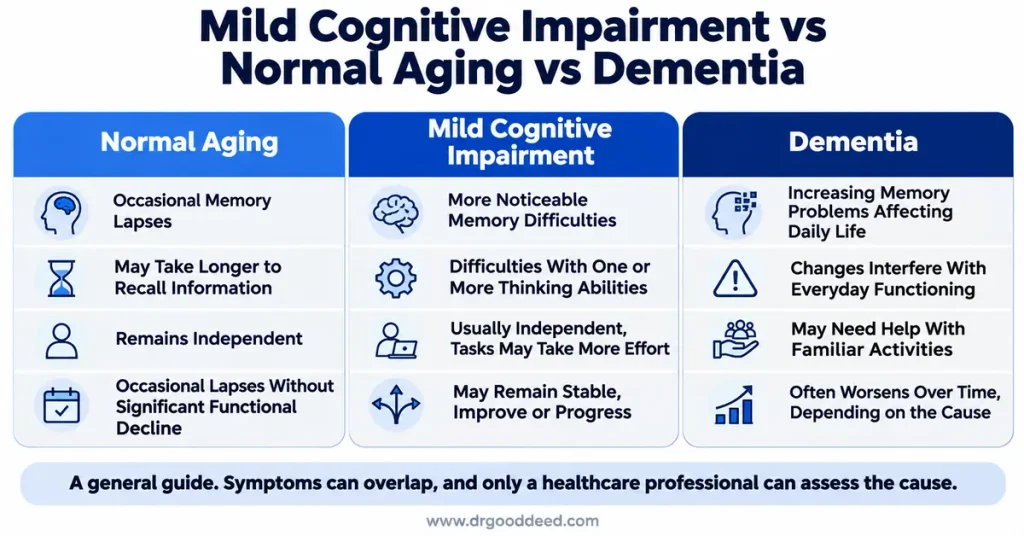
| Feature | Normal aging | Mild cognitive impairment (MCI) | Dementia |
| Memory | Occasional lapses | More noticeable memory difficulties | Increasing memory problems that affect daily life |
| Thinking skills | May take longer to recall information | Difficulties with one or more thinking abilities | Changes interfere with everyday functioning |
| Daily activities | Remain independent | Usually remain independent, although tasks may take more effort | May need help with familiar activities |
| Changes over time | Occasional lapses without significant functional decline | May remain stable, improve, or progress | Often worsens over time, depending on the cause |
| What others notice | Occasional forgetfulness | Repeated changes may become noticeable to family | Increasing difficulties with daily responsibilities may become apparent |
These distinctions help explain MCI vs. dementia, although symptoms can overlap and a healthcare professional must assess persistent changes to determine their cause. According to the Alzheimer’s Society, memory can become less reliable from around age 60, but normal age-related lapses rarely interfere with daily life. For example, you might misplace your glasses or forget a name and remember it later. Memory or thinking problems that persist for more than a few months may suggest mild cognitive impairment (MCI) and warrant medical assessment, although symptom duration alone cannot confirm a diagnosis.
What Does Normal Memory Loss Look Like?
Normal age-related forgetfulness usually involves occasional memory lapses that do not significantly interfere with daily activities. For example, you might misplace your glasses or forget someone’s name but remember it later. According to the Alzheimer’s Society, memory changes can become noticeable from around age 60. Older adults may also need more time and repetition to learn new information, but these changes generally do not affect their ability to live independently.
According to the Alzheimer’s Society, age-related memory changes can become noticeable from around age 60. However, these lapses do not necessarily indicate dementia. The key distinction is whether you can still manage everyday activities independently. Symptoms lasting more than a few months may suggest mild cognitive impairment (MCI), but how long symptoms last does not, on its own, confirm MCI.
When Does Forgetfulness Suggest MCI?
MCI becomes more likely when memory or thinking difficulties occur more frequently than expected for a person’s age. Someone might repeatedly forget recent conversations, struggle to follow instructions, or find it unusually difficult to organize familiar tasks.
Memory changes that persist for several months should be discussed with a healthcare professional. However, how long symptoms last does not, on its own, prove mild cognitive impairment (MCI). Sleep disturbances, depression, medication side effects, and other health conditions can also contribute to memory problems and should be considered during an assessment.
How Is MCI Different From Dementia?
People with MCI are typically independent in their activities of daily living, despite the need for increased effort or time to perform some tasks. Dementia is characterized by cognitive deficits that cause functional impairment in activities of daily living such as finances, meal preparation and safety.
Dementia is an umbrella term for conditions that affect memory, thinking, and everyday functioning. Alzheimer’s disease is one possible cause. For a closer look at how these terms differ, read our guide to Alzheimer’s disease vs dementia.
What Are the Early Signs of MCI?
Mild cognitive impairment symptoms can affect more than memory. Depending on the person, changes may involve learning, attention, reasoning, language, or motivation. The symptoms may be subtle at first, making changes over time particularly important.
Common early signs of MCI include:
- Memory and learning: Frequently forgetting recent conversations, appointments, or newly learned information.
- Attention: Finding it harder to concentrate or follow a conversation.
- Reasoning: Taking longer to solve familiar problems or make decisions.
- Language: Struggling to find familiar words during conversations.
- Motivation: Showing less interest in usual activities, although depression, fatigue, and other conditions can cause similar changes.
Family members may notice repeated questions, missed appointments, or difficulty with everyday tasks before the person recognizes a change. These observations can help a healthcare professional assess possible mild cognitive impairment (MCI), but they do not confirm a diagnosis on their own.
What Are Amnestic and Non-Amnestic MCI?
Amnestic MCI primarily affects memory, particularly the ability to remember recent events or learn new information. Non-amnestic MCI mainly affects other thinking abilities, such as attention, language, reasoning, or visual-spatial skills.
These terms describe the main cognitive abilities affected. They do not, by themselves, establish how severe the condition is or whether it will progress to dementia.
What Causes Mild Cognitive Impairment?
The causes of mild cognitive impairment (MCI) vary from person to person. Although MCI can be associated with an underlying neurological disease, other health conditions may also affect memory and thinking. According to the Alzheimer’s Society, sleep disorders and medication side effects can contribute to memory problems and should be considered during an assessment.
The term “mild cognitive decline” may also appear as a stage label on pages describing conditions such as Lewy body dementia. However, a stage label is not the same as a clinical diagnosis of MCI.
A clinician may investigate several possibilities:
- Sleep disorders: Poor sleep and conditions such as sleep apnea can affect concentration and memory. Learn more about sleep apnea without snoring.
- Medication side effects: Some medicines can affect alertness, attention, or thinking. Do not stop or change prescribed medicines without consulting the prescriber.
- Depression and anxiety: Mood conditions can make it harder to concentrate, recall information, or stay motivated. Read more about whether depression can cause memory loss.
- Thyroid problems: Thyroid dysfunction can contribute to cognitive symptoms and may require blood tests to investigate.
- Vitamin B12 deficiency: Low vitamin B12 levels can affect neurological functioning and may be a contributing factor in some people.
- Neurological disease: MCI can sometimes be an early sign of a disease that later causes dementia, including Alzheimer’s disease.
Identifying the cause is important, as some are treatable. However, the treatment of one underlying cause does not necessarily mean that all cognitive problems will be resolved. A clinician can identify what tests to perform depending on the patient’s symptoms and medical history.
How Is Mild Cognitive Impairment Diagnosed?
Mild cognitive impairment diagnosis involves looking at the person’s symptoms, medical history, cognitive abilities, and everyday functioning. There is no single MCI test that can independently diagnose every case.
A primary care clinician or memory service may use several steps to understand the changes.
- Medical history: The clinician asks when the symptoms began, how often they occur, and whether they have become more noticeable.
- Family observations: With the person’s agreement, a family member may describe changes in memory, behavior, or daily activities.
- Physical and neurological examination: This helps the clinician look for signs that may suggest an underlying medical or neurological condition.
- Cognitive testing: These standardized tests can evaluate short- and long-term memory, attention, language skills, and other cognitive functions.
- Blood tests: Can help identify other causes of memory symptoms, such as an underactive thyroid or vitamin B12 deficiency. Dr Chugh should confirm the recommended test list before publication.
- Brain imaging, when indicated: Imaging may be considered if the medical history or examination suggests a need to investigate possible neurological causes.
A cognitive screening score is only one part of the assessment. The results must be interpreted alongside a person’s age, education, medical history, and ability to manage daily activities. Further specialist assessment may be needed if the cause remains unclear.
Online memory quizzes cannot establish whether someone has MCI. A qualified healthcare professional must interpret the symptoms and assessment findings to determine what may be happening.
Does MCI Progress to Dementia?
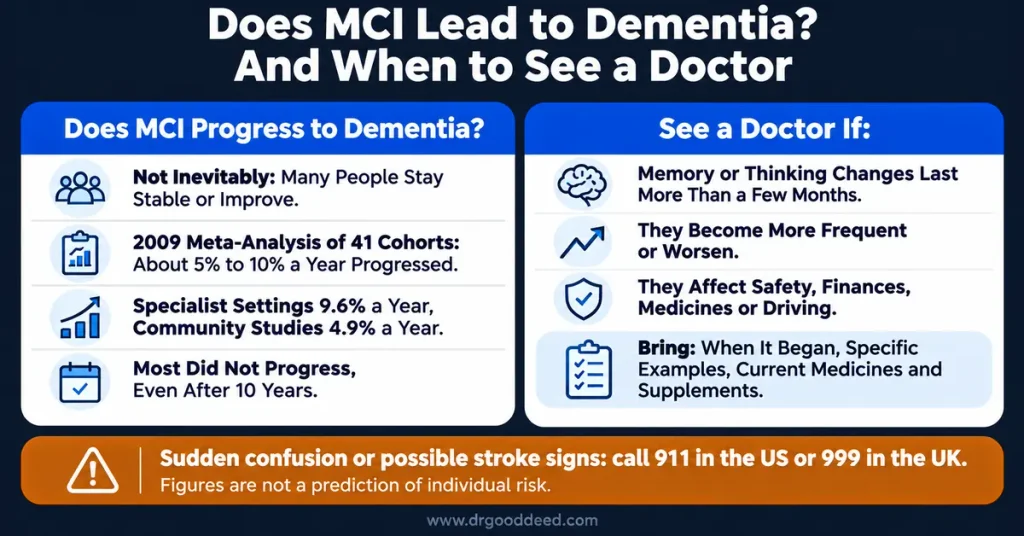
MCI progression to dementia is not inevitable: many people remain stable or improve over time. However, some people with mild cognitive impairment develop dementia as their symptoms progress. Outcomes vary depending on the underlying causes and other health factors.
A 2009 meta-analysis by Mitchell and Shiri-Feshki, which reviewed 41 inception cohorts, found that around 5% to 10% of people with mild cognitive impairment (MCI) progressed to dementia each year. Rates were higher in specialist settings (9.6% a year) than in community studies (4.9% a year). However, the study also found that most people with MCI did not progress to dementia, even after 10 years.
The figures should not be treated as a precise prediction of an individual’s risk. Differences in study populations, definitions of MCI, and follow-up methods can influence the results.
Dementia is a syndrome involving a decline in thinking and memory that affects daily life and can be caused by several diseases. MCI is not dementia, although it can be an early sign of a disease that causes dementia (Alzheimer’s Society). Regular follow-up helps healthcare professionals monitor changes in cognitive abilities and daily functioning.
Can Mild Cognitive Impairment Be Reversed?
Whether MCI improves depends on what is contributing to the symptoms. Some conditions, including certain sleep disorders and medication side effects, are treatable. Addressing these factors may help, but improvement is not guaranteed.
When MCI is due to an underlying neurologic disorder, the prognosis may depend on that condition. A healthcare professional can help you understand the evaluation result, determine what underlying conditions can be treated, and help plan any further treatment or monitoring.
Be cautious of products or programs that promise to reverse MCI or restore memory. Supplements, brain-training products, and individual exercises should not be presented as proven treatments for the condition. Discuss any proposed treatment with a healthcare professional.
When Should You See a Doctor?
When to see a doctor for memory loss: Contact a healthcare professional if memory problems or other cognitive changes persist for more than a few months, become more frequent, progressively worsen, or interfere with daily activities. Seek advice sooner if these changes affect safety, managing finances, taking medication correctly, driving, or other everyday tasks.
Bring the following information, if available, for discussion with a healthcare provider:
- What time the changes began and whether the condition is progressive.
- Specific examples of absent memories, repeated questions, or an inability to perform common activities.
- Current medicines and supplements.
- Recent changes in sleep, mood, or general health.
- Questions about assessment, follow-up, and support.
If you are concerned about a parent or another family member, share specific examples of the changes you have noticed. With their agreement, accompanying them to an appointment may help the clinician understand how their daily functioning has changed.
Where Should You Seek Help?
In the United States: Start with a primary care clinician. They can assess the symptoms and refer you to a neurologist or memory clinic if needed.
In the United Kingdom: Contact your GP, who can assess the changes and refer you to a memory service when appropriate. NHS 111 can help if you are unsure which service to contact.
Know when symptoms are an emergency. Sudden confusion or symptoms that may indicate a stroke need urgent medical assessment rather than a routine memory appointment. In the US, call 911 or go to an emergency department. In the UK, call 999 for a suspected stroke or another serious emergency. Learn more about what a stroke can feel like.
What Can You Do After an MCI Assessment?
An assessment can help determine the cause of memory changes, rule out other conditions, and indicate what tests are needed. Ask your clinician what it all means, if other tests are needed, and when to come back in if symptoms change.
Keep track of any changes in practical matters, such as memory, focus, and day-to-day function. Come in for follow-up visits and talk to your care team about sleeping, mood, hearing, medications, and other concerns.
You can also explore general ways to stay mentally engaged, such as activities discussed in our guide to brain exercises to help keep you mentally sharp.
Take Persistent Memory Changes Seriously
Differentiating between mild cognitive impairment (MCI) and normal ageing is not about a single memory lapse or misplaced object. Everyone misplaces things or forgets a name sometimes. However, if these lapses become more frequent, worsen over time, or interfere with daily life, it is worth seeking a medical evaluation to identify the cause.
Understanding the cause of the cognitive changes is essential to addressing the issue, ruling out other conditions and receiving effective treatment and care in the future.
Frequently Asked Questions
What is the difference between mild cognitive impairment and normal aging?
Normal aging causes occasional forgetfulness that rarely affects daily life. MCI involves greater memory or thinking difficulties than expected for age, while independence is generally preserved.
How do you know if memory loss is MCI or normal aging?
Repeated difficulties with familiar mental tasks or persistent changes may warrant assessment. Only a qualified healthcare professional can determine the cause.
What are the early signs of mild cognitive impairment?
Early signs may include difficulty remembering recent information, concentrating, reasoning, finding words, or learning new information.
Does mild cognitive impairment always lead to dementia?
No. MCI can remain stable or improve, although it progresses to dementia in some people.
Is MCI the same as early Alzheimer’s disease?
No. Mild cognitive impairment (MCI) is a condition involving noticeable changes in memory or other thinking skills that do not significantly interfere with everyday independence. It can be an early sign of Alzheimer’s disease, but not everyone with MCI develops Alzheimer’s or another form of dementia.
Can stress or poor sleep cause symptoms similar to MCI?
Yes. Stress, sleep problems, and certain medicines can affect memory and concentration. A healthcare professional can help identify whether these factors or another underlying condition may be contributing to the symptoms.
Can MCI affect thinking skills other than memory?
Yes. MCI can affect attention, language, reasoning, or other thinking abilities, depending on the person. Some people experience changes in more than one cognitive area.
Medical Disclaimer: This article is for informational and educational purposes only and does not replace professional medical advice, diagnosis, or treatment. Always consult a qualified healthcare professional about your symptoms or health concerns. Never delay or disregard professional medical advice based on information provided in this article.
Sources:
1. Alzheimer’s Society. Mild cognitive impairment (MCI). Link: https://www.alzheimers.org.uk/about-dementia/types-dementia/mild-cognitive-impairment-mci link
2. National Institute on Aging. Assessing Cognitive Impairment in Older Patients. Link: https://www.nia.nih.gov/health/health-care-professionals-information/assessing-cognitive-impairment-older-patients link
3. PubMed. Article indexed under PMID 25514304. Link: https://pubmed.ncbi.nlm.nih.gov/25514304/ link
4. PubMed. Article indexed under PMID 29282327. Link: https://pubmed.ncbi.nlm.nih.gov/29282327/ link
5. PubMed. Article indexed under PMID 35605068. Link: https://pubmed.ncbi.nlm.nih.gov/35605068/ link
6. Mitchell AJ, Shiri-Feshki M. Rate of progression of mild cognitive impairment to dementia—meta-analysis of 41 robust inception cohort studies. Acta Psychiatr Scand. 2009;119(4):252–265. Link: https://pubmed.ncbi.nlm.nih.gov/19236314/ link
Medical Disclaimer: This article is for general information only and is not medical advice. It does not replace a diagnosis, treatment plan, or guidance from a qualified healthcare professional. Always talk to your doctor about your own symptoms and before starting, stopping, or changing any treatment. If you think you may be having a medical emergency, call 911 or go to your nearest emergency room.