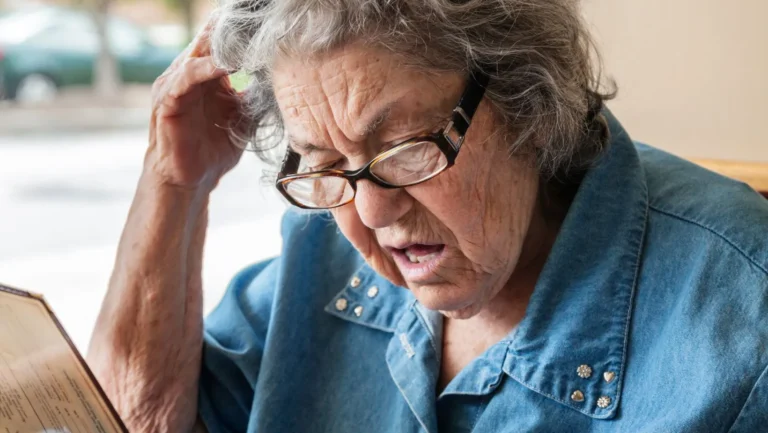

Forgetting words is usually not a sign of dementia, as occasional difficulty recalling words is common, especially with age. However, frequent or worsening problems with finding the right words that interfere with daily activities should be evaluated by a doctor (Alzheimer’s Society).
Key Takeaways
- Is forgetting words a sign of dementia? Usually not. Occasional word-finding difficulties are common, but frequent, worsening problems that affect daily life should be evaluated by a doctor.
- If it begins to occur often and impacts day-to-day functionality, it would be a reason to consult a medical professional.
- Stress, lack of sleep, medications, and other conditions may also contribute to challenges with word recall and comprehension.
- Additionally, sudden inability to speak or understand words is a symptom of a stroke, and one should seek emergency medical attention in such a case.
- Word-finding difficulties can be concerning, but occasional lapses are common and do not necessarily indicate dementia. However, persistent or worsening difficulty recalling words that affects daily communication should be discussed with a healthcare professional.
According to the Alzheimer’s Society, frequently struggling to recall familiar words or using vague phrases such as “that thing” may indicate a need to seek medical advice.
When Is Forgetting Words a Sign of Dementia?
Pay closer attention when word-finding difficulties occur more frequently or begin to interfere with conversations and everyday tasks (Alzheimer’s Society).
Difficulty in finding the right word can happen in day-to-day life. However, often having trouble coming up with familiar words or using vague terms such as ‘that thing’ can be a sign that it is time to seek help.
What Does Normal Word-Finding Look Like?
You may know exactly what you want to say but need a few extra seconds to remember the right word. This is often called a tip-of-the-tongue experience. Sometimes the word comes back naturally, or you remember it when someone gives you a clue.
These moments can happen at any age. They may become more noticeable with age, particularly when you are distracted, tired, or trying to manage several things at once.
When Should You Pay Closer Attention?
The situation is definitely more worthy of your attention when word-finding problems begin to come up more often or start interfering with conversations and everyday responsibilities.
For instance, you may have more and more issues understanding someone or something, forgetting the details of a conversation, and being unable to recall things you know well. Family members may even notice that something has changed in your communication.
Difficulty finding the right words and struggling to follow conversations are possible symptoms of dementia. Dementia is not a natural part of aging, so persistent changes should not simply be dismissed as getting older.
Normal Aging vs. Dementia
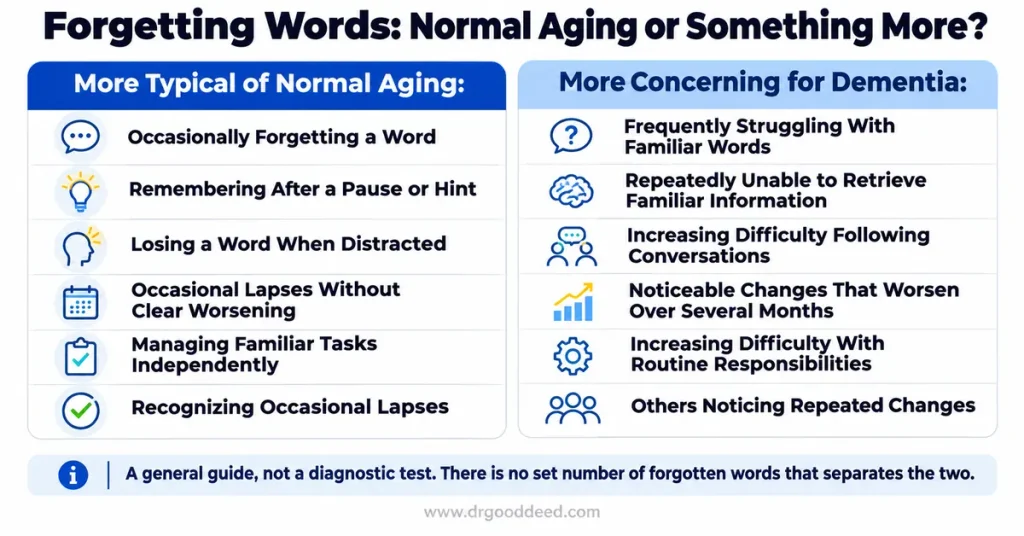
Normal aging and dementia can both involve memory lapses, but the frequency, progression, and effect on daily life can differ.
| Feature | More typical of normal aging | More concerning for dementia |
| Word recall | Occasionally forgetting a word | Frequently struggling with familiar words |
| Memory cues | Remembering after a pause or hint | Repeatedly being unable to retrieve familiar information |
| Conversations | Losing a word when distracted | Increasing difficulty following or participating in conversations |
| Progression | Occasional lapses without clear worsening | Noticeable changes that worsen over several months |
| Daily activities | Managing familiar tasks independently | Increasing difficulty with routine responsibilities |
| Observations | Recognizing occasional lapses | Others noticing repeated changes in memory or communication |
This comparison is a general guide, not a diagnostic test. People with dementia may recognize their difficulties, and people without dementia can have significant problems with language or memory.
Seek medical guidance when symptoms worsen over several months or make everyday tasks harder. There is no specific number of forgotten words that reliably distinguishes normal aging from dementia.
If you are unsure how dementia differs from Alzheimer’s disease, read our guide to Alzheimer’s versus dementia. Understanding the distinction can help you make sense of the terms used during a medical assessment.
What Causes Trouble Finding Words?
Dementia is only one possible explanation for word-finding difficulty. Sleep problems, stress, hearing difficulties, medicines, and certain medical conditions can also affect concentration, memory, or communication.
Can Stress, Anxiety, or Poor Sleep Affect Word Recall?
Yes. Stress and anxiety can impair the ability to concentrate on the conversation or to remember the information that needs to be recalled. Lack of sleep can also affect concentration and short-term memory, making word finding more challenging.
You may struggle to find the right words during a stressful meeting but speak fluently when you feel relaxed. This pattern may indicate that stress or difficulty concentrating is contributing to the problem rather than memory loss. However, if word-finding difficulties become frequent, worsen over time, or interfere with daily conversations and activities, consult a healthcare professional for evaluation.
Depression can also be a reason for impaired concentration, which may also affect memory. If impaired word finding is accompanied by other symptoms of depression, such as low mood, lack of motivation and interest, or disturbed sleep, speak with a healthcare professional about the changes. You can learn more about potential connections between depression and memory loss in our relevant article.
Sleep is another important consideration because inadequate rest can affect daytime thinking. Our guide to how long you can go without sleep explains why sleep loss matters for overall functioning.
Can Medicines or Other Health Conditions Cause It?
Some drugs can cause side effects like loss of memory or poor concentration; hearing problems may result in conversations becoming challenging to follow; and thyroid issues and vitamin B12 deficiency are among the different medical conditions a physician might consider when a patient is experiencing memory loss.
Several factors can contribute at the same time. For this reason, persistent word-finding problems should not automatically be attributed to anxiety, aging, or dementia.
Tell your doctor about your symptoms, medical history, and all medicines you take. Do not stop or change prescribed treatment without medical advice.
Which Word-Finding Symptoms Matter?
Occasionally forgetting a word or a familiar name is common and does not necessarily indicate dementia. However, persistent or worsening changes in language, memory, or communication may warrant medical evaluation. Warning signs include using the wrong words, struggling to follow conversations, or having difficulty remembering familiar information.
According to UVA Health, forgetting the name of a neighbor’s dog can be a normal memory lapse, but forgetting the word “dog” itself is more concerning. Other changes to watch for include difficulty with numbers or simple calculations and sudden changes in mood or personality. If these symptoms persist, worsen, or interfere with daily life, consult a healthcare professional.
Look for patterns such as:
- Forgetting words and names: Finding it harder and harder to remember familiar names or to find words you once knew.
- Use of vague terms: Saying things such as “that thing” or “the place” when you can’t think of the right word.
- Losing track of conversations: Having difficulty following discussions or keeping up with what others are saying.
- Getting lost in familiar places: Struggling to navigate familiar routes or becoming disoriented in places you know well. This can be a warning sign that warrants medical evaluation (Harvard Health; UVA Health).
- Becoming confused: Struggling to do things you used to be able to do more easily, for example, shopping or paying bills.
- Friends and family becoming concerned: If people close to you seem to be noticing your memory or communication problems.
These are all possible signs or symptoms of dementia, but they don’t necessarily mean someone has the condition. The key factors are how many symptoms there are, how quickly they appear, whether they affect everyday life, and the results of a professional medical evaluation.
What Are Anomia and Primary Progressive Aphasia?
- Anomia is difficulty retrieving words, particularly the names of familiar people or objects. It can occur for several reasons and does not automatically indicate dementia.
- Aphasia is a language disorder that can affect speaking, understanding, reading, or writing. It may occur after a stroke or in certain neurological conditions.
- Primary progressive aphasia is a less common neurological syndrome in which language abilities gradually deteriorate. It requires specialist evaluation to establish the diagnosis and investigate the underlying cause.
You may also hear the term mild cognitive impairment. This describes measurable changes in memory or thinking that are greater than expected for a person’s age but do not necessarily interfere substantially with independent daily functioning. Some people with mild cognitive impairment later develop dementia, while others remain stable or improve.
Word-finding difficulty becomes more concerning when it forms part of a progressive pattern involving other changes in memory, thinking, or everyday activities.
When Should You See a Doctor?
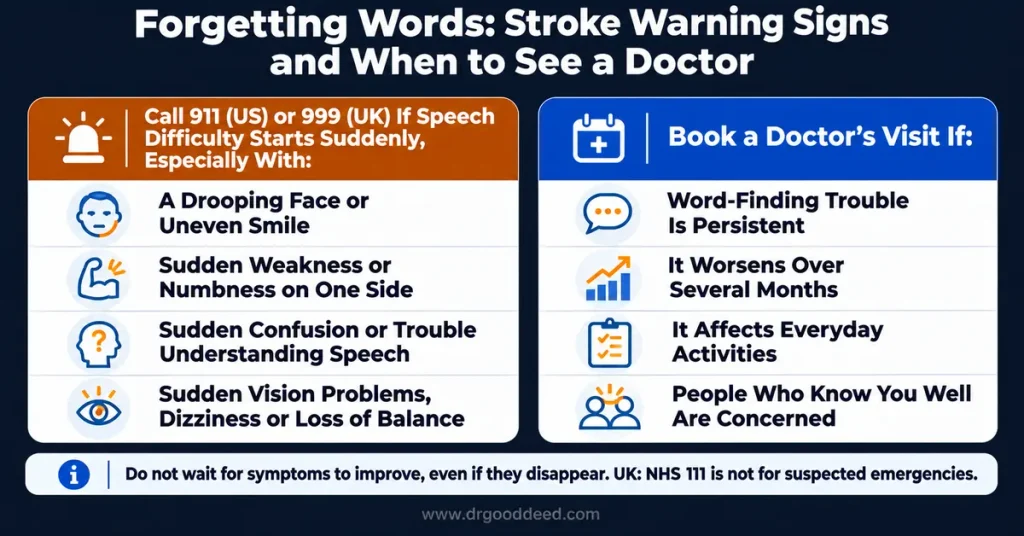
Arrange a medical appointment if trouble finding words becomes persistent, worsens over several months, affects everyday activities, or concerns people who know you well. You do not need to wait until the symptoms become severe.
In the United States, primary care clinicians can evaluate the situation and decide if a referral to a neurologist or neuropsychologist is appropriate.
In the UK, contact your GP if you are concerned about persistent or worsening word-finding difficulties or other possible signs of dementia. The NHS advises seeking medical guidance so a doctor can assess your symptoms and determine whether a specialist referral is needed. If you are unsure where to get help and need urgent medical advice, you can contact NHS 111.
Emergency section addition: If symptoms develop suddenly, such as sudden difficulty speaking or finding words, call 999 immediately, as this could indicate a stroke. Do not use NHS 111 for a suspected emergency.
What Happens During a Medical Evaluation?
There is no single test that confirms every case of dementia. Your doctor will consider your symptoms, medical history, examination findings, and the results of any appropriate investigations.
An evaluation may include:
- Questions about when the word-finding problems began and whether they are getting worse.
- A review of your medical history, medicines, sleep, mood, and hearing.
- Observations from a family member or someone who knows you well, with your agreement where appropriate.
- Tests of memory, attention, language, and other thinking abilities.
- Blood tests or brain imaging when clinically indicated.
- Referral for specialist cognitive testing or a speech and language assessment if necessary.
A memory screening test can identify areas that need further assessment, but it cannot diagnose dementia on its own.
What Should You Prepare Before Your Appointment?
A few practical notes can help your doctor understand what has changed.
- Write down examples of words or names you struggled to recall and when the incidents occurred.
- Note whether the problem affects conversations, work, or everyday tasks.
- Bring along an updated list of your medications and supplements.
- Ask a family member to tell you about changes in sleeping, mood, hearing, or other areas if you feel comfortable.
You don’t have to stop and write down every slip of memory or test your recall. It’s more important to note changes in these areas.
When Is Sudden Word Loss an Emergency?
Sudden difficulty finding words or speaking is different from gradual word-finding problems. It can be a warning sign of a stroke and requires immediate medical attention.
Call emergency services if speech difficulty begins suddenly, especially if it occurs with:
- A drooping face or an uneven smile.
- Sudden weakness or numbness, particularly on one side of the body.
- Sudden confusion or difficulty understanding speech.
- Sudden vision problems, dizziness, or loss of balance.
In the United States, call 911. In the United Kingdom, call 999 or seek emergency care through the appropriate emergency service. Do not wait for symptoms to improve, even if they disappear after a short time.
For more information about warning signs, read our guide to what a stroke can feel like. If symptoms begin suddenly, seek emergency care rather than relying on online information.
Conclusion
Occasionally forgetting a word is common, but a pattern of worsening word-finding difficulties over several months should be assessed by a doctor.
If you or your loved ones are facing consistent issues with word retention, set up an appointment with a medical professional and go over the evolution of symptoms. They will help you address the possible causes and figure out whether further action is required. Don’t jump to conclusions, but also don’t brush gradual changes with a sigh of relief.
Frequently Asked Questions
Is forgetting words a sign of dementia?
Not typically, if it occurs occasionally. In frequent, worsening cases affecting daily functioning, it can be an indicator of dementia, which requires medical attention.
Is it normal to forget words as you get older?
Yes. Tip-of-the-tongue moments can happen at any age and become more common as you get older (Being Patient). However, dementia is not a normal part of aging, and persistent or worsening word-finding difficulties should be discussed with a healthcare professional (NHS).
Can anxiety make you forget words?
Yes. Anxiety can affect concentration and make word retrieval harder, particularly during stressful situations. Persistent symptoms still deserve assessment.
Can medicines cause trouble finding words?
Some medications can have side effects such as these, so it’s best to discuss your concerns with your primary physician, as well as the medications you take, before undergoing any treatment.
Which doctor should I see about memory problems?
In the US, start with a primary care clinician. In the UK, contact your GP, who can assess your symptoms and arrange a specialist referral if needed.
Medical Disclaimer: This article is for informational and educational purposes only and does not replace professional medical advice, diagnosis, or treatment. Always consult a qualified healthcare professional about your symptoms or health concerns. Never delay or disregard professional medical advice based on information provided in this article.
Sources:
1. NHS. Symptoms of dementia [Internet]. [cited 2026 Oct 24]. Available from: https://www.nhs.uk/conditions/dementia/symptoms-and-diagnosis/symptoms/ link
2. Alzheimer’s Society. Do I have dementia? [Internet]. [cited 2026 Oct 24]. Available from: https://www.alzheimers.org.uk/about-dementia/worried-about-memory-problems/do-i-have-dementia-signs link
3. NHS. What is dementia? [Internet]. [cited 2026 Oct 24]. Available from: https://www.nhs.uk/conditions/dementia/about-dementia/what-is-dementia/ link
4. NHS. Symptoms of Alzheimer’s disease [Internet]. [cited 2026 Oct 24]. Available from: https://www.nhs.uk/conditions/alzheimers-disease/symptoms/ link
5. Alzheimer’s Society. Dementia symptoms [Internet]. [cited 2026 Oct 24]. Available from: https://www.alzheimers.org.uk/about-dementia/stages-and-symptoms/dementia-symptoms link
Medical Disclaimer: This article is for general information only and is not medical advice. It does not replace a diagnosis, treatment plan, or guidance from a qualified healthcare professional. Always talk to your doctor about your own symptoms and before starting, stopping, or changing any treatment. If you think you may be having a medical emergency, call 911 or go to your nearest emergency room.