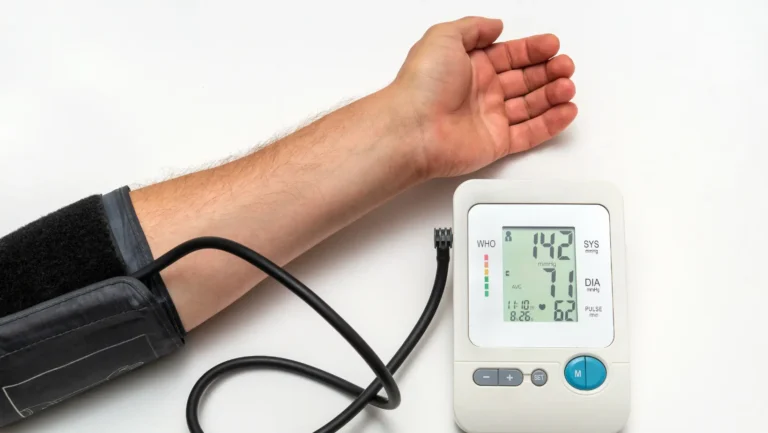

Blood pressure different in each arm is common, even when you feel healthy. Small differences are usually normal and can come from how the reading is taken or from natural variation. A difference of 10 mmHg or more should be checked again, and a repeated difference of 15 mmHg or more has been linked to a higher risk of vascular disease.
Knowing how to measure both arms correctly helps you understand your readings and decide when to ask for medical advice.
Key Takeaways
- Blood pressure different in each arm is often normal variation, but a gap of 10 mmHg or more deserves a repeat check.
- A repeated gap of 15 mmHg or more is linked to vascular disease and higher mortality in studies, but it does not diagnose any condition.
- Check both arms when measuring blood pressure for the first time, ideally simultaneously, and use the arm with the higher reading afterward.
- Sudden, severe chest or upper back pain with other warning signs requires emergency care. Call 911 in the US or 999 in the UK.
| Difference between arms | What it may mean | Recommended next step |
| Under 10 mmHg | Often reflects normal variation or measurement effects | Check your technique and repeat the readings. |
| 10 to 14 mmHg | May reflect measurement variation or an underlying vascular issue | Repeat the measurements and discuss persistent differences with your doctor. |
| 15 mmHg or more, repeatedly | More strongly associated with vascular disease and mortality in studies | Arrange a medical assessment and ask whether a vascular check is appropriate. |
| Any difference with sudden, severe chest or back pain | Could indicate a medical emergency, including aortic dissection | Call 911 or 999 immediately. |
Is Blood Pressure Different in Each Arm Normal?
Often, yes. Blood pressure different in each arm is commonly due to normal variation, measurement technique or the timing of readings, and a single difference does not necessarily mean a health problem.
Research shows that the reported frequency varies according to the population and measurement method:
- UCLA Health reports a difference greater than 10 mmHg in about 4% of the general population and 11% of people with diagnosed hypertension.
- A 2013 British Journal of General Practice study found a difference of at least 10 mmHg in 39.3% of 710 patients attending a hypertension clinic when readings were taken sequentially.
- An American College of Physicians commentary on a 2012 meta-analysis noted that sequential measurements were twice as likely to identify an inter-arm difference as simultaneous measurements.
These figures are not directly comparable because the studies used different populations and methods.
When a clinician measures one arm and then the other, changes in blood pressure between readings can create an apparent difference. Stress, anxiety, posture, cuff size and arm position may also affect results. Learn how anxiety affects blood pressure.
In the hypertension clinic study, researchers found no consistent pattern showing that the left or right arm was more likely to have the higher reading. Repeating measurements correctly helps distinguish a temporary difference from a persistent one.
How Big a Difference Is a Problem?
The blood pressure difference between arms is usually assessed using the systolic pressure, or top number. An inter-arm blood pressure difference of 10 mmHg has been proposed as the upper limit of normal, but the threshold does not diagnose vascular disease.
Research suggests that larger, persistent differences may provide useful information about cardiovascular risk:
- At least 5 mmHg: A 2021 analysis of 53,827 people across 24 studies found that each 5 mmHg increase in systolic difference was associated with a 5% higher relative hazard of all-cause mortality and a 6% higher relative hazard of cardiovascular mortality.
- At least 10 mmHg: A 2012 Lancet meta-analysis linked this difference with peripheral vascular disease.
- At least 15 mmHg: The same meta-analysis reported associations with cardiovascular mortality, with a hazard ratio of 1.7, and all-cause mortality, with a hazard ratio of 1.6.
Much of the evidence comes from higher-risk populations. The researchers also noted that inter-arm differences have low sensitivity for peripheral vascular disease, meaning that the absence of a difference cannot reliably rule out the condition.
A repeated difference of 10 mmHg or more deserves a doctor’s review, especially if it reaches 15 mmHg. Your doctor will weigh it alongside your general health, symptoms and other cardiovascular risk factors.

What Causes Blood Pressure Higher in One Arm?
Blood pressure higher in one arm is often a measurement effect, but a difference that persists can point to narrowed arteries or a structural condition that affects blood flow to the arm.
Possible causes include:
- Peripheral artery disease: Narrowing of arteries such as the subclavian artery can reduce blood flow to one arm.
- Atherosclerosis in older adults: Plaque build-up in the arteries can lead to unequal readings. See how cholesterol affects blood pressure.
- Muscle compression or structural blockage in younger people: Compression or anatomical differences may affect blood flow.
- Subclavian steal syndrome: Narrowing of an artery supplying the arm can sometimes cause dizziness or fainting.
- Coarctation of the aorta: This condition, present from birth, can produce different pressures in the arms, including consistently lower pressure in the left arm in some cases.
- Aortic dissection: A rare but life-threatening tear in the aorta can affect blood flow and produce unequal arm pressures.
Not every difference has a medical cause. An incorrectly sized cuff, an unsupported arm, an arm positioned above or below heart level, or taking readings one after the other can also affect the results.
Diabetes, kidney disease and cognitive decline have been associated with inter-arm differences in some research, but they are not known causes of the difference.
Which Arm to Use for Blood Pressure at Home?
If your blood pressure is different in each arm, check both arms first and use the arm with the consistently higher reading for future measurements. Correct technique helps you identify a difference that persists rather than one caused by measurement error.
Follow these steps at home:
1. Avoid caffeine, alcohol, and nicotine for at least 30 minutes before measuring.
2. Sit quietly with your back supported and feet flat on the floor.
3. Use a validated upper-arm blood pressure monitor with the correct cuff size.
4. Support your arm at heart level and keep it relaxed.
5. Take two readings on one arm, then repeat on the other arm. Allow about one minute between readings.
6. Average the readings for each arm and compare the results. If possible, have both arms measured simultaneously during your first assessment.
7. Repeat the process on another occasion if the difference is unexpected.
If one arm repeatedly gives a higher reading, use that arm for routine monitoring unless your healthcare professional advises otherwise.
For help choosing a validated device, see the home blood pressure monitor guide.

What Happens If the Difference Is Real?
A difference that persists on repeat readings should be checked by a doctor, because it can be a sign of a circulation problem. Your doctor will confirm the readings and decide whether more tests are needed.
Here is what to expect:
- Your doctor might take another set of measurements on both arms, using the same technique, in order to see if the difference still exists.
- Your doctor might want to know about your symptoms, medical history, the medications you’re taking, and your cardiovascular risk factors.
- If the difference is more than 10 mmHg, ask whether an ankle-brachial index (ABI) test is right for you. It compares blood pressure at the ankle with blood pressure in the arm and can help check for peripheral artery disease in the legs.
- Your clinician will decide whether further assessment is needed based on the repeated readings and your overall health.
Guidelines commonly recommend measuring blood pressure in both arms during an initial assessment, although this practice is not always followed.
In the US, contact your primary care doctor. In the UK, book an appointment with your GP. A difference between arms does not prove you have a vascular condition, and having no difference does not rule one out.
When Is a Difference Between Arms an Emergency?
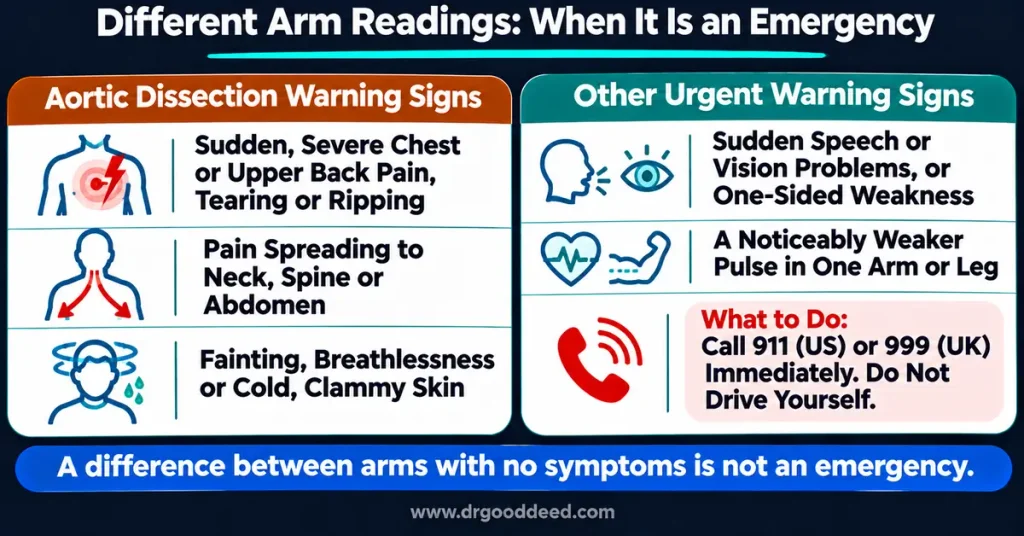
A different blood pressure in each arm, on its own and without symptoms, is not an emergency. It becomes urgent when it comes with sudden severe pain or stroke-like symptoms, which can signal a serious condition.
Aortic dissection is a rare, life-threatening emergency in which a tear develops in the aorta, the body’s main artery. Seek emergency help for warning signs such as:
- Sudden, severe chest or upper back pain, sometimes described as tearing or ripping.
- Pain that spreads to the neck, spine, or abdomen.
- Fainting, breathlessness, or cold, clammy skin.
- Sudden speech or vision problems, or weakness on one side of the body.
- A noticeably weaker pulse in one arm or leg, especially with other symptoms.
Call 911 in the US or 999 in the UK immediately if these symptoms occur. Do not drive yourself to the hospital. Go to the emergency department in the US or A&E in the UK if emergency services direct you to do so.
Do not wait to repeat blood pressure readings when severe symptoms suggest an emergency. Severe chest pain can also be a heart attack, so know the warning signs of a heart attack and the symptoms of a stroke in women.
Frequently Asked Questions
Is it normal for blood pressure to be higher in the left arm than the right?
Yes. Either arm can have the higher reading. Research has not established a consistent left- or right-arm pattern, so compare both arms rather than assuming one is always more accurate.
Can a blood pressure difference between arms go away?
Yes. A difference caused by the measurement method, timing or short-term changes in blood pressure often shrinks or disappears when readings are repeated. Talk to your doctor about any difference that persists.
Does a difference between arms mean I have heart disease?
Not necessarily. A blood pressure difference between arms is linked with vascular disease and cardiovascular risk, but it cannot diagnose heart disease on its own. Repeat readings and a doctor’s assessment decide whether more tests are needed.
Do both numbers matter, or only the top number?
The top number, or systolic pressure, is the main measure used in many studies of differences between arms. Some research also considers diastolic pressure, the bottom number. Your doctor can assess both numbers and determine whether the difference warrants further evaluation.
Sources
The Lancet, Association of a Difference in Systolic Blood Pressure Between Arms With Vascular Disease and Mortality: A Systematic Review and Meta-Analysis. link
Hypertension, Associations Between Systolic Interarm Differences in Blood Pressure and Cardiovascular Disease Outcomes and Mortality. link
British Journal of General Practice, Inter-Arm Blood Pressure Differences Compared With Ambulatory Monitoring: A Manifestation of the White-Coat Effect? link
UCLA Health, Why You Should Have Your Blood Pressure Checked in Both Arms. link
Harvard Health Publishing, Different Blood Pressure in Right and Left Arms Could Signal Trouble. link
Medical Disclaimer: This article is for general information only and is not medical advice. It does not replace a diagnosis, treatment plan, or guidance from a qualified healthcare professional. Always talk to your doctor about your own symptoms and before starting, stopping, or changing any treatment. If you think you may be having a medical emergency, call 911 or go to your nearest emergency room.