


Anxiety can cause memory loss. Anxiety disrupts the hippocampus, the brain region responsible for forming and retrieving memories, through chronic cortisol elevation and attentional interference.
Research from the University of Iowa found that prolonged stress hormone exposure measurably shrinks hippocampal volume, directly impairing memory function. Anxiety disorders affect over 40 million adults in the United States, and cognitive symptoms like forgetfulness and brain fog rank among the most frequently reported but least discussed effects.
Memory Problems Caused by Anxiety
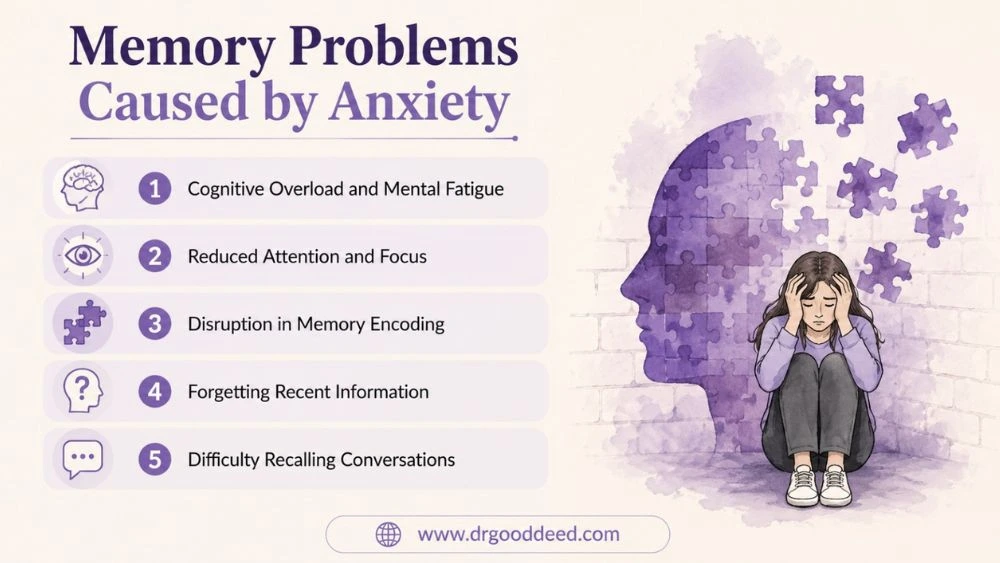
Memory problems caused by anxiety are not a psychological weakness. They result from specific, measurable changes in brain chemistry and neural activity. When anxiety stays elevated, the brain’s resources shift away from memory processing and toward threat detection.
Cognitive Overload and Mental Fatigue
The anxious brain runs constantly. It processes worst-case scenarios, monitors for danger, and rehearses past events. This consumes working memory capacity. Working memory is the brain’s short-term storage system; it holds information you’re actively using. When anxiety fills that space with worry, there’s less room for new information to enter and stick.
A 2013 study in Clinical Psychological Science found that individuals with high anxiety used significantly more working memory resources on threat-related thoughts, leaving less capacity for everyday cognitive tasks.
Reduced Attention and Focus
Memory requires attention first. If information doesn’t get your full attention, it never encodes properly. Anxiety fractures attention constantly. The brain scans for threats instead of focusing on the present conversation, task, or event. What looks like forgetting is often a failure to pay attention in the first place.
Disruption in Memory Encoding
Encoding is the process of converting experience into memory. The amygdala (your brain’s alarm system) and the hippocampus work together during this process. Anxiety overactivates the amygdala. When the amygdala fires repeatedly, it suppresses hippocampal activity. The result: information reaches the brain but doesn’t get stored properly.
Short-Term Memory Issues Anxiety
Short-term memory issues anxiety produces are distinct from age-related memory decline or early dementia. The forgetting pattern is specific and tied directly to stress levels.
Forgetting Recent Information
People with anxiety regularly forget things said to them minutes ago. A colleague gives instructions; they’re gone by the time the meeting ends. A doctor explains a diagnosis; the patient retains maybe 30 percent. This happens because the anxious brain encodes emotionally charged content well (threats, fears) but struggles with neutral, practical information.
Misplacing Items
Putting keys somewhere unusual, forgetting where a phone was set down, losing track of everyday objects; these are classic short-term memory issues anxiety produces. The root cause is divided attention. The brain performs the action (setting down the keys) on autopilot while conscious attention stays locked on anxious thoughts. No attention means no memory trace.
Difficulty Recalling Conversations
Anxiety interferes with episodic memory, which is memory of specific events and conversations. People often remember that a conversation happened but cannot recall what was said. This is especially common in high-stress interactions, job interviews, medical appointments, and difficult conversations with loved ones.
Attention Issues Causing Memory Lapses
Attention issues causing memory lapses represent the most direct pathway between anxiety and forgetting. Memory and attention are not separate systems; attention is the gate that information must pass through before it becomes a memory.
Inability to Focus on Tasks
Anxiety produces intrusive thoughts that interrupt sustained attention. Reading the same paragraph three times without retaining it is a textbook example. The eyes move, but the mind processes anxious content instead. This isn’t a distraction in the ordinary sense; it’s the brain prioritizing perceived threats over the task at hand.
Divided Attention Reducing Retention
When attention splits between a task and anxious rumination, retention drops for both. The brain doesn’t multitask; it switches rapidly between two streams. Every switch reduces encoding quality. A 2017 study in Behaviour Research and Therapy confirmed that anxiety-driven cognitive interference specifically reduced recall of concurrent tasks by up to 35 percent.
Mental Distraction from Worry
Worry is repetitive, automatic thinking about future threats. It runs in the background constantly during anxiety. This background noise consumes processing resources that memory formation requires. The more severe the worry, the worse the encoding, and therefore the worse the recall.
Symptoms of Anxiety-Related Memory Problems
Anxiety-related memory symptoms differ from dementia or neurological disease. The pattern matters.
- Brain fog: A persistent sense of mental cloudiness without a clear physical cause. Thinking feels slower. Words don’t come easily. Concentrating takes visible effort.
- Difficulty concentrating: Tasks that were once automatic, like reading, writing, or following a conversation, now require deliberate effort.
- Slower thinking: Processing speed drops noticeably during high-anxiety periods. The brain takes longer to retrieve words, make decisions, or connect ideas.
- Forgetfulness under stress: Memory failures cluster around stressful periods, not randomly throughout the week.
The key distinguishing feature: anxiety-related memory problems improve when anxiety decreases. Neurological memory loss does not follow this pattern.
How to Improve Memory With Anxiety
Improving memory with anxiety starts with treating the anxiety, not just the memory symptom.
Reducing Anxiety Levels
Cognitive Behavioral Therapy (CBT) is the most evidence-backed intervention. As CBT reduces anxiety frequency and intensity, working memory capacity recovers. A 2014 study in Psychological Medicine found that patients who completed 12 weeks of CBT showed significant improvement in working memory performance alongside reduced anxiety scores.
Improving Focus and Attention
Single-tasking is more effective than most people expect. Performing one task at a time, with phone and notifications removed, restores attention quality within days. The Pomodoro Technique, which involves 25-minute focused work intervals followed by 5-minute breaks, reduces cognitive fatigue and improves information retention in anxious individuals.
Sleep Optimization
Sleep is when the brain consolidates memories from the day. Anxiety disrupts sleep architecture, specifically REM sleep, which is the stage where memory consolidation happens most actively. Even one night of poor sleep reduces next-day recall by up to 40 percent, according to research from the University of California, Berkeley. Fixing sleep fixes a large portion of the memory problem.
Mental Exercises and Routines
Working memory training using apps like Cogmed, which has clinical trial data behind it, improves working memory capacity over 5 weeks of daily practice. Crossword puzzles and reading improve verbal recall. These don’t cure anxiety, but they maintain cognitive function while anxiety treatment progresses.
Practical Techniques to Boost Memory During Anxiety
These work immediately, without requiring anxiety to be resolved first.
Writing Things Down
Externalizing memory removes pressure from an overloaded brain. Write down tasks, appointments, and key information immediately after receiving it. This isn’t a crutch; it’s a cognitive load management strategy. Research from Princeton University found that handwriting notes (rather than typing) improves encoding and recall even in low-anxiety populations.
Breaking Tasks Into Smaller Steps
Large tasks overwhelm working memory under anxiety. Breaking a task into steps of 2 to 3 actions keeps each chunk within working memory capacity. Completing each step before moving to the next prevents the cognitive spillover that causes of anxiety.
Mindfulness and Grounding
A 5-minute grounding practice before cognitively demanding tasks, specifically the 5-4-3-2-1 technique (identifying 5 things you see, 4 you can touch, 3 you hear, 2 you smell, 1 you taste), pulls attention into the present moment. This temporarily quiets the amygdala and creates the attentional space memory encoding requires.
Lifestyle Changes That Support Brain Function
Nervous system overload anxiety produces cumulative damage to memory function over months and years if lifestyle factors go unaddressed. These changes produce measurable cognitive benefit within 4 to 8 weeks.
- Exercise: 150 minutes of moderate aerobic exercise weekly increases BDNF (brain-derived neurotrophic factor), a protein that supports hippocampal growth. A Harvard Medical School review confirmed that regular exercise increased hippocampal volume by 2 percent in adults with high stress, directly improving memory.
- Omega-3 fatty acids: Found in salmon, sardines, and walnuts. A 2012 study in Biological Psychiatry found that omega-3 supplementation reduced anxiety symptoms and inflammatory markers that impair memory function simultaneously.
- Magnesium: Anxiety depletes magnesium rapidly. Low magnesium worsens both anxiety and memory performance. Foods high in magnesium include pumpkin seeds, dark chocolate, and spinach.
- Limiting alcohol: Even moderate alcohol disrupts REM sleep and reduces hippocampal neurogenesis. Two or more drinks per day consistently worsen memory in anxious adults over time.
- Social interaction: Conversation is one of the most cognitively demanding activities the brain performs. Regular social engagement maintains working memory and processing speed during anxiety periods.
FAQs
Can anxiety cause memory loss?
Yes. Anxiety can cause memory loss through cortisol elevation, which suppresses hippocampal activity and reduces working memory capacity. It also disrupts attention, which prevents proper memory encoding. Memory problems worsen during high-anxiety periods and improve when anxiety is treated. This pattern distinguishes anxiety-related memory loss from neurological conditions.
How do attention issues cause memory lapses?
Attention issues causing memory lapses occur because memory encoding requires full attention. Anxiety fills working memory with worry, leaving insufficient capacity to encode new information. A 2017 Behaviour Research and Therapy study found anxiety-driven distraction reduced concurrent task recall by 35 percent. No attention means no memory trace, so the information simply never stores.
What is nervous system overload anxiety?
Nervous system overload anxiety describes the state where chronic sympathetic activation keeps cortisol and adrenaline continuously elevated. The brain stays in threat-detection mode rather than processing and storing information. This produces brain fog, slower thinking, and fragmented recall. It resolves when the parasympathetic nervous system regains dominance through treatment or stress reduction.
How to improve memory with anxiety?
Start with CBT, which restores working memory capacity within 12 weeks according to published clinical data. Prioritize REM sleep, practice single-tasking, and write things down immediately. Improving memory with anxiety long-term requires reducing anxiety itself, not just managing the memory symptom in isolation.
Can anxiety cause brain fog?
Yes. Brain fog from anxiety results from three simultaneous effects: cortisol suppressing hippocampal function, working memory saturation from worry, and sleep disruption reducing daily memory consolidation. Anxiety can cause memory loss severe enough to feel like fog. The fog lifts within 3 to 6 weeks of effective anxiety treatment in most adults.
Is anxiety memory loss permanent?
No. Anxiety can cause memory loss that becomes permanent only in rare cases of extreme, prolonged stress causing measurable hippocampal atrophy. In the vast majority of anxiety cases, memory improves fully once anxiety reduces. A 2014 Psychological Medicine study showed working memory normalizing after 12 weeks of CBT treatment.
When should I see a doctor for memory issues?
See a doctor immediately if memory loss includes forgetting close family members’ names, getting lost in familiar locations, or losing entire time periods with no recall. These physical symptoms suggest neurological conditions beyond anxiety. Also seek evaluation if memory problems persist after anxiety treatment shows clear improvement.
Can treating anxiety restore memory?
Yes. Memory problems caused by anxiety are functionally reversible. As cortisol drops through CBT, medication, or lifestyle change, hippocampal suppression lifts. Working memory capacity returns as rumination decreases. Most patients report noticeable memory improvement within 4 to 6 weeks of beginning effective anxiety treatment.