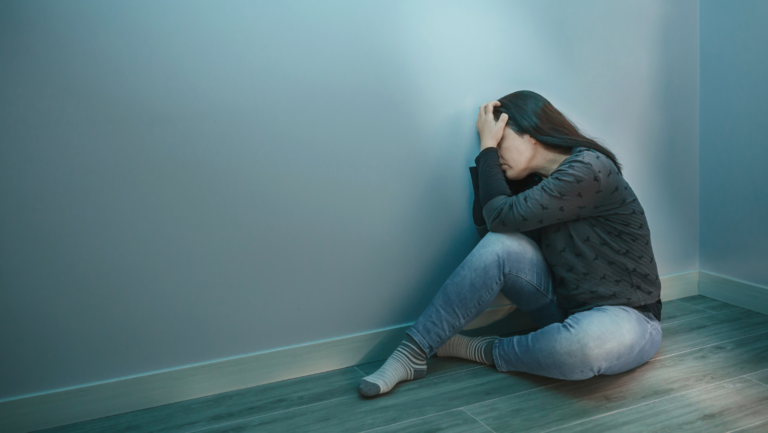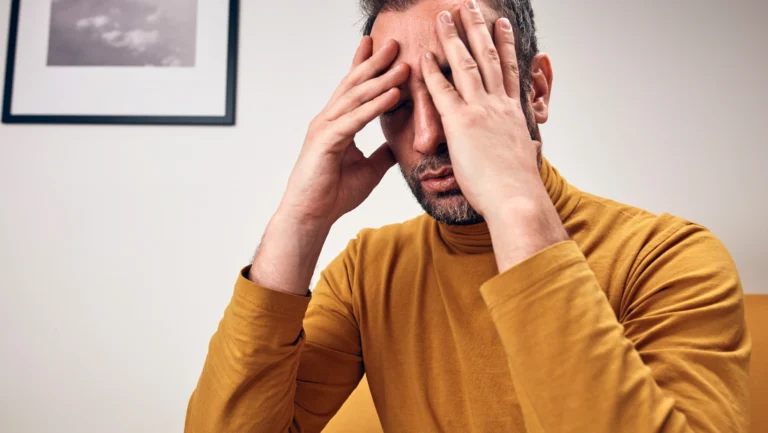
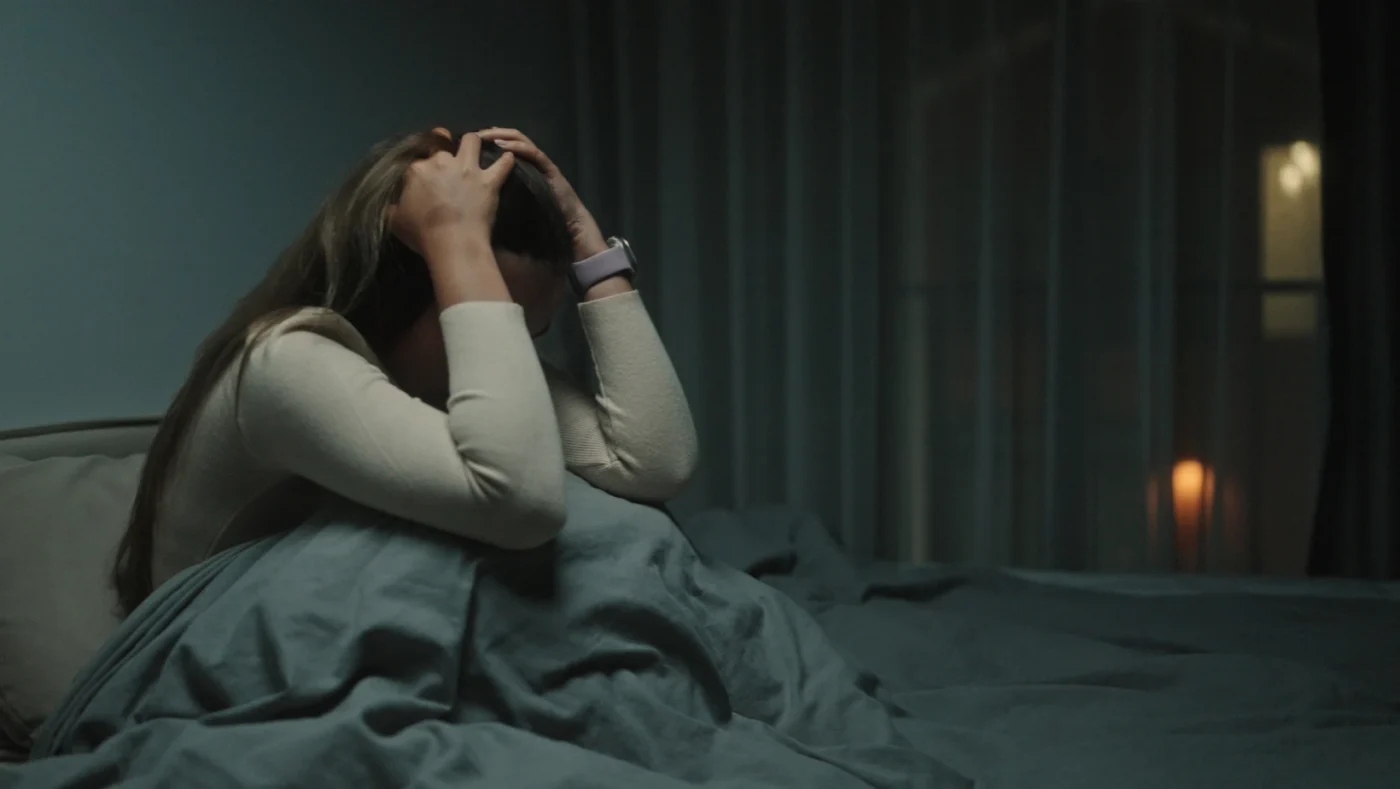

Anxiety is worse at night because the brain loses its daytime distractions and turns inward. Without tasks, conversations, and external demands absorbing attention, the default mode network (the brain’s background processing system) activates and amplifies unresolved worries.
Research published in Cognitive Therapy and Research confirms that nighttime rumination is a primary predictor of both anxiety severity and insomnia duration. Across the United States, an estimated 40 million adults with anxiety disorders report nighttime symptoms as their most disruptive.
Nighttime Causes Anxiety
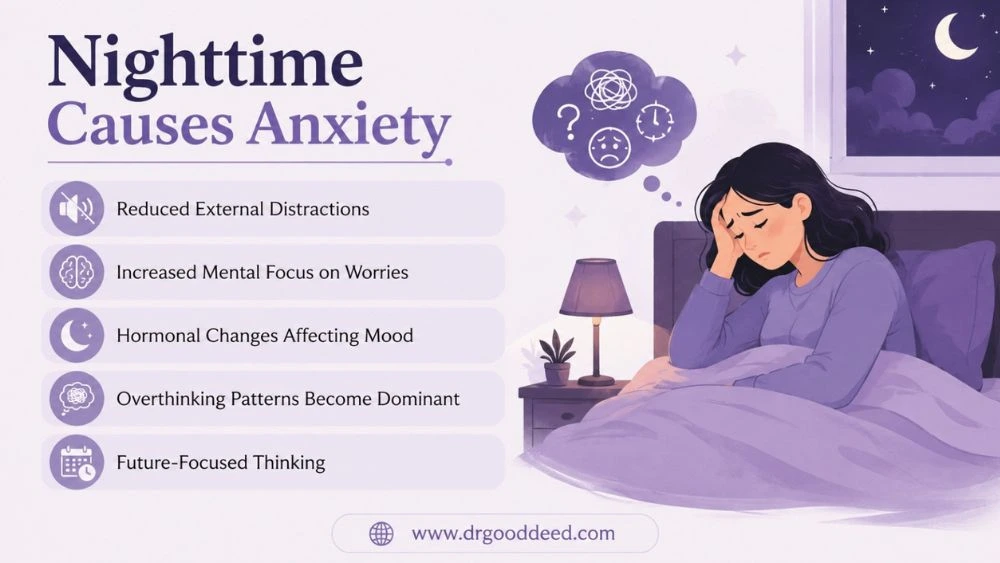
Nighttime causes anxiety through a combination of reduced sensory input, hormonal shifts, and the brain’s natural tendency to process unfinished thoughts during quiet periods. This isn’t random. It follows a predictable pattern tied to circadian biology.
Reduced External Distractions
During the day, the brain manages tasks, conversations, screens, and deadlines. These external inputs pull attention outward and away from internal worry. At night, that external input disappears. The brain doesn’t just sit quietly; it fills the silence with whatever it left unprocessed during the day. Worry, regret, planning, fear; all of it surfaces when there’s nothing else competing for attention.
Increased Mental Focus on Worries
Cortisol, the body’s primary stress hormone, follows a circadian rhythm. It peaks in the morning and drops through the evening. Lower cortisol means lower mental energy to suppress or manage anxious thoughts. The brain’s prefrontal cortex, which handles rational thinking and emotional regulation, functions less effectively late at night. Worry gets louder because the brain’s ability to talk itself down is weakest at bedtime.
Hormonal Changes Affecting Mood
Melatonin rises at night to signal sleep, but in anxious individuals, the stress system and the sleep system conflict. Adrenaline and cortisol from unresolved anxiety block melatonin’s effectiveness. A 2019 study in Sleep Medicine Reviews found that adults with generalized anxiety disorder (GAD) had significantly disrupted melatonin timing compared to non-anxious controls, which extended the window during which anxiety physical symptoms remained active.
Lack of Distractions Increasing Anxiety
Lack of distractions increasing anxiety is the most underreported driver of nighttime anxiety in clinical literature. Most people understand that they feel more anxious at night; fewer understand that daytime busyness was actively suppressing the anxiety they’ll feel later.
Quiet Environment Amplifies Thoughts
Sound and activity suppress the brain’s internal chatter. A quiet bedroom removes those suppressors. For people with anxiety, this quiet reads as empty space that worry immediately fills. Some people report that background noise (white noise, fans, low-volume television) reduces nighttime anxiety specifically because it partially replicates daytime sensory input.
No Tasks to Shift Attention
Task completion releases dopamine. During the day, finishing emails, meals, and errands provides small dopamine hits that stabilize mood. At night, there are no tasks. Dopamine drops. The reward system goes quiet, and anxiety fills the gap. This is why anxiety is worse at night for many high-functioning people who feel fine during work hours.
Overthinking Patterns Become Dominant
The brain defaults to future-focused thinking at night. Psychologists call this “prospective anxiety.” Instead of processing what happened today, the anxious brain rehearses tomorrow’s problems, worst-case scenarios, and unresolved conflicts.
A 2020 study in Journal of Abnormal Psychology found that nighttime worry predominantly focused on future events, not past ones, making it harder to resolve because the feared event hasn’t happened yet.
Racing Thoughts at Night Anxiety
Racing thoughts at night anxiety describes the specific experience of thoughts moving too fast to follow, jumping between topics, and preventing mental stillness. This is distinct from general worry; it’s a cognitive state with a physiological basis.
Unresolved Worries Surfacing
The brain uses sleep as a processing period. Before sleep begins, it attempts to flag unresolved items for overnight processing. In anxious individuals, this flagging process runs in overdrive. Everything unresolved, every email not sent, every conversation left tense, every unpaid bill, activates simultaneously. The volume of flagged content exceeds the brain’s ability to process it quietly.
Future-Focused Thinking
Racing thoughts almost always point forward, not backward. The brain rehearses presentations, arguments, medical appointments, financial decisions, and relationship conflicts that haven’t happened yet. This rehearsal feels productive but doesn’t resolve anything. It maintains arousal instead of allowing the nervous system to wind down toward sleep.
Difficulty Shutting Off the Mind
The default mode network activates most strongly when external input disappears. In a healthy, low-anxiety brain, this network produces mild reflection and then quiets as sleep approaches. In an anxious brain, the network loops repeatedly through the same content. Melatonin rises but can’t override an active stress response, so sleep initiation delays by 30 to 90 minutes or more.
Common Symptoms of Nighttime Anxiety
Recognizing these symptoms distinguishes anxiety-driven insomnia from other sleep disorders.
- Restlessness and tension: An inability to lie still, accompanied by muscle tightness in the shoulders, jaw, or stomach. This is the body reflecting the sympathetic nervous system’s activation.
- Rapid heartbeat: Adrenaline released during evening anxiety spikes heart rate above the normal resting range. Some people notice their heart pounding against the mattress when lying on their left side.
- Sweating or uneasiness: Night sweats in the absence of fever or menopause often link directly to nocturnal cortisol spikes driven by anxiety.
- Difficulty relaxing: The nervous system stays in sympathetic mode despite the body being still. Relaxation feels physically impossible, not just mentally challenging.
Bedtime Routine for Anxiety Relief
A structured bedtime routine for anxiety relief works by giving the nervous system predictable cues that safety is established and sleep is coming. The routine itself trains the body’s circadian system over 2 to 3 weeks.
Consistent Sleep Schedule
Go to bed and wake up at the same time every day, including weekends. Irregular sleep timing desynchronizes the circadian clock, which worsens anxiety timing and intensity. The National Sleep Foundation recommends maintaining sleep timing within a 30-minute window daily.
Reducing Screen Time
Blue light from phones and tablets suppresses melatonin production for up to 90 minutes after exposure. More critically, content on screens, especially news and social media, activates the amygdala and restimulates anxiety that was beginning to wind down. Stop screens at least 60 minutes before bed.
Creating a Calm Environment
Lower bedroom temperature to between 65 and 68 degrees Fahrenheit. Research from the National Institutes of Health confirms that cooler temperatures signal the body to lower core temperature, which accelerates sleep onset. Use blackout curtains. Darkness increases the speed of melatonin release.
Pre-Sleep Relaxation Practices
A consistent 10 to 15 minute wind-down practice, performed at the same time each night, begins conditioning the nervous system to associate that time with safety. Options that have clinical support include body scan meditation, progressive muscle relaxation, and slow breathing. The specific practice matters less than the consistency.
Relaxation Techniques for Sleep
Relaxation techniques for sleep work by directly activating the parasympathetic nervous system, reducing cortisol, and slowing heart rate before sleep initiation.
Deep Breathing Exercises
The 4-7-8 breathing technique (inhale 4 seconds, hold 7, exhale 8) is among the most effective pre-sleep breathing methods. The extended hold and exhale activate the vagus nerve and drop heart rate within 4 to 6 breath cycles. Dr. Andrew Weil at the University of Arizona popularized this technique based on pranayama breathing research; independent sleep studies support its use in reducing sleep-onset anxiety.
Progressive Muscle Relaxation (PMR)
Tense each muscle group for 5 seconds, then release for 30 seconds. Start at the feet and work upward to the face. PMR reduces muscle tension by teaching the nervous system to recognize the contrast between tension and release. A 2015 meta-analysis in Sleep Medicine Reviews found PMR reduced sleep-onset latency (time to fall asleep) by an average of 19 minutes in adults with anxiety-related insomnia.
Guided Meditation
Apps like Calm and Headspace both have peer-reviewed data supporting their anxiety and sleep outcomes. A 2018 JAMA Internal Medicine study found mindfulness meditation reduced insomnia severity scores by 43 percent over 6 weeks. Sleep-specific guided meditations (body scan, sleep stories) work by occupying the default mode network with low-arousal content instead of worry.
How to Stop Racing Thoughts at Night
Racing thoughts at night anxiety responds to cognitive offloading more than relaxation techniques alone.
Journaling Before Bed
Write down every worry, task, and unresolved thought before getting into bed. This externalizes the mental flagging process that the brain runs automatically. A 2018 study in Experimental Brain Research found that writing a specific to-do list (not just worry journaling) reduced sleep-onset time by 9 minutes on average because the brain no longer needed to hold the items in active memory.
Cognitive Distraction Techniques
Counting backward from 300 by 3s forces the prefrontal cortex to perform a mild cognitive task, which interrupts the default mode network’s worry loop without fully activating alertness. It’s cognitively demanding enough to stop rumination but not stimulating enough to prevent sleep.
Mindfulness Practices
Observing thoughts without engaging them is the core mindfulness skill. Instead of following a worry thought into its consequences, label it (“planning thought,” “fear thought”) and return attention to the breath. This breaks the escalation pattern that turns a single worry into racing thoughts at night anxiety lasting 90 minutes.
Lifestyle Changes to Reduce Night Anxiety
Daytime habits determine nighttime anxiety levels more than most people expect.
- Limiting caffeine: Caffeine has a half-life of 5 to 6 hours. A 3 PM coffee still has half its caffeine active at 8 PM. Caffeine blocks adenosine receptors, which suppresses the sleepiness signal and keeps the nervous system more reactive to anxiety triggers at night. Cut caffeine after 1 PM.
- Regular exercise: 30 minutes of moderate aerobic exercise, completed before 6 PM, reduces cortisol levels in the evening and increases slow-wave sleep depth. People who exercise regularly report significantly lower nighttime anxiety scores within 4 weeks.
- Stress management during the day: Unresolved daytime stress is the primary fuel. Anxiety is worse at night. CBT, scheduled worry time (a 15-minute daily window for writing down worries), and brief midday breathing breaks reduce the volume of content the brain carries into the evening.
FAQs
Why is anxiety worse at night?
Anxiety is worse at night because the prefrontal cortex weakens in the evening, reducing the brain’s ability to suppress worry, and external distractions disappear, giving the default mode network nothing to compete with. Cortisol also drops at night, but in anxious individuals, adrenaline spikes fill the gap and sustain alertness.
What is the best bedtime routine for anxiety relief?
The most effective bedtime routine for anxiety relief is: stop screens 60 minutes before bed, write a specific to-do list for tomorrow (reduces sleep-onset by 9 minutes per published research), perform 10 minutes of progressive muscle relaxation, then use 4-7-8 breathing until sleep starts. Repeat the same sequence nightly for 3 weeks to condition the nervous system.
How to stop anxiety before sleep?
Write down all unresolved worries and tomorrow’s tasks before getting into bed. This removes the brain’s need to hold them in active memory. Then use the 4-7-8 breathing technique for 5 to 8 minutes. If thoughts return, label them (“planning,” “fear”) and redirect to breath. Do not check the phone after starting this sequence.
Can night anxiety cause insomnia?
Yes. Racing thoughts at night anxiety delays sleep onset and reduces REM sleep quality. Chronic nighttime anxiety produces psychophysiological insomnia, a condition where the bed becomes associated with wakefulness instead of sleep. This develops within 2 to 4 weeks of consistent nighttime anxiety. CBT for Insomnia (CBT-I) is the evidence-backed treatment, showing 70 to 80 percent success rates in clinical trials.
When should I see a doctor for anxiety at night?
See a doctor if nighttime anxiety causes insomnia lasting more than 3 weeks, if it triggers panic attacks with chest pain or difficulty breathing, or if daytime function is impaired from sleep deprivation. Also seek evaluation if nighttime anxiety follows trauma, as post-traumatic stress disorder (PTSD) produces nighttime hyperarousal that requires specialized treatment beyond sleep hygiene.
Can improving sleep reduce anxiety?
Yes. Sleep and anxiety have a bidirectional relationship. Poor sleep raises next-day amygdala reactivity by up to 60 percent, according to UC Berkeley research, making anxiety worse the following evening. Improving sleep through CBT-I and consistent sleep timing reduces anxiety scores measurably within 4 to 6 weeks, independent of any direct anxiety treatment.