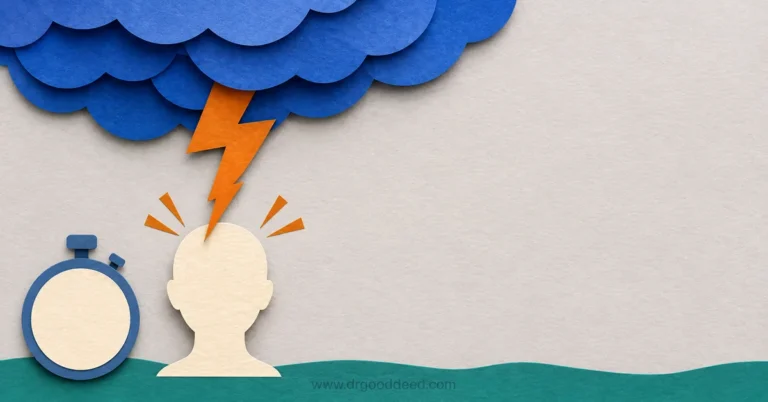

An ice pick headache is a sudden, sharp stab of pain in the head that lasts only a few seconds and then disappears. These headaches are usually harmless, but a new headache pattern, repeated pain in one exact spot, or other symptoms may need medical attention.
Key Takeaways
- An ice pick headache is a brief, sharp stab of head pain lasting seconds; it is usually harmless and not caused by disease.
- Most stabs last three seconds or less, and people usually experience one or a few episodes a day.
- Ice pick headaches are closely linked with migraine but are a separate type of headache.
- Repeated stabs in the exact same spot should be checked by a doctor.
- Call 911 for an explosive or worst-ever headache, or one accompanied by weakness, speech or vision changes, or confusion.
What Is an Ice Pick Headache?
An ice pick headache, also called primary stabbing headache, is a quick jab of pain in the head that strikes without warning and fades within seconds.
The International Classification of Headache Disorders (ICHD-3) describes primary stabbing headaches as spontaneous, short-lasting episodes of pain. They usually have the following features:
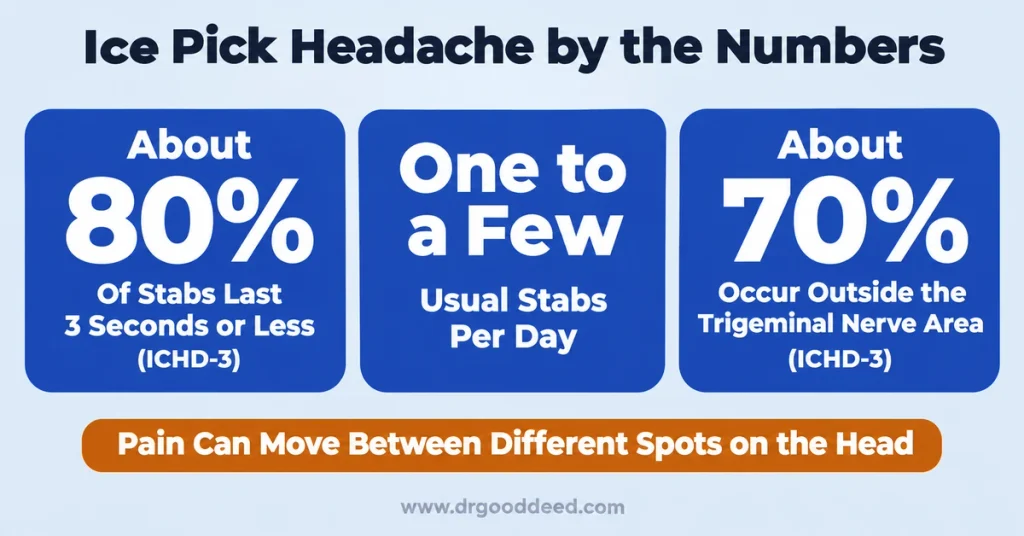
- Duration: Around 80% of stabs last three seconds or less, although some may last longer.
- Frequency: Episodes can happen irregularly, ranging from one to several times a day. Most people experience one or a few stabs daily.
- Location: Pain can occur anywhere on the head and may move from one area to another.
- No other symptoms: The stabs do not usually cause tearing, red eyes, a runny nose, or other cranial autonomic symptoms. These are automatic body responses that can accompany certain headache disorders.
Unlike some other headaches, an ice pick headache does not usually build gradually. The pain appears suddenly and disappears just as quickly.
Ice Pick Headache Symptoms and Who Gets Them
Ice pick headaches cause sudden, sharp pains that can occur anywhere on the head. The pain may feel like a needle prick, an ice pick, or a brief electric shock.
You may feel the pain around your forehead, temples, back of your head, or near your eyes. However, it is not limited to these areas. According to ICHD-3, around 70% of stabs occur outside the trigeminal nerve area, which covers much of the face and front of the head. The pain may also move between different locations.
Other things to know include:
- How common they are: Research estimates their prevalence at around 2% to 35%, according to Chua and Nahas (2016). A 2025 study in the Journal of Headache and Pain reported a lifetime prevalence of 35.2% in its study group.
- Migraine connection: Ice pick headaches are more common in people who experience migraine.
- Children: A 2024 study published in Cephalalgia found that the median age of onset was eight years, with cases ranging from ages three to 17. Some children experienced longer episodes, and neurological examinations were normal.
- Women: Ice pick headaches appear to be more common in women, according to Chua and Nahas (2016).
Where a headache sits can hint at its type. See our headache location chart to understand what different headache locations may indicate.
What Causes Ice Pick Headaches?
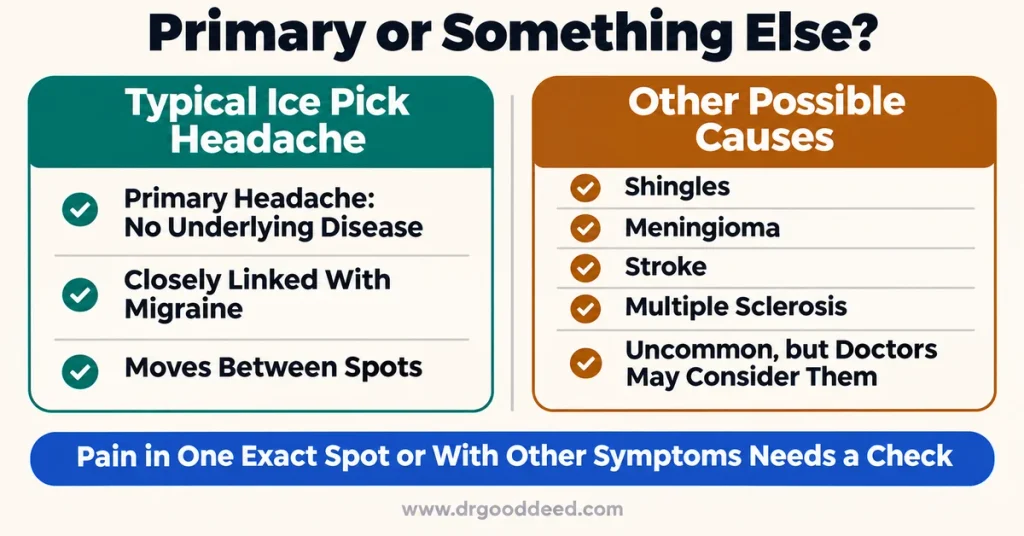
The exact cause of ice pick headaches is not known. They are classified as a primary headache disorder, which means the headache itself is the condition rather than a symptom of another disease.
They are closely linked with migraine, although the two conditions are different. A 2025 study of patients at a specialist headache center found that 90% of people with primary stabbing headaches also had migraine. However, this finding came from a specialist clinic group and may not represent everyone who experiences these headaches.
Other conditions can sometimes cause sudden, sharp pain in the head. These include:
- Shingles: A viral infection that can affect nerves and cause pain.
- Meningioma: A type of tumor that grows in the meninges, the protective layers covering the brain and spinal cord.
- Stroke: A medical emergency that may cause a sudden headache along with other neurological symptoms.
- Multiple sclerosis (MS): A condition affecting the brain and spinal cord that can cause different neurological symptoms.
These conditions are uncommon explanations for typical ice pick headaches. However, a doctor may consider them when the pain is unusual, stays in one location, or occurs with other symptoms.
Stabs near the eye can overlap with migraine behind the eyes, although the two conditions are not the same.
Is an Ice Pick Headache Dangerous?
Usually, no. An ice pick headache is generally not dangerous because primary stabbing headaches occur without an underlying disease causing the pain.
However, there is one important exception. According to ICHD-3, repeated stabs that always affect the exact same spot need medical evaluation to rule out a structural cause.
You should speak with a doctor if:
- You experience repeated pain in exactly the same area of your head.
- The headaches are new or feel different from your usual headaches.
- The episodes become more frequent or last longer.
- You develop other symptoms, such as fever, weakness, vision changes, or confusion.
If you are worried about a more serious cause, learn about the early signs of a brain tumor and how they differ from typical headaches.
Ice Pick Headache vs Other Sharp Head Pain
Not every sudden, sharp headache is an ice pick headache. Some conditions can cause severe head pain and need urgent medical attention.
The following table compares ice pick headache with other causes of sudden, sharp head pain.
| Headache or condition | How the pain feels | Other symptoms | What to do |
| Ice pick headache | Brief, sharp stabs lasting seconds. Pain may move between different areas. | Usually no other symptoms. | See a doctor if the pain is new, unusual, or repeatedly affects the same spot. |
| Thunderclap headache | Sudden, extremely severe pain that reaches its peak quickly. | May indicate bleeding around the brain or another serious condition. | Call 911 or go to the ER immediately. |
| Stroke | A sudden headache may occur, although it is not always present. | Weakness, facial drooping, speech problems, vision changes, or difficulty walking. | Call 911 immediately. Do not drive yourself. |
| Giant cell (temporal) arteritis | Headache often affects the temples, particularly in adults over 50. | Jaw pain while chewing and vision changes. | Seek urgent medical attention. |
| Cluster headache | Severe pain, usually around or behind one eye. | Red or watery eye, runny or blocked nose on the affected side. | Seek medical attention for diagnosis and treatment. |
Ice pick headache is one of several types of headaches doctors recognize.
Never assume that an explosive headache or one accompanied by stroke symptoms is an ice pick headache. Sudden, severe head pain can sometimes signal a medical emergency.
How Doctors Diagnose Ice Pick Headaches
A neurologist can often diagnose an ice pick headache by reviewing your symptoms and performing a neurological examination. Brain imaging is not necessary for everyone.
Your doctor may follow these steps:
- Headache history: They will ask when the pain started, how long each episode lasts, where it occurs, and how often it happens.
- Neurological examination: The doctor will check your strength, vision, coordination, reflexes, and other neurological functions.
- Headache diary: Keeping a record of your episodes can help identify patterns. Note when the pain occurs, where you feel it, how long it lasts, and whether you experience other symptoms.
- Imaging: If the pain stays in one exact spot or has unusual features, your doctor may recommend brain imaging, such as an MRI, to look for structural causes.
Not everyone with an ice pick headache needs an MRI or other imaging tests. The decision depends on your symptoms, medical history, and examination findings.
Ice Pick Headache Treatment and Relief
Most ice pick headache episodes end within seconds, often before any treatment can be taken. If you experience frequent or disruptive attacks, a doctor may consider preventive treatment.
Your treatment options may include:
- Medical evaluation: See a doctor if your episodes become frequent, disruptive, or different from your usual pattern.
- Preventive treatment: A doctor may prescribe preventive medication if you experience frequent attacks. However, treatment does not work for everyone. Research reviewed by Chua and Nahas (2016) suggests that up to 35% of people may not respond to the usual first-line treatment.
- Hand warming: Hand warming has been studied as a possible approach to managing primary stabbing headaches. However, more research is needed to establish how effective it is.
- Headache diary: Record the frequency, location, duration, and other symptoms associated with your headaches. This information can help your neurologist decide whether further investigation or treatment is needed.
How Do You Get Rid of Ice Pick Headaches?
There is no definite way to stop a single episode because the pain usually disappears within seconds. If the episodes happen frequently, a doctor can help determine whether preventive treatment is appropriate.
Avoid trying treatments based only on the type of pain you experience. A medical professional can confirm the diagnosis and recommend safe options based on your symptoms.
When to Worry About a Stabbing Headache
Most brief stabbing headaches are not emergencies. However, certain symptoms can point to a serious condition that needs immediate medical attention.
Call 911 or go to the ER immediately if you experience:
- A sudden, explosive headache or the worst headache of your life.
- A headache with weakness, facial drooping, slurred speech, confusion, or sudden vision changes.
- A sudden, severe headache with fainting or difficulty staying awake.
- A severe headache with fever and a stiff neck.
A sudden severe headache can be a warning sign of a stroke or bleeding around the brain.
The CDC recommends using BE FAST to recognize possible stroke symptoms:
- Balance: Sudden loss of balance or coordination.
- Eyes: Sudden vision changes.
- Face: Drooping on one side of the face.
- Arms: Weakness or numbness in one arm.
- Speech: Slurred speech or difficulty speaking.
- Time: Call 911 immediately if you notice any of these symptoms.
Do not drive yourself to the hospital if you suspect a stroke.
Seek urgent medical attention if you experience:
- A new headache that starts after age 50.
- A headache following a head injury.
- A child with a headache accompanied by fever, rash, or unusual sleepiness.
- Headache or jaw pain while chewing, particularly when accompanied by vision changes.
- New, worsening, or repeated headaches that affect the exact same area.
For less urgent but new or changing headaches without emergency symptoms, contact your primary care doctor. They can assess your symptoms and refer you to a neurologist if needed.
Urgent care may also be appropriate for a new or worsening headache that needs prompt assessment but has no emergency warning signs. Do not use urgent care instead of the ER when emergency symptoms are present.
Women can also experience different warning signs during a stroke. Read more about stroke symptoms in women.
Doctor’s Tip: If you experience repeated pain in the exact same area or notice a new headache pattern after age 50, see a doctor. Even when each stab lasts only a few seconds, a change in the pattern should not be ignored.
If a stab is new, stays in one spot, or comes with other symptoms, get checked instead of assuming it is an ice pick headache.
Frequently Asked Questions
Is a Stabbing Headache That Lasts Seconds Normal?
A stabbing headache that lasts seconds is common and is usually a harmless ice pick headache, especially in people who also get migraines. The pain often appears suddenly and disappears quickly. However, repeated stabs in one exact spot, new headache patterns, or other symptoms should be checked by a doctor.
Can Ice Pick Headaches Turn Into Migraines?
No. Ice pick headaches and migraines are separate primary headache disorders. However, both can occur in the same person. A 2025 study at a specialist headache center found that 90% of people with primary stabbing headaches also had migraine. This suggests a strong connection between the two conditions.
Do Ice Pick Headaches Mean I Have an Aneurysm?
Usually, no. An ice pick headache is typically a brief stab that disappears within seconds. A brain aneurysm is a weakened area in a blood vessel wall that can sometimes bleed. A sudden, explosive headache or the worst headache of your life needs immediate medical attention. Call 911.
Does a Brain Tumor Cause Ice Pick Headaches?
Rarely, a structural condition such as a meningioma can cause stabbing head pain. However, most ice pick headaches are not caused by brain tumors. If the pain repeatedly affects the exact same spot, becomes worse, or comes with other symptoms, see a doctor for an evaluation.
What If Ice Pick Headaches Keep Happening All Day?
Most people experience one or a few episodes a day. Frequent stabs throughout the day, headaches that continue for several days, or a new pain pattern should be discussed with a doctor. Keeping a headache diary can help your neurologist understand how often the pain occurs and whether further tests are needed.
Sources
International Headache Society, ICHD-3: Primary stabbing headache. link
MedlinePlus, Headaches: Danger signs. link
National Institute of Neurological Disorders and Stroke (NINDS), Headache. link
CDC, Signs and Symptoms of Stroke. link
Journal of Headache and Pain, Primary stabbing headache in a tertiary headache centre. link
Cephalalgia, Childhood primary stabbing headache: A double center study. link
Current Pain and Headache Reports, Ice Pick Headache (Chua AL, Nahas S). link
Medical Disclaimer: This article is for general information only and is not medical advice. It does not replace a diagnosis, treatment plan, or guidance from a qualified healthcare professional. Always talk to your doctor about your own symptoms and before starting, stopping, or changing any treatment. If you think you may be having a medical emergency, call 911 or go to your nearest emergency room.