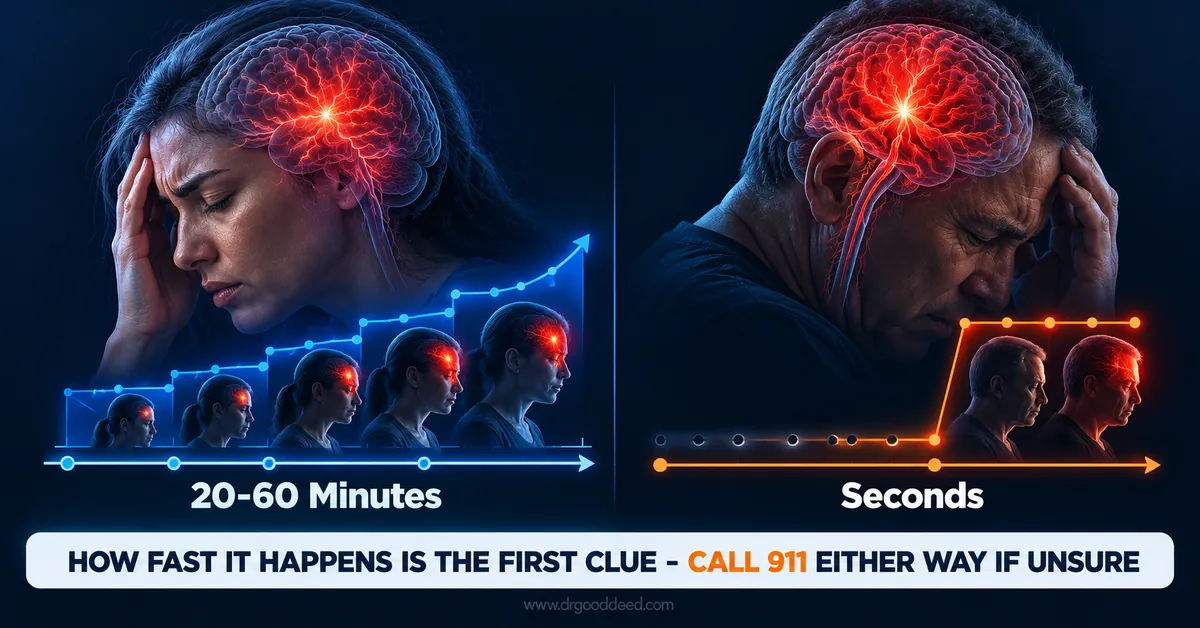

Hemiplegic migraine and stroke can cause similar symptoms, including sudden weakness or paralysis on one side of the body, difficulty speaking, numbness, vision changes, dizziness, and confusion, but they have different causes.
Hemiplegic migraine is a rare migraine type that can produce temporary motor weakness, often alongside migraine symptoms such as headache, aura, nausea, or sensitivity to light and sound. A stroke occurs when blood flow to part of the brain becomes blocked or when a blood vessel bleeds, causing brain injury.
Key Takeaways
- Hemiplegic migraine causes temporary one-sided weakness that can closely resemble stroke, this overlap is well documented and explains most of the diagnostic confusion.
- Stroke symptoms appear suddenly, within seconds to minutes, while hemiplegic migraine symptoms typically build gradually over 20 to 60 minutes.
- Facial drooping, especially when smiling, is a stroke-specific red flag not typically seen in hemiplegic migraine.
- Doctors rule out stroke first on every first-time presentation, regardless of how confident the migraine history seems.
- Anyone without a prior hemiplegic migraine diagnosis experiencing these symptoms for the first time should call emergency services immediately.
The Overlapping Illusion: Why Hemiplegic Migraine Looks Like a Stroke
- Both conditions can cause one-sided weakness or paralysis affecting the arm, leg, or face, the defining feature that makes hemiplegic migraine so alarming to experience.
- Numbness, tingling, and vision disturbances such as blind spots or blurred vision appear in both hemiplegic migraine and ischemic stroke.
- Speech difficulty, including slurred or garbled words, shows up in both conditions, making verbal symptoms alone an unreliable way to distinguish them.
- Dizziness and trouble walking can accompany either condition, adding to why even trained observers sometimes need imaging for confirmation
The Critical Timeline Test: Spreading Cortical Depression vs. Acute Vascular Ischemia
The timing and progression of neurological symptoms can help distinguish migraine aura from an acute ischemic stroke, although symptoms can overlap and timing alone cannot safely diagnose either condition. Migraine aura commonly develops gradually over several minutes as symptoms spread or evolve, while stroke symptoms often appear suddenly and reach maximum intensity at or near onset.
The Gradual “Migraine March” Sensation Profile
- Migraine aura typically builds gradually over 5–20 minutes.
- Visual symptoms may expand or move across the visual field.
- Tingling or numbness can spread progressively from one area to another.
- Different aura symptoms may occur sequentially, such as visual changes followed by sensory or speech symptoms.
- Aura symptoms generally last 5–60 minutes before resolving.
The Instantaneous Stroke Drop Phenomenon
- Stroke symptoms commonly begin suddenly, without a gradual progression.
- Weakness, numbness, facial drooping, speech difficulty, or vision loss may appear abruptly.
- The deficit may be maximal at onset rather than gradually spreading.
- A sudden new neurological deficit requires emergency medical assessment, even in someone with a history of migraine.
- A person should not assume sudden symptoms are migraine simply because they resemble a previous aura.
Symptoms That Point to Stroke, Not Hemiplegic Migraine
Certain symptoms lean heavily toward stroke and are not typically part of a hemiplegic migraine attack; this is the differentiator with the clearest safety value.
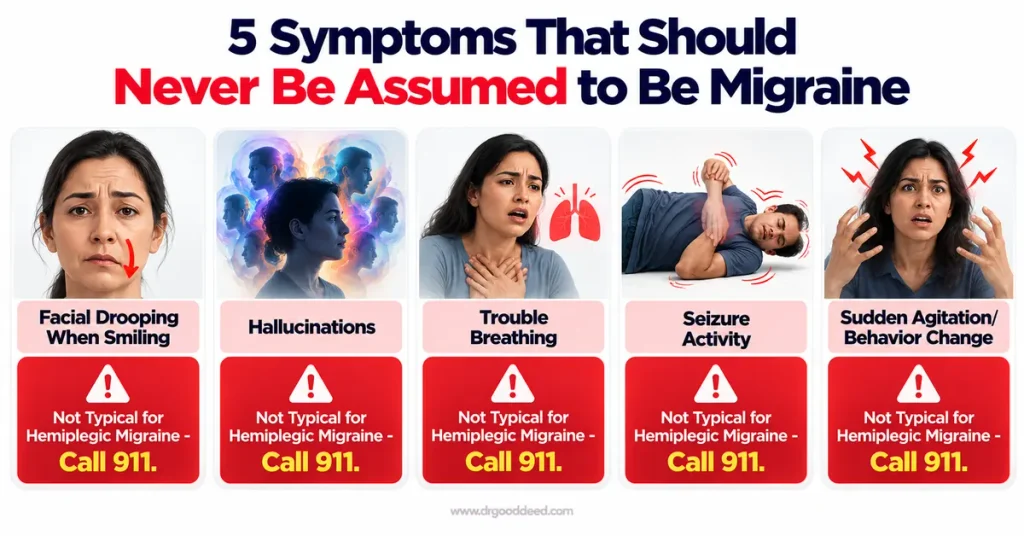
- Facial drooping, particularly noticeable when trying to smile, points strongly toward stroke and is not a typical hemiplegic migraine feature.
- Hallucinations are considered atypical for hemiplegic migraine and raise concern for stroke or another acute neurological event.
- Trouble breathing signals a more serious emergency and should never be attributed to a migraine attack without immediate evaluation.
- Seizure activity accompanying sudden weakness is a stroke-associated red flag, not an expected hemiplegic migraine symptom.
- Sudden agitation or an abrupt behavioral change is more consistent with stroke than with a typical migraine presentation.
Expert Insight: The sequential build of visual aura followed by sensory symptoms and then motor weakness over 20 to 60 minutes is a genuinely useful clinical clue for hemiplegic migraine, but it should never be used to delay a 911 call on a first-time episode, since roughly 5% of stroke patients also report gradual, migraine-like symptom onset in published comparisons.
The FAST Checklist for Safety
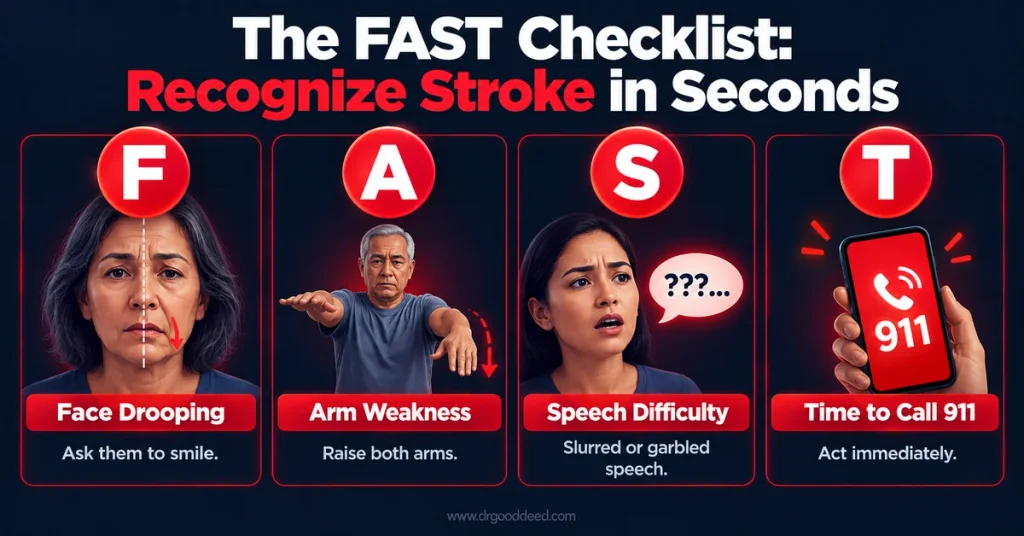
The FAST checklist remains the fastest, most reliable public tool for recognizing stroke, and it directly ties back to the facial-drooping differentiator covered above.
- F, Face drooping: ask the person to smile, one-sided drooping is a stroke warning sign rarely seen in hemiplegic migraine.
- A, Arm weakness: ask them to raise both arms, drifting or inability to lift one arm signals possible stroke.
- S, Speech difficulty: slurred, garbled, or unclear speech is a warning sign shared by both conditions but still demands urgent evaluation.
- T, Time to call emergency services: if any of the above appears, especially with sudden onset, call 911 immediately rather than waiting to see if symptoms pass.
Why Doctors Rule Out Stroke First, Every Time
Emergency providers default to ruling out stroke before considering hemiplegic migraine on any first presentation, and this clinical priority exists for a specific, defensible reason.
- Brain imaging, typically CT or MRI, is standard practice on a first attack specifically to rule out bleeding, blood clots, or tumors before a migraine diagnosis is considered.
- Blood work and a detailed neurological exam accompany imaging to check for other causes mimicking hemiplegic migraine’s presentation.
- Migraine treatment can safely wait a few hours for confirmation, but missing an actual stroke cannot, this asymmetry drives the entire diagnostic approach.
- A confirmed prior hemiplegic migraine diagnosis, ideally with documented genetic or family history, still doesn’t exempt a new, different, or worsening episode from repeat evaluation.
This rule-out-first approach reflects how narrow the treatment window is for actual stroke compared to the far more forgiving timeline for migraine care.
When to Call Emergency Services
Anyone without a prior hemiplegic migraine diagnosis experiencing sudden one-sided weakness, facial drooping, or speech difficulty should call emergency services immediately, this guidance applies without exception. Even with a known hemiplegic migraine history, any new symptom, faster onset, or unfamiliar pattern warrants the same urgent response.
FAQs
Can hemiplegic migraine happen alongside an actual stroke?
Yes, though rare, people with migraine, including hemiplegic migraine, carry a modestly higher lifetime stroke risk. This is exactly why new or first-time weakness always requires emergency evaluation rather than assumption.
Does facial drooping ever happen with hemiplegic migraine?
Rarely. Facial drooping, especially when smiling, is considered a stroke-specific red flag and isn’t a typical hemiplegic migraine feature. Its presence should prompt an immediate 911 call, not migraine self-management.
Should you call 911 even if you’ve had hemiplegic migraine before?
Yes, if the episode feels different, faster, or more severe than prior attacks. A documented history doesn’t guarantee the current episode is migraine, new or atypical symptoms still require emergency evaluation.
What tests confirm it’s migraine and not a stroke?
Brain imaging (CT or MRI) rules out bleeding, clots, or tumors. Combined with bloodwork, a neurological exam, and symptom history including onset speed, these results confirm hemiplegic migraine only after stroke is excluded.
Can stress or panic make hemiplegic migraine symptoms worse?
Yes, stress is a recognized migraine trigger and can intensify attack severity. However, stress alone never explains sudden facial drooping or one-sided weakness, those symptoms still require emergency evaluation regardless of stress levels.
Sources
- Migraine and Stroke: Links, Differences, Risk Factors, and More, Medical News Today link
- Hemiplegic Migraine: When a Migraine Mimics a Stroke, Virtual Headache Specialist link
- Migraine Aura-Like Symptoms at Onset of Stroke and Stroke-Like Symptoms in Migraine With Aura, National Center for Biotechnology Information link
- How Do You Differentiate the Symptoms of Hemiplegic Migraine From a Stroke, Migraine World Summit link
Medical Disclaimer: This article is for general information only and is not medical advice. It does not replace a diagnosis, treatment plan, or guidance from a qualified healthcare professional. Always talk to your doctor about your own symptoms and before starting, stopping, or changing any treatment. If you think you may be having a medical emergency, call 911 or go to your nearest emergency room.