
If fluorescent office lighting or a bright monitor makes your dizziness spike, a specific lens tint can help. To choose the best indoor sunglasses for vestibular migraine photophobia, look for lightly tinted lenses in neutral gray, rose, or FL-41-style tints, which can reduce sensitivity to bright or flickering light while maintaining comfortable vision indoors.
Choose lenses with anti-reflective and UV protection, avoid very dark sunglasses indoors, and consider photochromic lenses if your light sensitivity changes throughout the day.
Key Takeaways
- Vestibular migraine frequently includes severe photophobia alongside dizziness, not headache alone.
- Dark sunglasses worn indoors train the eyes to expect less light, which can heighten sensitivity over time.
- FL-41 tinted lenses were built specifically for indoor, all-day wear rather than outdoor glare.
- Peer-reviewed research links FL-41 use to a measurable drop in migraine frequency, though results vary by person.
- Newer color-science research shows the visual pain pathway responds differently to blue, green, amber, and red light.
The Vestibular Connection: Why Dizziness and Extreme Light Sensitivity Happen Together
Vestibular migraine is a distinct neurological diagnosis, formally defined by the Bárány Society and the International Headache Society.
- It combines recurrent episodes of vertigo or dizziness, lasting five minutes to 72 hours, with a personal history of migraine.
- The diagnostic criteria were based on clinical symptoms including headache, vertigo, phonophobia, photophobia, and visual auras.
- In practice, this means the same neural pathways that make ordinary migraine painful under bright light are also active during a vertigo spell, which is why fluorescent panels and screens can trigger both the spinning sensation and the urge to shut your eyes at the same time.
For the broader picture on this migraine subtype, see our complete guide to migraine.
Why “Indoor” Sunglasses Are Different From Regular Sunglasses
Wearing dark outdoor sunglasses lenses indoors, where ambient light is already dim compared to daylight, forces your pupils to dilate further and pushes your retina toward dark adaptation, a state where your eyes become more efficient at gathering light and, paradoxically, more reactive when normal light returns.
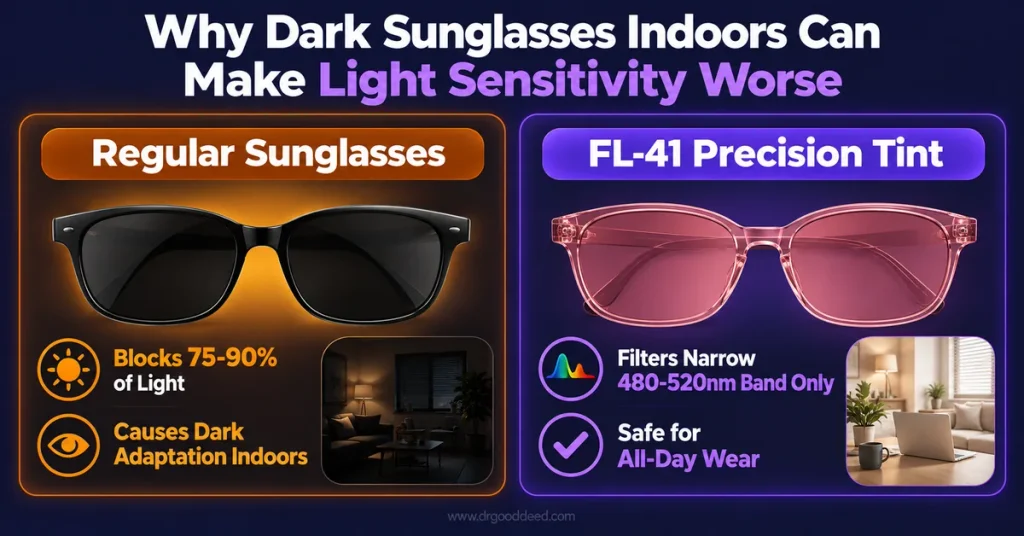
- Standard sunglasses block 75 to 90 percent of all visible light, which is too much for an office, classroom, or car interior.
- Prolonged dark adaptation from indoor sunglasses use has been associated with rebound light sensitivity once the glasses come off.
- Lenses built for the best indoor sunglasses for vestibular migraine photophobia searches are lighter, letting in enough ambient light for normal indoor tasks while filtering the specific wavelengths tied to pain.
- Because they are lighter, these lenses avoid the social and functional downsides of wearing dark glasses at a desk or in a meeting all day.
Why FL-41 is the Best Lens Tint for Vestibular Migraine Photophobia
FL-41 is a rose-colored precision tint.
- Arnold Wilkins, then of the Medical Research Council Applied Psychology Unit at Cambridge, developed the tint with optician Peter Wilkinson in the early 1990s to counter eyestrain and headaches triggered by flickering fluorescent lighting.
- The tint blocks a narrow band of light in the 480 to 520 nanometer range, overlaps with wavelengths shown to activate light-sensitive thalamic pain neurons involved in migraine.
- FL-41 filters roughly 80 percent of light in that specific blue-green band, according to clinical reviews of the tint.
- Unlike generic pink or amber sunglasses, FL-41 is a “precision” tint, meaning it targets a defined wavelength range rather than dimming all colors equally.
- The tint’s rose-brown appearance is a byproduct of which wavelengths it removes, not an arbitrary design decision.
- Because it targets a narrow band, FL-41 does not require the heavy overall darkness that causes dark adaptation problems with regular sunglasses.
What the Research Actually Shows
The most cited FL-41 trial comes from pediatric neurology.
- Researchers at the University of Birmingham found that migraine patients wearing FL-41 tints experienced a reduction in migraine frequency, from 6.2 episodes per month to 1.6 episodes per month, in the original controlled study on children with migraine and photophobia published in the journal Headache.
- A companion paper from Wilkins and Wilkinson in Ophthalmic and Physiological Optics established the tint’s ability to reduce fluorescent flicker perception in the first place.
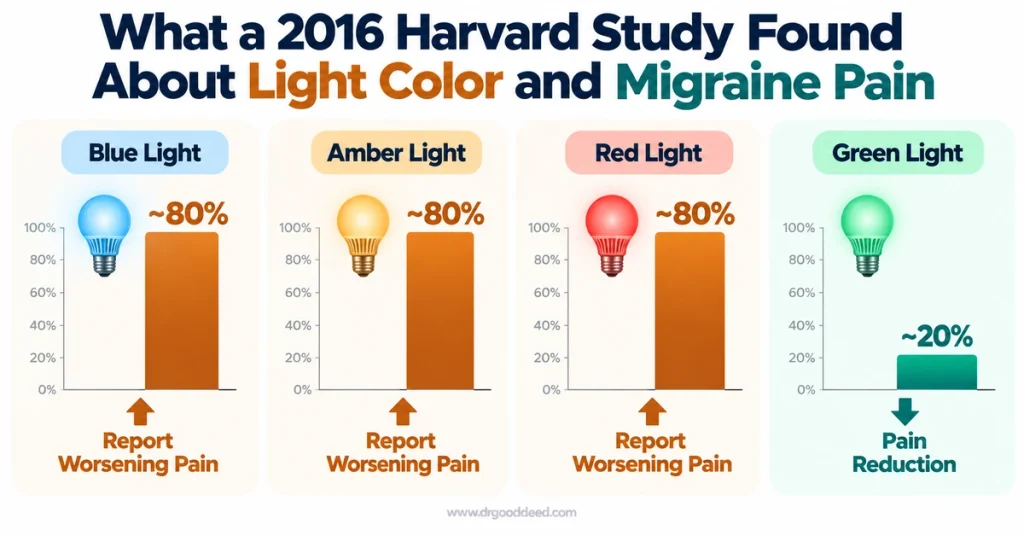
A 2016 Harvard Medical School study published in the journal Brain, led by Rodrigo Noseda and Rami Burstein, tested how migraine patients responded to blue, green, amber, and red light during an actual attack.
- At high intensity, nearly 80 percent of patients reported worsening headache pain in every color except green, and green light reduced pain by about 20 percent.
- This matters because FL-41 was designed to block blue-green wavelengths, not amber or red, so a person whose photophobia is driven more by amber or red light sensitivity may notice less benefit from a standard FL-41 lens than someone whose triggers sit in the blue-green range.
Expert Insight: A patient’s photophobia trigger color is not uniform across the migraine population, so a lens tint that helps one person’s vestibular migraine may underperform for another whose retinal pain pathway responds more strongly to amber or red wavelengths.
Why Green Light Hurts Less Than Blue or Red
- Retinal imaging in the Noseda-Burstein study traced the effect to thalamic neurons that receive input from color-sensitive cone cells, showing these neurons fire most strongly to blue light and least to a narrow green band near 530 nanometers.
- This is a separate mechanism from FL-41’s fluorescent-flicker origins, which targeted blue-green wavelengths for reducing the perceived pulsing of old fluorescent tubes.
- A small number of newer lens brands, including Avulux, use this cone-pathway research to filter blue and amber wavelengths while deliberately transmitting more green light, aiming at the pain pathway rather than the flicker pathway.
No head-to-head trial has yet proven one filtering approach superior to the other for vestibular migraine specifically, so patients with dizziness-predominant symptoms should treat brand claims about “clinically proven for vertigo” with caution.
Buyer’s Guide: What to Look for in Vestibular Migraine Sunglasses
Frame design, tint consistency, and whether you need a prescription all affect whether indoor sunglasses for vestibular migraine photophobia actually reduce your symptoms day to day.
Choosing Wrap-Around Frames to Block Peripheral Light and Glare
Vestibular migraine involves visual motion sensitivity, so light leaking in from the sides can trigger symptoms even with a well-tinted lens. A wraparound or side-shield frame blocks glare from windows, overhead fixtures, and monitors positioned at an angle, which flat, narrow frames cannot do.
Lens Quality, Tint Consistency Rules
Tint strength depends on the manufacturer, the base lens material, and whether the color is baked into the lens or applied as a surface coating.
- A coated tint can wear unevenly and fade faster than a tint integrated into the lens material itself.
- Two pairs labeled “FL-41” can differ noticeably in how much of the 480 to 520 nanometer band they actually filter.
- Requesting a spectral transmission chart from the manufacturer, when available, is the only reliable way to compare lenses beyond marketing copy.
Prescription vs. Non-Prescription Indoor Eyewear Options
Most FL-41 brands offer both off-the-shelf lenses and prescription lens inserts.
- Non-prescription options work for people with normal vision or those who wear contacts.
- Prescription FL-41 lenses cost more and take longer to produce but avoid the discomfort of stacking sunglasses over prescription glasses.
- Some optometrists can apply an FL-41-equivalent tint directly to a patient’s existing prescription lenses in-house.
Alternative Ways to Manage Photophobia and Light Triggers at Work
Lenses are one part of a broader light-management plan.
- Lower screen brightness and enable a warm color temperature setting on phones and computers during flare-ups.
- Replace flickering fluorescent office bulbs with flicker-free LED fixtures where possible.
- Position your workstation so light comes from the side rather than directly overhead or behind a screen, reducing glare-driven strain.
Tracking which environments trigger your photophobia most using migraine tracker apps can help you plan ahead.
| Pro Tip: Test a new FL-41 or precision-tint lens for 15 to 20 minutes under your actual trigger lighting, such as your office’s fluorescent panels or your main monitor, before judging whether it helps; symptom relief from lens tints is often immediate rather than something that builds gradually over days. |
When to See a Doctor or Specialist for Vestibular Vertigo
Sunglasses manage symptoms; they do not diagnose the underlying cause. Sudden or worsening light sensitivity, especially when paired with new or more severe vertigo, warrants a medical evaluation rather than a new pair of glasses.
A neurologist or a specialist familiar with the Bárány Society criteria can confirm whether vestibular migraine, rather than another inner ear or neurological condition, is driving your symptoms.
FAQs
Can I wear FL-41 glasses all day?
Yes. FL-41 tinted lenses are designed for continuous indoor wear because they transmit more overall light than dark sunglasses, avoiding the dark adaptation problem tied to all-day sunglasses use indoors.
Do FL-41 glasses work for regular migraines too, not just vestibular?
Yes. The original controlled trials tested FL-41 on children with common migraine and photophobia, not vestibular migraine specifically, so its evidence base is broader than the vestibular subtype alone.
Are FL-41 glasses covered by insurance?
Rarely as a standalone item. Vision insurance sometimes covers the base prescription lens, but the FL-41 tint upgrade is usually billed as a separate, out-of-pocket cost.
How long until FL-41 glasses start helping?
Many users notice reduced glare and eyestrain within the first 15 to 20 minutes of wearing them under trigger lighting. Reduced migraine frequency, as shown in clinical trials, took weeks to months of consistent use.
Can children with migraine use FL-41 lenses?
Yes. The foundational Birmingham study specifically enrolled children aged 7 to 16, making pediatric use one of the best-documented applications of FL-41 in the research literature.
Sources
- Wilkins AJ, Wilkinson P. A tint to reduce eye-strain from fluorescent lighting? Preliminary observations. Ophthalmic Physiol Opt. 1991 link
- Good PA, Taylor RH, Mortimer MJ. The use of tinted glasses in childhood migraine. Headache. 1991 link
- Noseda R, et al. Migraine photophobia originating in cone-driven retinal pathways. Brain. 2016 link
- Harvard Medical School: Green light and migraine relief link
- Bárány Society and International Headache Society vestibular migraine diagnostic criteria link
- Vestibular migraine: the most frequent entity of episodic vertigo link
- Association of Migraine Disorders: What to Know About Migraine Glasses link
- University of Utah Moran Eye Center: Eyeglasses for Migraine and Other Conditions link
- TheraSpecs: What is FL-41 and How Does It Improve Light Sensitivity? link
- Clinical characteristics of definite vestibular migraine, Bárány Society/IHS criteria link
Medical Disclaimer: This article is for general information only and is not medical advice. It does not replace a diagnosis, treatment plan, or guidance from a qualified healthcare professional. Always talk to your doctor about your own symptoms and before starting, stopping, or changing any treatment. If you think you may be having a medical emergency, call 911 or go to your nearest emergency room.