
Cold therapy is one of the most widely self-administered migraine remedies, used more often than almost any other home treatment for migraine without aura.
Cooling caps may provide temporary migraine relief by applying gentle cold to the forehead, temples, and scalp, which can reduce pain signals and create a soothing numbing effect. When choosing one, look for a comfortable, flexible cap that provides even cooling without excessive pressure and can stay cold for a reasonable period.
Key Takeaways
- Cold therapy likely works through a mix of vasoconstriction and altered nerve signaling, not a single mechanism.
- Most commercial cooling caps for migraine relief use a full-head gel design, which is not the design used in the most frequently cited clinical trial.
- That flagship trial’s headline result did not clearly separate the frozen wrap from its own room-temperature comparison at the key 30-minute mark.
- The best supporting evidence for cold therapy comes from combining it with relaxation techniques.
- Cooling caps do not treat the underlying cause of migraine, but they can be a useful addition to your usual migraine management plan.
How Cold Therapy Is Thought to Help With Migraines
Cold applied to the head or neck is believed to ease migraine pain through vasoconstriction, the narrowing of blood vessels that counteracts the vessel dilation associated with migraine attacks.
- Cold also activates TRPM8, a temperature-sensing ion channel on sensory nerves that plays a documented role in modulating pain signaling, including in migraine models.
- A temporary slowing of nerve conduction velocity in the treated area, which may blunt how intensely pain signals register.
None of these mechanisms are fully confirmed as the explanation, and researchers still describe cold therapy’s mechanism as incompletely understood.
The Research Gap: Most Cooling Caps Don’t Match What Was Actually Studied
The most frequently cited migraine cold-therapy trial, a 2013 randomized crossover study from the University of Hawai’i, did not test a full-head gel cap at all.
- It tested an adjustable neck wrap holding two freezable ice packs, positioned specifically over the carotid arteries at the front of the neck.
- The researchers chose that location deliberately, reasoning that large blood vessels sit closer to the skin surface at the neck than under the thicker skull.
- Yet most cooling caps sold today are 360-degree gel helmets that cover the scalp, forehead, and temples, a completely different design from the one in the primary evidence base.
What the Clinical Evidence Actually Shows
In that 2013 trial, 55 participants used the frozen neck wrap during one migraine attack and a room-temperature version during another, serving as their own control.
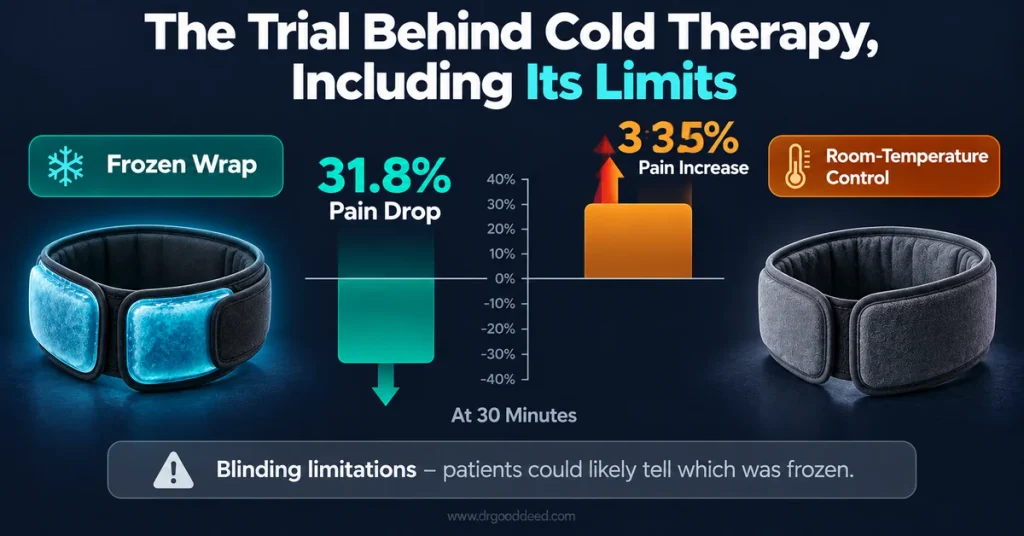
- At the 30-minute mark, the treatment arm showed a 31.8% drop in pain, while the control arm showed a 31.5% increase in pain.
- A difference the researchers reported as statistically significant (P<.001).
- The catch is blinding.
- The study authors themselves acknowledged that participants could very likely tell which wrap was frozen, since the sensation of ice against skin is unmistakable, so a genuine placebo effect could not be ruled out.
A separate 2006 pilot study tested a full-head frozen gel cap on 28 migraine patients but used no control group at all. More recently, a 2025 randomized trial found that adding cold application to progressive muscle relaxation produced a modestly greater reduction in monthly migraine attack frequency than relaxation alone (P=.021), though it made no significant difference to pain intensity between the two groups.
Full-Head Wraps vs Targeted Neck Cooling
The two dominant cooling cap designs are not interchangeable, and they are not equally studied.
| Design | Research backing | Commercial availability |
| Neck wrap (carotid-targeted) | Randomized crossover trial, n=55, statistically significant result with blinding limitations | Less common, sold mostly as therapy wraps |
| Full-head gel cap (360-degree) | Small uncontrolled pilot study only | Dominates the migraine cold-therapy market |
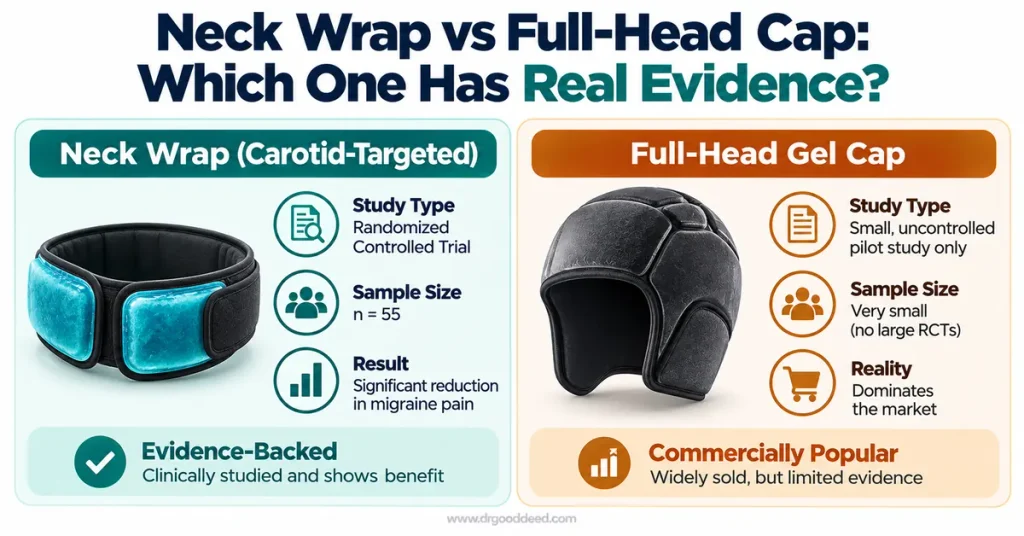
Neck-targeted cooling has the more direct clinical trial behind it, even with its flaws, while full-head wraps are the products most people actually buy.
What to Look for When Buying a Cooling Cap
Since the evidence doesn’t clearly favor one commercial design, practical fit and usability matter as much as marketing claims when choosing between products.
Cold Retention Time
Gel-based caps typically stay usably cold for 15 to 30 minutes before warming to room temperature, while thicker double-layer gel packs can extend that to 45 minutes.
Check the manufacturer’s stated retention time, since migraine attacks often outlast a single freeze cycle, and having a spare cap in the freezer avoids a gap in treatment mid-attack.
Fit and Comfort for Extended Wear
A cap that presses too tightly across the temples can itself trigger tension-type discomfort, which defeats the purpose during a migraine attack.
Look for adjustable straps, a lightweight gel formulation, and a design that doesn’t require lying flat, since many people with migraine need to keep moving or sitting upright.
Hot and Cold Dual-Use Options
Some caps and wraps can be heated instead of frozen, which matters because a subset of people with migraine respond better to heat, particularly for neck and shoulder muscle tension that often accompanies an attack. A dual-use product lets you test both without buying two separate items.
Pro Tip: Store your cooling cap in a resealable bag inside the freezer rather than loose. Ice crystals that form directly on an exposed gel cap can make it stiffer and less comfortable to mold against the head or neck when you actually need it.
Cold Therapy Works Best as Part of a Bigger Approach, Not Alone
The 2025 trial on progressive muscle relaxation found a real, measurable frequency benefit when cold application was added to relaxation training, but relaxation alone still produced significant improvements in pain, disability, and quality of life on its own. That pattern, cold therapy adding value on top of another technique rather than replacing it, lines up with how most headache specialists currently frame non-drug migraine tools. Pairing a cooling cap for migraine relief with recognizing your own early warning signs of a migraine attack gives you more than one tool to work with, rather than relying on a single product to do all the work.
When to See a Doctor
Cold therapy is not appropriate as a substitute for medical evaluation when a headache pattern changes. Certain symptoms during what feels like a migraine attack warrant emergency care, including a sudden “thunderclap” headache, new weakness on one side of the body, trouble speaking, vision loss, or a headache following a head injury.
A routine doctor’s visit is also worth scheduling if attacks are becoming more frequent, harder to manage, or are new after age 50, since these patterns can sometimes signal something other than migraine.
FAQs
How long should you use a cooling cap during a migraine?
Most trial protocols applied cold for 25 to 30 minutes per session. Longer exposure hasn’t shown added benefit in available research and raises the risk of skin irritation or cold-induced discomfort, so stopping at the 30-minute mark is reasonable.
Can cooling caps replace medication?
No. No clinical trial has tested cooling caps as a replacement for abortive or preventive migraine medication. Available evidence positions cold therapy as an add-on to relaxation techniques or standard treatment, not a substitute for prescribed care.
Is heat or cold better for migraines?
Neither is universally better. Cold is more studied for pain reduction during an attack, while heat is often preferred for neck or shoulder muscle tension that accompanies migraine. Personal response varies, so testing both is reasonable.
Can you use a regular ice pack instead of a cooling cap?
Yes. A cloth-wrapped ice pack applied to the neck or forehead uses the same cold-therapy principle as commercial caps. Purpose-built caps mainly add convenience, shape, and longer cold retention, not a different mechanism of action.
Are cooling caps safe to use every day?
Generally yes, when used for short sessions with a barrier between ice and skin. Daily use hasn’t been directly studied for migraine, so anyone using cold therapy very frequently should mention it to their doctor to rule out overuse patterns.
Sources
- Randomized controlled trial: targeted neck cooling in the treatment of the migraine patient. Hawaii J Med Public Health. 2013. link
- Cold therapy in migraine patients: open-label, non-controlled pilot study. Evid Based Complement Alternat Med. 2006. link
- Cold intervention for relieving migraine symptoms: a systematic review and meta-analysis. J Clin Nurs. 2023. link
- Effectiveness of cold application combined with progressive muscle relaxation in migraine without aura: a randomized controlled trial. Medicine. 2025. link
- TRPM8 channels, cold and headache: data of experimental and clinical studies. link
- Migraine in the Emergency Department: When to Go to the ED for Migraine. American Migraine Foundation. link
Medical Disclaimer: This article is for general information only and is not medical advice. It does not replace a diagnosis, treatment plan, or guidance from a qualified healthcare professional. Always talk to your doctor about your own symptoms and before starting, stopping, or changing any treatment. If you think you may be having a medical emergency, call 911 or go to your nearest emergency room.