


Pulsatile tinnitus is the sensation of hearing a heartbeat-like sound in your ear. It may be harmless, but because it can sometimes signal a blood vessel problem, medical evaluation is important. The sound may be more noticeable in quiet surroundings or when resting, especially if it persists, affects one ear, or occurs alongside other symptoms.
Key Takeaways
- Pulsatile tinnitus is hearing a heartbeat-like sound in your ear. It may be harmless, but medical evaluation is important because vascular problems can sometimes cause it.
- Pulsatile tinnitus sounds like a rhythmic whooshing, thumping, or pulsing that matches your heartbeat
- It can affect one or both ears and may be easier to notice in a quiet room or when lying down.
- Pulsatile tinnitus may result from blood vessel changes, increased pressure around the brain, ear conditions, anemia, thyroid disorders, or high blood pressure. About two-thirds of cases have an identifiable cause, while roughly one-third remain unexplained.
- New headaches with vision changes, double vision, or pain behind the eye need prompt medical attention.
| Type | What it involves | Examples |
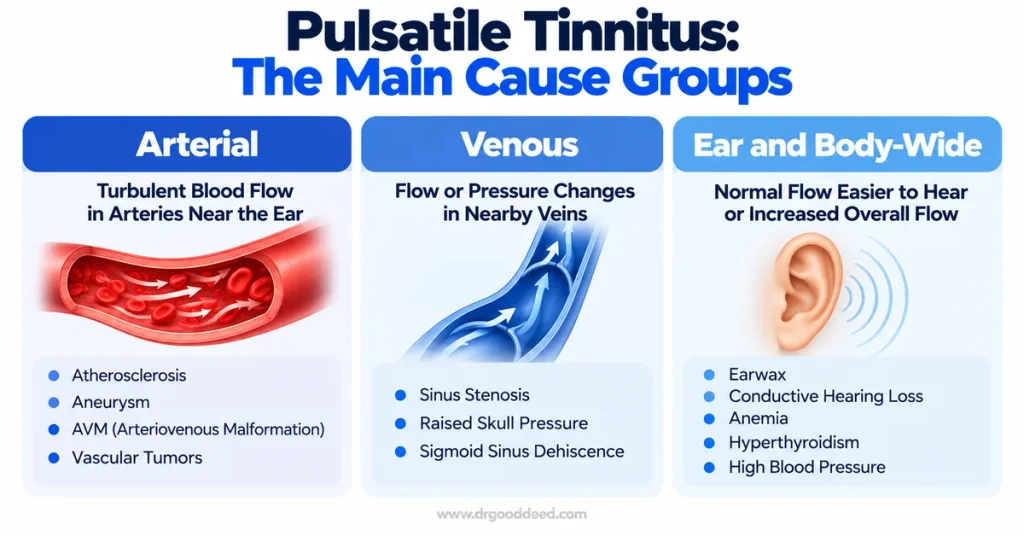
| Arterial | Changes or turbulence in blood flow through arteries near the ear | Atherosclerosis, aneurysm, arteriovenous malformation, vascular tumors |
| Venous | Changes in blood flow or pressure within nearby veins and venous sinuses | Sinus stenosis, raised skull pressure, sigmoid sinus dehiscence or diverticulum |
| Ear and body-wide | Normal blood flow becomes easier to hear or overall blood flow increases | Earwax, conductive hearing loss, anemia, hyperthyroidism, high blood pressure |
| Sigmoid sinus dehiscence or diverticulum | Structural changes in the venous sinus that may contribute to pulsatile tinnitus. | Reported in 25% to 35% of cases. |
Why Can You Hear Your Heartbeat in Your Ear?
Why can you hear your heartbeat in your ear? Pulsatile tinnitus is a sound that follows the rhythm of your heartbeat. People often describe it as a whooshing, rushing, pulsing, or thumping noise.
- This is different from typical tinnitus, which may sound like ringing, buzzing, or hissing without following the heartbeat. With pulsatile tinnitus, the timing of the sound is closely linked to your pulse.
- The sound is generally due to blood flowing through vessels near the ear.
- In certain instances, a healthcare professional is able to detect it using a stethoscope, even though most individuals who have pulsatile tinnitus hear it themselves.
Pulsatile tinnitus in one ear is a common pattern, although the sound can occur in both ears. It may become more noticeable at night, in a quiet environment, or when you are lying down because there is less background noise to distract from it.
Especially following exercise when your heart rate is elevated, and this does not necessarily warrant concern. Nevertheless, if the sound persists or keeps returning, it should be assessed since it may in some cases be associated with an underlying ear, blood vessel, or pressure-related condition.
Is Pulsatile Tinnitus Dangerous?
Many cases are not caused by a dangerous condition, but persistent pulsatile tinnitus can sometimes be associated with blood vessel or pressure-related problems.
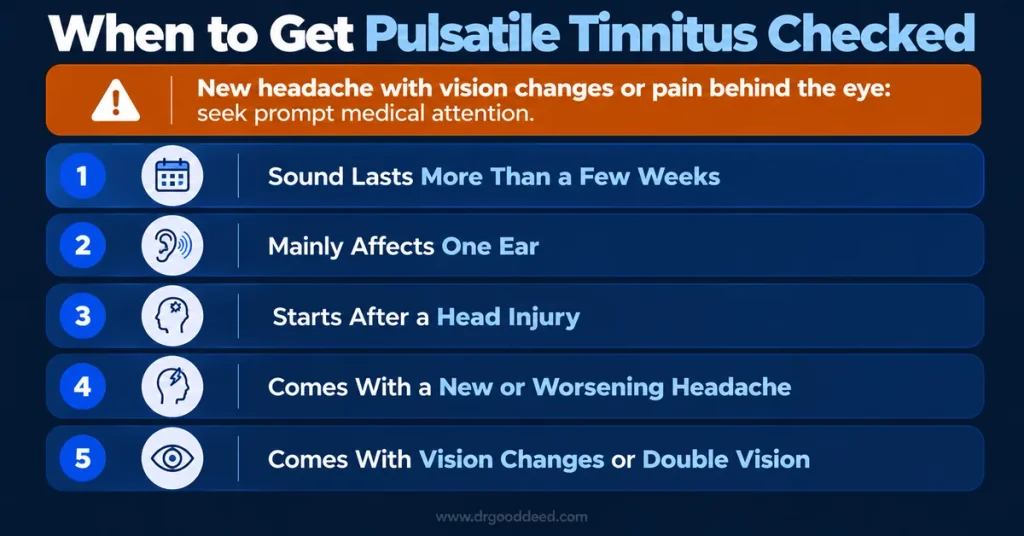
It is a good idea to see a healthcare professional if the sound lasts more than a few weeks or:
- Mainly affects one ear.
- Starts after a head injury.
- Occurs with a new or worsening headache.
- Happens along with changes in vision or double vision.
New headaches accompanied by vision changes, double vision, or pain behind the eye can occur with raised pressure around the brain and should be assessed promptly. If you develop signs of a stroke or sudden vision loss, seek emergency medical care immediately.
In the US, depending on the severity of your symptoms, this may mean going to urgent care or an emergency department. In the UK, you may need to contact your GP or attend A&E if symptoms are sudden or severe.
| One important point: do not press firmly on your neck to see whether the sound changes. Doctors may use specific examination techniques when trying to understand whether a sound has an arterial or venous origin, but forceful neck pressure should not be attempted at home. |
What Causes Pulsatile Tinnitus?
Pulsatile tinnitus causes can be broadly grouped into arterial, venous, ear-related, and body-wide conditions. There is no single cause that can reliably be called the most common because different sources report different patterns.
About two-thirds of people have an identifiable cause (one review estimates up to 70%), and about a third have none found. This is why evaluation usually looks at the person’s symptoms, medical history, ear findings, hearing, and possible vascular or pressure-related factors.
Arterial Causes:
Arterial causes involve changes in blood flow through arteries located near the ear.
- Atherosclerosis occurs when fatty deposits accumulate inside the arteries, narrowing them and altering blood flow. Other potential vascular causes include aneurysms and arteriovenous malformations (abnormal connections between arteries and veins).
- Other possible causes include aneurysms, arteriovenous malformations (AVMs), and vascular tumors such as paragangliomas.
- Another possible cause is a dural arteriovenous fistula, an abnormal connection between arteries and veins that can alter normal blood flow. Factors such as high cholesterol and high blood pressure may also affect vascular health. Hearing a pulse-synchronous sound does not necessarily mean you have an aneurysm, an arteriovenous malformation (AVM), or another serious vascular condition. These conditions require appropriate clinical assessment and, when necessary, imaging tests.
Venous Causes:
Venous sinus stenosis, a narrowing in one of the large veins that drain the brain, can make blood flow turbulent. Pulsatile tinnitus can also occur with idiopathic intracranial hypertension (IIH), a condition involving increased pressure around the brain.
Idiopathic intracranial hypertension (IIH) can cause headaches when lying down, visual disturbances, double vision, or pain behind the eyes.
- Factors associated with it include pregnancy, rapid weight gain, anemia, and exposure to certain medicines, including tetracyclines and vitamin A derivatives.
- Another possible cause is sigmoid sinus dehiscence or diverticulum, which involves structural changes in a venous sinus near the ear. Studies report sigmoid sinus dehiscence or diverticulum in about 25% to 35% of cases, more often in women.
- UCSF Radiology names venous sinus stenosis or IIH, Harvard Health lists conductive hearing loss and carotid plaque, and StatPearls names carotid atherosclerosis. It is therefore more accurate to describe the possible causes rather than label one condition as the leading cause for everyone.
Ear and Body-Wide Causes:
Sometimes the problem is not that blood flow has become abnormal, but that the sound has become easier for you to hear.
- Earwax and conductive hearing loss, for example, can reduce outside sounds that normally mask internal sounds. This can make the sound of blood moving through nearby vessels more noticeable.
- Certain conditions that affect the whole body can also increase blood flow or change circulation. These include anemia, hyperthyroidism, high blood pressure, and Paget’s disease.
- Anemia, an overactive thyroid, and high blood pressure can affect blood flow and make pulsatile tinnitus more noticeable; thyroid-related symptoms may also include dizziness and balance problems.
How Is Pulsatile Tinnitus Diagnosed?
- Pulsatile tinnitus is evaluated using your symptoms and medical history along with an ear examination, hearing test, and, when needed, imaging.
- Your healthcare professional may ask when the sound started, whether it matches your heartbeat, whether it affects one or both ears, and whether anything makes it better or worse. They may also ask about headaches, vision changes, previous head injuries, medications, and other health conditions.
- A clinician checks the ears for earwax, middle-ear problems, or anything visible behind the eardrum.
- A hearing test checks for hearing loss, especially conductive hearing loss
- A clinician may also listen around the head and neck with a stethoscope and perform a neurological examination when appropriate.
- Imaging is chosen according to what the examination suggests.
- According to the American College of Radiology Appropriateness Criteria (2023), when no lesion is suspected behind the eardrum.CT of the temporal bone without contrast may also be appropriate in selected cases.
- When a lesion behind the eardrum is suspected, CT of the temporal bone without contrast is usually appropriate.
The right imaging test depends on the individual patient and the suspected cause. There is no single scan that is appropriate for everyone with pulsatile tinnitus.
How Is Pulsatile Tinnitus Treated?
Pulsatile tinnitus treatment depends on what is causing the sound. Treating the underlying condition may reduce or resolve the symptom in some people.
For example:
- High blood pressure: Managing blood pressure may help when hypertension contributes to the symptoms.
- Anemia: Treating the underlying cause of anemia may improve the abnormal blood-flow sensation.
- Hyperthyroidism: Treatment focuses on controlling excessive thyroid activity.
- Raised skull pressure: Treatment is directed at the underlying pressure-related condition.
- Sigmoid sinus abnormalities: Selected patients may be considered for procedures such as sigmoid sinus wall reconstruction.
- Certain venous abnormalities: Endovascular procedures, including stenting or coiling, may be considered in carefully selected patients.
Procedures for vascular and venous causes have shown benefits in selected patients, but much of the available evidence comes from small case series and retrospective studies. They should therefore not be presented as proven treatments for every person with pulsatile tinnitus.
If it is not possible to identify a specific cause that can be dealt with, then the treatment can aim at helping you come to terms with the sound and at reducing its impact on your everyday life. Therapies such as cognitive behavioral therapy, acceptance and commitment therapy, and stress-management techniques may be of some help regarding the distress caused by tinnitus.
These approaches can make the symptom easier to manage, but they do not necessarily remove the underlying sound.
Some medicines can cause tinnitus in general. If you think a medicine may be contributing to your symptoms, speak with your prescribing healthcare professional. Do not stop or change a prescribed medicine on your own.
Frequently Asked Questions
Should you see an ENT, a neurologist or a cardiologist for pulsatile tinnitus?
A GP can evaluate problems relating to the ears and hearing. In cases where headaches, visual symptoms, or increased pressure around the brain are suspected, a neurologist should be involved. If the tests indicate a vascular issue, then a vascular specialist or neurointerventional radiologist will need to be brought in. A cardiologist should be consulted when a cardiovascular cause is suspected.
Can stress or anxiety cause pulsatile tinnitus?
Stress and anxiety can make tinnitus more noticeable and harder to ignore. However, they should not automatically be considered the cause of a sound that consistently follows your heartbeat. Persistent pulsatile tinnitus still needs appropriate medical evaluation.
Is it normal to hear your heartbeat in your ear after exercise?
Pulsatile tinnitus is normal to become more aware of your heartbeat following exercise since your heart rate and blood flow rise; the feeling should then become less obvious as your heart rate returns to normal. However, if you can still hear a pulsing sound when at rest, especially in one ear, you should tell a healthcare professional about it.
Can pulsatile tinnitus go away on its own?
Persistent or recurrent pulsatile tinnitus should not simply be ignored. An evaluation can help determine whether an underlying ear, vascular, pressure-related, or body-wide condition is present.
Medical Disclaimer: This article is for informational and educational purposes only and does not replace professional medical advice, diagnosis, or treatment. Always consult a qualified healthcare professional about your symptoms or health concerns. Never delay or disregard professional medical advice based on information provided in this article.
Sources:
1. National Institute on Deafness and Other Communication Disorders (NIDCD). Tinnitus. link
2. Penn Medicine. Pulsatile Tinnitus. link
3. UCSF Radiology. Pulsatile Tinnitus. link
4. PubMed: Research article on pulsatile tinnitus. link
5. American Stroke Association. Stroke Symptoms. link
6. American College of Radiology (ACR). (2023). ACR Appropriateness Criteria®: Tinnitus. link
7. Harvard Health Publishing. Tinnitus: Ringing in the ears and what to do about it. link
8. StatPearls Publishing. Pulsatile Tinnitus. link
9. Cleveland Clinic. Pulsatile Tinnitus. link
Medical Disclaimer: This article is for general information only and is not medical advice. It does not replace a diagnosis, treatment plan, or guidance from a qualified healthcare professional. Always talk to your doctor about your own symptoms and before starting, stopping, or changing any treatment. If you think you may be having a medical emergency, call 911 or go to your nearest emergency room.