


Can a UTI cause confusion in the elderly? Yes, and UTI confusion in the elderly usually appears suddenly as delirium, though infection is only one possible cause. This change may appear as difficulty following conversations, unusual behavior, sleepiness, or trouble recognizing familiar people. However, a UTI is only one possible cause, and sudden confusion always deserves prompt medical attention.
Key Takeaways
- UTI confusion in the elderly is real, but sudden confusion has many causes and needs prompt medical review.
- Delirium causes a sudden change in attention, awareness, or thinking, sometimes alongside urinary symptoms.
- Delirium usually develops over hours or days, while dementia generally causes gradual changes over months or years.
- A positive urine test alone does not prove that a UTI caused the confusion.
- Call 911 or go to the ER for stroke signs or severe illness. Arrange same-day medical assessment for any new, unexplained confusion.
Can a UTI Cause Confusion in the Elderly?
Yes, a urinary tract infection can trigger delirium, and UTI confusion in the elderly often develops over hours or days.
Delirium is a serious change in mental abilities that affects how you think, pay attention, understand your surroundings, or respond to people. It may appear suddenly and can fluctuate throughout the day.
An older adult who spoke clearly in the morning may become disoriented by evening. They might struggle to follow instructions, seem unusually restless, or become quiet and withdrawn.
A UTI affects the urinary system, including the bladder and sometimes the kidneys. In some older adults, an infection can trigger a widespread inflammatory response that affects brain function.
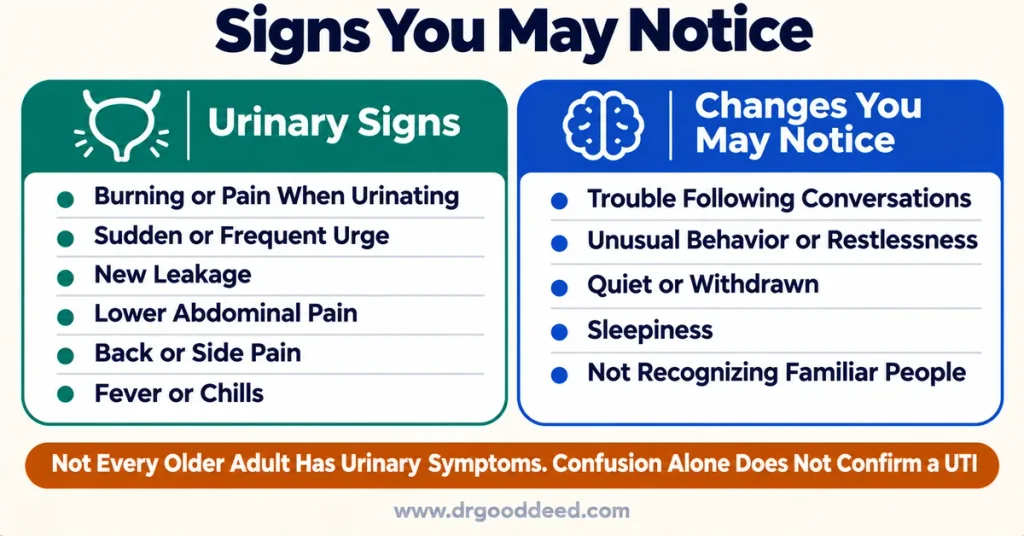
Signs you may notice
Confusion may appear with other symptoms of a UTI, such as:
- Burning or pain during urination
- A sudden or frequent urge to urinate
- Passing small amounts of urine more often than usual
- New urinary leakage
- Pain or pressure in the lower abdomen
- Back or side pain
- Fever or chills
- A noticeable change in usual behavior or alertness
Not every older adult develops typical urinary symptoms. Some people may also struggle to describe what they feel, especially if they already have memory or communication problems.
However, confusion by itself does not confirm a UTI. Other conditions can cause the same change, so a clinician needs to assess the full picture.
If you notice burning or urgency along with confusion, the combination may help the care team identify a possible urinary infection. You can also read about yeast infection vs. UTI to understand other possible causes of urinary discomfort.
Why a UTI Can Trigger Delirium in Older Adults
A UTI can trigger delirium because the body’s response to infection may affect how the brain functions. Older adults often have less reserve to cope with illness, making them more vulnerable to sudden changes in attention and awareness.
Researchers are still studying exactly how infections affect the brain. Inflammation appears to play a role, but experts do not fully understand every step involved.
How infection may affect the brain
When your body detects an infection, your immune system releases inflammatory signals to help fight it. These signals can affect the brain’s normal activity.
Researchers are investigating whether inflammation, changes in the blood-brain barrier, and the body’s stress response contribute to delirium.
Interleukin-6 is one inflammatory signal studied in this process. However, findings from animal research do not prove that the same mechanism explains delirium in every person.
The connection between infection and delirium is complex. A UTI may be a trigger, but a person’s overall health, medications, hydration, and existing brain conditions can also influence their risk.
Who may be more vulnerable?
Older adults may have a higher risk of delirium when they have:
- Dementia or another cognitive condition
- Parkinson’s disease
- A previous episode of delirium
- Multiple medical conditions
- Recent surgery or hospitalization
- Reduced mobility or frailty
- Hearing or vision difficulties
A person living with dementia may already have difficulty communicating urinary symptoms. An infection or another illness can then cause a sudden decline from their usual mental state.
Research also reports an association between UTIs and delirium. Kim and colleagues, in a 2026 review, reported UTI rates of 25.9% to 32% among patients with delirium, compared with 13% among those without delirium. These observational findings show an association, not proof that a UTI causes delirium.
UTI Delirium vs. Dementia: Key Differences
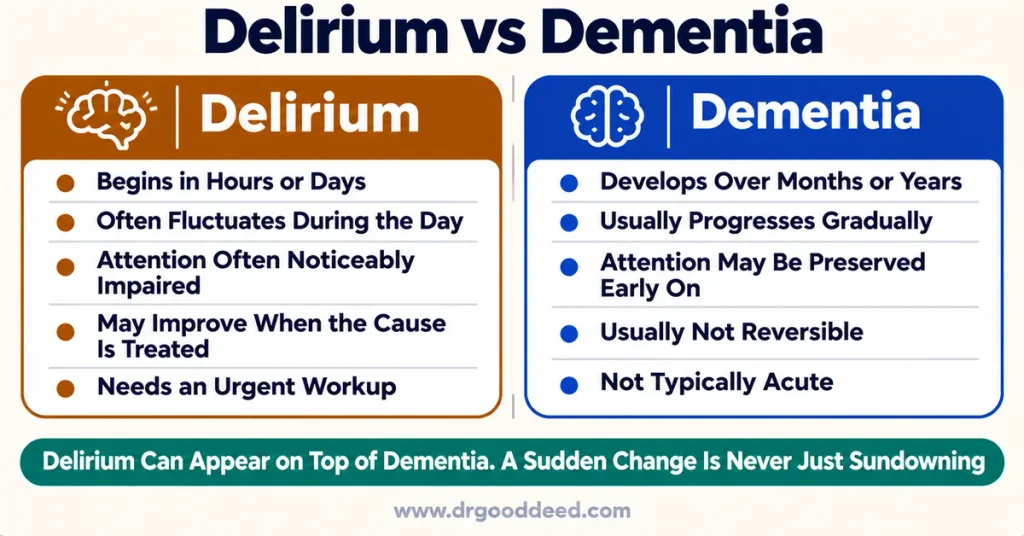
UTI delirium and dementia can both affect memory, thinking, and behavior, but they usually develop differently.
Delirium begins suddenly and often fluctuates. Dementia usually develops gradually and causes ongoing changes in memory and other thinking abilities. Slow changes over months can point to one of the main types of dementia.
Table: How delirium and dementia differ
| Feature | Delirium | Dementia |
| Onset | Hours or days | Months or years |
| Symptoms | Often fluctuate during the day | Usually progress gradually |
| Attention | Often noticeably impaired | May remain relatively preserved early on |
| Awareness | May change throughout the day | Usually stable in early stages |
| Sleep | Sleep-wake patterns may change suddenly | Sleep changes may develop over time |
| Main causes | Infection, medication effects, dehydration, or other acute illness | Conditions that cause ongoing brain changes |
| Recovery | May improve when the cause is treated, but recovery varies | Usually progressive, depending on the cause |
| Reversibility | Often reversible | Usually irreversible |
| Thinking and speech | Disorganized, rambling | Word-finding difficulty, repetition |
| Hallucinations | Common (especially visual) | Uncommon early, except in Lewy body dementia |
| Psychomotor changes | Hyperactive or hypoactive | Usually normal early |
| Medical emergency | Yes, needs urgent workup | Not typically acute |
Can a UTI seem like dementia?
Yes, delirium caused by an illness can resemble dementia because it affects memory, communication, and behavior.
For example, an older adult may suddenly forget familiar names, become disoriented at home, or struggle with everyday tasks. These changes can look like a rapid worsening of dementia.
However, delirium is not the same as dementia. A person may develop delirium even if they have never had memory problems before.
If someone already has dementia, delirium can cause a sudden decline on top of their usual symptoms. Some people recover fully, while others may take longer or not return completely to their previous level of functioning.
Doctors generally avoid assessing a person’s long-term cognitive abilities during active delirium because the sudden illness can distort the results.
What should you tell the doctor?
Share details that help the care team understand the person’s usual mental state and the timing of the change.
Tell them:
- What the person was normally able to do before the confusion began
- When you first noticed the change
- Whether the symptoms come and go
- Any new urinary symptoms, fever, or pain
- Recent medication changes or missed doses
- Changes in eating, drinking, sleep, or mobility
- Any recent fall, illness, or hospital visit
Doctor’s Tip: Explain what is different from the person’s usual behavior rather than simply saying they are confused. Specific examples help clinicians recognize delirium and investigate its cause.
If confusion appears mainly in the evening in someone with dementia, sundowning in dementia may also be relevant. However, a sudden or unusual change should not automatically be attributed to sundowning.
Other Causes of Sudden Confusion in the Elderly
A UTI is one possible cause of sudden confusion in older adults, but several other conditions can trigger delirium.
A clinician should look for the cause rather than assuming that a change in mental status is due to a urinary infection.
Other possible causes include:
- Other infections: Pneumonia, influenza, COVID-19, and other infections can trigger delirium.
- Medication effects: A new medicine, a dose change, interactions, or withdrawal from certain medicines may affect alertness and thinking.
- Dehydration: Not getting enough fluids can affect circulation and the body’s normal functions.
- Electrolyte changes: Abnormal sodium levels and other chemical imbalances can affect brain function.
- Low blood sugar: A significant drop in blood glucose can cause confusion or altered awareness.
- Stroke: A sudden change in thinking, speech, movement, or vision may signal a stroke.
- Recent surgery or hospitalization: Pain, disrupted sleep, illness, and changes in surroundings can contribute to delirium.
- Other acute medical problems: Heart, lung, kidney, or other serious conditions may affect the brain.
Some causes can occur together. For example, an older adult may have an infection while also experiencing dehydration or medication-related effects.
Doctors may also investigate reversible cognitive decline when evaluating ongoing memory or thinking problems.
The important point is that sudden confusion is a symptom, not a diagnosis. Finding the underlying cause is essential for appropriate treatment.
Does a Positive Urine Test Prove a UTI?
No. A positive urine test alone does not prove that a UTI is present.
Some older adults have bacteria in their urine without having a urinary infection that needs treatment. This condition is called asymptomatic bacteriuria, which means bacteria are present in the urine without symptoms of a UTI.
It becomes especially important to distinguish this condition from an active infection when an older adult develops confusion.
Why urine testing can be difficult to interpret
A clinician may use a urinalysis to look for signs of inflammation or bacteria and a urine culture to identify bacteria growing in the sample.
However, a positive result can occur even when the urinary system is not causing the person’s symptoms.
The American Academy of Family Physicians reported in 2020 that asymptomatic bacteriuria occurs in approximately 25% to 50% of women and 15% to 50% of men living in long-term care facilities.
The CDC also explains that most people with asymptomatic bacteriuria do not need treatment.
This is why a urine result must be considered alongside symptoms, examination findings, and other possible causes of confusion.
What do experts recommend?
There is an important debate about testing older adults who develop delirium without typical urinary symptoms.
The guideline-based approach summarized by the American Academy of Family Physicians in 2020 recommends looking for other causes when delirium occurs without urinary symptoms or signs of a systemic infection. It also advises against treating asymptomatic bacteriuria in older adults who do not have specific indications for treatment.
The concern is that unnecessary testing may identify bacteria that are unrelated to the confusion and lead to unnecessary treatment.
However, a 2026 review by Kim and colleagues raises a different concern. The authors argue that existing recommendations rely heavily on research involving asymptomatic bacteriuria, rather than people whose delirium may be the main sign of a UTI.
They suggest that relying only on typical urinary symptoms may delay recognition of infection in people who cannot communicate their symptoms clearly.
These views highlight an area of ongoing discussion. They do not establish that confusion alone proves a UTI, nor do they mean that a possible infection should be ignored. No change to the guideline advice has been made; the 2026 review is an argument for changing it.
What about older adults in nursing homes?
People living in long-term care facilities may have bacteria in their urine even when they feel well.
If a resident suddenly becomes confused:
- Tell the nursing staff or care team immediately.
- Describe the person’s usual mental state and what has changed.
- Report any fever, urinary symptoms, pain, reduced intake, or other new signs.
- Ask how the team will assess delirium and investigate possible causes.
A urine test may be appropriate when the clinical picture supports it. The decision should come from the clinician’s assessment rather than confusion alone.
How Long UTI Confusion Lasts and What Helps
UTI delirium recovery varies from person to person. Confusion may improve as the underlying illness is treated, but some people recover more slowly or continue to have changes in their mental abilities.
There is no single recovery timeline that applies to everyone. Mayo Clinic (2026) notes that delirium may last hours, days, weeks, or months.
What affects recovery?
Recovery may depend on:
- The cause and severity of the illness
- How quickly clinicians identify and treat the underlying problem
- The person’s age and overall health
- Whether dementia or another brain condition is present
- Whether dehydration, medication effects, or other problems occur alongside the infection
- Whether complications such as sepsis develop
When a clinician confirms a UTI, they decide whether antibiotics are needed and select treatment based on the person’s clinical situation.
However, treating a suspected infection does not guarantee that confusion will disappear immediately. Delirium can continue even after the original trigger begins to improve.
How you can support recovery
A calm, familiar environment may help an older adult feel safer and more oriented while the care team treats the underlying cause.
You can help by:
- Staying nearby when possible and speaking in a calm, reassuring voice.
- Reminding the person of the time, place, and people around them.
- Keeping familiar objects, photographs, or personal belongings nearby.
- Supporting a regular sleep schedule and reducing unnecessary nighttime noise.
- Making sure they have their glasses and hearing aids if they use them.
- Offering fluids when appropriate and following any medical fluid restrictions.
- Encouraging safe movement with help from caregivers or healthcare staff.
- Reporting changes in alertness, behavior, or physical symptoms.
Avoid arguing with the person if they are confused. Reassurance and simple explanations are usually more helpful than repeatedly correcting them.
Can UTI delirium be permanent?
Delirium is often temporary, but some older adults do not return fully to their previous mental state.
Recovery may be incomplete, especially in people who already have dementia, frailty, or other significant health conditions.
If confusion continues after the infection or other suspected cause has been addressed, the person needs further medical assessment. Persistent symptoms should not automatically be blamed on the UTI.
When to See a Doctor About UTI Confusion
Any sudden, unexplained confusion in an older adult needs prompt medical attention, even if the person does not have a fever or urinary symptoms.
Do not wait for the confusion to become severe before seeking help.
Table: What you notice, what it may mean, and what to do
| What you notice | What it may mean | What to do |
| Sudden confusion, unusual behavior, or difficulty following conversations | Delirium or another acute medical problem | Arrange same-day medical assessment |
| Confusion with burning, urgency, fever, or new urinary symptoms | Possible UTI or another infection | Contact a clinician promptly or visit urgent care for assessment |
| Confusion with fever, rapid breathing, a fast heart rate, clammy skin, or severe weakness | Possible sepsis or serious illness | Seek emergency care immediately; call 911 if the person appears seriously ill |
| Sudden confusion with facial drooping, arm weakness, trouble speaking, or sudden vision or balance problems | Possible stroke | Call 911 immediately |
| Unresponsiveness, difficulty breathing, or a sudden collapse | Medical emergency | Call 911 immediately |
Sudden confusion can be a sign of sepsis, a life-threatening response to infection. The CDC lists confusion or disorientation among possible sepsis symptoms.
A UTI can sometimes lead to sepsis, particularly when an infection spreads, or the body develops a severe response.
Stroke can also cause sudden confusion. If you notice stroke symptoms in women or any other possible stroke signs, call 911 rather than waiting for a routine appointment.
If the person is already in a hospital or long-term care facility, notify the nurse or medical team immediately.
If you are unsure, treat UTI confusion in the elderly as urgent and call a clinician the same day.
Frequently Asked Questions
Do the Elderly Usually Pass Away From a UTI?
Most UTIs do not lead to death, but a serious or untreated infection can spread and cause sepsis, a life-threatening emergency. Older adults with severe illness or other health conditions may face greater risks. Seek prompt medical care if an older person develops sudden confusion, fever, severe weakness, or other concerning symptoms.
At What Age Does a UTI Cause Confusion?
There is no specific age when a UTI begins to cause confusion. Delirium becomes more common as people age, especially when they have dementia, Parkinson’s disease, frailty, or other medical conditions. A sudden change in thinking at any age needs medical assessment.
Can a UTI Cause Confusion in Younger Adults?
Yes, UTI delirium can happen in younger adults, but it is more common in older people. Confusion during an illness can also have other causes, including dehydration, medication effects, or a more serious infection. Seek medical advice for sudden or unexplained changes in mental status.
Can a UTI Cause Hallucinations?
Yes, delirium can cause hallucinations, which means seeing, hearing, or sensing things that are not present. A person may also become frightened, restless, or unusually suspicious. Infection is one possible trigger, but medications and other medical conditions can also cause hallucinations. Sudden symptoms need prompt assessment.
How Can Repeat UTIs and Delirium Be Prevented?
You can help reduce risk by supporting regular hydration when medically appropriate, maintaining personal hygiene, and seeking care when new urinary symptoms appear. Tell the clinician if UTIs keep returning or if confusion develops during an illness. A healthcare professional can review possible causes and recommend an appropriate prevention plan.
Sources
Mayo Clinic, Delirium: Symptoms and Causes (2026). link
MedlinePlus, Delirium. link
American Family Physician, Asymptomatic Bacteriuria (2020). link
Centers for Disease Control and Prevention, Urinary Tract Infection Basics. link
Alzheimer’s and Dementia, Urinary Tract Infection-Related Delirium in Alzheimer’s Disease and Related Dementias (Kim et al., 2026). link
Cureus, Urinary Tract Infection Induced Delirium in Elderly Patients (Dutta et al., 2022). link
Centers for Disease Control and Prevention, About Sepsis. link
Centers for Disease Control and Prevention, Signs and Symptoms of Stroke. link
Cedars-Sinai, How Urinary Tract Infections Can Trigger Delirium and Worsen Dementia (2026). link
Medical Disclaimer: This article is for general information only and is not medical advice. It does not replace a diagnosis, treatment plan, or guidance from a qualified healthcare professional. Always talk to your doctor about your own symptoms and before starting, stopping, or changing any treatment. If you think you may be having a medical emergency, call 911 or go to your nearest emergency room.