

Brain zaps are brief, electric-shock-like sensations that may occur when antidepressants are reduced, stopped, or occasionally missed. They can feel like a sudden jolt, buzz, or electrical flicker and may occur with dizziness, nausea, headaches, sleep disturbances, anxiety, or irritability.
Although these sensations can be unsettling, they are commonly associated with antidepressant discontinuation and are not considered seizures. Contact your prescribing doctor before changing, reducing, or stopping your medication, as withdrawal symptoms can sometimes be severe or persistent.
Key Takeaways
- Brain zaps are brief electric-shock sensations in the head that can follow stopping or lowering an antidepressant; call your prescriber before changing doses.
- Reviews estimate that roughly one-third to more than half of people who stop antidepressants experience discontinuation symptoms, although estimates vary.
- Each jolt typically lasts a few seconds, but symptoms may persist for days or weeks and, in some cases, months or longer.
- The cause is unknown. Proposed explanations remain hypotheses rather than established mechanisms.
- These sensations are not generally considered seizures and usually do not cause loss of awareness.
- If you have thoughts of harming yourself, seek immediate help. In the United States, call or text 988; in the UK, call Samaritans at 116 123. Elsewhere, contact local emergency services or a crisis helpline.
| What is measured | What sources say | Evidence type |
| A single jolt | Usually lasts a few seconds; some people describe sensations lasting up to a minute. | WebMD, Brain Zaps: Causes and How to Stop Them. |
| The episode after stopping | Symptoms commonly improve within one to two weeks, but some may persist for several weeks or months. | HealthSpectra, WebMD, and Medical News Today (MNT). WebMD and NICE guidance support the general duration range. |
| Longer reports | Some people report symptoms lasting months or years, although these reports do not establish how frequently prolonged symptoms occur. | Healthgrades and the 2018 analysis of online posts, as cited in the article brief. Verify the original references before publication. |
| Official warning | Antidepressant withdrawal can sometimes be severe or long-lasting, particularly after abrupt discontinuation. | Healthgrades and the 2018 analysis of online posts.Royal College of Psychiatrists (2019) and NICE. |
What Do Brain Zaps Feel Like?
1. Symptoms
When you stop taking antidepressants, you may experience brief, electric-shock-like sensations in the head, along with dizziness, nausea, headaches, sleep disturbances, anxiety, or irritability. If dizziness occurs with anxiety, understanding that anxiety can cause dizziness may help you better understand the connection between these symptoms.
2. Relapse
Sometimes, symptoms that appear after stopping antidepressants may be related to withdrawal, while others may signal a return of depression. If your low mood or other symptoms persist, speak with your healthcare provider and learn about practical ways to manage your mental health, including how to overcome depression.
3. What Helps
Getting enough sleep, staying connected with supportive people, and seeking professional help can make it easier to cope with emotional changes during antidepressant withdrawal. If you continue to experience low mood or lose interest in daily activities, learning more about depression can help you recognize symptoms and understand the available treatment options.
You might describe the sensation in different ways. Some feel a sudden jolt in the head, while others experience a buzzing or electric-shock-like feeling, especially when moving their eyes or head.
Other symptoms may occur alongside these sensations, including dizziness, nausea, headaches, sleep disturbances, anxiety, and irritability. These symptoms can make antidepressant withdrawal harder to manage. Contact your prescribing doctor if your symptoms become severe or interfere with your daily activities.
What Causes Brain Zaps When You Stop Antidepressants?
The causes of Brain zaps are unknown, and researchers have very little knowledge regarding why they occur. Brain zaps are most frequently reported in the case of antidepressant withdrawal.
Brain zaps may happen when an antidepressant is stopped, when the dose is reduced, or when doses are missed. The risk of experiencing withdrawal symptoms is greater with antidepressants that have a shorter half-life and after long-term use. Furthermore, sudden changes to the medication can also lead to withdrawal symptoms.
A 2019 review by Davies and Read found that an estimated 56% of people experienced antidepressant withdrawal symptoms, with estimates ranging from 27% to 86%. The review also reported that 46% of withdrawal cases involved severe symptoms. However, the findings have been criticized for potential selection bias, partly because some of the included evidence came from online surveys. Subsequent reviews have reported lower estimates, generally around 33% to 56%. These figures refer to antidepressant withdrawal overall, not specifically to brain zaps.
It is not known exactly how brain zaps work. One possible reason that has been suggested is a change in serotonin signaling, and some sources have mentioned seizure-like activity as well. However, neither of these explanations has been proven to be the cause.
The fact that there is uncertainty is significant since brain zaps shouldn’t be said to result from a particular chemical imbalance or be classified as a kind of minor seizure. The current evidence does not establish either of these explanations as being factual.
Are Brain Zaps Dangerous?
Brain zaps can feel scary and are commonly reported during antidepressant withdrawal, although their exact causes are not fully understood. There is no evidence that brain zaps damage the brain, but a small number of people report disabling symptoms that last for months or years. If you experience persistent, severe, or concerning symptoms, consult your doctor for appropriate assessment and guidance.
Is it dangerous to have brain zaps?
- Brain zaps are not regarded as seizures since they usually only last a few seconds and do not cause a loss of awareness.
- However, the sensation can still be disturbing, especially if it occurs repeatedly or unexpectedly.
- Any symptoms that don’t match the typical description of brain zaps should be subject to medical evaluation.
- Convulsions, a loss of awareness, fainting, or an abrupt loss of vision should not be simply attributed to antidepressant withdrawal.
Brain zaps that happen even if there has been no recent change in medication should also be evaluated by a healthcare professional since another cause might have to be taken into account.
When to Call Your Doctor?
Brain zaps may happen when stopping an antidepressant, but in some cases symptoms call for urgent or emergency treatment. Since mood can get worse after either stopping or reducing an antidepressant, mental health symptoms should be taken seriously.
- If you have any thoughts of harming yourself, dial or send a text to 988 in the United States.
- People in the UK can call Samaritans at 116 123.
- Emergency medical attention is needed if convulsions or a loss of awareness occurs.
- Fainting or sudden vision loss needs quick medical attention.
- If you experience severe agitation or confusion as a result of changing medications, you should get medical advice as soon as possible.
- Brain zaps should be assessed by a doctor if there is no change in medication.
- If the symptoms are persistent or severe, you should talk to your prescribing doctor.
In the United States, if your symptoms are serious, you should go to an urgent care center or visit the emergency department; in the UK, you should contact your GP or go to A&E.
If you are having suicidal thoughts or feel that you are unable to look after your own safety, don’t wait for the withdrawal symptoms to pass. Instead, contact an emergency service or a crisis support line at once.
Brain Zaps or Relapse?
Antidepressant withdrawal symptoms typically begin within hours or a few days of reducing or stopping medication, whereas relapse symptoms may emerge weeks or months later. However, withdrawal can sometimes have a delayed onset, and symptoms that persist after restarting medication do not necessarily indicate a relapse. Dizziness and electric shock-like sensations are more commonly associated with withdrawal.
| Feature | Withdrawal | Relapse |
| Onset | Often hours or days after reducing or stopping | Usually weeks or months later |
| Symptoms | May include dizziness, electric-shock sensations, and other physical symptoms | Often resembles the original depression or anxiety |
| Response to restoring medication | Improvement within days may support withdrawal | Lack of immediate improvement does not prove relapse |
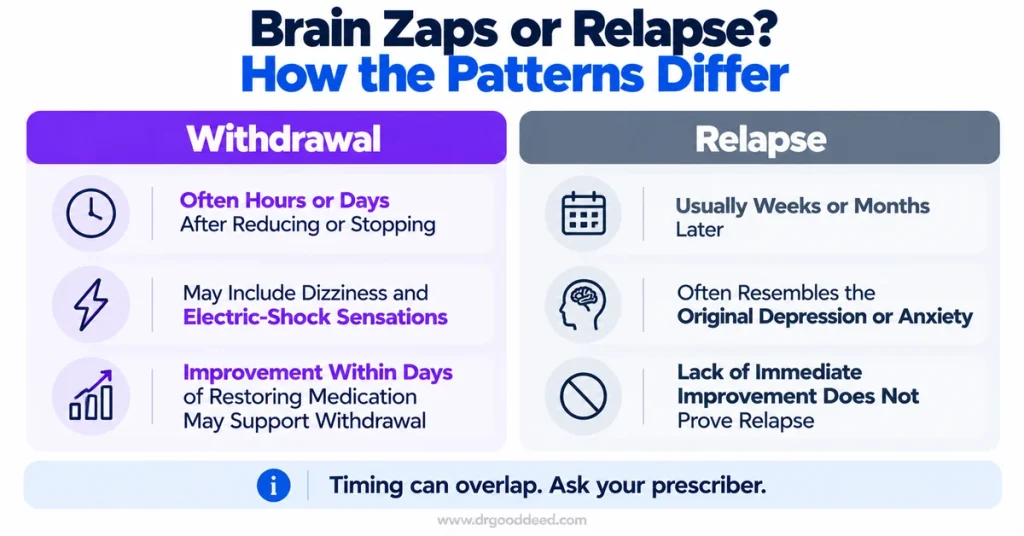
Relapse is also a real possibility after stopping antidepressants. A 2022 study published in Scientific Reports found that 36% of participants experienced a relapse within six months of discontinuing their medication. Therefore, it is important to monitor changes in mood and physical symptoms and discuss any concerns with the prescribing doctor.
How Long Do Brain Zaps Last?
How long do brain zaps last? One zap lasts only a few seconds, but the entire episode that occurs after stopping an antidepressant can last from days to weeks, and in some cases symptoms are reported to continue for months or even longer.
There is not a single period that applies to all individuals since different timeframes are given by consumer health sources, and some rather longer ones are reported online by people who have experienced it themselves.
What Helps Brain Zaps?
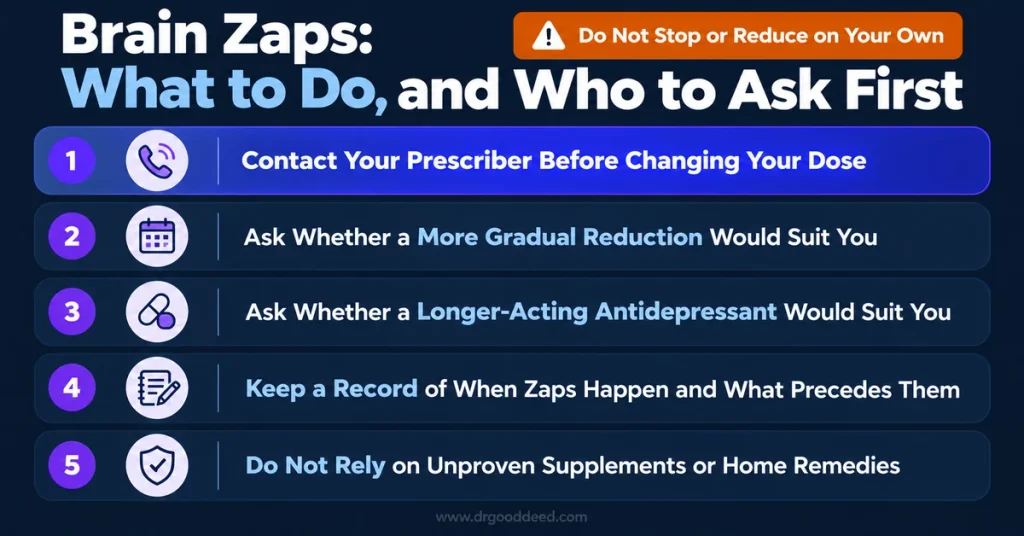
The best thing to do is to talk to your doctor who has prescribed the antidepressant to you. Do not stop, skip, reduce, or gradually decrease the use of an antidepressant without consulting them.
- Before altering your dose, you should contact your prescriber.
- Inquire if a more gradual reduction would be suitable.
- Talk to your prescribing doctor about severe withdrawal symptoms.
- Inquire whether or not a longer-acting antidepressant would be suitable.
- Keep a record of when brain zaps take place and of what causes them.
- Do not depend on supplements or home remedies that have not been proven to work.
Brain zaps are reported more frequently with SNRIs than SSRIs, possibly because some SNRIs have shorter half-lives. In an online survey reported by Psychiatrist.com, participants most commonly associated brain zaps with stopping antidepressants (39.9%), followed by tapering the dose (25.7%) and skipping a dose (12.5%). Switching to a longer-acting antidepressant, such as fluoxetine, may help, but reports suggest that this approach stops brain zaps in only about half of cases. Gradually tapering medication may also reduce symptoms, although neither strategy guarantees relief. Any medication changes should be made under the guidance of a prescribing clinician.
Keeping a simple record of when brain zaps occur can also be helpful. Note whether they follow a missed dose, a medication change, or a particular movement. Sharing this information with your prescribing doctor can help identify patterns and guide appropriate treatment.
It might also be helpful to keep a simple record of when the sensations take place. Make a note of whether they occur after missing a dose, making a change to the medication, or during a specific movement. This information will enable your prescribing doctor to understand the pattern.
Frequently Asked Questions
1. Can brain zaps happen while you are still taking your antidepressant?
Yes, brain zaps can occur while a person is still taking antidepressants, particularly after a missed dose, a dose reduction, or a change in medication.
2. Which antidepressants are most likely to cause brain zaps?
Antidepressants with a shorter half-life might be linked to a greater number of withdrawal symptoms. However, earlier evidence had focused on paroxetine; the current evidence does not justify ranking all antidepressants according to how likely they are to cause brain zaps.
3. Why do brain zaps happen when you move your eyes?
Eye or head movements are a frequently mentioned cause of brain zaps. Yet the reason why eye movements can cause this sensation is not known, and the suggested explanations are still uncertain.
4. Can anything other than antidepressants cause brain zaps?
Brain zaps have been reported after using MDMA and other substances, but evidence linking these substances to brain zaps is limited. More research is needed to understand the causes and frequency of these symptoms.
Sources
1. Davies J, Read J. A systematic review into the incidence, severity and duration of antidepressant withdrawal effects: Are guidelines evidence-based? Addictive Behaviors. 2019;97:111–121. https://pubmed.ncbi.nlm.nih.gov/30292574/ link
2. Horowitz MA, Taylor D. Distinguishing relapse from antidepressant withdrawal: Clinical practice and antidepressant discontinuation studies. BJPsych Advances. 2022;28(5):297–311. https://doi.org/10.1192/bja.2021.62 link
3. Low predictive power of clinical features for relapse prediction after antidepressant discontinuation in a naturalistic setting. Scientific Reports. 2022. https://www.nature.com/articles/s41598-022-13893-9 link
4. Royal College of Psychiatrists. Position statement on antidepressants and depression (PS04/19). 2019. https://www.rcpsych.ac.uk/docs/default-source/improving-care/better-mh-policy/position-statements/ps04_19—antidepressants-and-depression.pdf link
5. Royal College of Psychiatrists. Stopping antidepressants: Information resource. 2024. https://www.rcpsych.ac.uk/docs/default-source/mental-health/treatments-and-wellbeing/print-outs/stopping-antidepressants-information-resource-print-version-18-03-24.pdf link
Medical Disclaimer: This article is for general information only and is not medical advice. It does not replace a diagnosis, treatment plan, or guidance from a qualified healthcare professional. Always talk to your doctor about your own symptoms and before starting, stopping, or changing any treatment. If you think you may be having a medical emergency, call 911 or go to your nearest emergency room.