
Most vacation illness is an ordinary viral infection picked up in crowded airports, stations and planes, and a poor night’s sleep before departure makes it easier for the virus to take hold. It isn’t a formal diagnosis, just a pattern: respiratory, stomach or stress-linked symptoms that begin during a trip or within days of getting home.
A third explanation, “leisure sickness,” has much thinner support. This article ranks the main explanations by the strength of the research, shows how the timing of your symptoms points to where you caught the illness, and explains which symptoms need prompt medical attention. It is general information and does not replace advice from your own doctor.
Key Takeaways
- Exposure to unfamiliar germs in crowded transit has the strongest evidence behind it.
- In a lab study, adults who slept under 6 hours a night for a week were 4.2 times as likely to catch a cold as those sleeping over 7 hours. The volunteers weren’t travelers, so the link to trips is indirect.
- Leisure sickness rests on a single 2002 Dutch survey, and no medical study has confirmed it.
- In the best-known flight survey, recirculated cabin air did not raise cold rates.
- Symptom timing narrows the source: norovirus appears within 12 to 48 hours, a cold within 1 to 3 days, and tropical infections later.
- A fever after international travel needs urgent testing.
What Causes Illness on Vacation, Ranked by Evidence
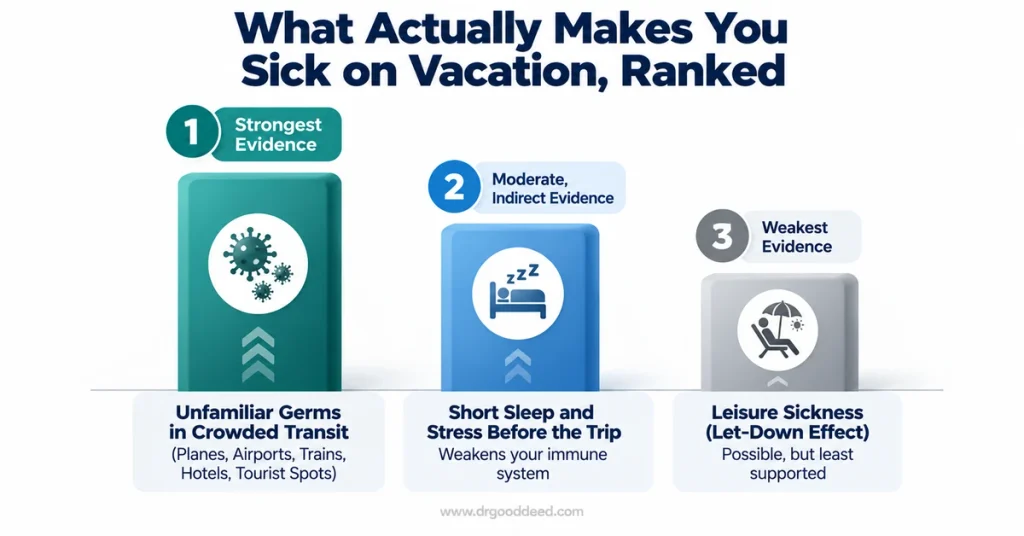
Three explanations compete, and the research backs them unevenly. Exposure to new germs in crowded transit comes first, short sleep and stress before the trip second, and leisure sickness last.
| Explanation | Strength of evidence | Main limitation |
| Unfamiliar germs in crowded transit | Strongest | Flight data is self-reported, with no concurrent control group |
| Short sleep and stress before the trip | Moderate, indirect | The key study tested non-travelers |
| Leisure sickness (the “let-down effect”) | Weakest | One survey based on recall; no medical confirmation |
Do Unfamiliar Germs in Crowded Transit Make You Sick?
Yes. This is the best-supported cause, and it usually starts at the airport, train station or bus terminal. William Schaffner of Vanderbilt University Medical Center says mass transit spreads respiratory viruses, and that airports bring travelers into contact with strains their immune systems haven’t met.
The most cited numbers come from a 1999 survey of about 1,100 passengers flying from the San Francisco area to Denver. A week later, 21% of those on fresh-air planes and 19% of those on recirculated-air planes reported a cold (Zitter et al., JAMA, 2002). So recirculated air did not raise the risk. Two caveats apply: passengers reported their own symptoms, and the roughly 3% figure quoted for non-travelers was not a concurrent control group. The study team also pointed out that stress, lost sleep and poor eating during travel could explain the high rates (NBC News).
A 2004 study in the Journal of Environmental Health Research went further and estimated that cold transmission on aircraft runs 5, 23 or 113 times higher than on the ground, depending on whether exposure lasted 6 days, 24 hours or 5 hours. Those are modeled estimates, not measurements.
Can Short Sleep and Stress Before a Trip Make You Sick?
Possibly. Short sleep clearly raises cold risk, but the strongest data come from people who weren’t traveling.
In a 2015 study in the journal Sleep, Prather and colleagues tracked 164 healthy adults with wrist sensors for a week, then gave them nasal drops containing a cold virus. Those who slept under 6 hours a night were 4.2 times as likely to catch the cold as those who slept more than 7 hours. Under 5 hours, the figure rose to 4.5 times. The result held after adjusting for self-rated stress, smoking and income.
Dr Steven Lamm of NYU says a change of routine raises stress hormones and disrupts sleep. That is an expert’s opinion rather than a trial result. Stress hormones affect far more than immunity, as our guides on whether stress can kill you and on stress and gut health explain.
The two causes probably work together. Because the Sleep study measured illness after deliberate virus exposure, sleep debt looks like something that raises the odds an exposure turns into a cold. Crowded transit supplies the exposure.
Is Leisure Sickness Real?
Only weakly supported. The idea comes mainly from one 2002 Dutch survey of 1,893 adults, about 3% of whom reported it. Most noticed symptoms during the first week of time off. The survey depended on recall, defined the condition loosely, and no medical study has confirmed it (The Conversation).
The leading theory goes like this. Work stress keeps cortisol elevated, which holds inflammation down. When the stress lifts on vacation, cortisol falls and the immune system may respond to germs already in the body with a stronger inflammatory reaction. Researchers treat this as the favored explanation, not a proven mechanism.
There is also a simpler reading of the same facts. A cold that starts on day two of a trip fits airport exposure at least as well as a stress let-down. Of the three explanations, leisure sickness ranks last.
Why Do You Get Sick After a Flight?
Your main exposure zone on a plane is the area within about two seats of you. Cabin filters work well, but infections spread when air stops circulating. Who sits near you, and how long you share air with them, matters more than recirculation itself.
- Filters: HEPA filters capture 99.97% of particles, according to reporting that drew on Reuters and the Wall Street Journal.
- A grounded plane: In a 1979 incident, 72% of 54 passengers fell ill after circulation stopped on a grounded aircraft. One old event can’t establish a rate.
- Aisle seats: On one Boston to Los Angeles flight, aisle passengers caught norovirus more often, and bathroom use didn’t explain it (Clinical Infectious Diseases, via Fortune). One flight and one virus make this a signal, not a rule.
- Tray tables: A 2015 TravelMath sampling found more than eight times as many bacteria on tray tables as on lavatory flush buttons. That is commercial sampling, and a bacteria count isn’t the same as infection.
How Long After a Trip Can You Get Sick?
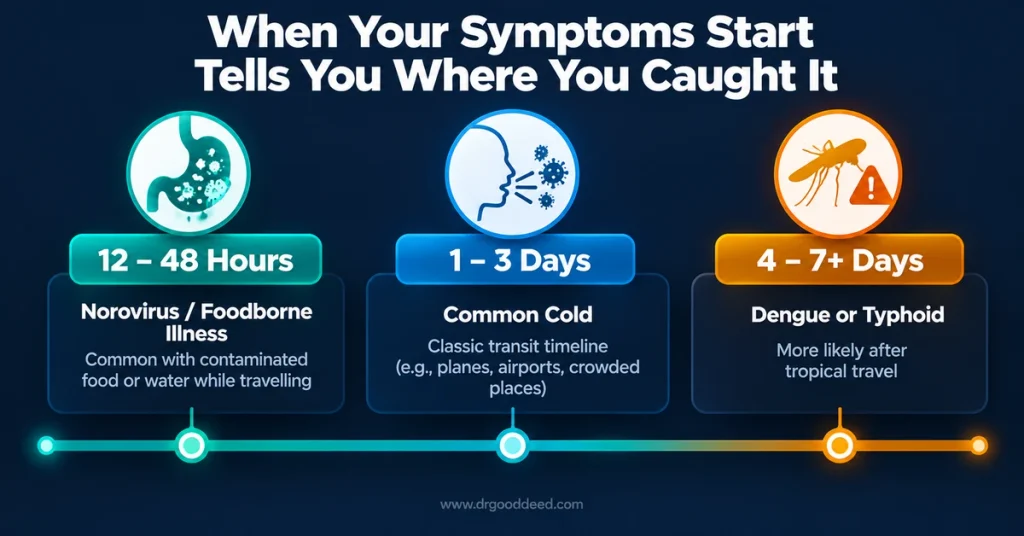
Symptoms that appear days after you get home often trace back to exposure during the trip, because many infections incubate silently before anything shows. The length of that window depends on the pathogen. Norovirus appears 12 to 48 hours after exposure and a common cold in 1 to 3 days. Longer incubations can push illness out by weeks.
| Symptoms start | Likely source | Examples | What to do |
| 12 to 48 hours after exposure | Recent transit or destination exposure, often the trip home | Norovirus (CDC) and other foodborne bacteria | Drink fluids deliberately. Most cases clear in 1 to 3 days. |
| 1 to 3 days after exposure | Transit or early-trip exposure, the classic cold-on-a-plane timeline | Rhinovirus and other cold viruses | Rest and fluids for mild symptoms. |
| 4 to 7 days after returning | Destination exposure with a longer incubation, or a second infection late in the trip | Dengue or typhoid fever after tropical travel (CDC Yellow Book) | Tell the clinician where and when you traveled. Fever needs urgent testing. |
Dr Ashima Oza of Weill Cornell Medicine says most illness in returned travelers is viral and settles within 5 to 7 days. Dr Robert Winters, quoted in Gulf News, advises seeing a doctor if symptoms last beyond five days.
If you do get ill, write down your departure date, your return date and the hour the first symptom began. Clinicians use incubation windows to tell a transit cold (1 to 3 days) from a destination infection (4 to 7 days or later), and a written itinerary speeds that up.
How to Avoid Getting Sick on Vacation
Protect your sleep and vaccine coverage before the trip, then cut down on contact with pathogens during it. Each step below targets a specific biological weak point.
- Sleep 7 or more hours a night in the week before you leave. This supports the sleep-dependent immune response.
- Get the seasonal flu shot at least two weeks before departure. That gives antibodies time to form.
- See a clinician 4 to 6 weeks out about destination vaccines. This covers vaccine-preventable infections.
- Wash your hands before eating and after transit. It blocks hand-to-mouth, eye and nose transfer.
- Sit away from visibly ill passengers when you can. The droplet zone extends about two seats around you.
- Track your symptoms for five days after you return. Late-onset infections get caught earlier.
- Tell your doctor where and when you traveled. It narrows the list of likely pathogens.
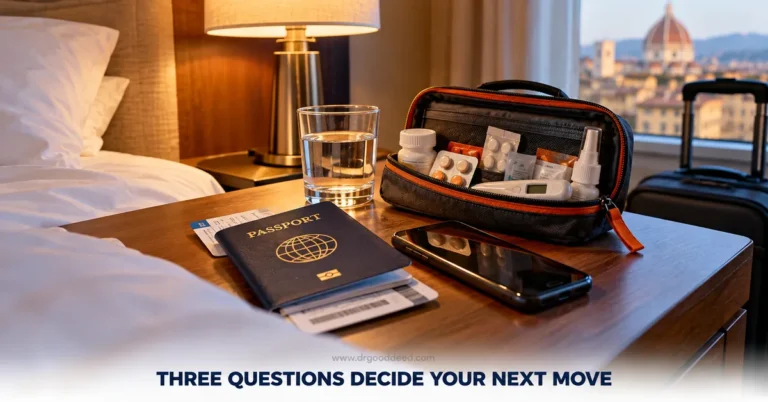
The evidence reviewed here doesn’t support vitamin C or zinc kits, routine blood panels, or cabin humidity fixes. The basics above do more. For a sensible packing list, see our travel pharmacy checklist.
When Should You See a Doctor After Getting Sick on a Trip?
See a doctor promptly for any fever after international travel. If symptoms start while you’re still abroad, our guide on what to do if you get sick abroad covers the next steps. US readers can use urgent care or an emergency department, and UK readers a GP or A&E.
Malaria is the most common life-threatening tropical cause of fever in returned travelers, which is why a fever after travel can’t be left to settle on its own. Go to emergency care for:
- Trouble breathing, chest pain, confusion or fainting
Get same-day evaluation for:
- A severe headache with a stiff neck
- A rash together with fever
Book a visit and bring your itinerary if you have:
- A fever of 103°F (39.4°C) or higher, or one lasting more than three days
- Any symptoms lasting beyond five days
Even with testing, doctors find no specific cause in about 25% or more of febrile returned travelers, according to the CDC Yellow Book. An unexplained fever still warrants follow-up.
FAQs
Does recirculated cabin air cause more colds?
No. In the San Francisco to Denver survey, colds were reported by 19% of passengers on recirculated-air planes and 21% on fresh-air planes (JAMA, 2002). How close you sit to someone who is already sick appears to matter more.
Does an aisle seat make you more likely to get sick on a plane?
Possibly. On one norovirus outbreak flight, aisle passengers were infected more often, and bathroom trips didn’t account for it (Clinical Infectious Diseases). One flight and one virus aren’t enough to build a seating rule on.
Are tray tables really dirtier than toilet flush buttons?
In one 2015 TravelMath sampling, yes, by more than eight times the bacteria. That was commercial testing, not a clinical study, and bacteria on a surface don’t prove anyone got infected from it. Wiping the table or washing your hands before eating costs nothing.
Is leisure sickness a real diagnosis?
No. It remains an unproven idea, built on a recall-based survey in which about 3% of 1,893 Dutch adults reported it. No medical study has confirmed the effect.
How much sleep should I get before a trip?
More than 7 hours a night. In the 2015 Sleep study, people averaging under 6 hours were 4.2 times as likely to catch a cold after virus exposure.
Sources
- Zitter et al., JAMA 2002, via UCSF News: Recirculated airplane cabin air does not cause more colds link
- NBC News: Recirculated airplane air not tied to colds link
- Prather et al., Sleep 2015, via Carnegie Mellon University link
- CDC Yellow Book: Post-Travel Evaluation of the Ill Traveler link
- CDC: Symptoms of Norovirus link
- Weill Cornell Medicine: Feeling sick after vacation is more common than you might think link
- The Conversation: Why do I seem to get sick as soon as I take time off? link
- Fox News: Where germs lurk on planes link
- Fortune: The dirtiest spots on airplanes link
- Gulf News: Here’s why you get sick after vacation link
Medical Disclaimer: This article is for general information only and is not medical advice. It does not replace a diagnosis, treatment plan, or guidance from a qualified healthcare professional. Always talk to your doctor about your own symptoms and before starting, stopping, or changing any treatment. If you think you may be having a medical emergency, call 911 or go to your nearest emergency room.