

Stress can kill you, but not in a single moment. But chronic stress kills slowly, through heart disease, stroke, immune collapse, and organ damage, and the numbers are not subtle.
The American Institute of Stress reports that 77% of Americans experience physical symptoms from stress regularly. The CDC links stress to 6 of the top 10 leading causes of death in the US, including heart disease, cancer, and liver disease.
Stress a physiological state that damages the heart, brain, immune system, and gut in measurable ways. Effects of stress are reversible with consistent intervention. Exercise, sleep, and mindfulness are the most evidence-backed tools available for reversing the biological damage that chronic stress causes.
Can Stress Cause Serious Health Problems
Stress causes serious health problems, and the damage is measurable at the cellular level, not just in how someone feels emotionally.
Hormonal Imbalance: Cortisol Overload
Cortisol is the body’s main stress hormone. In short bursts, it is useful. It sharpens focus, raises blood sugar for energy, and suppresses non-essential functions during a threat. Under chronic stress, cortisol stays elevated for days, weeks, or months.
Sustained high cortisol damages the hippocampus (the memory center of the brain), raises blood sugar persistently, and suppresses immune function. A 2020 study in Psychoneuroendocrinology found that people with chronically elevated cortisol showed measurable hippocampal shrinkage over a 5-year period.
Chronic Inflammation
Cortisol normally controls inflammation. When cortisol stays elevated too long, immune cells stop responding to it. Inflammation then runs unchecked. Chronic low-grade inflammation damages blood vessel walls, accelerates plaque buildup in arteries, and increases cancer risk.
Researchers at Carnegie Mellon University found that people under chronic stress had immune cells that were 40% less responsive to cortisol’s anti-inflammatory signals compared to low-stress individuals.
Impact on the Cardiovascular System
The heart takes direct hits from chronic stress. Every stress episode increases heart rate and blood pressure. Over time, this repeated pressure wears down arterial walls, increases clot risk, and raises the chance of cardiac events. This is the biological mechanism behind how stress can cause serious health problems at a life-threatening scale.
High Blood Pressure Due to Stress
High blood pressure due to stress is one of the most documented and dangerous outcomes of chronic psychological stress.
Stress Increasing Heart Rate and Blood Pressure
Every time the fight-or-flight response activates, the adrenal glands release adrenaline. Adrenaline causes the heart to beat faster and blood vessels to narrow. Blood pressure spikes within seconds. In healthy short-term stress, this resolves quickly. In chronic stress, the spikes happen repeatedly throughout the day, keeping average blood pressure elevated.
Long-Term Hypertension Risk
The American Heart Association confirms that chronic stress is a contributing factor to sustained hypertension (blood pressure above 130/80 mmHg). Hypertension has no symptoms in most people. It silently damages arteries, the heart, kidneys, and eyes over years. Around 47% of American adults have hypertension, and stress-linked cases represent a growing share of that number.
Link to Stroke and Heart Disease
Sustained high blood pressure due to stress increases stroke risk by damaging the walls of cerebral blood vessels. It also accelerates atherosclerosis (artery hardening), which is the primary driver of heart attacks.
The Framingham Heart Study, one of the longest-running cardiovascular studies in history, found that psychological stress independently predicted cardiovascular events, separate from diet, smoking, and physical activity.
Immune System Weakness Stress
Immune system weakness due to stress. Stress produces specific, measurable changes in immune cell behavior that leave the body more vulnerable to infection and slower to recover from illness.
Reduced Immune Response
Chronic stress suppresses the production of lymphocytes, the white blood cells that fight viruses and bacteria. A landmark study at Ohio State University showed that medical students under exam stress had 30% lower natural killer (NK) cell activity compared to their baseline levels during low-stress periods. NK cells are the immune system’s first line of defense against viral infections.
Increased Susceptibility to Infections
People under chronic stress get sick more often. A controlled trial published in the New England Journal of Medicine exposed participants to the rhinovirus (common cold virus) after measuring their stress levels. Those with the highest chronic stress scores were 4.5 times more likely to develop a cold than those with low stress scores.
Slower Recovery from Illness
Immune system weakness stress also slows healing. Wounds heal more slowly in chronically stressed individuals. A study from the Ohio State University found that dental students’ mouth wounds took 40% longer to heal during exam periods compared to summer vacation. The same mechanism applies to post-surgical recovery and fighting off bacterial infections.
Conditions Linked to Chronic Stress
How dangerous is long-term stress becomes clearer when looking at the specific conditions it causes or worsens.
Heart Disease and Stroke
Chronic stress accelerates plaque buildup in coronary arteries and increases blood clotting factors like fibrinogen. Both mechanisms directly raise heart attack and stroke risk. The European Heart Journal published research showing that job strain (a well-studied form of chronic stress) increased coronary heart disease risk by 23% compared to low-job-strain groups.
Anxiety and Depression
The amygdala (the brain’s fear center) grows more reactive under chronic stress. The prefrontal cortex, which regulates rational thought and emotional control, shrinks. This biological shift predisposes the brain to anxiety and depression. The WHO estimates that depression is the leading cause of disability worldwide, and chronic stress is one of its strongest predictors.
Digestive Disorders
Stress directly alters gut motility and microbiome composition. It worsens IBS (irritable bowel syndrome), causes acid reflux, and slows gastric emptying. Research from Gut journal found that psychosocial stress changed gut bacteria composition within 72 hours, reducing beneficial Lactobacillus species significantly.
Sleep Disturbances
Elevated cortisol suppresses melatonin production. Melatonin controls the sleep-wake cycle. Chronic stress disrupts this cycle, reducing deep sleep (stages 3 and 4), which is when the body repairs tissue and consolidates memory. Poor sleep then raises cortisol further the next day, creating a self-reinforcing cycle.
Can Stress Trigger Life-Threatening Events
Stress can kill you through a sudden event in documented clinical scenarios.
Heart Attack Risk
Takotsubo cardiomyopathy, commonly called “broken heart syndrome,” is a real cardiac condition triggered by sudden intense emotional stress. The left ventricle of the heart temporarily balloons and weakens. It mimics a heart attack and can be fatal. Reports in the New England Journal of Medicine confirm it occurs in otherwise healthy people following extreme psychological stress.
Stroke Risk
Acute stress triggers rapid blood pressure spikes. In people with underlying hypertension or arterial plaques, these spikes can rupture a blood vessel in the brain, causing a hemorrhagic stroke. Research from Stroke journal found that anger and intense emotional stress increased stroke risk by 3.6 times in the two hours following the episode.
Severe Panic Episodes
Panic attacks during extreme stress produce chest pain, breathing difficulty, and a heart rate above 180 beats per minute in some cases. While panic attacks themselves are rarely fatal, they are medical emergencies in people with underlying cardiac conditions.
Warning Signs That Stress Is Becoming Dangerous
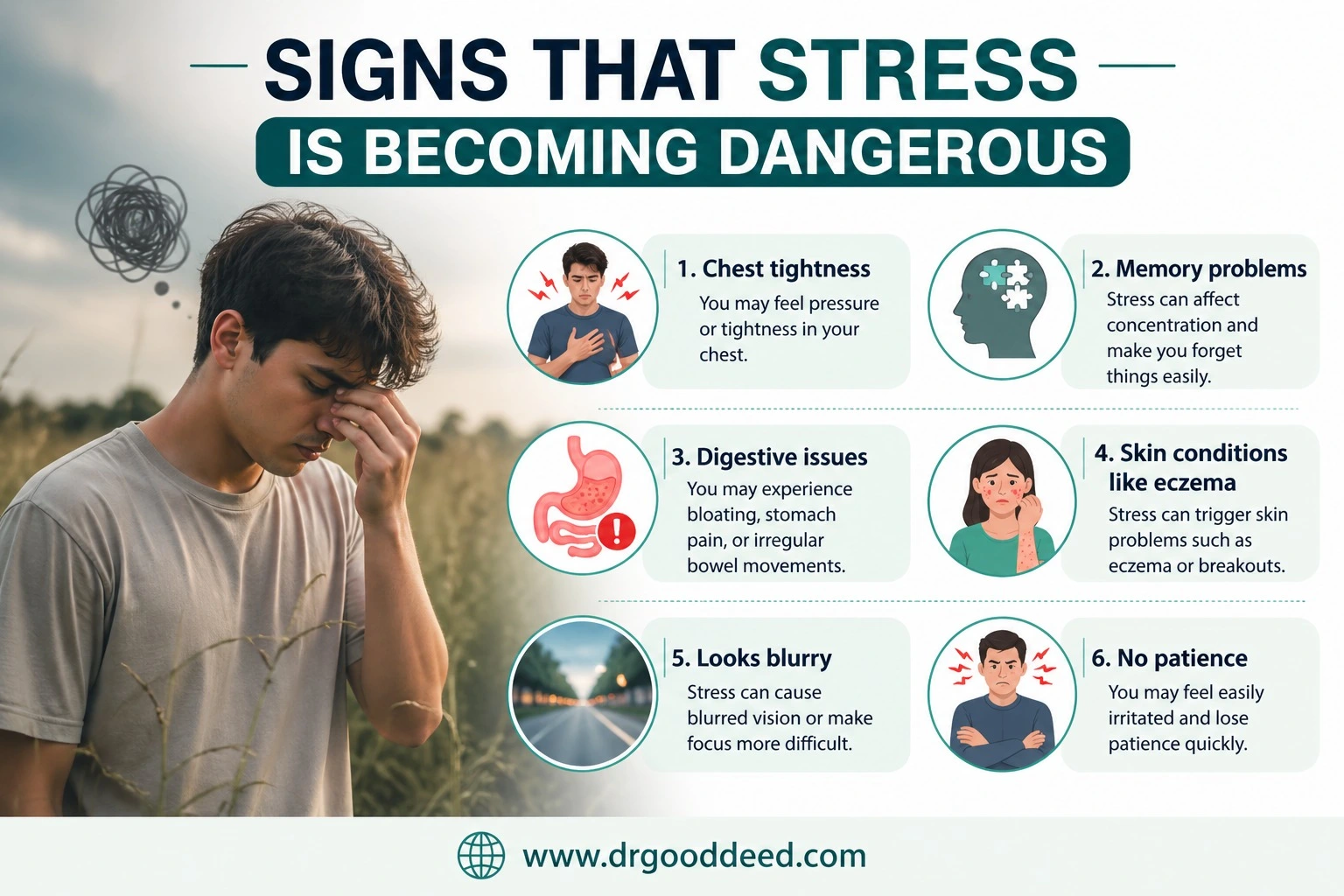
How dangerous long-term stress is partly determined by these warning signs. Persistent fatigue that sleep does not fix signals adrenal strain. Blood pressure readings consistently above 130/80 mmHg need medical evaluation. Frequent colds (more than 4 per year) indicate immune suppression. Waking up between 2 and 4 AM regularly points to elevated cortisol disrupting sleep architecture.
Additional warning signs:
- Chest tightness or palpitations during non-physical activity
- Memory problems and difficulty concentrating for more than a few minutes
- Digestive issues like acid reflux, bloating, or irregular bowel movements that started alongside stressful periods
- Skin conditions like eczema or psoriasis flaring during stressful weeks (both are immune-mediated and stress-sensitive)
How to Reduce Harmful Stress Levels
Reducing harmful stress levels requires consistent daily practice, not occasional intervention.
Regular Physical Activity
Exercise reduces cortisol, increases BDNF (brain-derived neurotrophic factor, which repairs stress-damaged neurons), and raises endorphins. 30 minutes of moderate aerobic activity 5 days per week reduces perceived stress scores by an average of 29% within 6 weeks, per JAMA Psychiatry data.
Sleep Optimization
Sleep below 6 hours per night raises cortisol by 37% the following day. Prioritize a fixed sleep and wake time. Keep the bedroom below 68°F. Avoid screens 1 hour before bed. These three changes measurably improve sleep quality within 2 weeks.
Mindfulness and Relaxation Techniques
MBSR (Mindfulness-Based Stress Reduction) is an 8-week structured program with 47 randomized controlled trials confirming its effectiveness. It reduces cortisol, lowers blood pressure, and improves immune function. Daily practice of 20 minutes produces measurable changes in cortisol levels within 4 weeks.
Social Support
Loneliness raises cortisol and inflammatory markers at levels comparable to smoking 15 cigarettes per day, per research from Brigham Young University. Consistent social connection, whether in person or via regular phone calls, reduces biological stress markers substantially.
Immediate Stress Response Tools
- Deep breathing: 4-7-8 breathing (inhale 4 counts, hold 7, exhale 8) activates the vagus nerve and drops heart rate within 60 seconds.
- Short walks: A 10-minute walk reduces adrenaline levels and lowers blood pressure within 20 minutes.
- Grounding techniques: The 5-4-3-2-1 method (identify 5 things you see, 4 you hear, 3 you can touch, 2 you smell, 1 you taste) interrupts the fight-or-flight response by redirecting the brain to sensory input.
FAQs
Can stress kill you directly?
Yes, through Takotsubo cardiomyopathy (stress-induced heart failure), hemorrhagic stroke triggered by acute blood pressure spikes, and fatal cardiac arrhythmias during panic. These are documented, not theoretical. Underlying cardiovascular disease significantly raises this risk.
How dangerous is long-term stress?
Chronic stress raises heart disease risk by 23%, triples stroke risk during acute episodes, suppresses NK cell activity by 30%, and shrinks the hippocampus over 5 years. It contributes to 6 of the top 10 leading causes of death in the US.
How does stress weaken the immune system?
Chronic cortisol makes immune cells stop responding to anti-inflammatory signals. NK cell production drops by 30%. Lymphocyte count falls. People under high chronic stress are 4.5 times more likely to develop a viral infection when exposed to one, per controlled rhinovirus trial data.
Can stress lead to heart attack or stroke?
Yes. Acute stress raises stroke risk by 3.6 times within 2 hours of an intense episode. Chronic stress causes Takotsubo cardiomyopathy and accelerates coronary artery plaque buildup. Job strain alone increases coronary heart disease risk by 23%, per the European Heart Journal.
What are warning signs of dangerous stress levels?
Blood pressure consistently above 130/80 mmHg, more than 4 colds per year, waking at 2 to 4 AM regularly, chest palpitations during rest, and persistent fatigue unimproved by sleep. Any combination of three or more warrants a doctor’s evaluation.
How to reduce harmful stress levels?
30 minutes of aerobic exercise 5 days per week reduces stress scores by 29% within 6 weeks. MBSR reduces cortisol measurably in 4 weeks. Fixing sleep to 7 to 9 hours prevents the 37% cortisol spike that follows poor sleep. These three changes together produce the strongest outcome.
Can managing stress improve health outcomes?
Yes. MBSR practice reduces blood pressure by an average of 5 mmHg systolic. Exercise cuts cardiovascular event risk by up to 35% in chronically stressed individuals. Improved stress management reduces all-cause mortality risk by 18% over 10 years, per Harvard T.H. Chan School of Public Health data.
When should you see a doctor for stress?
See a doctor if blood pressure stays above 130/80 mmHg for two consecutive weeks, if you experience chest pain or palpitations, if you get sick more than 4 times per year, or if stress disrupts sleep consistently for more than 3 weeks. These require medical assessment, not just lifestyle changes.