
Stress can make you sick, and the science is specific about how. Chronic stress triggers cortisol overproduction, suppresses immune function, and accelerates cardiovascular damage, all simultaneously. The American Psychological Association reports that 77% of US adults regularly experience physical symptoms caused by stress.
Stress is a physiological state with measurable effects on blood vessels, immune cells, gut bacteria, and brain structure. The body doesn’t distinguish between work pressure and physical threat. It responds the same way to both, and sustained response causes real, diagnosable damage.
How Stress Affects Physical Health
How stress affects physical health follows a measurable biological sequence. Cortisol, the primary stress hormone, raises blood pressure, increases blood glucose, suppresses immune cells, and slows digestion within minutes of a stress trigger. When this happens daily for months, the damage compounds into diagnosable conditions.
Activation of Fight-or-Flight Response
The hypothalamus, a small region in the brain, fires the alarm when stress begins. It signals the adrenal glands to release adrenaline and cortisol immediately. Heart rate spikes. Blood vessels constrict. Muscles tighten. This response evolved to handle short physical threats, like running from danger. It was never designed to stay active for weeks at a time.
Release of Cortisol and Stress Hormones
Cortisol in short bursts is protective. Cortisol sustained for months destroys tissue. It raises blood sugar to give muscles energy, but chronic elevation causes insulin resistance. It suppresses inflammation short-term, but chronic suppression leaves the immune system unable to fight infections properly.
The Carnegie Mellon University stress studies confirmed that people under chronic stress were significantly more likely to develop colds when exposed to rhinovirus than those with low stress levels.
Long-Term Wear on Body Systems
Each body system has a breaking point when stress stays activated too long. The cardiovascular system develops hypertension. The immune system becomes dysregulated, either underreacting to infections or overreacting in ways that trigger autoimmune flares. The endocrine system loses its normal cortisol rhythm, called the circadian cortisol curve, which disrupts sleep and metabolism simultaneously.
Nervous System Response to Stress
The nervous system response to stress explains why stress can make you sick has a clear answer: yes, because the nervous system controls every organ system in the body, and stress keeps it in a state that is incompatible with normal healing.
Sympathetic Nervous System Activation
The sympathetic nervous system is the “gas pedal.” Stress keeps it pressed down. Blood redirects away from digestion and toward muscles. Pupils dilate. Breathing speeds up. This is useful for 30 seconds. After days, the sustained activation depletes neurotransmitters, tightens chest muscles chronically, and raises baseline blood pressure by 5 to 10 mmHg in many adults.
Increased Heart Rate and Blood Pressure
Resting heart rate in chronically stressed adults averages 5 to 8 beats per minute higher than in low-stress controls, based on data from the Whitehall II study, a large UK cohort study tracking cardiovascular outcomes across stress levels. That constant extra demand on the heart contributes to arterial wall stiffening over years.
Reduced Recovery (Parasympathetic Suppression)
The parasympathetic nervous system is the “brake.” It governs rest, digestion, immune activity, and tissue repair. Chronic stress actively suppresses it. When the brake doesn’t engage properly during sleep and downtime, the body cannot complete normal recovery cycles. This is why chronically stressed people sleep but don’t feel rested.
Symptoms of Stress on the Body
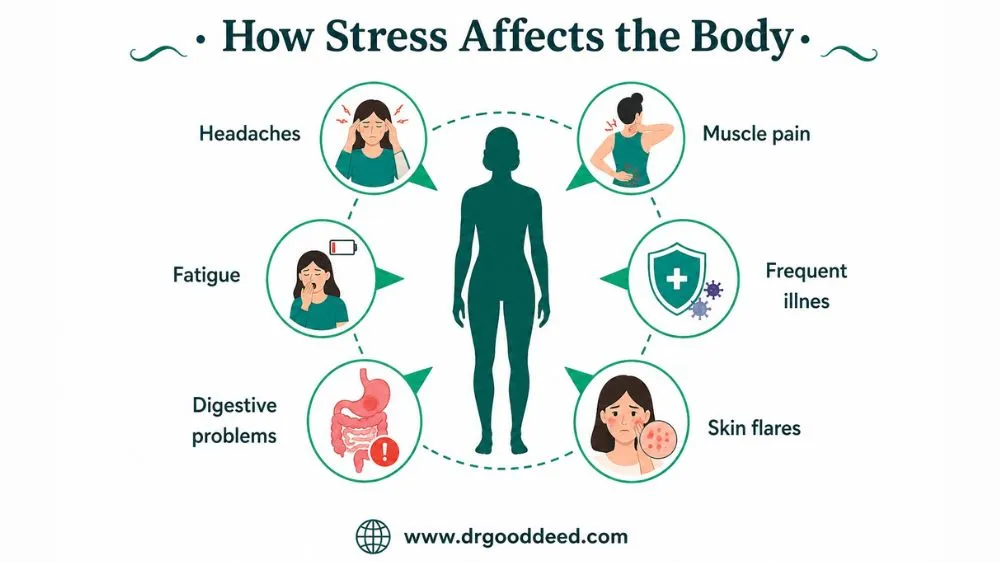
Symptoms of stress on the body cover more organ systems than most people realize. The connection between stress and physical symptoms is direct, not metaphorical.
- Headaches: Cortisol constricts blood vessels in the scalp and neck, causing tension headaches that cluster at the temples and base of the skull
- Muscle pain: Sustained sympathetic activation keeps skeletal muscles partially contracted, producing neck, shoulder, and lower back pain without any physical injury
- Fatigue: Dysregulated cortisol rhythm causes a “wired but tired” state; cortisol stays elevated at night when it should be low, disrupting sleep architecture
- Frequent illness: Cortisol suppresses natural killer (NK) cell activity; these are the immune cells that identify and destroy virus-infected cells
- Digestive problems: Stress shunts blood away from the gut, slowing motility and causing bloating, constipation, or diarrhea
- Skin flares: Stress worsens psoriasis, eczema, and acne by increasing inflammatory cytokines that trigger these conditions at the skin level
- Irregular heartbeat: Sustained adrenaline can trigger premature ventricular contractions (PVCs), the “fluttering” sensation in the chest that many stressed adults experience
Gut Brain Axis Stress Connection
The gut-brain axis stress connection is one of the least covered but most clinically important aspects of stress physiology. The gut and brain communicate bidirectionally through the vagus nerve, a long nerve running from the brainstem to the abdomen. Stress disrupts this communication in both directions.
Communication Between Brain and Gut
The gut contains approximately 100 million neurons, more than the spinal cord. This system is called the enteric nervous system. During stress, the brain sends signals via the vagus nerve that directly slow or accelerate gut contractions. This is why stress causes immediate nausea before a presentation or loose stools before a high-stakes event.
Impact on Gut Motility and Bacteria
Chronic stress alters the gut microbiome within days. A 2011 study at Ohio State University found that stress measurably reduced the diversity of gut bacteria in mice within a single week of sustained stress exposure.
Lower microbiome diversity correlates with reduced immune function, worse mood regulation, and higher inflammation markers in humans. The gut’s bacterial population produces about 90% of the body’s serotonin. Stress disrupts that production.
Stress-Related Gut Symptoms
Irritable bowel syndrome (IBS) affects about 45 million Americans, and research consistently links flare frequency to psychological stress. Stress doesn’t cause IBS structurally, but it amplifies pain signals from the gut through a process called visceral hypersensitivity. People with chronic stress report gut pain from stimuli that wouldn’t register as painful in non-stressed individuals.
Conditions Linked to Stress
Stress can make you sick enough to cause long-term diagnosed conditions. These are the most well-established links.
Anxiety and Depression
Sustained cortisol elevation shrinks the hippocampus, the brain region involved in memory and emotional regulation. The American Journal of Psychiatry has published multiple studies confirming smaller hippocampal volume in people with chronic stress disorders. This is not temporary. The structural change persists.
Heart Disease and Hypertension
The INTERHEART study, which analyzed heart attack risk across 52 countries, found that psychosocial stress accounted for a population-attributable risk of 32.5% for myocardial infarction. That makes chronic stress comparable to smoking as a heart disease risk factor.
Digestive Disorders
Stress worsens gastroesophageal reflux disease (GERD), peptic ulcers, and inflammatory bowel disease (IBD). It does this by increasing stomach acid secretion, reducing the protective mucus lining of the stomach, and triggering inflammation in the intestinal lining through immune dysregulation.
Weakened Immune Response
Chronic stress reduces vaccine effectiveness. A 1996 study at Ohio State University found that medical students who received hepatitis B vaccines during exam periods produced significantly lower antibody responses than those vaccinated during low-stress periods.
How to Manage Stress to Stay Healthy
Managing stress to stay healthy requires targeting the specific biological mechanisms stress activates, not just relaxation in a general sense.
Regular Physical Activity
Exercise is the only intervention that burns off adrenaline and cortisol biochemically. A 30-minute moderate-intensity workout reduces cortisol levels measurably within 90 minutes post-exercise. The CDC recommends 150 minutes of moderate aerobic activity weekly for general health. For stress specifically, consistency matters more than intensity.
Sleep Optimization
Cortisol should be lowest between 12 AM and 4 AM and peak around 8 AM. Chronic stress inverts this curve. Going to bed and waking at the same time daily, keeping the bedroom below 68°F, and avoiding screens 60 minutes before sleep all help restore normal cortisol rhythm within two to three weeks.
Mindfulness and Relaxation Techniques
Diaphragmatic breathing activates the parasympathetic nervous system within 90 seconds. Box breathing (4 seconds in, 4 hold, 4 out, 4 hold) has measurable effects on heart rate variability, a clinical marker of parasympathetic tone.
A 2018 JAMA Internal Medicine meta-analysis confirmed that mindfulness-based stress reduction (MBSR) produced significant reductions in anxiety, depression, and pain compared to control groups.
Social Support and Connection
Loneliness raises cortisol by approximately 21% in published studies. Sustained social connection does the opposite. Oxytocin, released during positive social interaction, directly suppresses cortisol and lowers blood pressure. This is not casual wellness advice. It is measurable endocrinology.
Quick Techniques to Reduce Stress Immediately
When stress peaks and the body enters full sympathetic activation, these methods produce fast physiological changes. They work because they directly engage the parasympathetic nervous system.
- Physiological sigh: Two short inhales through the nose followed by a long exhale through the mouth. This deflates the alveoli in the lungs that collapse during stress, rapidly lowering heart rate. Stanford neuroscientist Andrew Huberman’s lab confirmed this as the fastest known breathing method to reduce acute stress
- Cold water on the face: Triggers the mammalian dive reflex, which slows heart rate within 30 seconds by activating the vagus nerve
- 5-4-3-2-1 grounding: Name 5 things you see, 4 you hear, 3 you can touch, 2 you smell, 1 you taste. This forces the prefrontal cortex back online and interrupts the amygdala’s stress loop
- Progressive muscle relaxation: Tense each muscle group for 5 seconds, then release. Starting from the feet upward. Clinical trials show this reduces cortisol levels within 20 minutes of practice
- Chewing gum: Reduces cortisol by up to 16% in a 2008 study in Physiology and Behavior, possibly by mimicking the parasympathetic jaw activity associated with calm states
FAQs
Can stress make you physically sick?
Yes. Stress can make you sick. Sustained cortisol elevation suppresses natural killer cells, raises blood pressure, disrupts gut bacteria, and increases inflammatory cytokines. Carnegie Mellon researchers confirmed that chronically stressed adults were significantly more likely to develop colds when directly exposed to rhinovirus compared to low-stress controls.
What are symptoms of stress on the body?
Symptoms of stress on the body include tension headaches at the temples and skull base, sustained neck and shoulder muscle pain without injury, frequent viral infections, bloating or IBS flares, skin condition worsening (psoriasis, eczema, acne), and irregular heartbeat from sustained adrenaline exposure. These are organ-level responses, not mood symptoms.
How does the nervous system respond to stress?
The nervous system response to stress activates the sympathetic system within seconds, releasing adrenaline and cortisol, raising heart rate and blood pressure, and suppressing the parasympathetic system that governs digestion, immunity, and tissue repair. Resting heart rate increases 5 to 8 beats per minute in chronically stressed adults, based on the Whitehall II study.
Can stress weaken the immune system?
Yes. Chronic stress suppresses natural killer (NK) cell activity and reduces antibody production from vaccines. Ohio State University researchers found that medical students vaccinated during high-stress exam periods produced significantly lower hepatitis B antibody responses than those vaccinated during low-stress periods.
How to manage stress to stay healthy?
Managing stress to stay healthy requires four actions: 150 minutes of weekly aerobic exercise to metabolize cortisol, consistent sleep timing to restore the cortisol circadian curve, diaphragmatic breathing to activate the parasympathetic system within 90 seconds, and regular social connection to suppress cortisol through oxytocin release.
Why do some people get sick from stress more easily?
People with low baseline heart rate variability (HRV) have less parasympathetic reserve and recover slower from stress activation. Those with pre-existing conditions, like asthma, IBS, or autoimmune disease, face amplified flares because stress-driven inflammation directly worsens these conditions. Genetics controlling cortisol receptor sensitivity also differ significantly between individuals.
Can stress cause long-term health problems?
Yes. Stress can make you sick enough to cause permanent damage. Chronic stress shrinks hippocampal volume in the brain, raises baseline blood pressure into stage 1 hypertension, accelerates atherosclerosis, and alters gut microbiome diversity in ways that persist after the stressor resolves. The INTERHEART study linked psychosocial stress to 32.5% of heart attack risk globally.
When should you see a doctor for stress symptoms?
See a doctor if chest pain, irregular heartbeat, persistent insomnia beyond three weeks, significant unintended weight change, or new digestive bleeding appears. These indicate stress has progressed into organ-level dysfunction requiring medical evaluation, not just stress management techniques.