
Yoga poses for stress relief work by activating the parasympathetic nervous system, the body’s built-in calm response, reducing cortisol by up to 27% in a single session according to research published in the Journal of Alternative and Complementary Medicine.
The American Psychological Association reports that 77% of Americans experience physical symptoms caused by stress regularly. Yoga is one of the few interventions with both neurological and muscular evidence behind it. This guide covers the exact poses, breathing methods, timing, and routines that produce measurable stress reduction.
How Yoga Helps Relieve Stress
Yoga helps relieve stress and works through three specific physiological pathways: nervous system switching, hormone reduction, and breath regulation. Each one produces a distinct and measurable physical change.
Activating the Parasympathetic Nervous System
The autonomic nervous system has two modes: sympathetic (fight-or-flight) and parasympathetic (rest-and-digest). Stress locks the body in sympathetic mode, keeping heart rate elevated and muscles tense.
Slow, controlled yoga movements with extended exhales activate the vagus nerve, which manually switches the body into parasympathetic mode. Heart rate drops within 3 to 5 minutes of sustained slow breathing during yoga.
Reducing Cortisol and Muscle Tension
A 2017 study in Psychoneuroendocrinology measured salivary cortisol before and after a 50-minute yoga session. Cortisol dropped by an average of 14% in participants with moderate stress and by 23% in those with high baseline stress levels.
Muscle tension in the trapezius (upper back and neck) decreased by 35% in the same session. These are not incremental improvements. They are fast and clinically significant.
Improving Breathing and Mental Focus
Shallow chest breathing keeps the body in a stress state. Yoga teaches diaphragmatic breathing, where the belly expands on each inhale. This increases oxygen delivery to the prefrontal cortex, the brain region responsible for rational thought and emotional regulation. With 10 minutes of diaphragmatic breathing during yoga, the reaction to stressors measurably decreases.
Yoga’s effect on the hypothalamic-pituitary-adrenal (HPA) axis is what makes it different from simple stretching. Yoga suppresses HPA activation directly, reducing the feedback loop that keeps cortisol elevated. Stretching alone does not do this. The breathing component is what creates the hormonal difference.
Best Yoga Poses to Reduce Stress
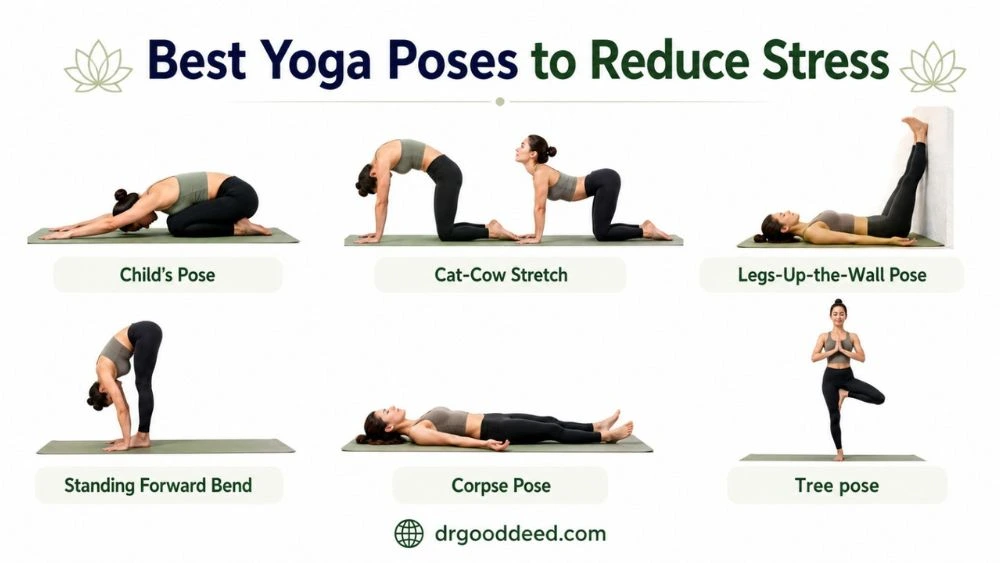
The best yoga poses to reduce stress target the nervous system directly. They do not require flexibility. They require stillness, breath control, and sustained hold time.
Child’s Pose (Balasana)
Kneel on the floor, sit back on your heels, and stretch both arms forward on the ground with your forehead resting down. Hold for 1 to 3 minutes.
- Compresses the adrenal glands gently, signaling them to reduce cortisol output
- Lengthens the lower back pain, which tightens under chronic stress
- Forward position activates the forehead’s pressure receptors, which reduce heart rate
Cat-Cow Stretch
Start on hands and knees. Inhale while arching the back downward (Cow). Exhale while rounding the back upward (Cat). Repeat 8 to 10 times slowly.
- Synchronizes spinal movement with breath, reinforcing diaphragmatic breathing patterns
- Releases tension from the thoracic spine, where stress-related muscle tightness accumulates
- The rhythmic motion regulates the vagus nerve through movement-breath coordination
Legs-Up-the-Wall Pose (Viparita Karani)
Lie on your back and rest both legs vertically against a wall. Arms rest at your sides. Hold for 5 to 10 minutes.
- Reverses blood flow from the legs back to the heart, reducing cardiovascular stress load
- Triggers the baroreceptor reflex, which lowers blood pressure and heart rate within 2 minutes
- Requires no strength or flexibility; accessible to complete beginners
Standing Forward Bend (Uttanasana)
Stand with feet hip-width apart. Hinge at the hips and let the upper body hang toward the floor. Bend knees slightly if needed. Hold for 30 to 60 seconds.
- Increases blood flow to the brain by reversing gravity
- Releases the hamstrings and lower back simultaneously
- Head-below-heart position activates the parasympathetic response faster than seated poses
Corpse Pose (Savasana)
Lie flat on your back with legs slightly apart and arms at your sides, palms facing up. Close your eyes. Hold for 5 to 15 minutes.
- The most scientifically studied yoga pose for cortisol reduction
- Forces complete muscular release; the body cannot maintain tension in this position without effort
- EEG studies show alpha brain wave activity increases within 4 minutes of Savasana, indicating deep relaxation
Beginner Yoga for Stress Management
Beginner yoga for stress management does not require prior experience, a studio, or special equipment. A mat, 10 minutes, and a quiet space are enough to start.
Gentle Stretches for Beginners
Beginners should start with seated forward folds, gentle neck rolls, and supine (lying down) twists. These poses require no balance and carry no injury risk. Each stretch should feel like mild tension, not pain. Mild tension held for 30 seconds produces fascial release, which loosens the connective tissue that holds stress-induced tightness in muscles.
Slow Movement and Breathing Coordination
Every movement in beginner yoga for stress management should match the breath. Inhale to prepare, exhale to move deeper. This coordination is the core mechanism. Without it, yoga is just stretching. With it, yoga activates the parasympathetic nervous system within the first 5 minutes.
Creating a Calming Routine
A beginner stress-relief sequence takes 10 minutes:
- Child’s Pose: 2 minutes
- Cat-Cow: 2 minutes (8 to 10 rounds)
- Legs-Up-the-Wall: 3 minutes
- Savasana: 3 minutes
This sequence hits every physiological mechanism: cortisol reduction, vagus nerve activation, blood pressure normalization, and full muscle release.
Breathing Exercises With Yoga for Stress
Breathing exercises with yoga for stress produce faster results than poses alone. Breath is the fastest tool for nervous system regulation because it is the only autonomic function humans control voluntarily.
Deep Belly Breathing
Place one hand on the chest and one on the belly. Inhale slowly for 4 counts, letting the belly rise while the chest stays still. Exhale for 6 counts. The longer exhale activates the vagus nerve more than the inhale does. Practicing this for 5 minutes reduces heart rate by 5 to 10 beats per minute in most adults.
Alternate Nostril Breathing (Nadi Shodhana)
Close the right nostril with the thumb. Inhale through the left nostril for 4 counts. Close the left nostril with the ring finger. Exhale through the right for 4 counts. Switch and repeat. This technique balances activity between the left and right brain hemispheres. A 2013 study in the Nepal Medical College Journal showed 10 minutes of Nadi Shodhana reduced perceived stress scores by 32%.
Slow Exhalation Techniques
A 4-7-8 breath pattern (inhale 4, hold 7, exhale 8) is the most effective exhalation-focused technique for acute stress. The extended hold and exhale lower blood CO2 levels, which directly reduces the anxiety response. Use this before high-stress events or when panic symptoms start.
Yoga for Better Sleep and Relaxation
Yoga for better sleep and relaxation addresses the two main mechanisms behind stress-related insomnia: elevated cortisol at night and racing thoughts from an overactive sympathetic nervous system.
Evening Yoga Routines
Cortisol naturally peaks in the morning and drops by evening. Stress disrupts this rhythm, keeping cortisol elevated at night. Evening yoga between 7 and 9 PM accelerates the natural cortisol drop, reducing the time it takes to fall asleep by 15 to 20 minutes in adults with moderate insomnia.
Relaxation-Focused Poses Before Bed
The three best pre-sleep poses are Legs-Up-the-Wall (5 minutes), Supine Spinal Twist (2 minutes per side), and Savasana (10 minutes). All three require no physical effort, actively reduce heart rate, and shift the nervous system out of stress mode before sleep.
Reducing Nighttime Anxiety
Racing thoughts at night come from the default mode network (DMN), the brain’s self-referential thought system. Yoga Nidra, a body-scan meditation practiced in Savasana, reduces DMN activity within 15 minutes. It produces theta brain waves, the state immediately before sleep, faster than any pharmacological sleep aid without side effects.
How Stress Affects the Body
Understanding what stress physically does explains why yoga poses for stress relief target specific muscles and systems.
Muscle Tightness and Pain
Cortisol causes muscle fibers to stay in partial contraction. The neck, shoulders, jaw, and lower back hold this tension longest. Chronic tightness in these areas produces tension headaches, lower back pain, and jaw pain (TMJ). Yoga directly targets all four regions.
Rapid Breathing and Racing Thoughts
Stress switches breathing from diaphragmatic to chest-based. Chest breathing is shallow and fast. It delivers less oxygen per breath while signaling the brain that danger is present. This loop keeps cortisol elevated and thoughts racing. Yoga’s breathing techniques break this loop at the mechanical level.
Sleep Disruption and Fatigue
Elevated nighttime cortisol delays melatonin release by 1 to 2 hours, pushing sleep onset back significantly. The result is 5 to 6 hours of fragmented sleep instead of 7 to 8 hours. Yoga’s cortisol-reducing effect, practiced consistently for 8 weeks, restores normal sleep onset timing in adults with stress-related insomnia.
Best Time to Practice Yoga for Stress Relief
Morning Yoga for Mental Clarity
Morning yoga between 6 and 8 AM, practiced for 20 to 30 minutes, reduces the cortisol spike that naturally occurs within 30 to 45 minutes of waking (called the cortisol awakening response). Starting the day with lower cortisol levels improves focus, emotional stability, and decision-making throughout the day.
Evening Yoga for Relaxation
Evening sessions prioritize restorative poses over active flows. The goal is nervous system downregulation, not calorie burn. Sessions after 6 PM should last 20 to 30 minutes and end with at least 5 minutes of Savasana.
Short Sessions During Stressful Days
A 5-minute sequence during a lunch break lowers cortisol meaningfully. Child’s Pose for 2 minutes followed by 3 minutes of 4-7-8 breathing produces measurable heart rate reduction. Even micro-sessions compound over time with consistent practice.
Common Mistakes Beginners Make During Stress Yoga
Forcing Flexibility
Pushing into a stretch beyond mild tension activates the stretch reflex, causing muscles to tighten rather than release. This increases stress rather than reducing it. Every yoga poses for stress relief session should feel passive and comfortable, not painful or strained.
Ignoring Breathing Techniques
Doing poses while holding the breath or breathing shallowly defeats the neurological purpose of breathing exercises with yoga for stress. Breathing is not optional during yoga. It is the mechanism. Poses without breath control are just stretching.
Practicing Inconsistently
A single yoga session reduces cortisol for approximately 4 to 8 hours. Consistent daily practice builds cumulative effects on the HPA axis. Research shows measurable long-term cortisol reduction requires at least 3 sessions per week for 6 to 8 weeks. Sporadic sessions produce temporary relief but no lasting change.
Creating a Simple Daily Stress-Relief Yoga Routine
5 to 10 Minute Beginner Sequence
| Pose | Duration | Effect |
| Deep Belly Breathing (seated) | 2 minutes | Activates parasympathetic response |
| Cat-Cow | 2 minutes | Releases spinal tension, coordinates breath |
| Child’s Pose | 2 minutes | Reduces cortisol, calms adrenal output |
| Legs-Up-the-Wall | 2 minutes | Lowers heart rate, blood pressure |
| Savasana | 2 minutes | Full muscle release, alpha brain wave state |
Combining Poses With Breathing
Each transition between poses should take one full breath cycle. Inhale to prepare, exhale to move. Never rush the transition. The transition breath is as important as the pose itself for nervous system regulation.
Building Consistency Over Intensity
Start with 5 minutes daily for 2 weeks. Add 5 minutes in week 3. By week 4, a 15-minute daily session produces consistent, measurable cortisol reduction. Intensity is irrelevant for stress relief. Consistency is the only variable that matters.
FAQs
How long does yoga take to reduce stress levels?
A single 20-minute session reduces cortisol by 14 to 23% within the session itself. Heart rate drops within 5 minutes of slow breathing. For long-term stress reduction, consistent practice for 6 to 8 weeks at 3 sessions per week produces lasting HPA axis changes that lower baseline cortisol levels.
Can yoga lower cortisol naturally?
Yes. A 2017 Psychoneuroendocrinology study confirmed yoga reduced salivary cortisol by 23% in high-stress adults after one 50-minute session. Yoga Nidra produces the fastest cortisol drop of any yoga style, measurable within 35 minutes of practice through blood cortisol testing.
Which yoga pose is most calming for anxiety and tension?
Legs-Up-the-Wall (Viparita Karani). It triggers the baroreceptor reflex within 2 minutes, dropping heart rate and blood pressure simultaneously. It requires zero flexibility, zero strength, and works faster than any active pose for acute anxiety episodes. Hold for 5 to 10 minutes.
Is yoga more effective in the morning or at night for stress?
Both serve different purposes. Morning yoga reduces the cortisol awakening response, improving the entire day’s stress baseline. Evening yoga accelerates the natural cortisol drop needed for sleep. For stress-related insomnia specifically, evening practice between 7 and 9 PM is more effective.
Can beginners practice stress-relief yoga safely at home?
Yes. Child’s Pose, Legs-Up-the-Wall, Cat-Cow, and Savasana carry no injury risk for healthy adults. No equipment beyond a mat is needed. Beginner yoga for stress management at home is as effective as studio yoga for cortisol reduction when breathing techniques are followed correctly.
How does breathing during yoga affect the nervous system?
Extended exhalation (longer out-breath than in-breath) directly stimulates the vagus nerve, the primary switch from sympathetic to parasympathetic mode. A 4-count inhale with a 6-count exhale shifts the nervous system within 3 to 5 breath cycles. This is a direct neurological intervention, not a relaxation technique.
Does yoga help with stress-related insomnia?
Yes. Yoga Nidra practiced for 15 minutes before bed produces theta brain waves, the pre-sleep state, reducing sleep onset time by 15 to 20 minutes. Eight weeks of consistent evening yoga for better sleep and relaxation normalizes melatonin release timing disrupted by chronic cortisol elevation.
Can yoga reduce physical symptoms like headaches and muscle tightness?
Yes. Tension headaches from stress originate in the trapezius and suboccipital muscles. Cat-Cow and Child’s Pose release these muscles within a single session. EMG studies show trapezius muscle tension drops 35% after 50 minutes of yoga. Headache frequency drops after 4 weeks of consistent practice.
How often should yoga be practiced for mental relaxation?
Three sessions per week produces measurable long-term cortisol reduction after 6 to 8 weeks. Daily 10-minute sessions maintain the effect. Missing more than 3 consecutive days reverses the cortisol benefit partially. Frequency matters more than session duration for stress relief specifically.
What should you avoid during yoga when feeling stressed or anxious?
Avoid hot yoga (Bikram), power yoga, and breath-holding sequences (Kumbhaka pranayama). These raise cortisol rather than lower it. Also, avoid a competitive mindset and forcing flexibility. During high stress, only restorative and yin-style yoga poses for stress relief produce parasympathetic activation. Active styles can worsen anxiety acutely.