

Yes, stress can cause vertigo is a clinically valid question with a direct answer: stress triggers real, measurable changes in the vestibular system and brain that produce genuine vertigo symptoms.
The spinning, the disorientation, the loss of balance; these are physiological responses to stress, not imagination. In the US, vertigo affects roughly 69 million people, and a significant portion of recurring cases link directly to chronic psychological stress, according to research published in Frontiers in Neurology.
How Stress Affects Balance and Inner Ear
How stress affects balance and inner ear function is more specific than most people realize. Stress does not just make the brain feel foggy. It chemically alters the way the inner ear sends signals to the brain, and it raises the brain’s sensitivity to those signals at the same time.
Stress Altering Brain-Inner Ear Communication
The inner ear contains the vestibular system, a set of fluid-filled canals that detect head position and movement. It sends signals continuously to the brainstem to maintain balance. Under stress, cortisol and adrenaline flood the bloodstream.
These hormones increase neural excitability in the brainstem and cerebellum, the two regions that process balance signals. The result is signal mismatch. The brain receives conflicting data about where the body is in space, and vertigo follows.
A 2021 study in Journal of Vestibular Research confirmed that patients with high perceived stress scores showed significantly higher rates of vestibular dysfunction compared to low-stress control groups.
Increased Sensitivity in Balance System
Under chronic stress, the brain becomes hypervigilant. It starts over-amplifying signals from the inner ear, treating minor sensory input as major threats. Even a small head movement can trigger a spinning sensation because the brain processes it as a large positional shift. This is why stress can cause vertigo flare-ups after something as simple as standing up quickly.
Disruption of Vestibular Function
Cortisol directly affects the fluid pressure inside the inner ear (endolymph). Elevated cortisol disrupts the sodium-potassium balance in this fluid. When endolymph pressure shifts, hair cells inside the cochlea and vestibular canals misfire.
This is the same mechanism seen in Meniere’s disease, a condition where endolymph buildup causes episodic vertigo. Chronic stress creates a milder but consistent version of this disruption.
Nervous System Response Causing Dizziness
Nervous system response causing dizziness during stress is a direct consequence of the fight-or-flight system activating in a situation where there is no physical threat to respond to.
Fight-or-Flight Activation
When the brain perceives stress, the sympathetic nervous system fires. Adrenaline spikes. The body prepares to run or fight. Blood vessels constrict in some areas and dilate in others. Breathing becomes shallow. This cascade of changes is useful if there is a real physical danger. When the trigger is a work deadline or a difficult conversation, the body still goes through the same process, but without the physical release, and the nervous system stays activated.
Increased Heart Rate and Blood Flow Changes
Heart rate jumps under stress. Blood pressure changes rapidly. Blood flow shifts away from the brain’s vestibular processing regions toward the large muscle groups. Reduced cerebral blood flow in the brainstem and cerebellum impairs balance processing directly. This is the physiological reason why anxiety attacks and extreme stress episodes are frequently accompanied by dizziness and a spinning sensation.
Reduced Stability in Balance Control
The cerebellum depends on a steady oxygen and glucose supply to maintain postural stability. During acute stress, this supply fluctuates. The result is temporary coordination problems: swaying when standing still, difficulty walking in a straight line, or a feeling that the ground is moving beneath your feet.
Symptoms of Stress-Related Vertigo
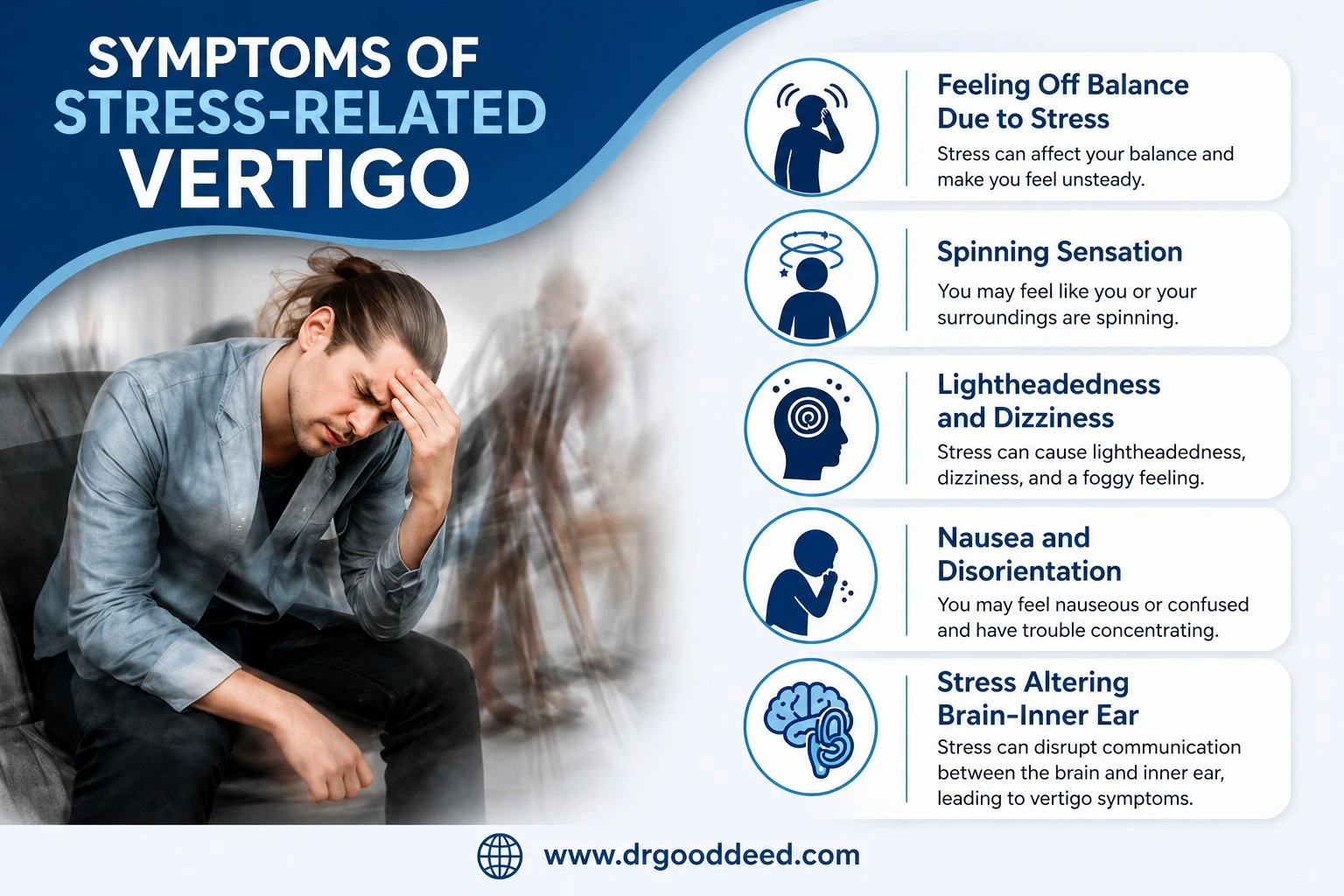
stress can cause vertigo symptoms that feel identical to those from inner ear disorders. The symptom overlap is significant, which is why many stress-related vertigo cases go misdiagnosed initially.
Feeling Off Balance Due to Stress
Feeling off balance due to stress is one of the most common but least discussed vertigo symptoms. It shows up as a floating or swaying sensation when standing, walking, or even sitting still. Unlike BPPV (benign paroxysmal positional vertigo), stress-related imbalance does not always require head movement to trigger.
Spinning Sensation (Vertigo)
True vertigo is the sensation that the room is spinning when it is not. Stress-induced vertigo produces this exact sensation, typically lasting seconds to a few minutes per episode. During high anxiety periods, episodes can repeat multiple times throughout a day.
Lightheadedness and Dizziness
This is the sensation of nearly blacking out or feeling faint without actually losing consciousness. It differs from true vertigo but often occurs alongside it during stress episodes. Shallow breathing during anxiety reduces carbon dioxide levels in the blood, which causes cerebral blood vessels to constrict, worsening lightheadedness.
Nausea and Disorientation
The vestibular system connects directly to the vagus nerve. When the balance signal gets disrupted, the vagus nerve signals the gut. Nausea, cold sweat, and general disorientation follow. Some people vomit during severe stress-vertigo episodes, particularly if the episode lasts longer than 10 to 15 minutes.
Feeling Off Balance Due to Stress
Feeling off balance due to stress is a distinct clinical presentation that separates stress-related vertigo from other causes. The key characteristic is its relationship to anxiety episodes.
Sudden Instability
Stress-related imbalance appears without warning. People report sudden unsteadiness during a stressful conversation, before a presentation, or in a crowded public space. The onset is fast, usually within seconds of the stress trigger.
Worsening During Anxiety Episodes
Symptoms intensify when anxiety peaks. A panic attack almost always includes some degree of dizziness or imbalance. Studies show that 65% of patients with panic disorder report recurring vertigo as part of their symptom profile.
Improvement with Relaxation
When the stressor resolves and breathing returns to normal, symptoms reduce. This pattern is a diagnostic indicator that stress is the primary cause. Vertigo from structural inner ear disorders does not reliably improve with relaxation.
How to Manage Stress-Related Vertigo
Managing stress-related vertigo involves two parallel approaches: calming the nervous system and retraining the vestibular system.
Stress Reduction Techniques
Diaphragmatic breathing lowers cortisol within minutes. Breathe in for 4 counts, hold for 4, exhale for 6. This activates the parasympathetic nervous system and reduces the neural over-excitation that stress can cause vertigo episodes. Daily mindfulness practice, specifically MBSR (Mindfulness-Based Stress Reduction), reduced dizziness scores by 38% in a 2020 controlled trial published in Psychosomatic Medicine.
Regular Physical Activity
30 minutes of aerobic exercise, specifically walking, swimming, or cycling, increases GABA activity in the brain. GABA is an inhibitory neurotransmitter that calms overactive neural pathways, including those driving vestibular hypersensitivity. Exercise also reduces baseline cortisol over time.
Vestibular Exercises
Vestibular rehabilitation therapy (VRT), specifically gaze stabilization and balance retraining exercises, rewires how the brain processes inner ear input. A physical therapist prescribes these. The Epley maneuver, while designed for BPPV, is sometimes used to rule out positional causes. For stress-related cases, gaze stabilization exercises (focusing on a fixed point while moving the head slowly) reduce hypersensitivity within 4 to 6 weeks.
Adequate Sleep and Hydration
Sleep deprivation elevates cortisol by up to 37% the following day, per research from the University of Chicago. Poor sleep makes stress-vertigo worse. Aim for 7 to 9 hours. Dehydration thickens the blood and reduces cerebral blood flow, worsening dizziness. Drink at least 8 cups of water daily.
During an Episode: What to Do Immediately
- Sit or lie down on a flat surface immediately. Do not stay standing.
- Fix your gaze on one stationary point in the room. This helps the brain recalibrate balance signals.
- Breathe slowly and deeply. Slow breathing raises carbon dioxide levels, which dilates cerebral vessels.
- Avoid sudden head movements until the episode passes completely.
- Do not drive during or immediately after a vertigo episode.
When Vertigo May Not Be Stress-Related
Stress can cause vertigo, explaining many recurring cases, but some vertigo requires medical evaluation. Stress is unlikely the cause if:
- Vertigo lasts more than 20 minutes continuously without improvement
- Hearing loss occurs alongside dizziness (Meniere’s disease)
- Vertigo follows a head injury or trauma
- Episodes include double vision, slurred speech, or facial numbness; these are stroke warning signs and require emergency care
- Vertigo only appears with specific head positions and does not change with stress level or mood (BPPV pattern)
Persistent vertigo unresponsive to stress management after 4 weeks warrants an ENT or neurologist evaluation. An MRI and videonystagmography (VNG) test can rule out structural causes.
FAQs
Can stress cause vertigo?
Yes. Stress elevates cortisol and adrenaline, which disrupt inner ear fluid pressure and increase brainstem sensitivity to balance signals. This produces genuine spinning and imbalance. Around 65% of panic disorder patients report vertigo as a recurring symptom during high-stress periods.
What is the nervous system response causing dizziness?
The sympathetic nervous system triggers adrenaline release, which shifts blood flow away from the brainstem and cerebellum. These regions control balance. Reduced blood flow to the cerebellum directly impairs coordination and produces lightheadedness and dizziness within seconds of a stress trigger.
Why does stress make me feel off balance?
Stress over-activates neural pathways that process balance signals from the inner ear. The brain amplifies minor vestibular input and interprets it as a large positional change. This produces swaying, unsteadiness, and the sensation of moving when you are standing still.
What is inner ear sensitivity and stress?
Inner ear sensitivity and stress refers to the brain’s tendency to over-process vestibular signals during chronic stress. Elevated cortisol disrupts endolymph fluid balance in the inner ear, causing hair cells to misfire. This creates balance errors without any structural damage to the ear.
Can anxiety cause vertigo symptoms?
Yes. Anxiety activates the same fight-or-flight response as acute stress. Shallow breathing during anxiety lowers blood carbon dioxide, constricts brain blood vessels, and impairs vestibular processing. Panic attacks produce vertigo in the majority of cases, typically lasting 5 to 20 minutes per episode.
How long does stress vertigo last?
Individual episodes last 30 seconds to 20 minutes. Recurrent stress-vertigo, where episodes repeat over days or weeks, persists as long as the underlying stress remains unmanaged. With consistent stress reduction and vestibular exercises, most people see improvement within 4 to 8 weeks.
When should I see a doctor for vertigo?
See a doctor if vertigo lasts more than 20 minutes continuously, if it comes with hearing loss, facial numbness, slurred speech, or double vision, or if it follows a head injury. These symptoms require immediate evaluation to rule out Meniere’s disease or stroke.
Can relaxation reduce vertigo symptoms?
Yes. Diaphragmatic breathing activates the parasympathetic nervous system within 3 to 5 minutes, which reduces cortisol, normalizes blood flow to the brainstem, and calms vestibular over-sensitivity. A 2020 clinical trial showed MBSR reduced dizziness severity scores by 38% in stress-related vertigo patients over 8 weeks.