

How long an IBS flare-up lasts depends on the trigger, your gut sensitivity, and how quickly you respond. For most people in the USA, a flare lasts anywhere from a few hours to several days.
Severe or unmanaged episodes can stretch into weeks. Irritable bowel syndrome (IBS) affects 10–15% of Americans, according to the American College of Gastroenterology (ACG). This guide covers every factor shaping how long IBS symptoms last, what drives flares longer, and what actually cuts them short.
Common Symptoms During an IBS Flare-Up
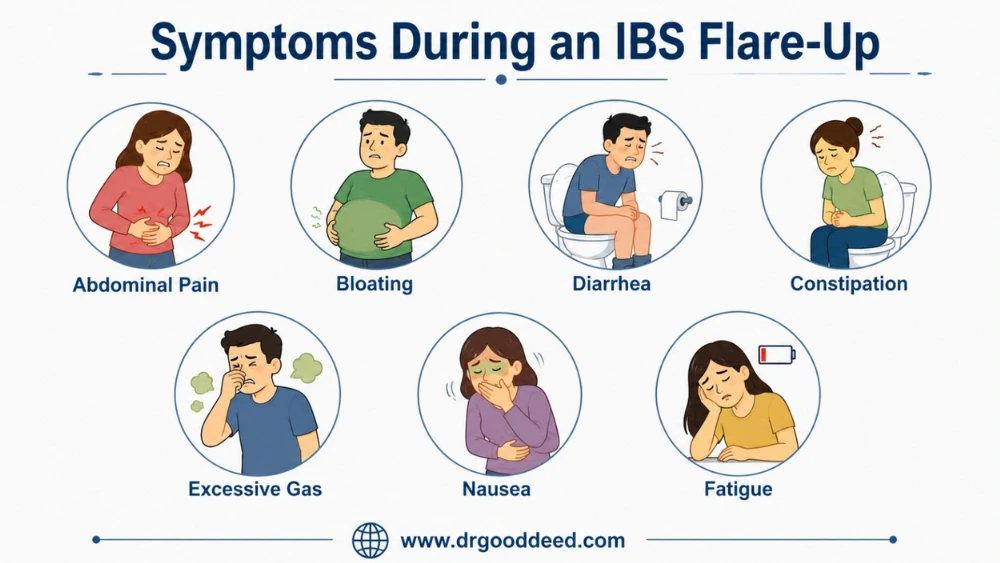
An IBS flare is a cluster of symptoms that hit simultaneously and affect work, sleep, and daily routines.
Abdominal Pain
Pain usually feels like cramping or squeezing in the lower abdomen, and it often eases after a bowel movement. Pain that does not improve after going to the bathroom is a red flag worth reporting to your doctor.
Bloating
The abdomen swells and feels tight, often worsening by afternoon. A 2021 study in Nutrients found that up to 83% of IBS patients list bloating as their most distressing symptom. It is not caused by overeating. It is caused by abnormal gas movement through a hypersensitive gut.
Diarrhea
IBS-D (diarrhea-predominant IBS) triggers loose, urgent stools, sometimes multiple times in a single morning. The urge arrives suddenly and is hard to control. This pattern is clinically distinct from food poisoning or a stomach virus.
Constipation
IBS-C (constipation-predominant IBS) produces hard, infrequent stools and a feeling of incomplete emptying. Straining worsens abdominal pain. Some people alternate between constipation and diarrhea, classified as IBS-M (mixed subtype).
Excessive Gas
Gas builds because the gut moves food abnormally. Colonic bacteria produce more gas than usual when fermentable foods are not processed properly. This connects directly to gut microbiome imbalance and IBS, which amplifies fermentation-related gas production.
Nausea
Nausea appears in roughly 40% of IBS patients during a flare. It accompanies abdominal cramps and makes eating feel difficult, though it rarely causes vomiting.
Fatigue
IBS-related fatigue is documented and measurable. A 2022 review in Frontiers in Nutrition confirmed that gut-brain signaling disruptions during a flare reduce energy and worsen brain fog. Fatigue during a flare is a physiological response, not weakness.
What Causes IBS Flare-Ups?
How long an IBS flare-up lasts ties directly to the cause. Remove the trigger, and the flare shortens. Keep the trigger active, and symptoms persist.
Dietary Triggers
High-FODMAP foods, alcohol, caffeine, fatty meals, and artificial sweeteners are the most documented dietary culprits. Monash University’s low-FODMAP research consistently shows dietary modification reduces flare frequency by 50–80% in IBS patients.
Stress and Emotional Factors
Stress-triggered IBS flare-ups rank among the most common causes reported in US gastroenterology clinics. Stress activates the hypothalamic-pituitary-adrenal (HPA) axis, which sends direct signals to the gut and alters motility within hours.
Gut Infections
Post-infectious IBS (PI-IBS) develops in 5–32% of people after a bacterial or viral gut infection, per ACG data. One bout of gastroenteritis can permanently alter gut sensitivity and motility. PI-IBS flares tend to last longer and respond more slowly to standard treatments.
Hormonal Changes
Women experience more frequent and severe IBS flares around menstruation. Estrogen and progesterone fluctuations slow or speed gut motility. This explains why IBS affects women at roughly twice the rate of men.
Sleep Disturbances
Poor sleep raises cortisol. Elevated cortisol worsens gut permeability and lowers the pain threshold. A 2023 study in Alimentary Pharmacology & Therapeutics confirmed that IBS patients sleeping fewer than 6 hours per night had significantly longer flare durations. This directly affects how long an IBS flare-up lasts from one episode to the next.
Lifestyle Factors
Sedentary behavior, irregular meal timing, and heavy alcohol use each worsen gut motility. Even mild dehydration can trigger a constipation-dominant flare within 24 hours.
Stress-Triggered IBS Flare-Ups
Stress-triggered IBS flare-ups are not random. The gut and brain communicate constantly through the vagus nerve and the enteric nervous system. Stress disrupts both pathways at once.
The Gut-Brain Connection
The gut contains over 100 million nerve cells and produces 95% of the body’s serotonin. When stress signals travel from the brain to the gut, motility changes immediately. This is a measurable neurological event, not a psychological one.
How Stress Affects Digestion
Under stress, the body releases corticotropin-releasing factor (CRF). CRF speeds up colon contractions in some people and slows them in others. This is why stress causes diarrhea in one IBS patient and constipation in another, even under identical circumstances.
Anxiety and Symptom Severity
A 2022 meta-analysis in The Lancet Gastroenterology & Hepatology found anxiety disorders in 44% of IBS patients. Higher anxiety scores directly correlated with longer IBS flare-up durations and worse pain ratings across all IBS subtypes.
Factors That Affect the Duration of IBS Flare-Ups
The duration of IBS flare-ups ranges from a few hours to several weeks. Most mild flares resolve in 1–3 days. Moderate ones last 3–7 days. Severe flares driven by infection, prolonged stress, or repeated dietary mistakes can persist 2–4 weeks.
Factors that extend flares:
- Continuing to eat the same trigger food throughout the flare
- Untreated anxiety or ongoing stress amplifying gut hypersensitivity
- Gut microbiome imbalance drinks and IBS worsening from recent antibiotic use
- Fewer than 6 hours of sleep per night, elevating cortisol
- No dietary adjustment within the first 24 hours
- Dehydration, particularly during diarrhea-predominant episodes
- Delayed care when infection is the underlying cause
The same trigger can cause a 12-hour flare one month and a 5-day flare the next, depending on stress load, sleep quality, and gut bacteria status at that time.
How to Shorten an IBS Flare-Up
Knowing how to shorten an IBS flare-up comes down to acting within the first 24 hours. The steps below have the strongest clinical evidence.
- Switch to low-FODMAP eating immediately: cut garlic, onion, wheat, lactose, and high-fructose fruits on day one
- Hydrate with electrolyte solutions, not plain water alone, as diarrhea depletes sodium and potassium faster than water replaces them
- Apply a heating pad at 104°F (40°C) to the abdomen for 20 minutes; a 2020 study in the Journal of Pain Research confirmed heat reduces gut spasm pain measurably
- Take enteric-coated peppermint oil capsules; a 2021 meta-analysis in the Journal of Clinical Gastroenterology showed a 40% reduction in IBS pain versus placebo
- Practice diaphragmatic breathing for 10 minutes twice daily to activate the parasympathetic nervous system and reduce gut motility disruption
- Eat smaller portions every 3–4 hours instead of large meals that overwhelm a sensitive gut
Cutting the trigger, hydrating, resting, and reducing gut stimulation simultaneously produces the fastest recoveries. When you apply all of these steps together, shortening an IBS flare-up becomes less about guesswork and more about a repeatable response plan.
Treatment Options for IBS Flare-Ups
A consistent sleep schedule, regular meal timing, and 30 minutes of moderate daily exercise, specifically walking or yoga, reduce flare frequency and improve gut transit time.
Medications for IBS Symptoms
- Antispasmodics (hyoscine, dicyclomine): reduce gut cramping during active flares
- Loperamide: slows transit time in IBS-D
- Osmotic laxatives (polyethylene glycol): used for IBS-C
- Low-dose antidepressants (amitriptyline, SSRIs): lower gut pain hypersensitivity per ACG 2021 guidelines
- Rifaximin: FDA-approved antibiotic for non-constipation IBS with significant bloating
Probiotics and Gut Health
Gut microbiome imbalance and IBS is now a primary research focus. Two strains have the strongest evidence: Lactobacillus plantarum 299v and Bifidobacterium infantis 35624 improved IBS symptoms consistently in 2020–2023 clinical trials. Most store-bought probiotic products do not contain these specific strains. Check the strain name on the label, not the brand.
Psychological Therapies
Cognitive behavioral therapy (CBT) and gut-directed hypnotherapy each reduced IBS symptom severity by 50–70% in 12-week programs, per a 2021 review in The American Journal of Gastroenterology. These approaches work best alongside medication, not instead of it.
Personalized Treatment Approaches
No two IBS patients respond identically. A gastroenterologist can order a SIBO breath test, stool microbiome analysis, and food sensitivity panels to identify your specific triggers and build an individualized plan.
How Identifying Triggers Cut One Patient’s Flare Duration from 10 Days to 48 Hours
How Recognizing Dietary and Stress Triggers Helped Marcus Thompson Finally Control His IBS
Marcus Thompson, a 38-year-old software engineer from Austin, Texas, had IBS-D for six years. His flares lasted 7–10 days at a time. A gastroenterologist ran a SIBO breath test, which came back positive, and enrolled him in a 12-week gut-directed CBT program alongside a structured low-FODMAP elimination diet.
Within three months, his average flare duration dropped from 7 days to under 48 hours. He identified wheat, onion, and work deadline stress as his three main triggers. His experience shows how much or how long IBS symptoms last can change when the right triggers are identified and managed systematically. His gastroenterologist also recommended Lactobacillus plantarum 299v supplementation. Marcus now keeps a symptom diary and adjusts his diet in the first 12 hours of any early warning sign.
Name has been altered to protect patient privacy.
Preventing Future IBS Flare-Ups
Preventing flares is more effective than treating them. Most Americans with IBS do not have a written trigger management plan, and that gap directly extends how long an IBS flare-up can last each time one occurs.
Evidence-backed prevention steps:
- Keep a food and symptom diary for at least 4 weeks; apps like the Monash FODMAP app identify patterns quickly
- Follow a modified low-FODMAP diet with guidance from a registered dietitian trained in IBS
- Maintain a consistent sleep routine, aiming for 7–8 hours with a bedtime before 11 PM
- Practice daily stress reduction through CBT techniques, yoga, or 10 minutes of breathing exercises, not just during active flares
- Limit NSAID use (ibuprofen, naproxen), as these increase gut permeability in a dose-dependent way, worsening IBS
- Follow up with a gastroenterologist every 6 months if flare frequency or severity is increasing
Prevention is not about eliminating every possible risk. It is about lowering the total load on a gut that is already running at higher-than-normal sensitivity.
When an IBS Flare-Up May Indicate Another Condition
Not every prolonged gut episode is IBS. Several conditions mimic it closely but require different diagnostic steps and treatment.
Inflammatory Bowel Disease (IBD)
Crohn’s disease and ulcerative colitis cause gut inflammation. Unlike IBS, IBD produces blood in stool, elevated CRP and ESR on blood tests, and visible inflammation on colonoscopy. Persistent flares with rectal bleeding need evaluation immediately, not watchful waiting.
Celiac Disease
Gluten triggers immune-mediated intestinal damage in celiac disease, which is different from gluten sensitivity. Anti-tTG IgA antibody testing and intestinal biopsy confirm the diagnosis. Many celiac patients are misdiagnosed with IBS for years before a correct workup is done.
Food Allergies
True IgE-mediated food allergies produce gut symptoms that overlap with IBS. Allergy skin testing and structured elimination protocols separate allergy from IBS-related food intolerance.
Gastrointestinal Infections
C. difficile, Giardia, and Salmonella each cause symptoms indistinguishable from IBS flares on presentation. Stool cultures rule these out. Recent international travel warrants parasite testing before an IBS diagnosis is confirmed.
Other Digestive Disorders
Microscopic colitis, SIBO, and bile acid malabsorption all mimic IBS. Each requires specific diagnostic testing. A gastroenterologist identifies which condition fits based on symptom pattern, stool studies, and breath testing.
FAQ
1. How long can an IBS flare-up last?
How long an IBS flare-up lasts ranges from 24 hours for a mild dietary trigger to 4 weeks for stress-driven or post-infectious episodes. The ACG places the median flare at 4 days for IBS-D and 6 days for IBS-C.
2. How long do IBS symptoms last during a flare-up?
How long an IBS flare-up lasts varies by type: cramps and diarrhea peak in the first 48 hours, while bloating and fatigue persist 2–3 days longer if the dietary trigger stays in your system.
3. What is the average duration of IBS flare-ups?
The average duration of IBS flare-ups is 2–4 days for mild cases and 5–7 days for moderate ones. Severe flares, particularly post-infectious IBS, average 10–14 days without targeted intervention.
4. Can an IBS flare-up last for weeks?
Yes. How long an IBS flare-up lasts extends to 3–4 weeks when the core trigger, chronic stress, repeated FODMAP exposure, or an untreated gut infection, stays active. Post-infectious IBS is the most likely cause of multi-week flares.
5. What causes IBS flare-ups to last longer?
Three factors extend the duration of IBS flare-ups most reliably: continuing to eat high-FODMAP foods, unmanaged anxiety, and fewer than 6 hours of sleep per night. Each one independently prolongs gut hypersensitivity.
6. How can I shorten an IBS flare-up?
Start low-FODMAP eating immediately, take enteric-coated peppermint oil, apply abdominal heat at 104°F, and drink electrolyte solutions. These four combined have the strongest evidence for reducing how long an IBS flare-up can last, from days to under 48 hours.
7. Can stress trigger IBS flare-ups?
Yes. Stress-triggered IBS flare-ups occur because cortisol and CRF directly alter gut motility and lower pain thresholds. Even anticipatory stress before a work deadline can trigger a flare within 2–4 hours.
8. How does gut microbiome imbalance affect IBS symptoms?
Gut microbiome imbalance and IBS worsen symptoms through three pathways: excess gas fermentation, reduced mucosal barrier strength, and lower serotonin production. Antibiotic use disrupts the microbiome fastest, with IBS symptoms often returning 2–6 weeks after a course ends.
9. What foods should I eat during an IBS flare-up?
White rice, boiled chicken, cooked carrots, ripe bananas, and plain oats. These are low in FODMAPs, easy to digest, and unlikely to extend how long an IBS flare-up can last.
10. Which foods can make an IBS flare-up worse?
Garlic, onion, wheat, apples, cauliflower, cow’s milk, coffee, and sorbitol-containing sugar-free products are the top documented aggravators. Even one serving during an active flare can add 24–48 hours to the episode.
Sources
Alimentary Pharmacology & Therapeutics (2023), Sleep disruption and IBS flare duration
American College of Gastroenterology IBS Guidelines (2021)
Nutrients (2021), Bloating and IBS symptom burden study
Frontiers in Nutrition (2022), Gut-brain fatigue and IBS review
Journal of Clinical Gastroenterology (2021), Peppermint oil meta-analysis
The American Journal of Gastroenterology (2021), CBT and hypnotherapy review
DISCLAIMER: This article is for informational purposes only. It does not substitute professional medical advice, diagnosis, or treatment. Always speak with a licensed healthcare provider about your symptoms.